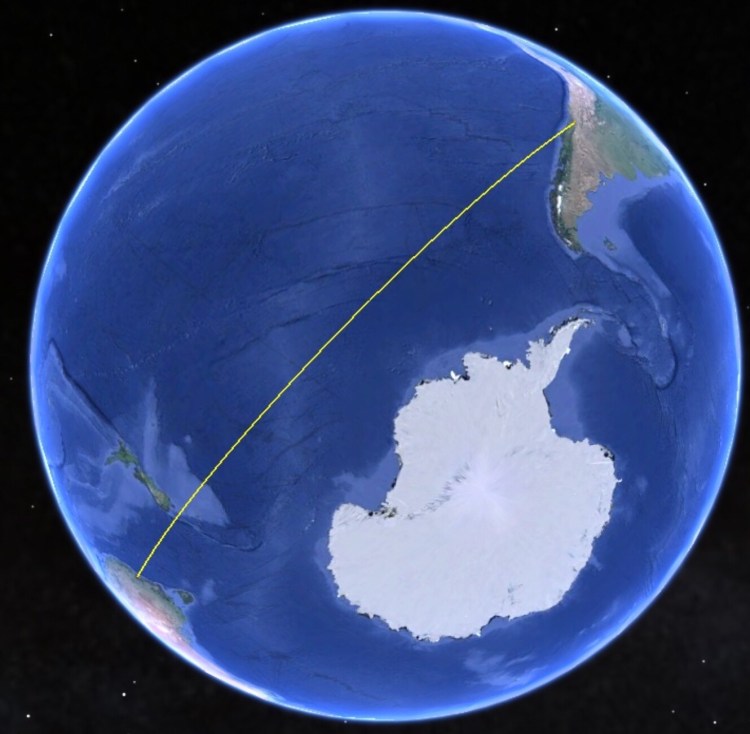
I remember the first time I read Roald Dahl’s ‘Matilda’. I was young enough to be enthralled by Harry Wormwood’s ingenuity as he used a drill to roll back the odometer on used cars, selling them on to unsuspecting bargain hunters. This scene played on my mind yesterday as I flew from Sydney to Santiago, rolling back the clock en route to the Colombian capital, Bogota, and the beginning of this two-wheeled adventure.
Flying east at an average speed of 1000km/h propels you back into the past. Time zones roll beneath the plane as you plunge over the horizon. Taking off from Sydney during the middle of the day accentuated this experience. We flew away from the sun towards a visible dusk and into a sunset which was played in fast forward.
Sydney’s Kingsford Smith is easily my favourite Australian airport at which to land and take-off. It’s location provides those with a window seat (and the ability to look away from their devices) a clear visual of the factors which have influenced, and will continue to dictate, the population distribution of this area. The sandstone cliffs lining the coast act as the front line in a battle against ocean swells. With fresh water from the Paramatta River and a safe ocean harbour hiding behind the cliffs, it is no wonder that traditional owners and settlers alike found this landscape idyllic. The urban fabric that has evolved is limited in its sprawl by the ocean to the east and the Great Dividing Range to the west. It is always humbling to view cities from above, just to be reminded that nature does still have the last word (at times).
As the plane drew away from the Australian coastline, the Tasman became shrouded in a dense sea fog, rendering the view a monotonous grey. I was, however, given a continuing visual spectacular in the form of Wes Anderson’s ‘Isle of Dogs’ on the screen ‘in the back of the seat in front of me’.
When the credit began to roll I looked out of my window to be greeted by a scene of familiarity yet overwhelming beauty. The snow-covered Southern Alps of New Zealand were only distinguishable from the clouds due to their sharp ridge lines. In the fading sunlight, the western flanks of the highest peaks were a glowing pink. I’m not sure if I saw Aoraki (Mount Cook), yet the meaning of this word – cloud piercer – was true for each of the peaks below me. Cracks were visible in the snow fields; evidence of the slow-moving glaciers that feed the braided streams in the alluvial valleys between the mountain ranges. With a maximum width of 400km, the South Island of Aotearoa faded as quickly as it had arrived. The joy this provided me with, however, lasted well into the Pacific as the reality began to sink in of the Andean peaks which are waiting.
The plane continued its arc over the more southern latitudes and deep into the night.
What only seemed like mere hours later, first light became visible on the horizon. All of the colours of a good bruise eventually gave way to the light pastel blue which signifies the sun is about to appear. And, just as the sun rose, the clouds covering the ocean parted and gave way to my first sighting of the South American continent. A consistent south-westerly swell wrapped its away around the large headland below, and ballooning plumes of brown sediment were visible at the mouth of every river along the coast, contrasting the glacial blue of the Pacific Ocean.
The coast was lined with sand dunes; a buffer between the ocean and the vegetated hills that were like every shirt I own – creased and un-ironed. Industry was rife with large swathes of cleared forest and the terraced craters of open cut mining operations becoming increasingly visible as we flew inland. The plane banked to the left and headed north for Santiago. Upon approaching the Chilean capital, the green hills gave way to peaks that were well above the tree line. The first of these had a dusting of snow on their southern slopes – enough to spike the excitement levels in a lover of high places. However, this giddiness was soon giving a reality check as the true scale of the Andes became visible for the first time. The plane was suddenly sharing its altitude with jagged peaks, clearly high enough to be blanketed in snow year round.
Much like the urban landscape of of Sydney, the layout of Santiago is overwhelming influenced by the relief of the surrounding peaks. The flat plains were all populated, with subdivisions shaped to fit efficiently within their mountainous borders. Beneath the peaks, a think layer of haze hung in all the valleys. I assume this pollution is held in by the lower temperatures and relatively high altitude for a city. (Also a clear indicator of the effect the pulp mill would have had in the Tamar Valley back home). Coming in to land, the plane glided into this haze and upon exiting the plane, the peaks above were only just distinguishable.
12 hours and 45 minutes after leaving Sydney, I arrived in Santiago. An incredible route. I’m beginning to sound like Dad. ‘People that complain about the price of airfares don’t appreciate what they’re getting..an incredible machine, flying thousands of meters above the ground, thousands of kilometres around the world…blah.’
Despite the novelty of turning back time and being giving the justifiable opportunity of having my second Wednesday breakfast, there is still the body clock which ticks louder than ever. Perhaps the jet lag is equivalent to the engines of the cars that Mr Wormwood was selling; turned back in time but feeling super rough.
The flight from Santiago to Bogota saw me sitting in an aisle seat, flanked by passengers who shut their window shades so that they could see their screens. I assume the Andes were standing proudly to the east, and yet again, the Wednesday sun was fading to the west. It’s all good though. I’ll be back to explore in a few months, just lower, and much slower.
 Faults and Folds