Whatever I have previously described as a mountain, a hill, a rise or a climb…forget it. Retrospectively, Colombia has been a flat road until the last few days.
I have already written about the three mountain ranges that run north to south in Colombia; cordilleras Oriental, Central and Occidental. Rising from the fluvial valleys that separate them, these spines of rock make the riding through central Colombia somewhat predictable. If the verdure-draped hills are either side of you, then you are most likely humming along between the fields of sugarcane that line the low-lying rivers. Alternatively, if you find yourself searching for that misplaced lower gear, then you’re probably on your way over one of the ranges and into the adjacent valley; a climb followed by a dreamy descent that instantly eradicates any memory of breathlessness. This familiarity with the landscape was a welcome introduction to riding in Colombia and the beginning of this trip.
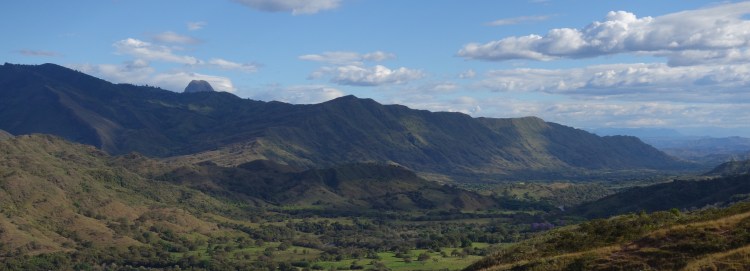
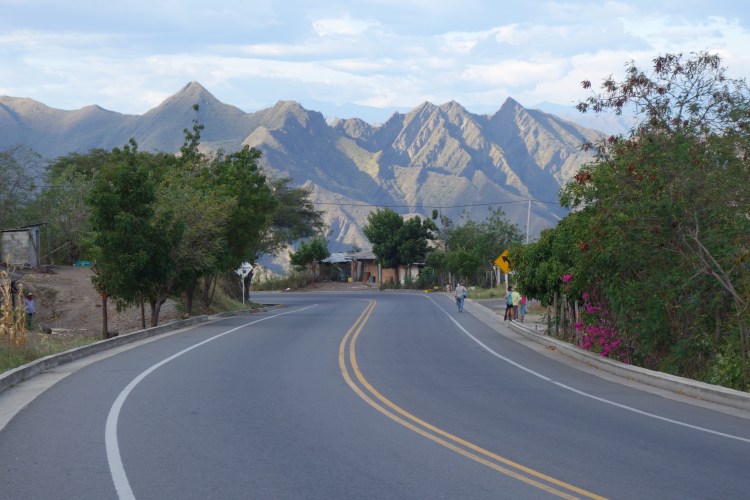
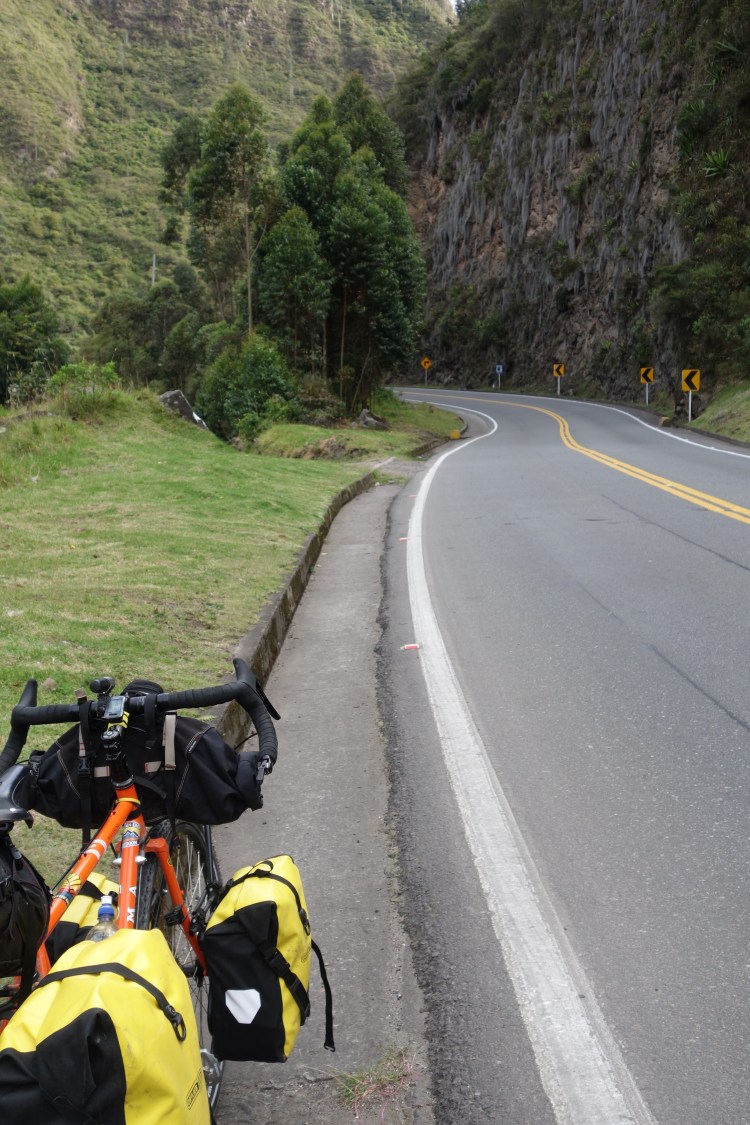
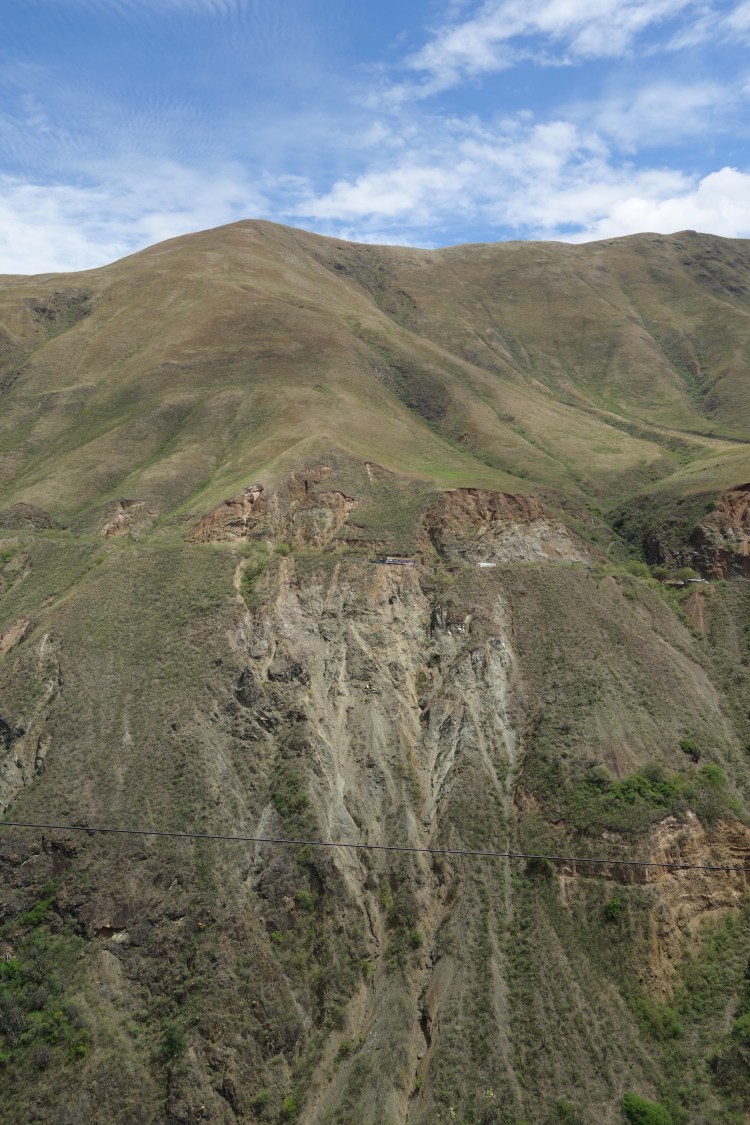
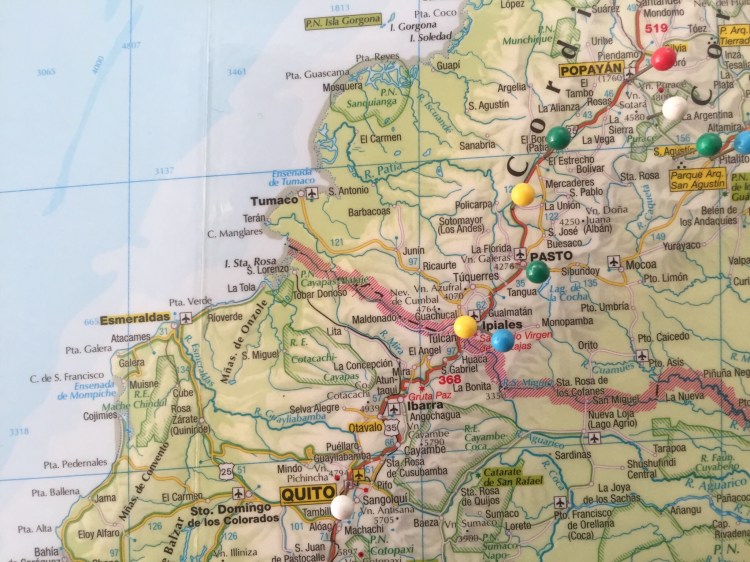
However, after joining the Pan-American highway at Popayán everything changed. The familiarity of the road was swept away by the rivers as the riding became as unpredictable as a drunken grandparent at Christmas. The cordilleras converged, knotting together into a perfect mess of seemingly bottomless gorges, exposed ridge lines, volatile land slips and, somehow, a road. I would spend mornings admiring peaks, which in the afternoons I would be looking down upon. The vistas left me intoxicated, the passing trucks slapped me back into sobriety. With my pedals spinning the smallest ring for entire days, the slow climbs also allowed my mind to change gears. Subsequently, there were as many highs and lows within as there were on this road through the mountains.
Much like the geological forces at play, the four days from Popayán to the Colombian-Ecuadorian border were formative and uplifting. I met some rich souls on the road, whilst at times the road ripped mine out through my lungs. The mountains of southern Colombia are by far the biggest hills I’ve ridden in my life. Still, everyone on the road heading north refers to the mountains of Peru, puffing their cheeks out and slowly, yet audibly, letting the air whistle out as an unspoken statement of the road ahead. Regardless of what is to come, I am now in the mountains.
Taking the ‘ups’ with the ‘downs’
When a car drives past ‘beeping’ with a waving hand hanging out the window, it is like getting a push for a few meters. Instantly, thoughts of being alone are tossed aside as you watch your new friend continue driving up the road. When that car or motorbike is also sporting flags of the world and an excess of camping gear, the camaraderie is unspoken yet strongly binding.
Riding out of Popayán, a motorbike, loaded to the hilt and supporting two heavily-bearded men, sped past. The horn was held down and the riders were waving frantically, and impressively, with arms and legs. It was a laugh. I continued up and over the rolling hills that were increasing in frequency and size like the oncoming of a good winter swell. An hour later, in the trough between hills, I saw the same motorbike parked outside a bakery. It was the perfect excuse for a break. I walked in and the camaraderie formed on the road was reiterated as I was met with tight hugs and beaming smiles by both riders. As I sat down, I was brought a coffee and two sweet breads by the waitress.
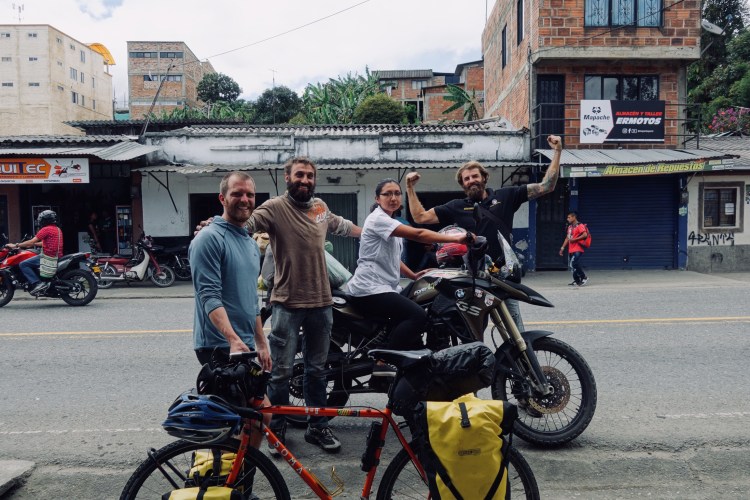
Paolo (Portuguese ) and Lorenzo (Brazillian) were true warriors of the road. Over the course of ten years (including a four-year hiatus where Lorenzo sampled the sedentary lifestyle of marriage) they have been exploring the world on two wheels. On the back of their motorbike, they have ridden throughout Europe, Africa and extensively within the Americas. This particular trip is in the wake of the aforementioned marriage which ended earlier this year in Brazil. Lorenzo said he called Paolo immediately, expressing the need to get back on the road. Within weeks, they were together again and both mentioned crying with joy as they rode out of town back in March. When I asked if they alternate the driving, Lorenzo, clearly excited by the ingenuity, told me that he always sits at the front. However, they worked out that Paulo can drive from the back so sometimes Lorenzo can have a snooze on the fuel tank.
Over the next half hour we shared stories and I was taught many tips for saving money on the road ahead. One of the strategies clarified how I was drinking a free coffee… The boys hadn’t spent money on anything other than fuel, for months. After a picture together we exchanged details and parted ways. As they sped off to cross the border, I was left wishing I had a motor for the first time this trip. Spending a few days with Paulo and Lorenzo would have been unforgettable, much like their passion and enthusiasm for life.
Not long after the boys rode off into the distance, I crested a hill and embarked on what was a sensational descent into a blossom-filled valley. Crossing the river at the bottom marked the end of the braking and the beginning of the sweating. The climb that followed lasted for over an hour and the longer it went, the stronger I felt.
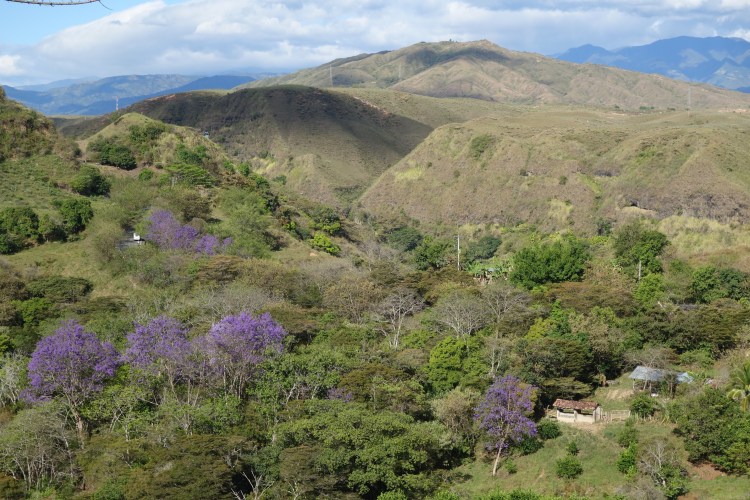
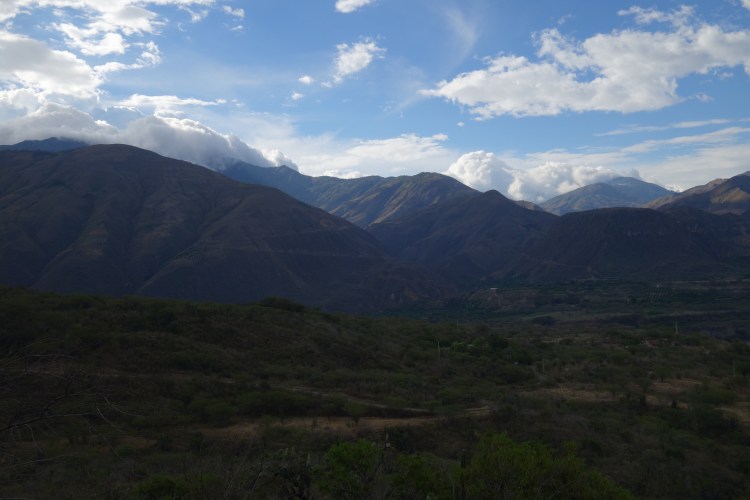
I carried this strength into the 25km descent on the other side of the saddle. The road was dwarfed by the amphitheatre-like, forested cliffs that towered above the road. The afternoon light illuminated the various ridge lines in the distance. As the sun fell towards the horizon, each row of mountains was given its five-minutes in the limelight, making for a sensational twilight pedal.
At one point in the afternoon, having just passed a toll station, I was sitting with my back to a small bamboo restaurant having a drink when I was approached by a military officer, clearly up for a chat. Whilst I caught parts of what he was saying, I was more enthralled by how he could be wearing the heavy, tight-fitting uniform, without breaking a sweat. Ironically, he was clearly aware of how spent I was feeling. He bought me a small brown package from the shop and said that it would give me the energy to “ride to Argentina, tonight”. I had seen this substance hanging from the roadside stalls. It was panela – unrefined whole cane sugar – which comes in solid blocks of sucrose due to the evaporation of all sugar cane juice it the production process. It was just what my body needed.
Despite not making it to Argentina that night, I rolled into a small town called El Strecho in a bit of a sugar coma and with my first 100+km day behind me. Interestingly, the few towns surrounding, and including, El Strecho were comprised of solely black residents. I’m unsure of the reason for this stark pattern of population distribution, but within one town from El Strecho, black residents were, again, almost non-existent.
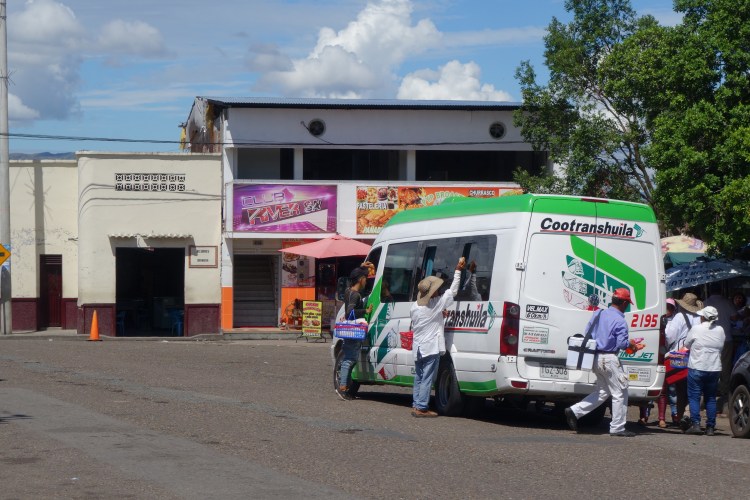
My favourite aspect of passing through these small, one-street towns, is watching sellers swarm any passenger vehicle that slows down. It is almost primal. The vehicles, representing opportunity and possible reward are encircled as hopeful hands push their goods through any open window. Some are withdrawn with loose change in place of the watermelons slices, packets of chocolates, or cold cans of soft drink. But, upon observation, its mostly a ‘no’. Still, the cycle continues everyday, in every town.
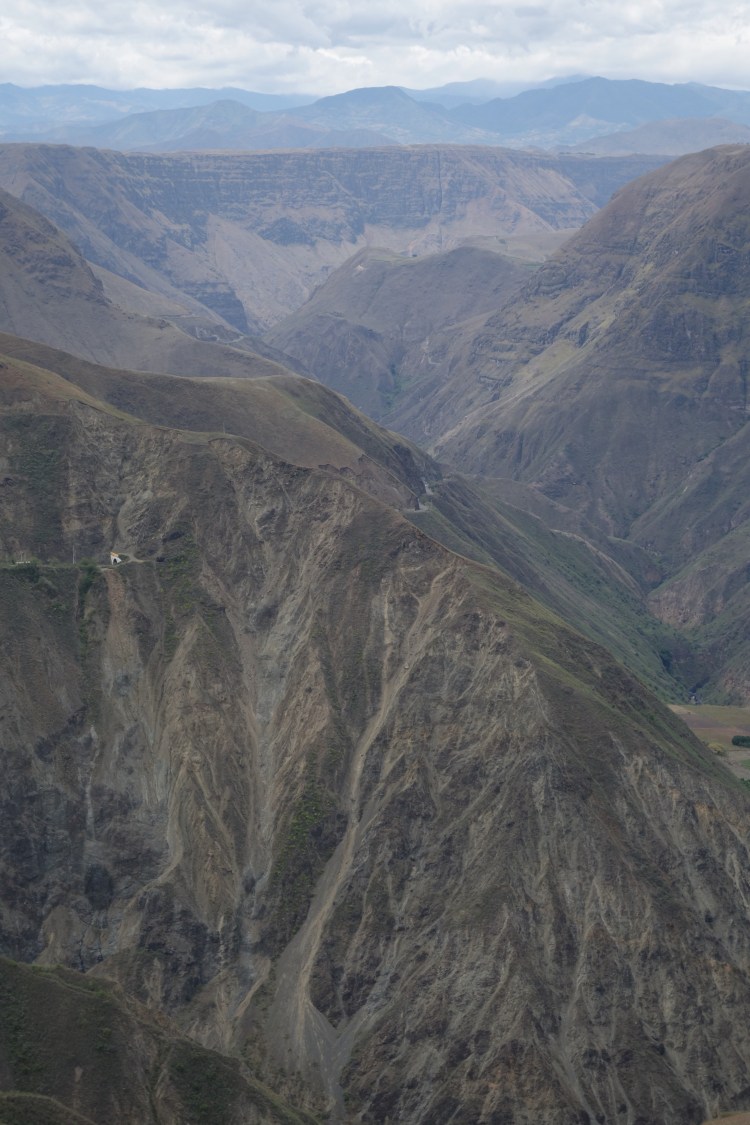
The road south continued to rise and fall. The greenery lining the cracked asphalt gave way to hardier shrubs and the return of the occasional cactus. Without the shade, the heat of the day was ruthless. At times, the steel frame of my bike was too hot to touch. In the middle of the day, slight downhills even became exerting as the rubber of the tyres held on extra-tight to the hot road. The route flirted with the clear flowing Patia river, but never quite came within reach for a much needed swim. The tanned mountains, becoming increasingly folded and creased, began to remind me of central Otago in New Zealand. Or perhaps New Zealand is just a fun-sized model of these hills. It is the scale of this region that was so difficult for me to comprehend. Countless times, I found myself staring across a valley at the faintest scar dissecting the opposing hillside, only to realise it was the road I was headed towards. It felt as though I should be able to reach across and separate my thumb and forefinger so as to expand the scene, as I would do on my phone when studying lines on maps.
Hour long climbs became a frequent occurrence, as did fresh mangoes and cups of icy kumis – a fermented cow’s milk drink which is much more refreshing than it sounds. Heledarias (ice cream stalls) became difficult to ride past. As the landscape continued to humble me, and rainbows rose out of valleys, the roads themselves began to be a source of wonder. Men in yellow suits with wheel barrows lined the roads in the steepest sections. Their job; shovel up the endless stream of dirt and rubble than cascades down from the loose slopes above the road. At night in my tent, it took me a while to work out what was occurring. I was at 2500m on the side of a mountain, yet it sounded like there was a small surging swell washing up on a beach of corse sand on the other side of the canvas. Tunnels cut through the hillside when all other options of a safe passage had been exhausted. These were quite terrifying, given the amount of trucks using this route. I would try to time my run so as not be caught alone in these dark corridors with a truck. My red, flashing LED light just seemed so incompetent for the job of making me visible.
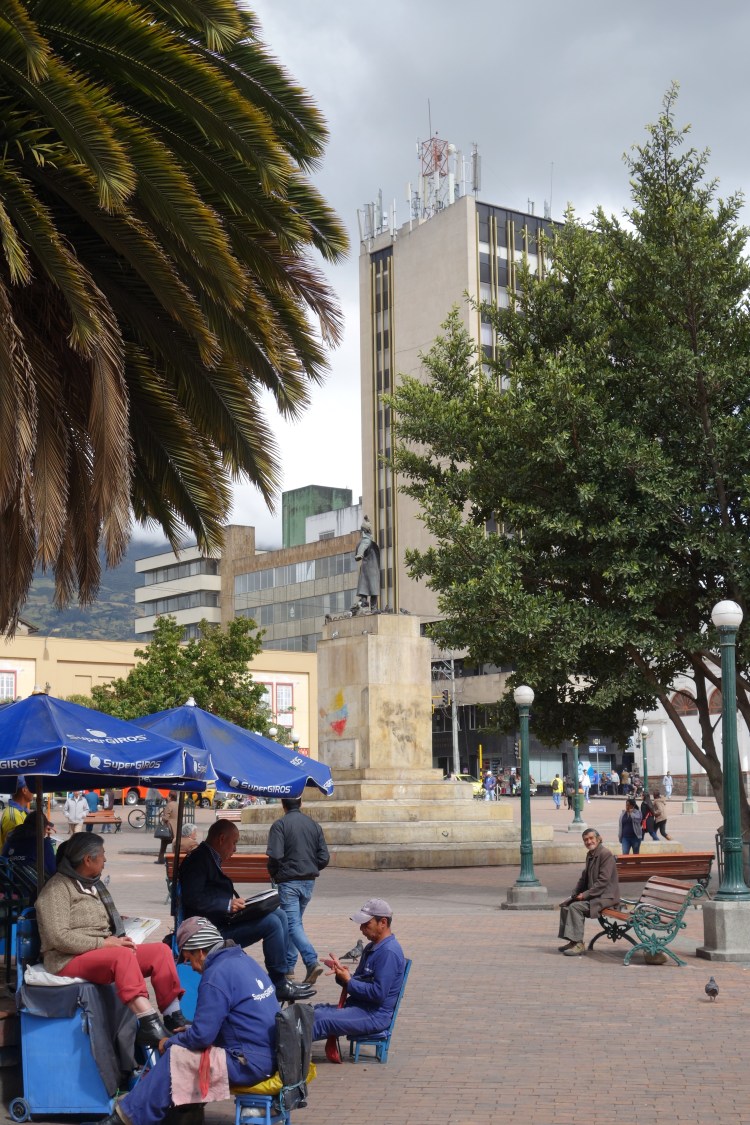
My second last night in Colombia was spent in the city of Pasto – the capital city of the department of Nariño. Ten kilometres out from Pasto, I had been sitting at the base of the final climb into town, shaking a mixture of oats, water, cinnamon and sugar in my drink bottle. I was desperate for one last surge of energy. Seemingly out of nowhere, three road cyclists pulled up beside me. They looked up at the hill, then back at me, and with a flick of the chin gestured to me that I should ride with them. I explained how much slower I’d be, but they persisted. What was going to be a solo slog, became an ascent at pace as each of us took a turn at the front. Albeit, my ‘turn’ was like that of a rider who’s teammate has just broken away and I’m desperately trying to slow the pace of the pursuivants. Despite the unexpected, late afternoon exertion, I rolled into Pasto much earlier than I would have if I had ridden alone. As darkness encroached and the street lights flickered to life, I was struck by the Colonial architecture adorning the main roads. The plazas and squares were expansive and the streets were narrow. I was late to leave town the next morning as I got caught up wandering the alleyways and watching the shoeshiners buff the boots of those reading the morning papers.
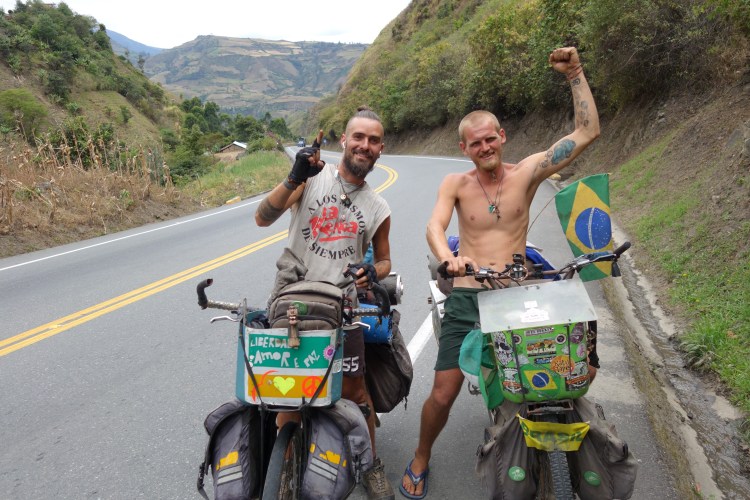
Descending out of Pasto, which sits at around 2900m, I saw two cycle-tourists heading up the hill towards me. These were the first cycle-tourists I’d met, apart from Doug the night before. Doug was an elderly Canadian man who had made a habit out of spending his summers riding around South America and visiting his dentist in Bogotá (I didn’t quite work out why he needs a South American dentist). He spent the remainder of the year saving money working as a tree planter and a life model. Anyway, I pulled hard on the brake levers, stretching the cable as much as my greeting smile was stretching my face. The two guys pulled over, and again, I was met with hugs. Henry and Gabriel were one year and eight months into their three year lap of the continent, starting and ending in their home country, Brazil. The temperate gradient was strikingly clear as I stood there in rain jacket and thermal having ridden down from a chilling mist, while Henry stood there topless, in thongs. It would have been easy to pull out a few mangoes and sit on the side of the road for hours with these two, but they knew how much was left of the hill we we were standing on. Hopefully their presence is the beginning of more frequent rendezvous with fellow cyclists.
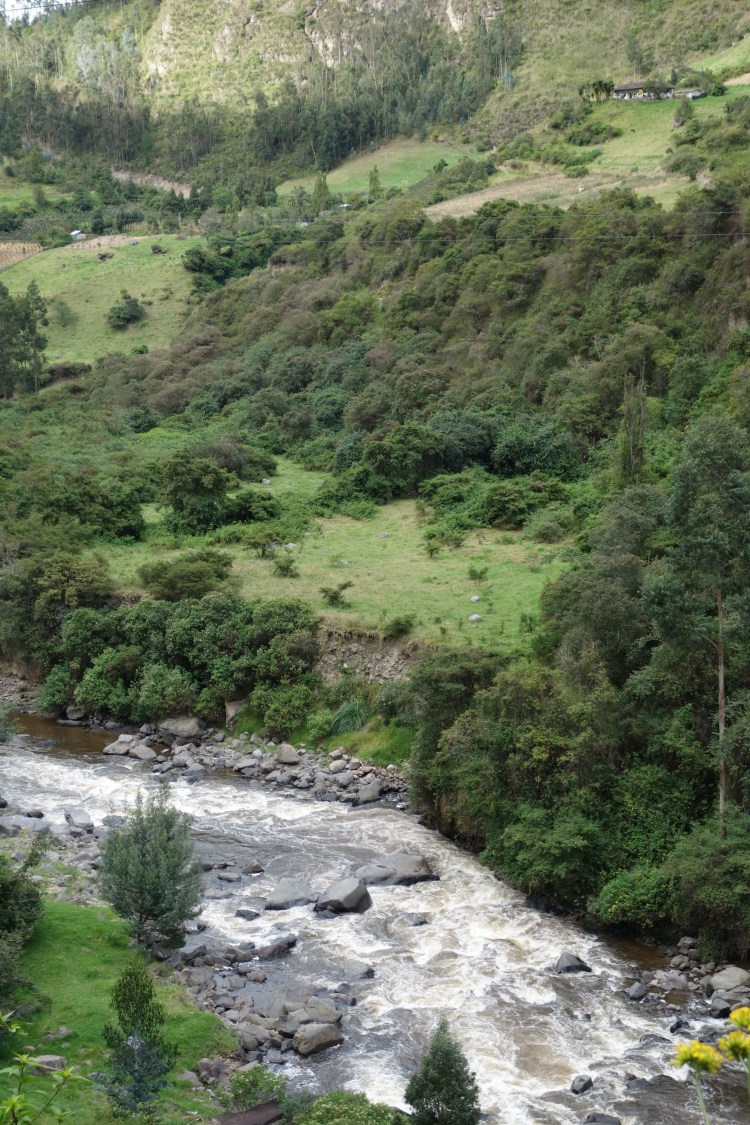
The approach to Ipiales was far more charming than I had envisioned, given its reputation as a standard border town. The bends in the road were dictated by the snaking Angasmayo River, which flowed beside me in the opposite direction to which I was riding. Stands of eucalypts shaded both me and the water as it navigated the rocks and riffles in its path.
Following a sustained climb through farmland and dozens of wood-fired brick kilns, smoke billowing out from within their blackened walls, I rolled into Ipiales. It had been four scorching days, 330km, and an unknown amount of meters climbed since leaving Popayán. Ipiales would be my last night in Colombia, two and a half weeks after embarking on this trip from Bogotá. Within hours of arriving, I quickly discovered that Ipiales would also be the place I spent a night on the bathroom floor, head in the toilet, with the devil trying to crack his way out of my skull with hatchet. More on that later.
A cycle of mindfulness
I’ve tried countless times over the last seven or eight years to adopt elements of mindfulness into my life. Ironically, my mind is often too full and I constantly fail to make a habit of daily practice. Until recently, mindfulness to me was a process in which I should find stillness, focus intently on one thought or sensation, and actively choose to accept or reject other thoughts that appear in my head. It is euphoric when it works. But, personally, I have trouble finding a place for this approach when tackling my day to day struggles. Fortunately, in the lead up to this trip, I was gifted a new strategy.
This is definitely my interpretation of the concept, but it works for me. Applied to any thought, action or response that I undertake or encounter, I consider three options; moving away, moving against, moving towards:
- Is this thought I’m having a move away, in a completely different direction, from the person I envision myself to be?
- Is it conflicting, hypercritical, or abrasively moving against the version of myself that I am striving towards?
- Or, is this thought in line with who I want to become, moving towards my goal?
I interpret this strategy as a form of active mindfulness. It empowers me with the ability to actively critique myself, whilst in the midst of any activity or thought. It is a skill that is ultimately helping me stay true to myself which, for an inherent ‘pleaser’ and expert at conflict avoidance through self-sacrifice, has been a long-time struggle. Before packing my bike into a box for this trip, I used a label maker to print out a sticker for each of the three promoting questions.
Stuck to the frame and in constant view between my knees whilst I ride south, I thought this would help me deal navigate some of the emotional obstacles that a solo journey like this would present. However, over the last few days riding through the mountains I have begun to experience the mindfulness that solo cycling itself can provide.
Long, slow climbs allow all senses to be recalibrated. I find myself lost in the sensation of sweat forming on my brow, building in momentum as it rolls down my nose, before the feeling of it detaching from my skin as it gets caught it the breeze. The deep valleys play with sound waves, constantly testing my hearing as I work to interpret if the sound of a traffic is approaching me from in front or behind. I have learnt to predict an oncoming descent or climb based on the sound of truck gears in the distance. High pitched revving indicates a struggling vehicle ahead, translating to a descent for me! Alternatively, the discharging, low moan of engine brakes is a telltale sign that there is still some climbing to be done. And, when I’ve settled into a climb, I have learnt to predict how much longer it will continue. The intensity of the smell of passing vehicles’ brakes is a clear sign of how long they have been descending. If I’m hit in the face with the aroma of burning rubber, then it often translates to a long, grinding stint in the saddle.
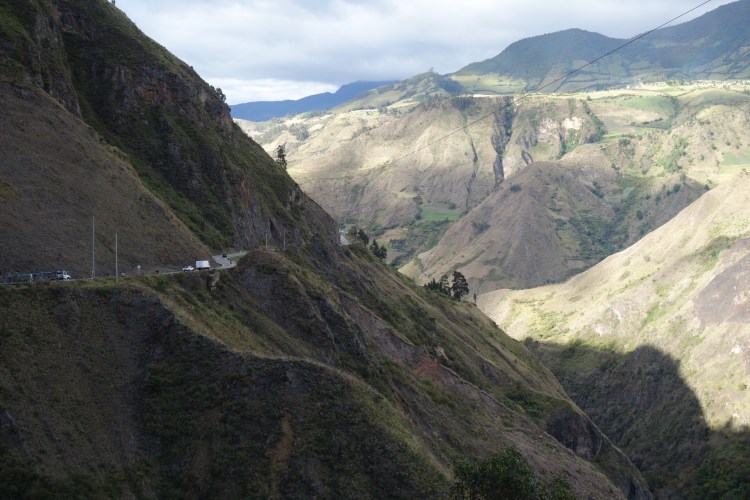
At times, the heat and the hills have left my body completely depleted. When I have stopped to eat or gulp down something sweet, I have physically felt it being converted to energy. Whilst ephemeral, the sensation is nothing short of magnificent. I feel as though I could be part of advertisement for an energy drink, where the viewers can see the liquid flowing through my body. This refuelling doesn’t just come from food or drink, either. There were moments on the road over the last few days, where I would round a bend and be confronted by a pedal-stopping view. I could feel my mind smiling and the energy this produced was bewildering, as it would send me on up the road with vigour and purpose in my pedal strokes.
It has been these various mental and physical observations that has piqued my awareness of being present. In the same vein as traditional mindfulness, I am working at using the sensory stimulation that cycling provides, to allow my mind to accept or reject particular thoughts whilst I am alone on these long roads.
A privileged passage south
Since joining the Pan-American highway, it is impossible not to notice the presence of Venezuelans also making their way south. I am frequently passed by trucks carrying dozens of people, lying on the roof, sprawled across their belongings to avoid losing them to the wind. Toilet doors are inscribed with names and dates of those passing through. Street corners are flooded by people trying to sell their remaining Venezuelan pesos; a currency that has been deemed relatively useless due to unfathomable inflation. Those who have managed to rid themselves of their remaining notes and coins have taken to selling assortments of chocolates, soft drinks and cigarettes. The sales pitch often occurs on busses, where someone will board the bus and give a rousing speech to the passengers about their journey from the failing state, before walking the aisle trying to sell their goods. Most interestingly, these migrants are often sporting scarves, beanies or t-shirts with their nation’s colours.
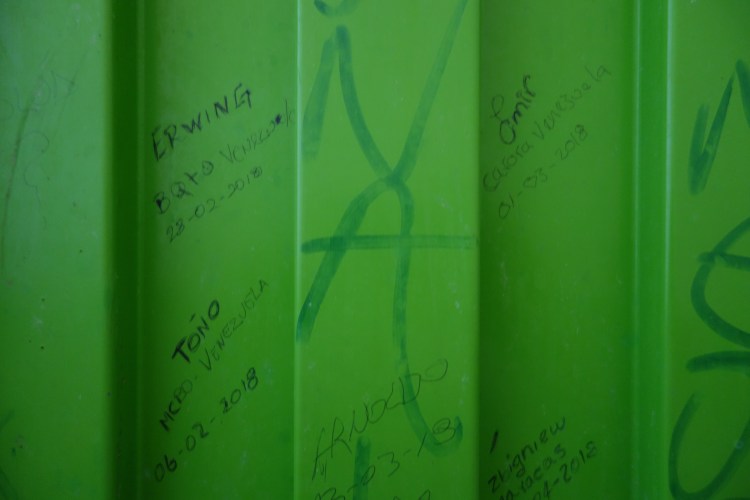
I have spent a large proportion of the last few days considering how our journeys south compare. My hardships, of course, are due to a choice. A choice to fulfil a dream which is rooted in privilege. To have such a dream in the first place requires a particular freedom in life, as well as personal and financial safety. Venezuelans fleeing their country are doing so because they can no longer afford food.
It is challenging to accept the relativity of our respective lives, but it is something I have to come to terms with. Fortunately, there is a freedom of passage for residents of most South American nations. Any form of official ID is generally enough to pass borders, as many of the people I have seen would have done. I guess this treaty provides people with some sense of autonomy when it comes to making the best out of a bad situation.
Despite 100,000 Venezuelans settling in Ecuador over the last two years, I have heard most of the migrants are enroute to Peru, where their savings will serve them better than in the USD economy of Ecuador. Given this scenario, I will most likely spend many more days on the road with Venezuelans, and many more hours contemplating the situation. Consequently, I will continue evaluating my position on the bike and how my passage south is also changing my life.
Forced reflections
As alluded to earlier, the route from Popayán to the border culminated in a touch of sickness. Whether it was a dodgy empanada, my nonchalant approach to drinking tap water throughout Colombia, or the altitude, I was crook. Lying on the bathroom floor in a hotel in Ipiales, my stomach sounded like a kettle in the final stages of its boil. Retrospectively, it was most likely a combination of all of these factors, in addition to the physical exertion I’ve thrown my body into over the last three weeks. Perhaps it was Colombia begging me to stay. Or maybe it was Ecuador crying out over the border to get away from the northern country as soon as I could. These were actually two of the delusions I had whilst lying there, willing my body to expel the demons that were inhabiting my gut lining.
Regardless of the cause, everything came crashing down; my health, my emotions, my motivation, and most worryingly, my self-belief. I was at the highest elevation of the trip, yet my lowest point by far.
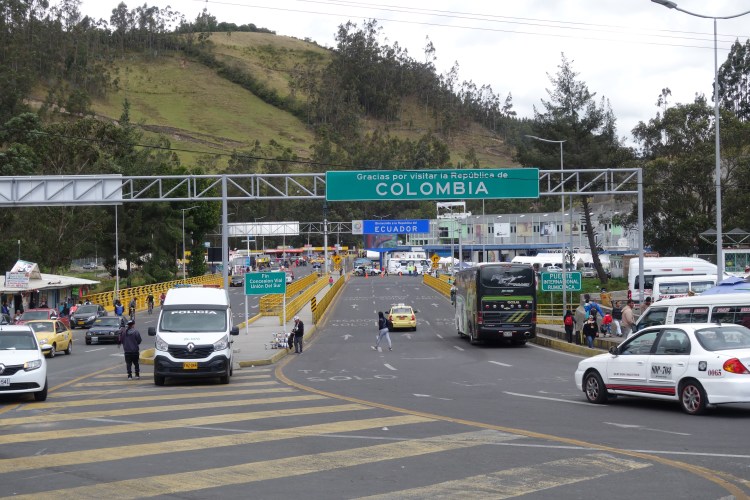
During this state of health and mind, I struggled across the border and into the Ecuadorian town of Tulcan. Whilst lying low for two days, losing fluids at the same rate I consumed them, I was desperately trying to reset. When I eventually felt like eating again, the walk up the street left me with wobbly legs and lungs that felt the size of grapes. I realised that I was a few days off being able to get back on the bike. Ina short, I decided to catch a bus to Quito where I could recuperate in a city with a little more stimulation and excitement than what was on offer in Tulcan. I will write more about Quito in the future, as for now I am focussed on self reparation.
I was surprised by how hard I found the few days of illness. It has certainly been the catalyst for some introspective reflection. The last year has seen plans made, plans changed and days filled to the brim with work, preparations for this trip, and time invested in relationships. Self imposed or not, there has been minimal rest, especially over the last three months. Theoretically, I was/am, prepared for this undertaking. However, being bedridden and vulnerable simply allowed time and my thoughts to catch up with me, and the reality of this trip to sink in.
I have resorted back to the ‘day by day’ approach as I work my way up to where I was, physically and emotionally, before the border. It is fair to say that the biggest mountain of the trip so far has been within. I am determined to overcome this, exercising self-care and positive approaches to the road ahead. So, for the next few days I will return to focussing on the sweat forming as I ride, the smells and sounds of passing traffic, and the belief that I am doing the best that I can.
Thanks for reading.

 Faults and Folds