Peru is a country of contrasts. Within the entangled riches of its rainforest heart, across the mountains that form its rocky spine, and along the coast that paints its edges golden and blue, Peru proffers a lifetime’s worth of questions to the inquisitive eye. Whilst the faults and folds of the country’s metamorphic foundations could intrigue a naturalist until the end of their days, Peru’s disparities extend far beyond its physical composition.
In addition to the famous Inca civilisation, Peru has witnessed the rise and fall of several empires. Over the course of history, each of these various groups have left their archeological mark on the landscape in some way or another. Additionally, the cultural influences of groups such as the Moche, Chimu, Nazcas, and Chachapoyas have been slow to fade in certain pockets of the nation. The rich indigenous history of Peru, combined with the colonial influence of the Spanish, has further contributed to the stark contrasts that are observable. The country is considered a bicultural society; that is, the part that is indigenous, and the part that is European influenced. Spanish speaking Peruvians, who adhere to a criollo lifestyle, are the white citizens (15% of the total population), and those who are a mix of indigenous and European heritage. Intriguingly, 45% of Peru’s population are purely indigenous, making it one of three countries in Latin America to have such a high indigenous representation. However, a disproportionate percentage of the indigenous population work in agriculture in the rural areas of the Andes. And, despite a drop in the nation’s poverty rate of 23% since 2002, rural poverty remains at nearly double the national average. People blame various factors such as large scale mining operations in remote regions and the construction of new highways which have bypassed many rural settlements. Regardless of the drivers, the contrasts in Peru’s society, economy, and natural landscape are undeniably evident.
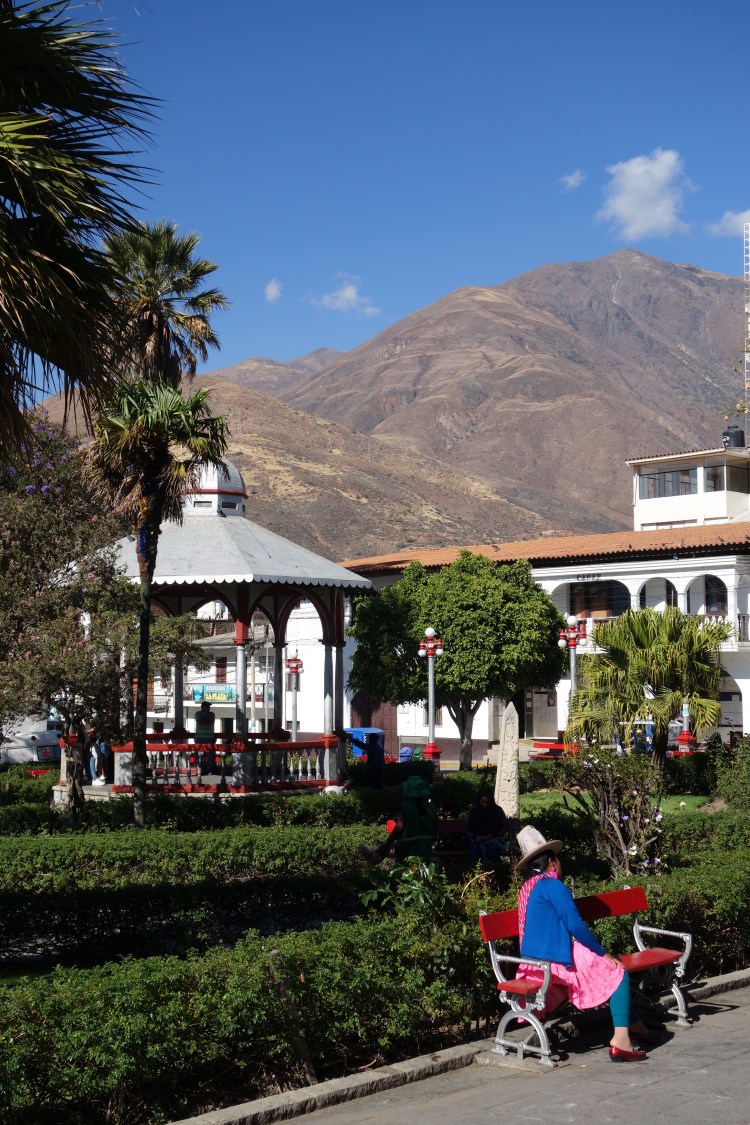
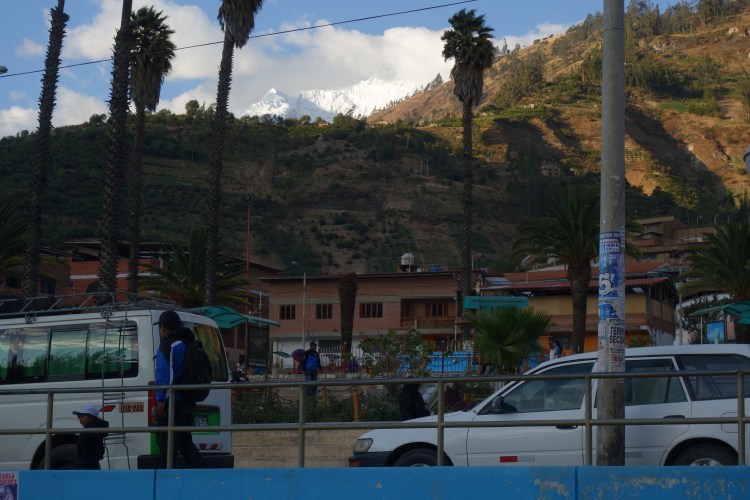
As expected, I awoke on my first morning in Caraz feeling a little ginger. With a bruised body and a bike in equal need of rest and repair, I planned to lie low for the day. But, as soon as I stepped out on to the street, these superficial sensations were blown away on the breeze. Beneath a blue sky, and the towering, conspicuous peak of Alpamayo, sat a humble town square. There was no need for Caraz to show off, for its surroundings spoke in volumes. After a day of recuperation, I spent several more exploring the region, by bike and on foot.
Whilst the towns of Caraz and Huaraz are only separated by a distance of 70km, the area between the two provided me with a week’s worth of exploration. By day I wandered between the alpine lakes, alluring peaks and rapidly retreating glaciers of the Huascarán National Park. In the evenings, I returned to whichever town I was staying, encountering some of the kindest people imaginable. In the context of my journey, a week to absorb one region felt both foreign and overdue. Despite some difficulty in adjusting to the renewed pace of travel, it reinforced my love of observing, and trying to understand, people and places.
The region between Caraz and Huaraz provided the quintessential location for experiencing the contrasting nature of Peru. Each street held stories of both success and disillusionment. Upon the trails that knitted the hillsides together, I encountered poverty stricken subsistence farmers ploughing in silence, as Gore-tex clad tour guides powered by. But, above all, it was the overbearing presence of the mountains that exaggerated the stark differences that exist side-by-side in this nation. The valley between Caraz and Huaraz, Callejón de Huaylas, strikes a narrow line in the dirt between the Cordillera Negra to the west, and the Cordillera Blanca to the the east. Despite being home to colourful personalities, the road between these two mountain towns is, quite literally, where black meets white.
Cañón del Pato
I’m not sure if Cañón del Pato (translation: Duck Canyon) is named after some abstract resemblance to a mallard, or because the 35 tunnels along the road cause an instinctual lowering of the head as one races through the dark abysses. Regardless, this 40km stretch of road offers one of the most surreal days in the saddle that a cyclist could imagine!
Ever since seeing a picture of this stretch of road, I had been intrigued by the ingenuity and engineering prowess required to create such a passage. Also, it looked like a bloody fun day out on the bike! As the canyon itself is around 30km north of Caraz, it presented the perfect opportunity for a return day trip. My excitement about a day on an unloaded bike was palpable.
I was quickly brought back to earth (almost literally) as I jumped out of my saddle, charging up the first hill with a new found freedom. Much like taking a heavy rucksack off at the end of a day’s walk, my sense of balance had become accustomed to the burden of the load that I was used to carrying. I very nearly threw myself off the bike and onto the footpath. Managing to stay upright, I pulled over and took a few calming breaths, before embarking on the continual descent to the canyon.
The road to the canyon followed the meandering Rio Santa. Agricultural fields lined the river, making the most of the flat, arable land before the walls of the canyon began to close in, rendering any productivity completely impossible.
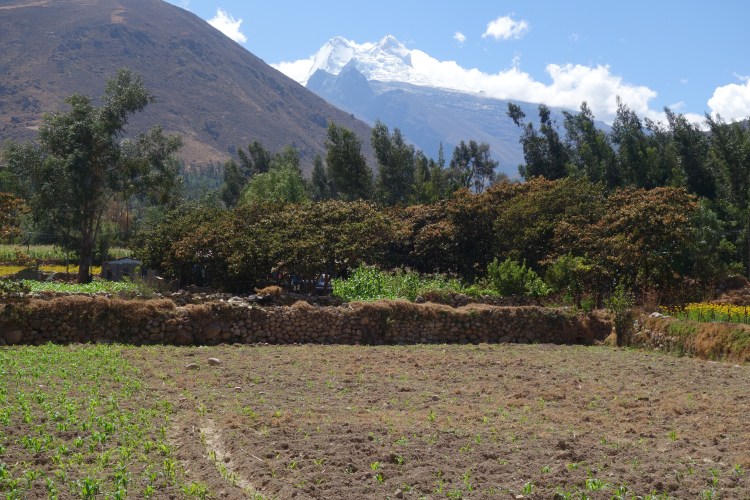


Since David had returned to the states, I hadn’t seen another cycle tourist. I had heard various tales from townsfolk along the way, that someone came through a day or two before me. However, travelling at a somewhat similar speed, there is a slim chance of meeting up. It’s a little surreal to consider how many possible friendships there may be either a day ahead or day behind me. However, within 20km from Caraz, I met three people riding in the opposite direction, spinning their lowest gears on the climb which I would encounter later in the day.
The first couple were from Germany. Upon seeing them approaching, I instantly felt better about the load I have been hauling south for the last few months. Not only were their bikes supporting full racks of panniers, but they were both shouldering packs that would have been between 50-60 litres in size. As if this wasn’t enough, as they got within talking distance, I noticed that the guy had a passenger with him. Covered by a blanket, and lying within a basket fashioned from a milk crate, a shaggy blonde head appeared. The dog, which I initially expected to be the size of a Jack Russell, jumped from the basket, and with it came a much bigger body than I anticipated. My look must have said it all as, without prompting, the guy wiped the gushing sweat from his brow and simply said, “Ja, he’s a big one”.
Aron, the dog, had begun following the couple in Ecuador. Unable to leave him, they have carried him ever since. In researching logistics, they had discovered that Chile, being considered ‘rabies-free’ is the easiest country from which to fly him to his new home in Germany. In listening to their story, my mind was bouncing between the desire to find myself a furry amigo, and how committed/crazy they were. Dogs generally are prohibited from National Parks – especially in Chile and Argentina – so Aron’s presence had required a complete readjustment of their plans. It would appear that they, the humans, were in fact Aron’s best friends in this situation.
Within minutes of shaking paws with Aron, and wishing him and his humans a safe onward journey, I saw another two-wheeled vagabond pedalling up the hill. Joey, from the US, was sporting a much more compact setup than the Germans, not to mention a badass handlebar moustache. He was eight months into his journey, having ridden from his front door in southern Colorado. We both expressed how social this stretch of road seemed, as it had also been weeks since he had seen any other cyclists. He shared some stories of other parties that I might have the ‘pleasure’ of coming across down the road. Before we parted ways, Joey asked where I was staying in Caraz and suggested a beer at the end of the day; the perfect proverbial carrot to dangle from my handlebars as I continued down into the canyon.

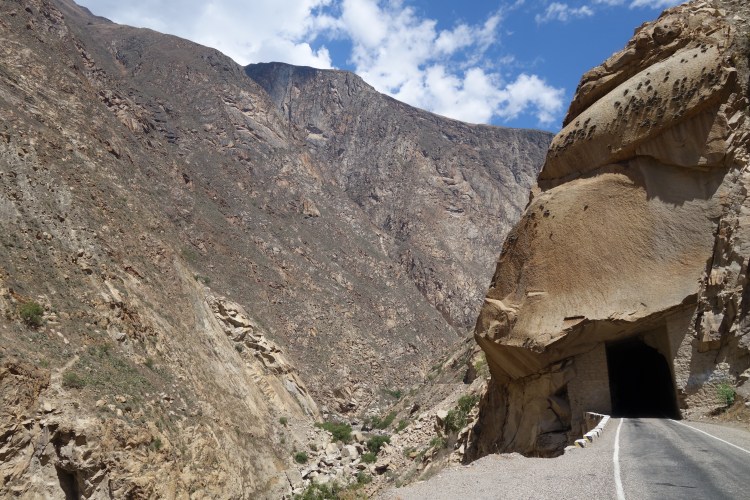
Almost instantly, the landscape either side of the road began to close in, as the canyon proper began to take shape. The forces at play were overwhelming. The Rio Santa, which up until now had been placidly meandering between fields of chamomile and quinoa, was forced into a narrow gorge. Overtime, it has created a haphazard, yet seamless, passage of drops, slots, pools and rapids between the mountain ranges either side. At certain points, the distance between the Cordillera Negra and the Cordillera Blanca is merely six metres; the river playing the role of the referee to ensure the two don’t butt peaks. From the river, both mountain ranges rise to over 5000m, making the passage between the two one of the most humbling experiences I’ve ever had, let alone on a bike. The Cordillera Blanca contains 22 summits over 6000m, qualifying it as the highest mountain range in the world outside the Himalayas.
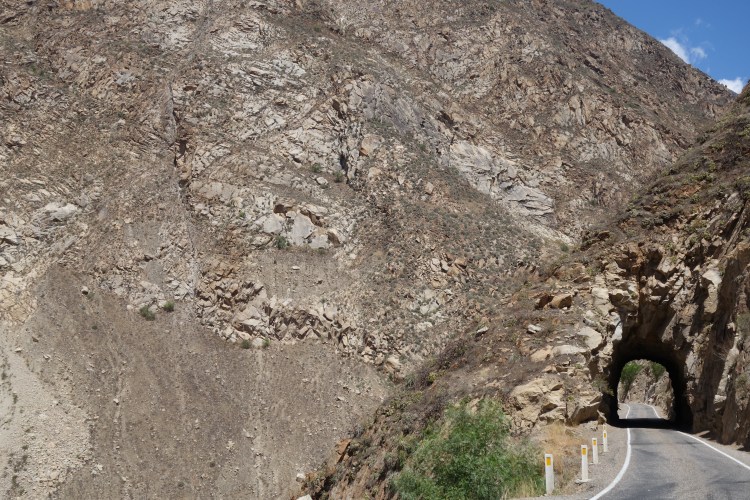
As with most of the riding so far, the greatest challenge has been keeping my eyes from getting lost in the siren-like landscapes. The Cañón del Pato demanded especially strong focus. The geography of the region had left road engineers with no option but to simply tunnel directly through some of the more stubborn parts of the Cordillera Negra’s foothills. At the entrance of each tunnel, large signs prompted vehicles to use their horns before entering – not that Peruvian drivers need any encouragement. Despite this safety measure, the fact the road was only wide enough for one car in most places made each me feel especially small on a bicycle. In addition to the risk of meeting a truck mid-tunnel, the light on my handlebars illuminated the source of the constant, menacing screeching; bats. What seemed like thousands of the flying rats, filled the space above my head as I raced through the dark.
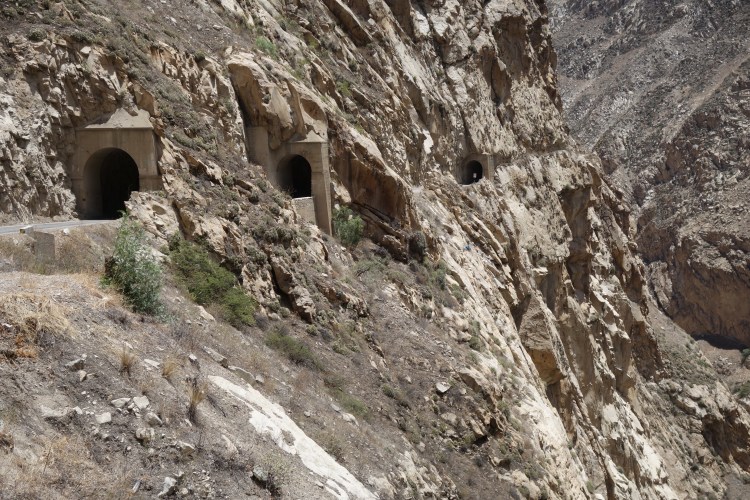

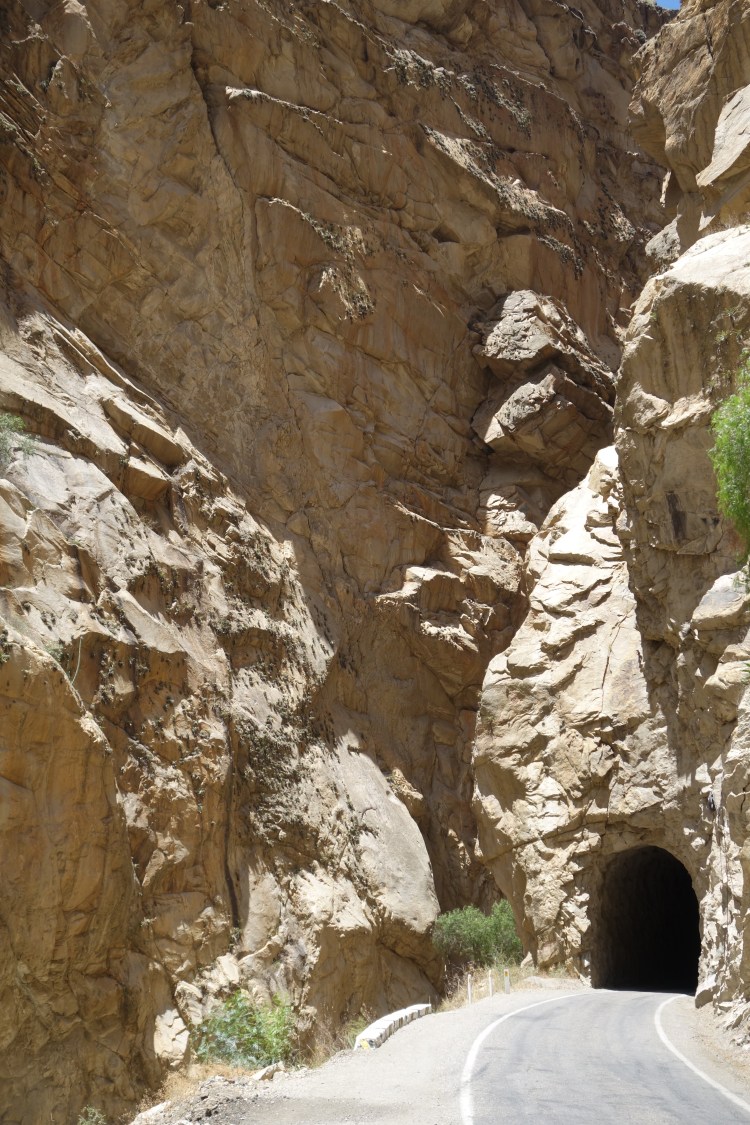
By the end of the last tunnel, my eyes could attest to the contrasting nature of Peru, as they were exhausted by the constant cycle of pupil dilation and constriction. 40km after leaving Caraz, I raced down a series of switchbacks and arrived in the hydro town of Huallanca. I had lunch amidst a sea of high-vis wearing workers from the power plant that was the defining feature of the small settlement. Feeling less than fully charged about the climb back to Caraz, I spotted one of the cycling parties that Joey had mentioned.
Propped against a brick wall, were three heavily loaded tandem bicycles. They belonged to a French family comprised of the parents and four children, ranging in age from six to fourteen. I’m hesitant to make assumptions, but the mood of the group seemed less than perky. The father was attending to a mechanical issue on one of the bikes, whilst the eldest son sat, round shouldered on the ground beside the bags. The mother was being dragged between food stalls by the two youngest, and hungriest looking children. The middle child was doing what middle children do best; entertaining himself whilst seemingly unfazed by the situation. Joey had told me that when he first came across them, the youngest child was in the grips of a bout of diarrhoea on the roadside, whilst the other three asked him to spare some food. Ever since coming across them, I’ve been yet to fully comprehend their undertaking. I’m not sure I ever will.
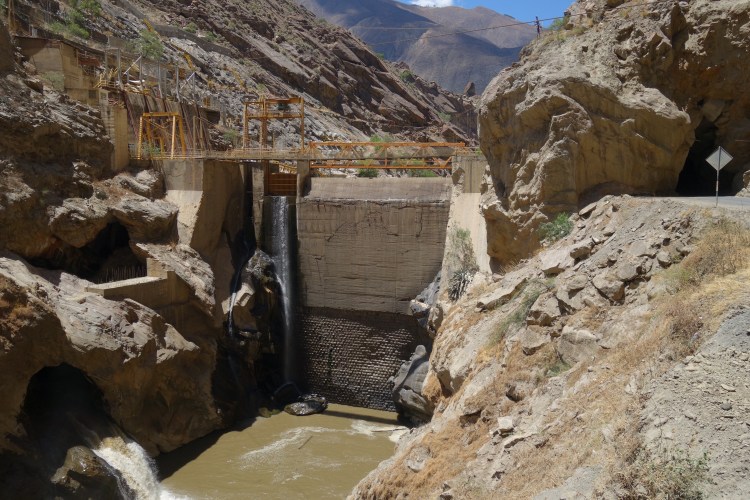
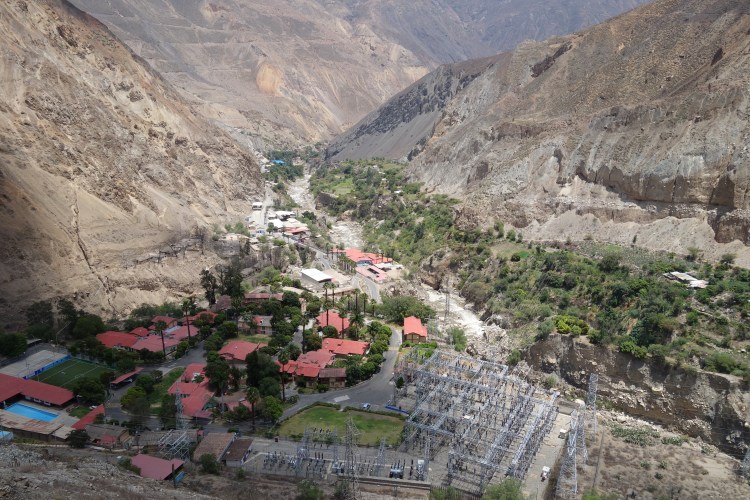
I waved goodbye, double checking that everyone in my party of one was ready for the climb ahead; a logistical battle at the best of times!
Despite retracing my tyre tracks back to Caraz, the climb offered another beautiful perspective of the Cañón in the afternoon light. As I was climbing, my pace in the tunnels was slower. Subsequently, I met a few vehicles in the dark which added to the already heightened heart rate.
Arriving back in Caraz, the peak of Alpamayo had been painted robin’s breast pink by the twilight. Over the 40km climb, with an unloaded bike, I averaged 24km/hour which was the first indication that perhaps I had gained a little fitness over the past two months. As I wheeled my bike into the garden of the hostel, Joey was already a few beers deep, and in the mood to discuss our mutual goal; Patagonia.
Although each day seems to trump the previous on this journey, I have no doubt that the ride through the Cañón del Pato will remain one of the most memorable days I’ll ever have on a bike.
Laguna Paron
Arguably, the biggest drawcard of the region between Caraz and Huaraz, is its proximity to Parque Nacional Huascarán. This 3400 square kilometre national park encompasses almost the entire area of the Cordillera Blanca above 4000m. Sitting up at night reading about the endless climbing and hiking possibilities that lay in the hills above me began to challenge my desire to continue riding. There is simply so much to explore in every crease and crevasse of this continent. The allure of the topaz lakes and mountains topped with snow mushrooms was overwhelming.
The morning after delving into the depths of Cañón del Pato, I set off early to immerse myself in the lofty heights of Parque Nacional Huascarán. Under a cloudless sky, I took a collectivo from the centre of town to the park boundary. Referred to as collectivos, these minivans or white stationwagons provide a cheap alternative to taxis throughout Peru. With a set destination, drivers will continue to pick up as many passengers along the way as physically possible, maximising their income from each journey. On bumpy roads, and often with as many chickens on board as humans, collectivos make for exciting journeys. On this particular day, I was the last one left at the end of the road, as we had dropped everyone else at their respective properties in the valley below.
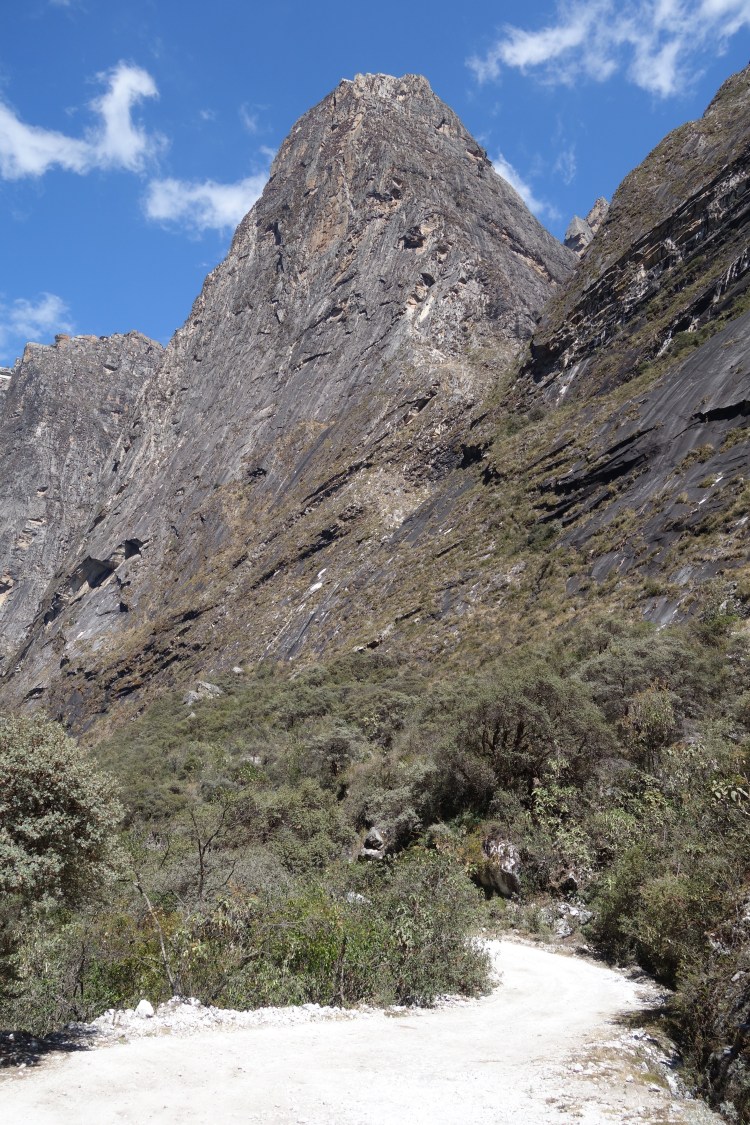

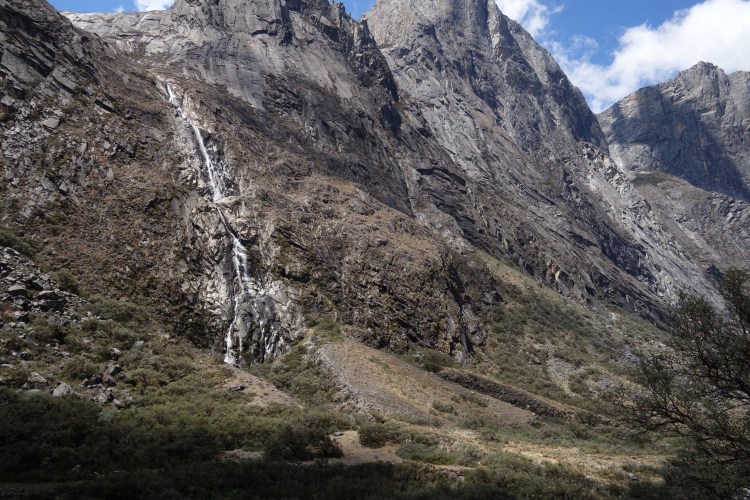
On a narrow road, I waved goodbye to the driver at the boom gate marking the park entrance, watching as he performed a 20-point turn to return back to Caraz. Two rangers were holding the fort, taking a small amount of money as an entrance fee. Whilst one of them didn’t look up from where he was squatted by a creek shaving, the other showed great excitement that I was from Tasmania. In these situations, I find most people refer to Looney Tunes. This guy, however, beamed when he talked of the natural beauty of Tassie.
Despite the fact that the road continues from the entrance of the park to the shore of Laguna Paron, I was in dire need of some time strolling in the hills. Fortunately, there was the option of a walking trail, which took a more direct route to the lake, cutting between the switchbacks in the road and detouring to the edge of crystalline creeks. The entire walk was framed by enormous, neck-straining rock walls. The slate coloured water marks, streaking down the pale yellow granite reminded me of the towering monoliths of Yosemite Valley. I was happy.
As I closed in on the lake, the walls of the valley began to part, revealing the snow covered, lower flanks of shy summits. Images of the mineral rich, topaz water of Laguna Paron are displayed in every second shop window of Caraz. However, the first view of the seemingly unnaturally blue expanse still left me questioning the reality of the scene. By now, the sky was scattered with fast moving clouds, causing a mesmerising, mottled blue render to race across the water. After staring at the shapeshifting patterns, the lake began to take on the appearance of a radioactive Dalmatian, or the skin of heavily birthmarked avatar.

From the end the lake, I slowly climbed to the rocky mirador which afforded an elevated perspective of the water below. Sheltering from the wind behind a boulder, I sat quietly so as not to frighten the peaks that were beginning to come out from hiding within the clouds. It took a while to adjust to the scale of the scene, regularly catching myself mistaking white summit cones for clouds. The light continued to dance across the lake, causing an ancient landscape to seemingly move at the pace of a hummingbird.
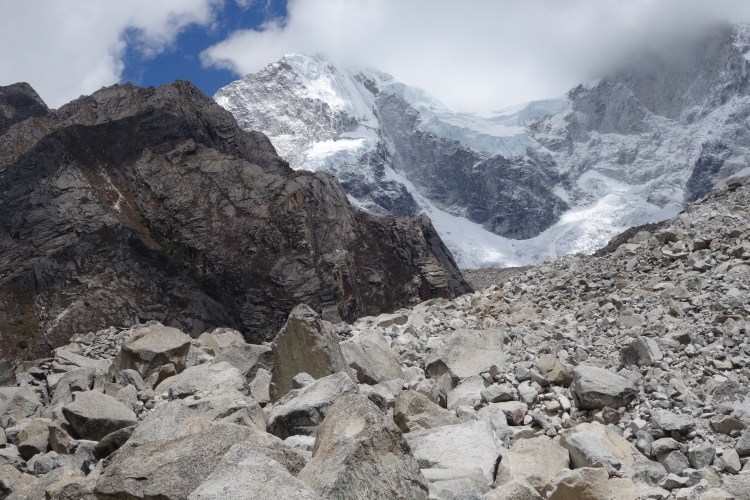

Back at the shore of the lake, the number of cars and mini busses was beginning to grow as they awaited their passengers for the trip back to Caraz. I had intended to walk back to the park entrance and try and get a lift with a passing collectivo. However, sitting on the bonnet of his dusty station wagon was the driver who had dropped me off earlier in the day. We made eye contact and he gave me a look that told me how much easier it was driving up than walking, still questioning my desire to be dropped off at the bottom of the road. I succumbed to his offer of a lift back to town, where along the way we managed to fit nine people in the five seater car.
Laguna 69
The three days and four nights in Caraz had been long enough to develop some settling routines. Mornings involved time in the hostel’s garden, trying to gain the trust of the timid kittens that roamed the grounds. Their presence was often only in the form of a rustling in the vines that flowed from the various balconies, or as a paw shooting from a stormwater drain in the hope of catching a passing skink. Given their stealthy existence, I was amazed to see my first hummingbird, hovering so effortlessly at the opening of a pink blossom in the middle of the garden.
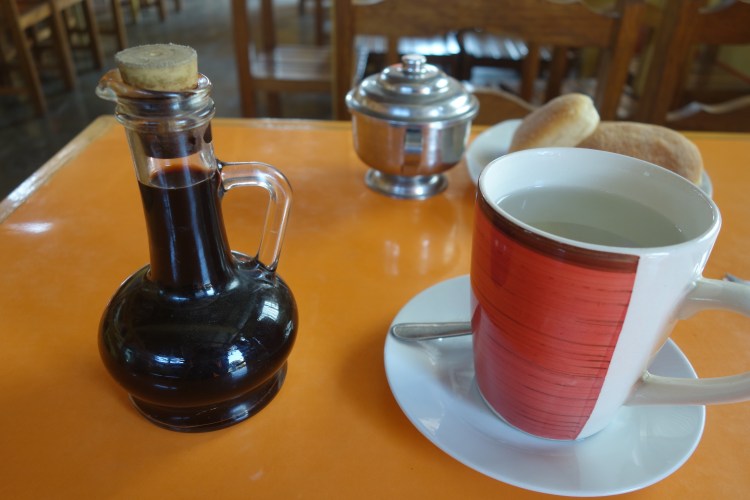
From the sanctuary of the flowers, a short stroll through the central plaza would take me to Alex’s Café, where a strong morning coffee and constant reassurance to the owner, Alex, that Peru was my favourite South American nation, was the perfect way to caffeinate for the day ahead. Coffee in Peru arrives at the table as an extract, in a small jug or glass bottle, which is then poured into a mug of hot water. The quality varies immensely, from a thick syrup of instant coffee, to a freshly brewed espresso shot. Alex was meticulous in his preparation, often overseeing the process of the extract mixing fluidly with the water. The satisfaction on his face was infectious.

Each evening, I frequented a small restaurant, which sat at the top of a flight of stairs from the street below, marked only by an inconspicuous, handwritten cardboard sign hanging from the door. The set menu, for 6 soles (around $2.50), included a soup, main, and a mug of manzanilla (chamomile tea). There was little conversation in the room, as everyone’s attention was drawn to the flatscreen television. Over the duration of the last few weeks, I’ve noticed what appears to be a nationwide fascination with a particular game show. The format of the show involves individuals from two teams of jacked-up men and women with perfect teeth, competing in a range of physical challenges. It is reminiscent of the good old days of ‘Gladiators’ on TV growing up, but at the end of each challenge, the two competitors need to be separated from a verbal dispute over who cheated. This is then settled by a judge, before the next couple face up to their task. Not only is the concept a little difficult to understand, but it seems to be on every night, with the same two teams, and played at maximum volume in every restaurant. Unless, of course, there is a game of soccer in progress. In a competition of Peruvian ‘Rock, Paper, Scissors’, soccer beats everything.
Following a final coffee with Alex, I eventually pulled myself away from Caraz, and began the arduous ride of 15km (no, there aren’t any zeros missing from this distance) to the next town down the valley, Yungay. With a stiff tailwind, the ride was brief, yet the change in location provided views of a different set of peaks high above in the Cordillera Blanca.
Being a small town, with limited accommodation options, it was beautiful surprise that the hostel I found became one of the most memorable stays I’ve had to date. I was welcomed at the door by Hector, a gentleman in his 70s, who’s misty eyes and smile-stretched, olive skin were instantly warming. He showed very little interest in taking money, or showing me a room. Instead he pulled out a series of maps to find out where I’d come from and where I planned to venture beyond Yungay. He made a number of suggestions for walks and rides in the region by slowly tracing his finger over the map, making a ‘chck, chck, chck’ sound, like an old cog railway climbing through the alps.


Following the twilight hours spent wandering the markets as vendors packed away their wares for the following day, I returned to the hostel, where I met Hector’s wife, Rusula. We sat on small plastic chairs in the doorway of my room. When I told her I was a teacher of Geography, it was as though I unlocked a doorway of affection. She stood up, rushed into the kitchen, and dragged Hector out by his flannelette shirt. With so much excitement, she told me that Hector had also been a Geography teacher. She pulled up another chair for him, and leaned back in her own, watching us with the expectation that Geographic conversation would flow like the nearby Rio Santa. Despite her anticipation, the discussion was slow.
‘So, Hector..you like maps?’
Over the course of the next hour, Rusula discussed their 52 year marriage and how she had lost her right arm to cancer. Only hours before, I had reached for a handshake. Ashamedly, I listened on. With tears swelling in both her’s and Hector’s eyes, she lay her hand on his knee and told me that throughout her entire illness, and the endless trips back and forwards from the hospital in Lima, her husband had shown her nothing but love. Following this, she questioned why on earth I’d want to be here alone, and not at home married, for it is the best thing in life. The language barrier was too much for explaining the intricacies of my answer.
After I discussed my hiking plans for the next day, Rusula made a quick phone call and ensured me that there would be a collectivo at the door at 6.55am in the morning to take me to the trailhead. She gave me a bag of bread for the driver and invited me to have dinner with the family on my return the next evening.
I put it down to the ice cream I’d treated myself for dessert, but my sleep was broken by stomach cramps throughout the night. Underslept and distrustful of my stomach, I met the collectivo in the morning and was ushered to the back seat of the van. Within minutes, I had my head out the window ready to paint the road. Whilst it came to nothing, the ride to the trailhead was torturous. Horrendously corrugated, the road followed switch backs up in to the hills, resulting in an involuntary game of ‘corners’ with the five other men who were squeezed onto the back seat. It took me an hour to realise that the continual screeching was not the van’s suspension, but in fact a crate of chickens on the seat in front.
Unfortunately, I missed most of the approach drive, as I had my eyes closed in an attempt to quell the turbulence in my stomach. After an hour and a half, we suddenly pulled up at the beginning of the trail. I squeezed between the seats and stepped out as the van left me on my own beside the road.
Whilst alone at the time, I had read that a number of busses usually arrive at the trail later in the morning, having come from Huaraz. Eager to enjoy the trail to myself, and hopefully let the fresh air ease my stomach, I got walking.
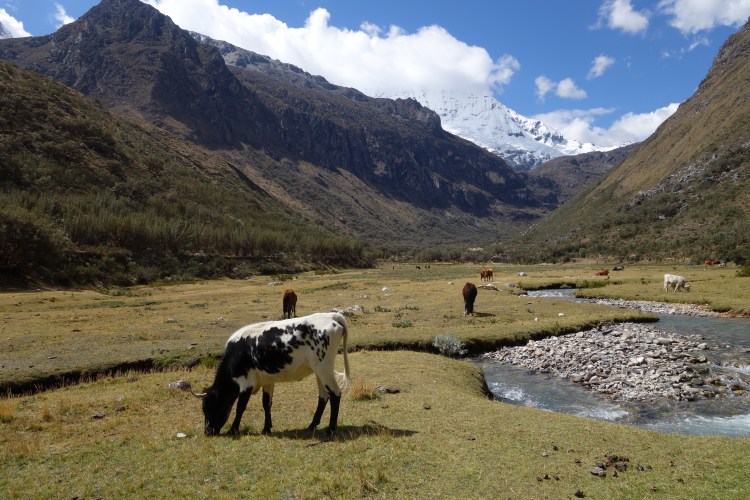


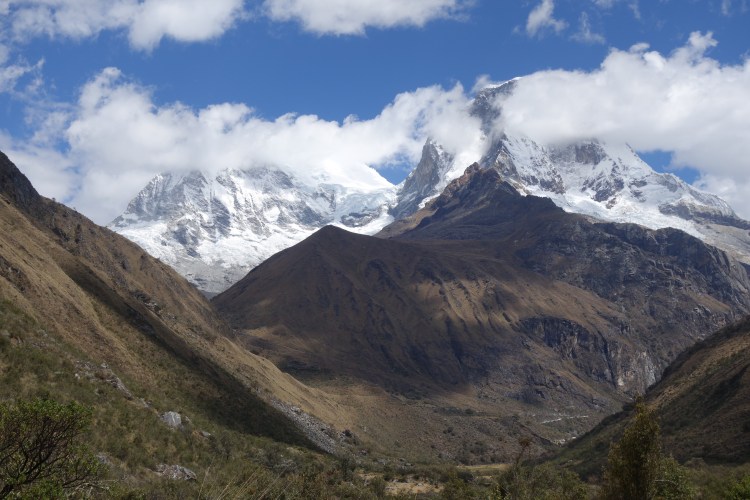
Ideally, I would attempt to articulately describe the trail to Laguna 69 (‘apparently’, out of the 80-odd lakes in the region, this was the only one they couldn’t think of a name for). However, the walk up the valley between waterfalls, grazing alpine cattle, glacier-cloaked peaks, and wildflowers was one of the toughest days of walking I’ve ever had. The bug within my guts was having a field day and, combined with the altitude of 4500+ meters, forced me to sit and rest every hundred meters. Eventually, I was passed by other walkers, and the further along I pushed, the more vulnerable I began to feel. The scenery was spectacular, but I’ll let the photos do the talking.
I arrived at the lake and lay in the shade of some alpine shrubs growing out of the glacial till, quickly falling asleep. An hour later, beside one of the most inspiring alpine scenes I’ve witnessed, I woke and without sitting up, simply rolled over and violently threw up. Unbeknownst to me, while I was sleeping I had gained the company of a small crowd. When the vomiting subsided, a kiwi guy, a few meters to my left asked if I was ok. Without responding, I just looked at him, wiped the bile from my beard and went back to sleep. A low point.

The walk back to the trailhead was spent in survival mode. Managing to again secure myself a position in the back of a collectivo returning to Yungay, each corrugation in the road was like a chisel to the crown of my head. After an unnecessarily demanding, and nauseatingly beautiful day in the hills, I finally arrived back at the hostel. Between my broken Spanish and pale face, I think Rusula understood that I wouldn’t be joining them for dinner.
Thankfully, I slept through the night, waking to voices outside my room which were were as equally fluent in Spanish as I am. I got dressed and emerged into the courtyard, finding two cycle tourists discussing the rates of rooms with Rusula.
Stephano and Tracy, also from Australia, had begun cycling from Quito around the same time I had left the Ecuadorian capital. They had recently sold their farm in Port Macquarie, before embarking on this ride, which they plan to continue into the new year. They then told me their plans for when they return. When arriving back in Australia, they are relocating to their new farm, in Sheffield, TASMANIA! After the bewilderment subsided, we exchanged details to meet up further down the road, and if not, then under the watchful presence of Mount Roland sometime next year.
Feeling ok, I decided to ride the remaining 60km to Huaraz, and spend a few days there to recuperate and plan the next stages of the trip. Once packed, I found Rusula to thank her for my stay. With her arm around me, she lay her head on my shoulder, with tears in her eyes and thanked me, for staying with them. She then rushed up the stairs to her house, and returned with two hand woven bracelets. Whilst one was for me, she made me promise that when I return to Australia, I will find a wife, give her the other one and a baby, and make sure I name it ‘Rusula’. Overwhelmed by her affection, but hesitant to say that her’s wasn’t on the top of my list of possible baby names, I hugged her tightly. She and Hector stood in the doorway of the hostel waving as I rolled out of Yungay with drink bottles full of electrolytes.

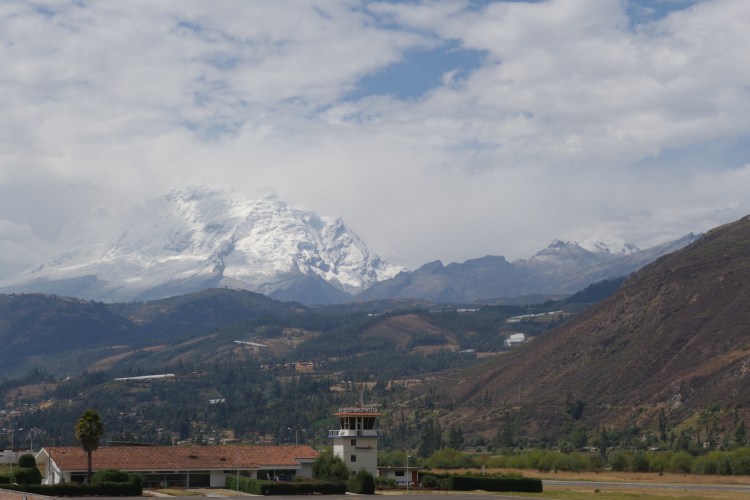
Whilst the ride was a bit of a slog, I was kept company by the Cordillera Blanca to my east. In Caraz, I had met a French couple who were travelling north. They had asked me if I’d return a key to a hostel which they had accidentally carried on with them. Fortunately, the hostel, Carolina Lodging, turned out to be a great spot, making the job of finding somewhere to stay much easier.
I spent three nights in Huaraz, making the most of the included rooftop breakfasts on offer at the hostel and spending my days wandering, writing, reading and washing my bike by the river. My stomach was still recovering from its record breaking, high altitude spew, so a few quiet days were required. Huaraz is very much considered the adrenaline capital of Peru, being the obligatory launching pad for most sojourns into the Cordillera Blanca. Compared to my last few weeks, the streets seemed full of rucksack wearing gringos. However, I’m told that is is now the shoulder season and the town is relatively quiet compared to the last few months.

The weather in Peru is clearly changing. Afternoon rain clouds roll in daily, bruising the sky and washing the streets. In the dorm room I was staying, I met a Belgian guy by the name of Dimi. In South America peak bagging, he had just returned from the mountains. He told me that conditions in the mountains are now less than ideal, with heavy precipitation and soft snow. The seasonal change was also pushing him further south, as he was planning on how to get to La Paz where he is hopeful of getting a few more weeks of climbing under his belt. We swapped details and made plans to meet up in La Paz, possibly to attempt a less technical summit or cycle south together for a few weeks if Dimi can get his hands on a bike. Regardless of the outcome, I’m sure a beer will suffice.
Thanks for reading.
 Faults and Folds