At times, I couldn’t bring myself to look out of the bus window. As the landscape of central Peru raced by, I felt my chest swelling and my conscience burning. From the shadow-trapping creases on barren hillsides, to the matted woollen cloaks of roadside ewes, the feeling of disconnect only intensified as the bus kicked up a cloud of dust. I desperately wished I was sitting on the other side of the glass, rubbing the dirt from my eyes.

Every other cyclist I’ve met along the way, has caught a bus at one stage or another. In conversation, they have always prefaced this fact with the statement, ‘we cheated…’. Prior to loading my own bike into the storage hold of a long haul bus, I have silently ridiculed their use of this language. The term ‘cheating’ alludes to acts of dishonesty, or unfairness, to simply gain an advantage. It is a term that is so strongly linked to competition. But, for me, cycle touring is strongly aligned with adventure, exploration and discovery; a stark contrast to my interpretation of competition. Plus, travelling by bike is arguably the most honest, fair way of coming to understand a place and its people (arguably the greatest advantage in life) so what does a bus ride here and there matter?
However, having exchanged my worn leather bike saddle for the dilapidated foam seat on a coach, I was quickly coming to understand why the term ‘cheating’ is so easily associated with taking the bus. Of course, it is an irrational sensation in the greater scheme of things, but I felt trapped. I had spent two months developing intimate relationships with various road surfaces, and forming a healthy respect for wind, rain and everything in between. And now, I had relinquished my autonomy over daily experiences and interactions on the road, to the bus driver who had a deadline to make. I grieved the passing of every tree, river and mountain that was left in our wake. In short, I struggled hopelessly with the change of pace. It required some serious introspection to pull myself from the rut that I was slipping into whilst bus-hopping my way through central Peru.
Albeit obvious in retrospect, it took me a few days in this spiralling thought pattern to reach a relatively healthy conclusion; there are too many mountains in this world for one person, and that’s ok.

I perpetually cram my days in the fear of losing time. With fingers in too many pies, and my head in too many places, this laborious existence is at times be so detrimental to my overall energy levels and quality of life. In stark contrast to my actions, I often find myself craving a slower place, and devoting myself to the development of expertise and skills in a single area. Reflective of the adage, ‘jack of all trades, master of none’, this thought possesses little originality. Regardless, it is a realisation that I needed to come to alone. It also reminds me of a quote my dad used to refer to, from one of his close mates: “there are two errors in the human design; firstly, our shin bones are on the front of our legs and, secondly, we all have to learn the same lessons”.
The feeling of ‘spreading myself too thinly’ extends beyond physical exploits such as this journey, and into my relationships, work, and general self confidence. The bus rides provided me with time to reflect on my professional pathway. My role as a high school teacher undoubtably presents opportunity for deep and valuable personal connections. However, the deadlines, pastoral care, ever changing and often superficial curriculum material, and annual uncertainty of my position description, detracts from my ability to develop an expertise in a particular area; something that is becoming an increasingly important value. The constant push and relentlessly skimming of the surface of ever important topics, has become detrimental to my satisfaction at work. In the same way there are too many mountains for me to climb in this life, there is also too much information for my one mind. I wonder if I would experience greater centrality and permanence in a profession that was project-based, requiring in-depth investigation and understanding of a particular topic? I wonder if I should revisit my undergraduate studies in Environmental Science and see where it takes me?
I acknowledge this passage is verging on stream-of-consciousness, however, these thoughts have influenced the direction of my travels. Whilst sitting in the plaza of one of the numerous towns beginning with ‘Hua’ in central Peru, I became convinced that my days were lacking a focus beyond simply reaching the next destination. To counter this concern, I enrolled in a week of Spanish classes in Cusco. Still a few hundred kilometres away by bus, the idea of developing a skill that will hopefully afford deeper connections with, and understanding of, a place and its people excited me greatly.
As the bus closed in on Cusco and the end of this passage of public transport, I was still looking at each grassy river bank as the ‘perfect’ campsite. However, by committing to a week in one town, focussed on one task, I felt like I was finally selecting one mountain to climb, rather that wallowing around in base camp worried that I’ll never be able to climb them all.
Lionel Richie and the back seat of a police car
Within minutes of sticking my thumb out in Aquia, I found myself in the passenger seat of a Ute driven by a gentleman called Fernando. He could only take me several kilometres, back to the junction where I had realised my navigational error the night before. However, he drove at a snails pace in fear of damaging my bike which was lying in the tray, so we managed some substantial conversation during the short journey. Fernando had just been passing through Aquia on his was to Lima from his home town further down the valley. He had not partaken in the celebrations of the fiesta and as a result was more likely to be sporting a legal blood alcohol level. As we drove back up the valley beside the Rio Pativilca, Fernando pointed out the string of powerlines that connected the surrounding ridge tops. Working in hydroelectricity, he was immensely proud of the region’s effort to bring power to previously disconnected hamlets and towns, such as Aquia. I feel an extended journey with Fernando would have been interesting, but alas, we were heading in different directions.
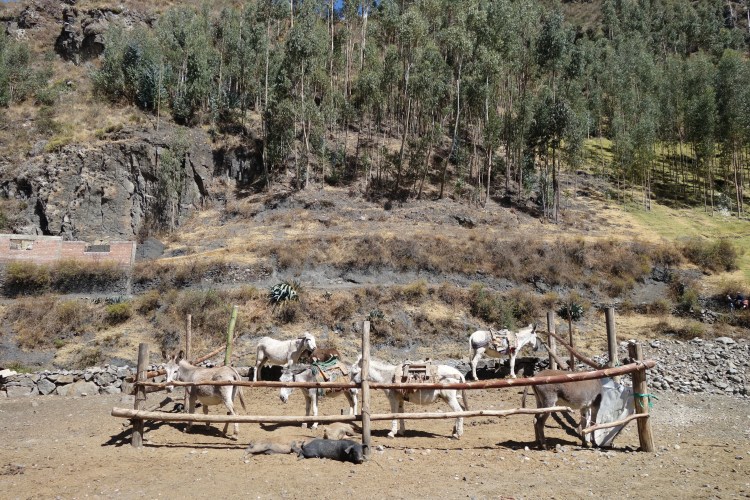
Overcome with déjà vu, I sat myself back on the step of the only building at the intersection, and again was approached by the old man who had directed me to Aquia less that 24 hours prior. I thanked him for his recommendation, and proceeded to demonstrate some of my dance moves from the fiesta, much to his amusement. As I contemplated my next move, trucks of various sizes raced past. Despite their abundant space for a boy and his bike, none of them seemed keen to halt their momentum, changing gears before commencing the climb to the top of the pass. Eventually, I managed to wrangle a lift with a group of guys travelling to Huallanca, the town in the adjacent valley which I had originally planned to wake up in that morning.
The three men, all dressed as police officers and driving a white Ute, labeled ‘Policia’, showed little hesitation when I approached them for a ride. Despite their accommodation, there wasn’t a single word shared during the 70km drive. As I climbed into the back seat, the officer opposite me nodded his head in acknowledgment and slowly reached his hand towards the guns and holsters lying on the seat that now separated us. He slid them closer to himself, keeping his hand firmly atop the weapons for the entire ride. Despite obviously following safety protocols, I prefer to believe that he thought I looked edgy and worthy of a few precautions.
Despite the lack of conversation, the atmosphere in the cabin was cranking. The more senior officer, sitting in the passengers seat, spent the drive maintaining a static free connection between his phone and a well loved auxiliary cord. As his young protégé in the drivers seat overtook trucks on blind corners, and spent a disproportionate amount of time in the wrong lane, the captain remained calm in his now semi-reclined seat, nodding his head to the music of Lionel Richie. Although we weren’t about to begin ‘dancin on the ceiling’, ‘all night long’, the tunes certainly set a particular mood for the journey. The speed with which we were taking corners eventually got the better me as I asked the driver if he could drop the pace. Unfortunately, he said I ‘can’t slow down’.
From the back of the police car I had a phenomenal view of the valley I had ridden down the night before. This time, the road was dry and the sunlight was striking the near vertical cliffs that hemmed the landscape. Still feeling a tad sheepish about my navigational mishap, I was able to recognise and appreciate the silver lining provided by this geological masterpiece. We eventually passed the turnoff to the Pastoruri Highway, signifying that the road ahead was now virgin territory. An equally impressive set of switchbacks on the other side of the pass delivered us in the town of Huallanca. We pulled up at a petrol station on the edge of town, where a subtle flick of the head from the captain indicated that my ride was over. I nodded back in silent thanks , grabbed my bike from the tray of the Ute, and rolled the remaining few hundred meters to the centre of town.
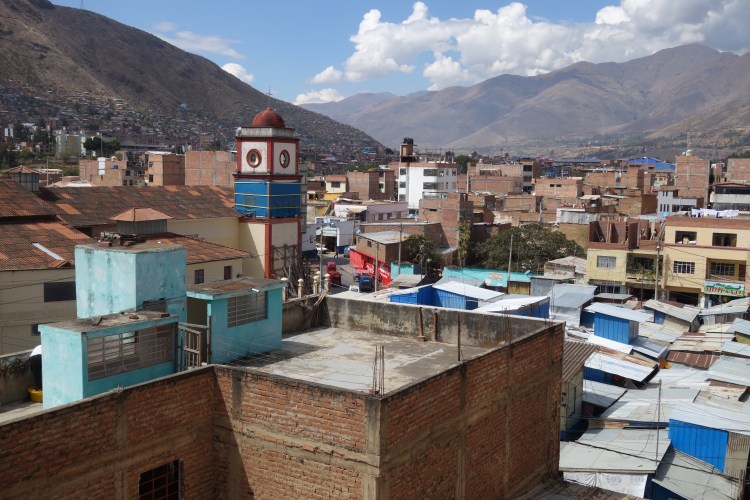
It quickly became evident that Huallanca wasn’t exactly on the gringo trail. As I sought out my next ride, my every move was followed by the curious eyes of townsfolk, young and old. The lack of tourist traffic through this colourful village was also made evident by the reactions I received when enquiring about how to reach my next destination. With the aim of reaching Huanuco by nightfall, and the expectation that it would require a single bus ride, the convoluted road network of central Peru served me up a sweet reality check.
I was told that I could definitely get a bus from the next town up the valley, La Union. However, getting there would require a collectivo. Upon approaching the first minivan, I asked if they were heading to La Union. My question was answered in the form of the driver snatching my bike and proceeding to haphazardly lash it to the roof of the van. Observing his suboptimal rope work from a quiet distance, I made sure to do a quick lap of the vehicle before we departed, adding a few extra hitches for good measure. In true collectivo fashion, we managed to acquire a merry band of 15 passengers over the short, 20km journey.
Dropped in La Union with my bike and bags, I began enquiring about the bus passage to Huanuco which I had been told was a sure thing. Upon reflection, the best way to fill your collectivo is by simply assuring potential passengers that all of their needs will be met. The collectivo driver who had promised there was a bus from La Union had been quick to take my money and return to Huallanca. I quickly discovered why. When I asked a few locals where to catch ‘the bus’, it was met with the same response; “No bus to Huanuco, only car. With bike, no car to Huanuco”.
Hmm.
Following half an hour wandering the single street of the town and plotting my next move, I met an old lady who was weaving a blanket and sitting outside a taxi depot. She ensured me that there would be a van to Huanuco at 3pm, leaving from this exact spot.
“Con bicicleta?”, I asked.
“Si, Si!” She replied with certainty.
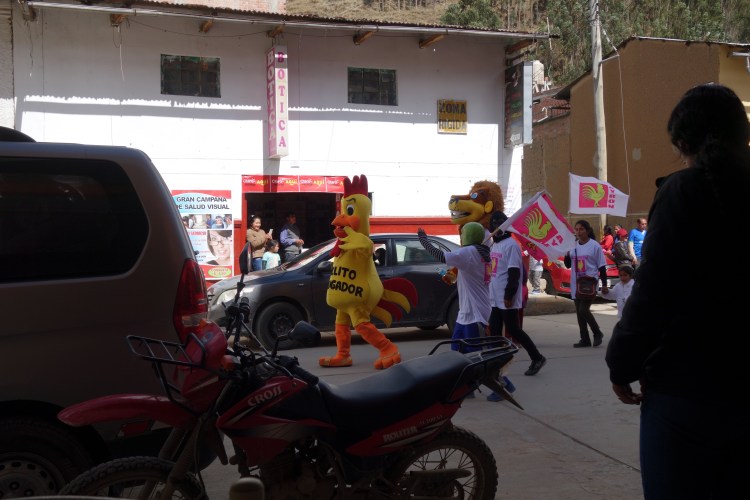
The clock had just ticked over midday. I stashed my bike at the back of the office and settled into a small restaurant which offered a cheap set menu and an uninhibited view of the proceedings on the street out the front. With the regional elections less than a fortnight away, the frequency of campaigning parades is increasing exponentially. Even in the relatively remote centre of La Union, the street was filled with vehicles sporting oversized speakers, leading a procession of flag bearing, passionate supporters. Generally, it is easy to identify the leader at the centre of the campaign. La Union left me baffled, however, as the demonstration was lead by a chicken.
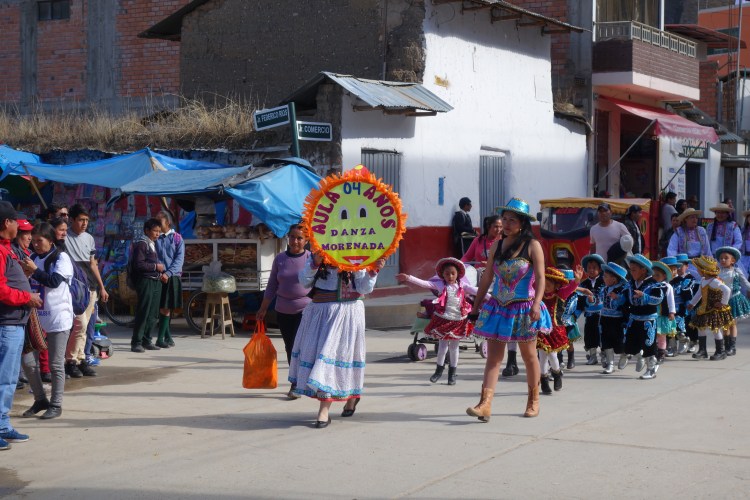
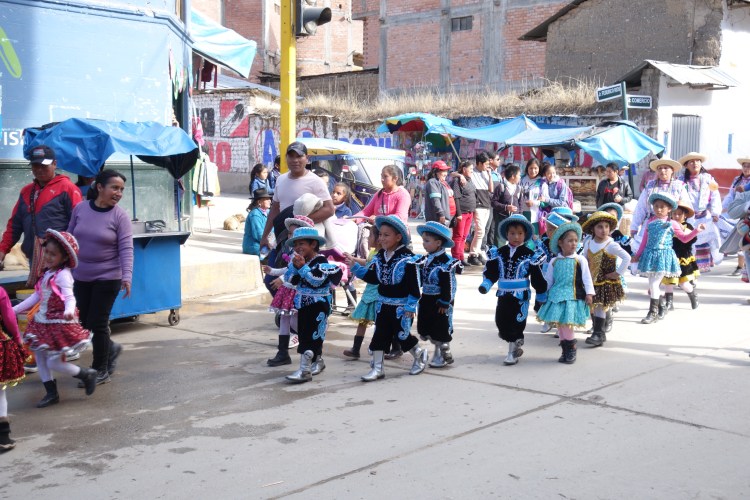
Following the poultry/politically-fuelled demonstration, I watched on as the town proudly presented their younger residents. A parade filed past, lead by a float ridden by the town’s five year olds, followed by the marching four year olds, then three year olds. Each cohort were adorned in vibrant traditional dress and sporting an equally impressive sense of pride.

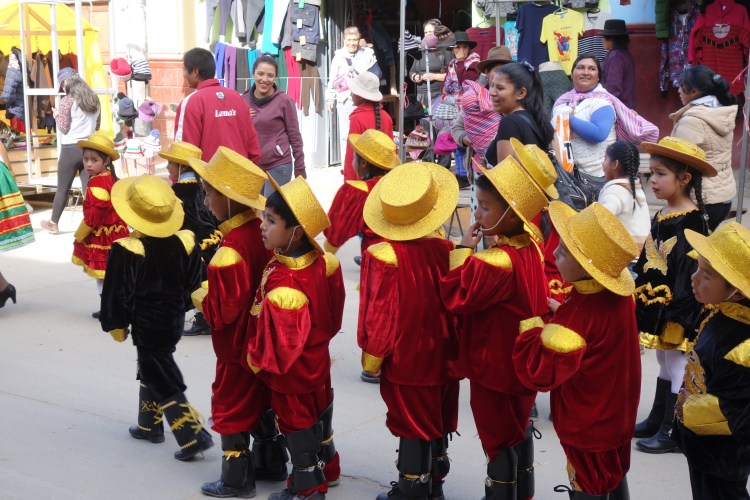
A touch before three, I arrived back to where the old lady who’s fingers were still buried in a skein of wool. I gently asked about the status of the 3pm van.
“No van to Huanuco, only car. With bike, double price”.
Given my requests and remote location, there was nothing that could be said. She had played me well; weaving wool and good deals with admirable nonchalance. Succumbing to the situation, I approached one of the drivers at the front of the depot. When he saw my bike, he held his palms up towards me, shaking his head in opposition to the idea. Fortunately, his more opportunistic amigo beside him scoffed at his lack of bravado, shoving him aside and accepting the challenge of transporting a seemingly lost gringo and his fluorescent bicycle.
The ingenuity that followed was impressive. Again, I watched on, forced to stand aside, as the driver placed a blanket and a spare tyre atop his sedan. He then processed to lash my bike to the roof with a worryingly fine spool of Spectra cord. He used various internal features of the car as tie-down points, before closing the doors and windows and standing back to admire his work. After giving my bike a few testing pulls and pushes, I too had to compliment the effort.
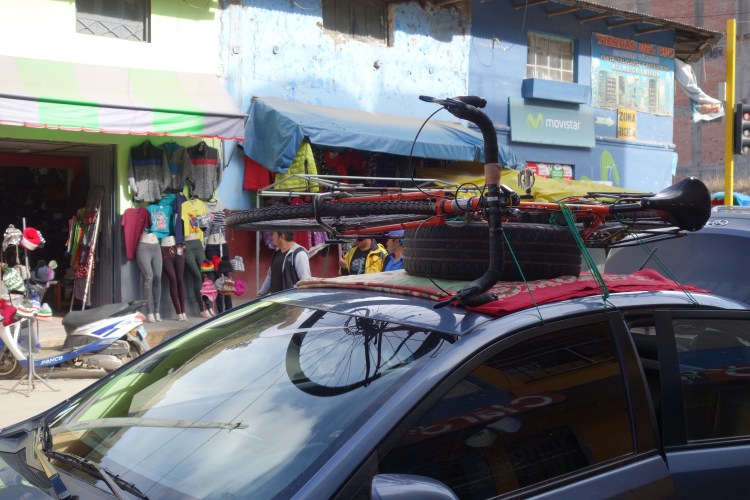
After half an hour the driver had managed to fill the other seats of the vehicle, and we hit the road. The route was phenomenal; narrow roads, an endless descent, hillside hugging communities, and wild rivers. It sounds like the perfect bike ride. However, after five minutes in the car I had lost all interest in riding in this region. Being behind the windscreen of a vehicle gave me an entirely new perspective of the perils facing cyclists on these roads. Despite the ever present and seemingly bottomless gorge only centimetres from the right tyres, the young driver appeared in need of an extra adrenaline rush. I doubt that he would have been of age to get a license in Australia, and if he did possess one, then it wouldn’t last long given his obsession of overtaking on blind corners. For the next three hours, I held on tightly, to both my seat and my breath. I made sure to regularly check my bike was still holding on too.
Night fell midway through the journey. The darkness and fatigued beam from the singular headlight simply added to the experience. The lights from Huanuco were visible for the last hour of the ride, as we made our way to the bottom of the valley. Albeit tempted to fall from the car and kiss the sweet concrete of the main plaza, I played it cool when we finally arrived in the centre of town. I thanked the driver, for the lift and my life, and went in search of some accommodation.
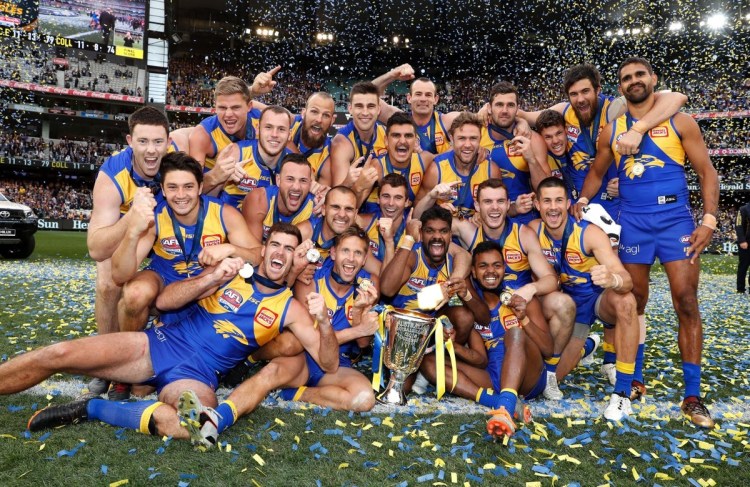
My prerequisites when it comes to somewhere to sleep are usually pretty simple; somewhere flat and dark. However, the night in Huanuco was different. I needed good wifi. At 1am, West Coast would be commencing their destruction of Collingwood ‘s hopes and dreams, and I made sure that I was tuned into the ABC radio broadcast of the historic event. It takes immense willpower not to devote a few thousand words to the emotions I experienced in the wee hours of my morning in Huanuco.
Bursting bubbles
Under slept yet still buzzing from the recent events on the other side of the Pacific, I strolled into town and purchased a bus ticket for that evening to Huancayo. With my time in Huanuco dictated by the imminent departure of the bus, I went about familiarising myself with the town. Settling into Café Arabica on the periphery of the the central Plaza de Armas, I spent a few hours attempting to do some writing whilst observing the daily happenings on the street in front of my seat. However, my time was absorbed by the owner’s charismatic and inquisitive children who were content with creating their own world on the floor beneath the tables. The challenge of humanely encouraging a rogue bee from the café provided endless entertainment. Eventually, the bee returned to the trees and bushes of the plaza, and I bid my now exhausted insect-wrangling comrades farewell.
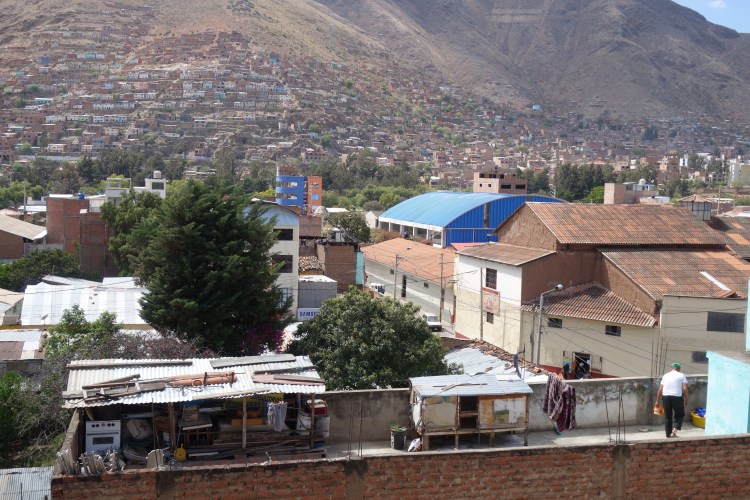

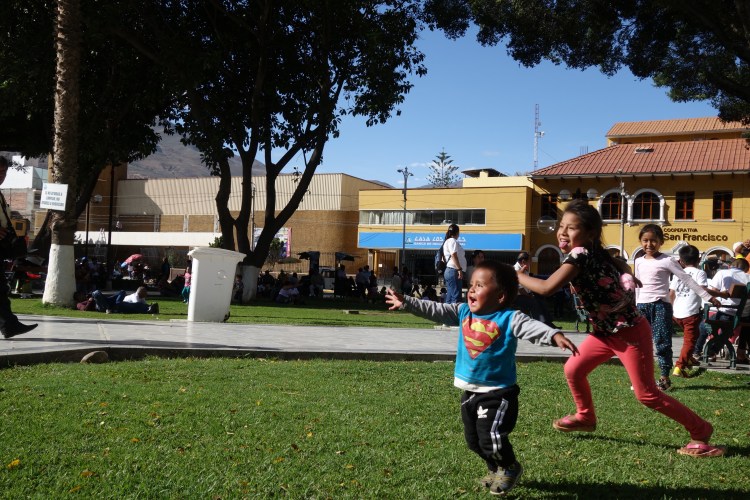
Whilst we were buried in the back corners of the café, avoiding the understandably irritated bee, an energetic crowd had developed in the plaza. Central to the conviviality was a festival-scale stage from which hung blue and white campaign banners and balloons, and enough speakers to make my eardrums quiver in fear. I found a tree to sit beneath, enthralled by a group of children who were entertaining themselves by blowing then chasing bubbles through the air. Their constant strive for a goal which only disappeared from their hands when they finally reached it was, in many ways, similar to the political hopes and dreams of their nearby parents. As the children ran amok in the background, the adults within the park were investing their energy in who they hoped would be a perfect government representative. But, as we all know with politics, once we finally get our hands on something that appears to be great, the bubble of pledges and promises often bursts and fades to nothing.
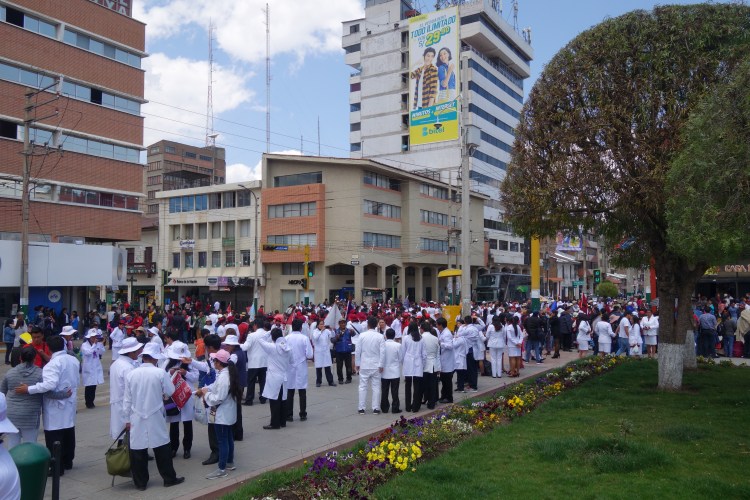
Following performances by various warm-up acts, the leader of the party, known simply as ‘Robinson’, was pushed to the centre of the stage in a wheelchair with his arms raised to the sky. I jostled for a position towards the front of the stage, immersing myself in a sea of waving flags and a chorus of chants lead by Robinson. The atmosphere was electric, however, after half an hour I needed to escape the repetitive and passionate chanting. Not entirely sure what Robinson and his party stood for, I silently wished him well for the remainder of his campaign. As I walked away from the plaza I passed dozens of campaign minivans which had been used to bus supportive followers (i.e. rent-a-crowd) into Huanuco for the day’s festivities.


Centre of the centre
During the night, the bus transported me into Peru’s Junín Region, and its capital city, Huancayo. Considered to be the cultural and commercial capital of the entire central Peruvian Andes area, Huancayo sits at an elevation of 3,271 metres. Arriving at the terminal at around 4.30am, I found a bench to lie on until the sun struck the valley. With the intention of breaking up the bus rides and exploring the greater Huancayo area, I had planned to spend a few nights in the region. However, during the night, as the bus bumped its way south along the roads of central Peru, I reflected on the direction I was headed.
In spite of the rapidly growing number on my odometer, and the vistas that will feed my memory for the rest of my days, there is still something missing. I’ve tried convincing myself that solitude will bring a strength of character and mind, which, in many ways has occurred. But, in this new found strength I’ve also been gifted clarity which has simply exposed my need for human connections. In the words of Murakami, “A person’s life may be a lonely thing by nature, but it is not isolated. To that life other lives are linked”. As I ride through the lives of people along the road, I feel an increasing desire to honour their connection to my life. However, at the core of human connection is communication, and, despite my efforts, I am still lacking the tool for this necessity; a shared language.
As Huancayo began to wake up, I found a café with wifi and commenced the search for a language course in Cusco. Instantly, I felt buoyed by this new purpose which would hopefully afford the connections that I feel like I am lacking in this journey. Within a few hours, I had managed to enquire about and secure a position at a Spanish school in Cusco, starting in a week. For the remainder of the day in Huancayo, I felt empowered by my assertiveness and recognition of my needs; two things that I don’t usually exercise perhaps as well as I should.

The remainder of my short stay in Huancayo was spent wandering the streets that surround the central Plaza De Constitucion. In the early 1930s, this once remote, central Peruvian outpost was connected to Lima by a railway. This new link brought with it various technologies, goods and services which, in turn, has lead to a rapid expansion of the metropolitan area in Huancayo. As a result, the aesthetic of the city is clearly divided between colonial buildings and more modern constructions. Despite the contemporary transition that has occurred, the region still holds great importance to many groups. Originally inhabited by the Huancas, the area was incorporated into the Wari Empire around 500 BC. Following an admirable campaign to defend their independence, the Huancas were eventually overrun by the the Incas, officially becoming part of the Incan Empire in 1460. Given its central location, the region became a significant stopping point on the Inca Trail. Following Spanish colonisation 1534, it wasn’t until 1572 that the city of Huancayo was founded and named the economic centre of the greater region.
In addition to its connection to Lima, and its continued importance as a regional economic centre, Huancayo also experienced significant growth due to recent internal migration patterns. Between 1981 and 2007, attacks from domestic terrorist group, Serdero Luminoso, saw people from the highlands and Amazonian lowlands flooding into relatively safe Andean cities such as Huancayo.
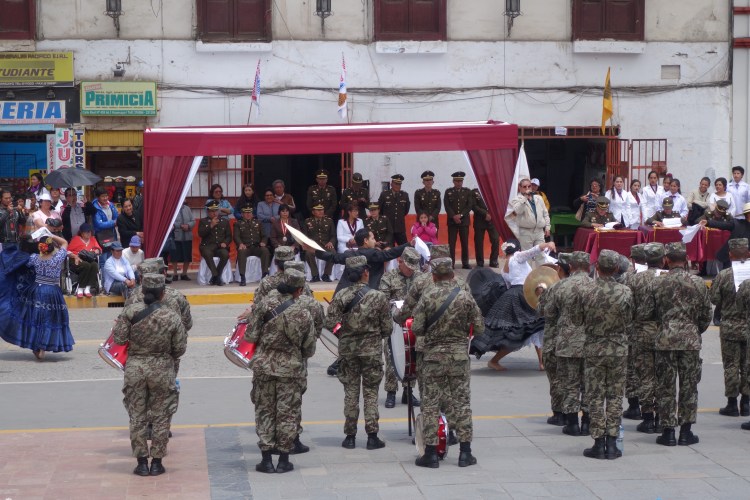
As a result of the rich and complex history in the region, Huancayo is now known for its various commemorations and celebrations throughout the calendar year. In keeping with this festive reputation, I was fortunate enough to witness the graduation celebrations for a local university. Over the course of the afternoon, graduates from various faculties were paraded down the main avenue, performing choreographed routines for the university’s upper echelon who sat expressionless in a marquee beside the road. Each group were greeted by their proud families in the plaza, which was filled with photographers and groups of classmates striking various celebratory poses.
Flamingoes, llamas and other tormenting visuals
Accepting the fact that my passage to Cusco would be aided by busses, I was determined, where possible to travel during the day. Although I wouldn’t be reaping the physical benefits provided by the severe undulations of central Peru, I didn’t also want to miss the visual feast on offer. Fortunately, there was a day bus from Huancayo to Ayacucho.
For maximum viewing pleasure, I had booked a seat at the front of the bus. After overseeing the handling of my bike as it was put into the storage hold, I climbed aboard and took my seat. Unfortunately, my good intentions had the door slammed in their face – literally. As soon as the bus took off, the driver shut a door dividing the cabin from the passengers, and pulled a curtain across the glass. My 180 degree view was instantly reduced to faded navy velvet. I still had the window to my left which at least provided the abridged version of the journey.
Within the first half an hour, I was privy to a minibus lying on its roof beside the road, as well as a larger tourist bus on its side in a ditch. I decided to turn inward for a while. Seated beside me was a young mother with her gorgeous son, Pierra. I quickly came to realise that this seating configuration meant we would come to know each other quite closely over the course of the day. Early on, Pierra needed his nappy changed, to which I can attest. Given the limited space, his mother bent him over her knee, going about the changing routine whilst his head lay in my lap. To distract the both of us from what was going on further south, I took to some nose-booping, which was received with excitedly giggling. I stopped when I realised that the stimulation might be leading to another, premature nappy change. Pierra’s mum spoke Spanish and Quechua, but was adamant that her son would only be spoken to in Spanish. In an overwhelming language exchange, we spent an hour or so comparing the English, Spanish and Quechua words for everyday objects and features that passed the bus window. The two of them eventually fell asleep, leaning against me. I took the liberty of moving to the free seats across the aisle, where I settled in for the rest of trip, totally absorbed by the passing landscape.
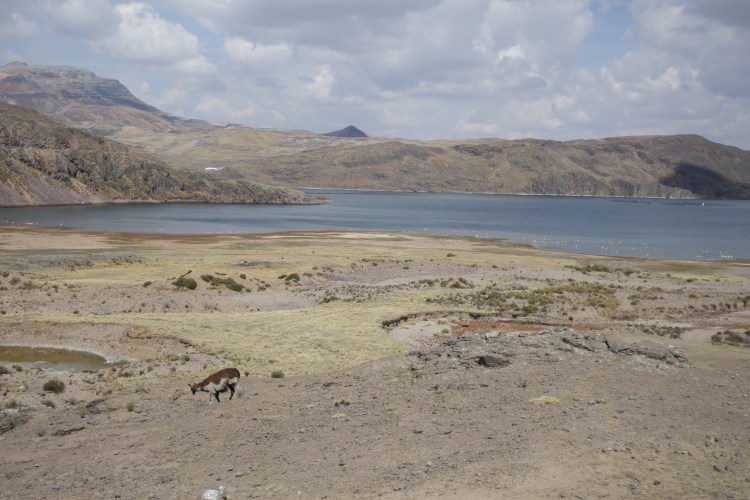
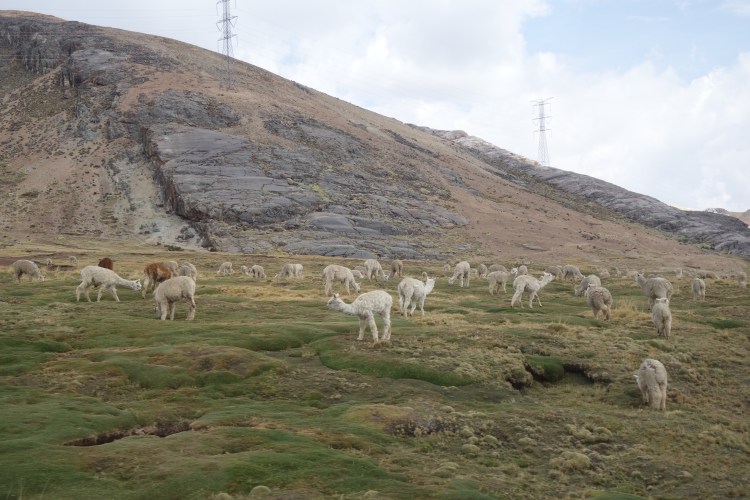
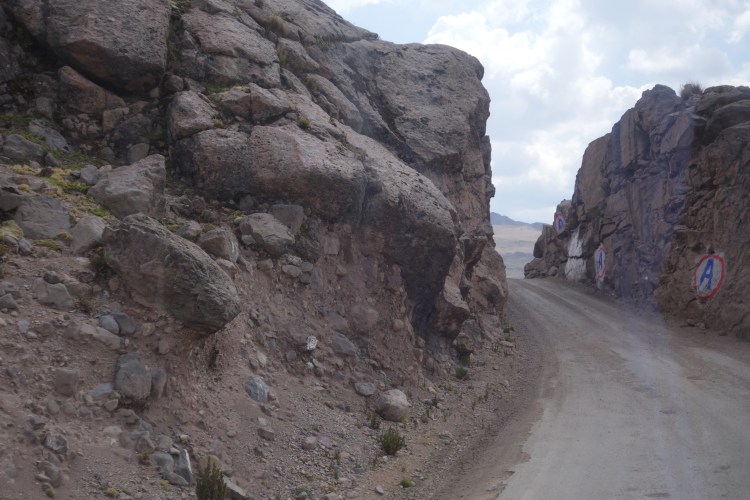
Following a seemingly endless descent, the bus climbed back out from the river valley passing through multiple geological zones. Road cuttings revealed abstract dips and strikes in the bed rock, providing an insight into the immense forces that had shaped the landscape. Once back at the top of the gorge, the road continued to climb, albeit at a much more relaxed gradient. In gaining elevation, there was a reciprocal loss in roadside vegetation. For the majority of the journey, the bus passed through barren antiplano, inhabited by dense herds of grazing llamas and alpacas. In rounding the southern end of a large lake, spotted with trout farms, I caught my first glimpse of a bird that has fascinated me for years; the flamingo. Despite being quite a distance away, they were unmistakable in how they waded the shallow edge of the lake.
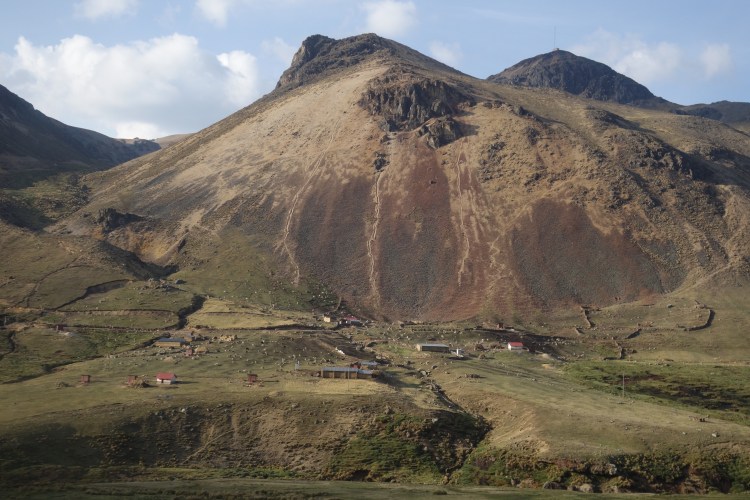
The last few hours of the ride were idyllic. The fading sunlight lit up the limestone ridge tops as our course was dictated by a serpentine river, shaded by stands of eucalypts and pines. As darkness fell, a thick cloud blanket tucked the valley in for the night.

Writing in retrospect, it is easy to simply illuminate the beauty of the journey and finish with a full stop. I guess the selection and omission of certain details is the ultimate liberty granted to the writer. While the views from the bus were sensational, the biggest mountains of the day were seen when looking inwards.
For the ten hour bus ride, I tortured myself. Every sun kissed hillside, clear stream, demanding climb or exhilarating descent, flooded me with feelings of failure for being inside a bus. My conscience spent the day in a constant cycle of feeling like I’m wasting this opportunity I’ve created, to being ok with taking the bus. If my brain was a bicep, the intense repetition would have caused in to pump out in the first hour of the journey. I was involuntarily punishing myself for not fulfilling the expectations that only I have created for myself. For so many years I’ve hidden behind this idea of a long distance cycling journey, and in many ways have defined myself by the concept. Throughout the day I rode an uncontrollable wave of emotion, that dumped me, exhausted, on the streets of Ayacucho. Beneath the surface, I guess I have been expecting some profound developments from this undertaking. The reality is that I’m getting some answers to questions that I don’t think I ever really wanted so conclusively.
In the same vein as a wild winter bush walk in the Tasmanian highlands, it didn’t take long to forget the internal hardships of the bus ride. Thoughts of frozen fingers, stinging cheeks and horizontal sleet, were replaced with the vivid recall of swirling flurries of soft snow and fresh wombat tracks. After finding somewhere to sleep in Ayacucho, I walked towards the central plaza, inviting myself into the opening of an art exhibition. The watercolours of Jesus Fernandez Obregon depicted various landscapes from throughout the Peruvian Andes, with the common factor that they all exist above 4200m. I became lost in the washed vistas, making comparisons with my own interpretation of the landscape. Interestingly, it was irrelevant as to whether I’d experienced these vistas from the saddle of my bike, or the seat of a bus.
“A town that has no memory of its history is doomed to repeat it”
Ayacucho is somewhat infamous for its unfortunate position at the centre of Serdero Luminoso’s domestic violence in the 80s and 90s. As a result, and in contrast to Huancayo, any potential development and growth in Ayacucho was halted. A silver lining of being left in the past is that the city is still brimming with colonial architecture and various traditional practices flood the sidewalks. Despite being warned that I might encounter a rare species in Ayacucho known as a ‘gringo’, the city seems well positioned to experience a boom in tourism in the coming years.
Having booked an overnight bus ticket to Cusco, I made sure to maximise my time in Ayacucho. Only metres from the door of the hostel was the city’s tourism office. Stopping briefly to pick up a map of the town, I was also asked to fill in the visitor log. Despite the colonial quirks and charms of Ayacucho, my name was one of five that had been entered in the last week. Wandering the streets further emphasised that, for whatever reasons, Ayacucho remains relatively void of travellers.
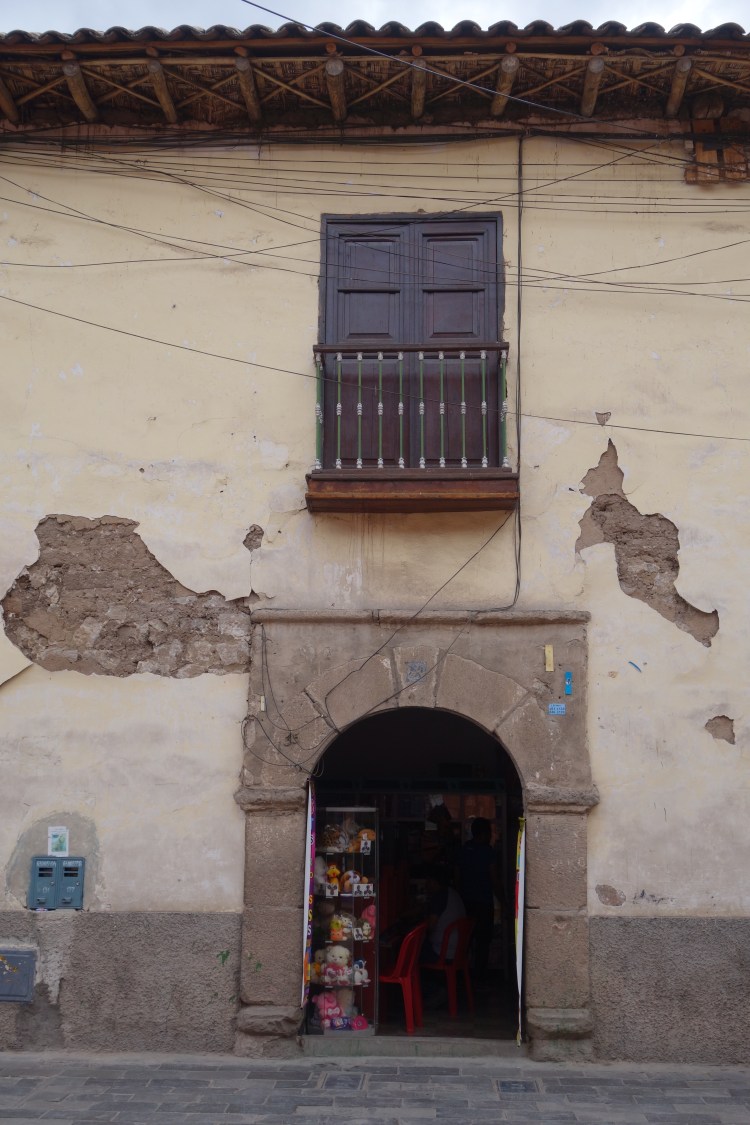


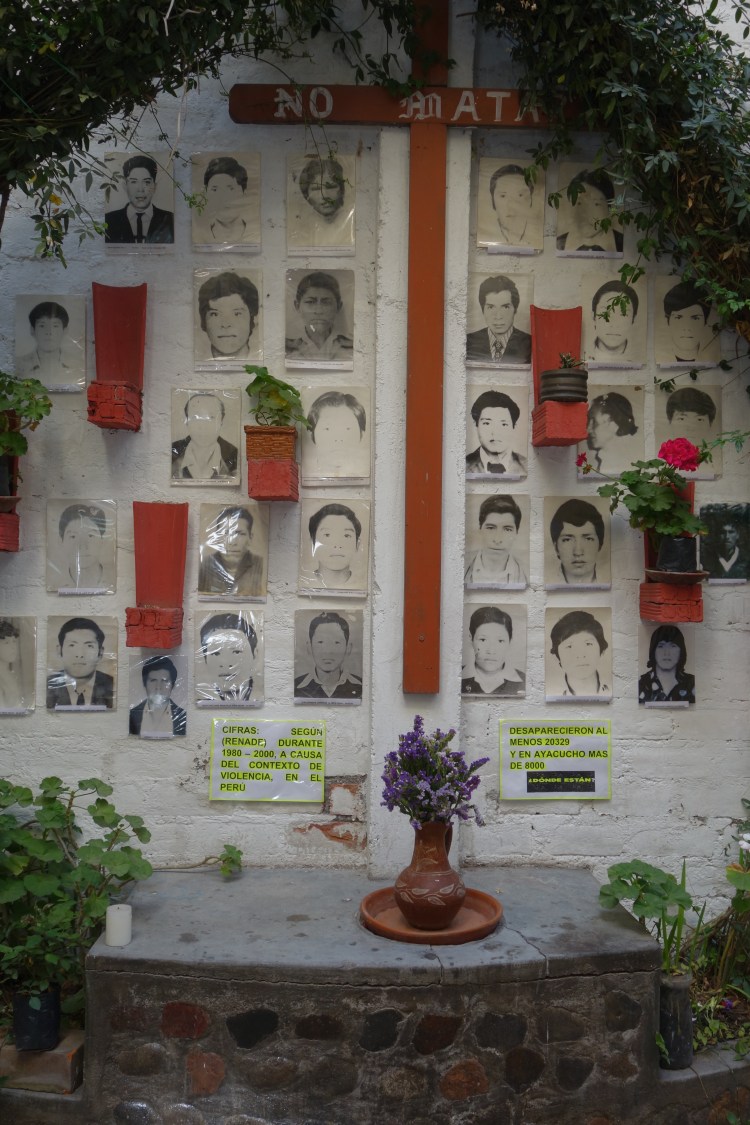
I spent the duration of the morning wandering the streets between Ayacucho’s 33 churches (one for each year of Jesus’ life). Each colonial façade and set of heavy wooden doors seemed to hide secret interior courtyards, giving the city a fantastical feel. Following a set lunch in an enormous mess hall where conversation and live music bounced of the walls, I made my way to Museo de la Memoria. Established in memory of the devastating impact that Sendero Luminoso had on the city, and Peru in general, the rawness of the displays throughout the three storey museum provide a moving experience, to say the least. Painted in black letters above the entrance were the words, “A town that has no memory of its history is doomed to repeat it”.
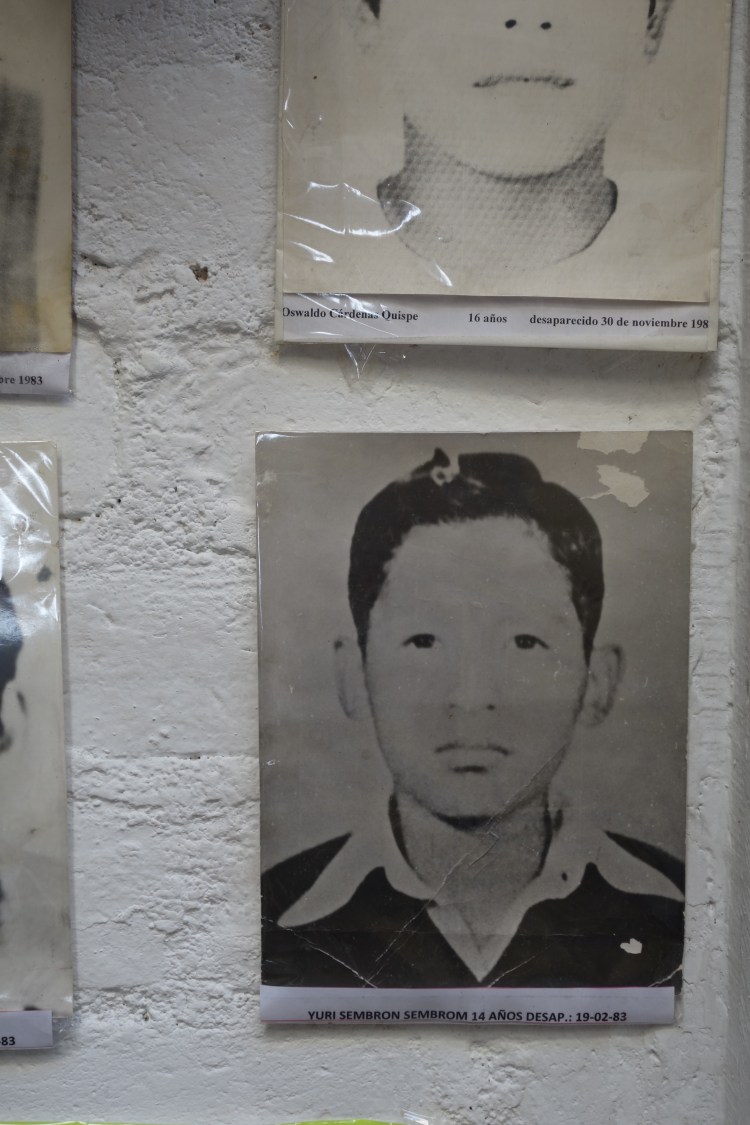
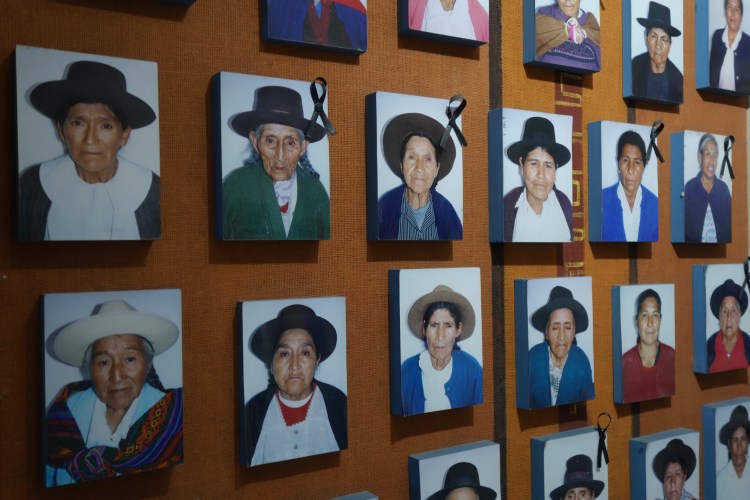
Upon entering, I was greeted by a wall of black and white photographs of the ‘disappeared’, labelled with their name and age. Disturbingly, the majority of these faces belonged to children and teenagers. Equally as confronting was a entire wall on the top floor of the museum, covered in the faces of mothers who had children killed during the decades-long conflict. Albeit entirely in Spanish, the various displays and presentations spoke a universal language. Replica torture chambers, mass burial sites, and torn clothing recovered from discovered bodies, rounded out the experience. As I left the museum, I thanked the two ladies who were sitting at the front desk accepting the entrance fee and selling postcards. I later learnt that the volunteers at the museum are the mothers of children lost, who have since devoted their time to ensuring that history doesn’t repeat itself.

As darkness fell over the colonial streetscape, now lit by an orange hue from streetlights, I made my way to the bus terminal. Desperately hoping to managing some sleep over the course of the final bus trip to Cusco, I unfortunately remained wide-eyed. For the duration of the journey, the bus rolled from side to side as it tackled the turbulent terrain. Every hour of lost sleep was a constant reminder of this vast, twisted, and humbling landscape that I found myself passing through.
Thanks for reading.
 Faults and Folds