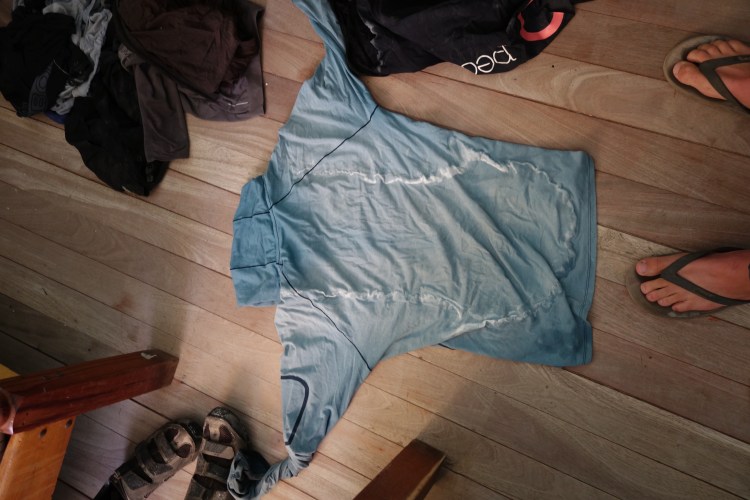
My eyes were slow to open on the first morning in Uyuni. The dry air and intense glare of the salt of the salar had left them looking, as my dad would say, like ‘piss-holes in the snow’. I had found a small, cheap hostel on the edge of town the night before and had seamlessly slipped from my riding gear into a deep sleep. Unfortunately, my much needed rest was cut short. The truck driver I was sharing a room with decided to accept a phone call at 4.30am. The whispered conversation quickly escalated into a heated argument. I tried, to no avail, to communicate my frustration through purposeful leg thrashing and aggressive sighing. When he eventually decided to end the call, or perhaps was hung up on, he effortlessly returned to a snoring slumber. At 5.00am, the local ticket sellers began their work for the day on the street below the window. Each available bus route from Uyuni was being spruiked by a different voice, each competing for business by alternating the pitch, intensity and duration of their calls. Like a silent lyrebird, I lay in the darkness learning and mimicking their voices until to point of near breaking. When I finally sat up in bed, I discovered my roommate lying awake, resting on an elbow and staring at me with a smile; the final straw. I pried open my swollen eyes and added ‘farmacia’ to my ‘to-do list, hoping some drops would ease the dryness. Pulling on the only ‘clean’ items left in my bag, I bundled up the remaining sweat and salt-caked clothing and headed out in search of a laundry.
Considering the desolation of the surrounding landscape, Uyuni appears wildly out of place. However, it doesn’t take long to realise that the mirage-life city plays an integral role in sustaining Bolivia’s economy. Home to roughly 30,000 permanent residents, Uyuni is the site of a major railway junction, serving lines from Chile, Argentina and the capital, La Paz. In addition, around 60,000 tourists each year use Uyuni as the stepping-off point for their adventures onto the salar. This industry appears to run the town with 4WDs outnumbeingr people. The influx of English speaking tourists is also having an observable impact on the streetscape of Uyuni. It’s as though the local council have informed shop owners that they will generate more business if their name clearly communicates, in English, what they are selling.
“There is a website called ‘Google Translate’. Type in what your businesses specialises in and use the English translation to attract customers. Easy!”
The ploy worked on me. I started my morning in Uyuni at ‘Hot Coffee House’ and ended the day at ‘Extreme Fun Pub’, indulging in a few cold sundowners.
Following a mug of strong black coffee and a plate of scrambled eggs, I resumed my search for a laundry. After a few false-leads I eventually discovered the heavy wooden doors of the local laundromat, which opened before I’d even knocked. A short, older man welcomed me inside, beaming with pride because I had selected his services. If only he knew what was lurking in the bag I was carrying. My initial shock at the cost of laundry was quickly subdued by some rational thinking; I was basically in a desert, asking for a service which required excessive water. Conflicted yet desperate, I handed over my stiffened, crusty clothing and headed back out into the dusty streets.
The most pressing job for the day was waiting for me back at the hostel. Looking at my bike, I could almost hear the built up layer of salt eating through the steel frame. I was worried that the thick white crust was the only thing holding my bike together and that washing it would leave me with nothing but two wheels and a seat. I picked off as much of the salt by hand before before rolling out onto the street in search of a hose.
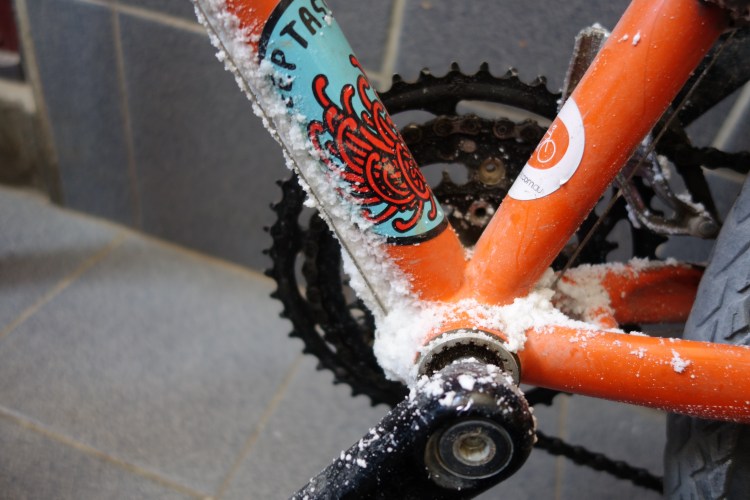
The process of seeking out a water source became almost primal. Like the Bolivian adaptation of Hansel and Gretel, vehicles carrying water would leave a trail of drops, starkly visible upon the dry, dusty roads. Sometimes I could follow these leads for a few hundred meters before they heat of the day caused the evidence to vanish. After half an hour of relatively aimless riding, I noticed a gleaming wet Jeep dive past. Retracing its path took me to the edge of town where a line of tour vehicles were parked beside a petrol station, waiting to use the town’s only high pressure hose. In preparation for my turn, I removed the wheels and chain from my bike ready for a fast and efficient once over. When I was passed the hose, I quickly got to work spraying and scrubbing in an effort to remove all of the corrosive salt from the smallest corners of the frame and chain rings. I was clearly a point of interest for the drivers waiting in line to wash their 4WDs, as I quickly attracted a crowd of men and began fielding questions of how much my bike was worth. Feeling slightly uncomfortable and well too aware that I couldn’t get away quickly while my wheels were lying next to the bike, I politely deflected their queries and cleaned as efficiently as I could. Fortunately, my bike was still in one piece below the salt. Once I was done with the hose, I turned into a finely tuned one-man pit crew, threw my bike back together, and raced back towards the centre of town leaving my own trail of water on the road.
Back at the hostel, I swapped my bike for maps and a notebook before heading out again with the intention of planning the next leg of riding which would carry me all the way to to Chile. The sun had fallen out of view and the street lights were beginning their evening struggle of waking up. Whilst the ‘Extreme Fun Pub’ didn’t sound like the most conducive place for route planning, the name did suggest the possibility of a little socialisation which was an equally pressing matter. Unfortunately, on this particular evening ‘extreme fun’ mustn’t have been what fellow weary travellers were seeking as the bar was devoid of patrons. In retrospect, it could also have been due to Coldplay’s ‘Greatest Hits’ which were spilling out onto the quiet street. The only other people inside were the matriarch of the pub and her young, heavily tattooed barman. They sat on stools in the corner of the room engrossed in the music and occasionally walked across the room to tap a flickering lightbulb back into place. I took a seat at one of the tables and almost toppled backwards as the legs of the chair sunk into the deep layer of salt crystals covering the floor. A quick scan of the drink menu revealed a host of unique cocktails, ranging from ‘Llama Sperm’ to ‘Sexy Llama Bitch’. Whilst I’m sure these concoctions would have eventuated in an extremely fun night, I opted instead for a beer which was served to me in a one litre vessel.
Looking at a map, Uyuni lies deep in the southwest of Bolivia. The obvious line into Chile follows the main road east; a distance of roughly 300km from where I was to the border. Despite the appeal of smooth, sealed surfaces, I had become increasingly aware through conversations with other travellers, that the region to the south of Uyuni possessed some of the wildest landscapes on the planet. Further research revealed that this high altitude plateau, pockmarked with turquoise lakes and sunburnt summits, is considered by many as one of South America’s greatest off-road journeys. Known as the ‘Lagunas Route’, the network of roads from Uyuni to the Chilean town of San Pedro de Atacama promised several days of challenging terrain. Every blog I read seemed to contradict the one before, leaving me in a cloud of doubt about whether my gear was suitable or if it was even possible on bicycle. After much deliberation, washed down with the confidence provided by a litre of beer, I set my mind to the task ahead. Studying the map, it appeared as though I had a hundred odd kilometres of riding before turning off the sealed road. This would allow me some time to refine my plans and conjure the motivation that the Lagunas Route demanded. I left the bar humming Coldplay’s ‘Paradise’; a hopeful omen for the days ahead. A rough calculation showed the entire route to be around 500 kilometres. On my way back to the hostel, I dropped into a small convenience store and picked up enough chocolate biscuits, pasta and sardines to five days which, at the time, seemed like a conservative allowance.
Gone with the wind
Leaving Uyuni was hard. Once again I had been woken by the ticket sellers. This prompted me to get up and begin packing my gear in the pre-dawn darkness. Enthused by the adventure ahead, I was eager to make an early start. However, I quickly discovered that the universe had other ideas. As soon as I began pedalling, my bike took over and steered itself back to ‘Hot Coffee House’. As expected, the coffee was hot and strong. The scrambled eggs were creamy and the butter was handmade. I finally rode out of town at 11am.
Navigation was simple. From Uyuni, there were two options; left to Argentina or right to Chile. After a quick stop at a gas station to fill up my fuel bottle, I turned onto the Ruta 5 and began heading east with my sights set on the town of San Christobal for a late lunch. It came as no surprise that the main highway in this remote corner of the earth was in a state of disrepair. However, with a stiffening breeze on my back, the task of dodging potholes did little to dampen my spirits. The road stretched out before me following a line of tired, sagging power lines. The distant salt flats caused the horizon line to tremor as the day warmed up.
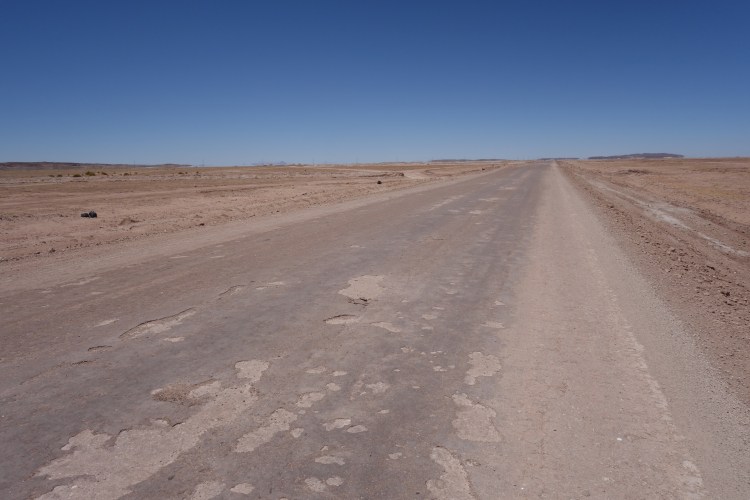
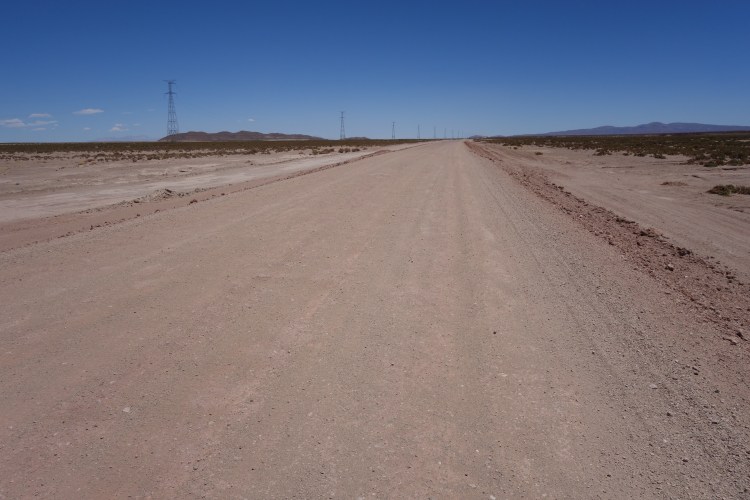
I stopped after 60 kilometres to make the most of a concrete wall beside the road. Crouching to escape the wind, I filled my stomach with fresh bread and jam which I had picked up on my way out of Uyuni that morning. The influx of carbs, combined with nature’s hand firmly on my back, were enough to carry me the next 30 kilometres to San Christobal.
There was a surprising number of people milling about in the street for a town that appeared to be quite isolated on the map. It didn’t take long to realise that this was a stop over point for tour groups returning from their journeys around the salar. Seeking shade, I sat on the ground outside the town’s market place. Tourists flocked in and out, returning with bottles of coke and water before loading back into the 4WDs which lined the street.
With little on my mind beyond rehydrating, it was a while before I noticed a man pacing closer and closer to my bike. When our eyes eventually met, the elderly local gentleman shot me a toothless grin and an emphatic thumbs up. I returned a smile which he took as an invitation to sit down and sidle up beside me. He introduced himself as Primo and proceeded to take great interest in my beard, giggling as he continuously attempted to touch my face. He also took great pleasure in laughing at me for wanting to cycle to Chile on my own. As the jeeps came and went, my proximity to Primo meant that the wary looks of tourists were directed at both of us sitting on the ground. Over the next 20 minutes of laughing and beard stroking, I developed a strong sense of solidarity with my new amigo.
When I had arrived in San Christobal my plan had been to ride a further 20 kilometres to the next small town and call it a day. But, with coke (the brown liquid) flooding my veins and an ever-strengthening tailwind, my enthusiasm was buoyed. Another 60 kilometres would deliver me in Alota; a hamlet marking the turnoff to the Lagunas Route proper and the end of sealed surfaces for the foreseeable future. Following a final farewell with Primo, I rolled out of San Christobal at 3.45pm.
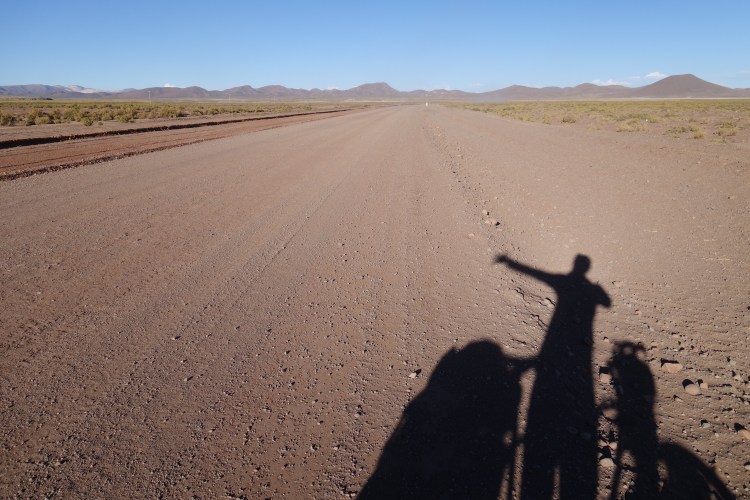
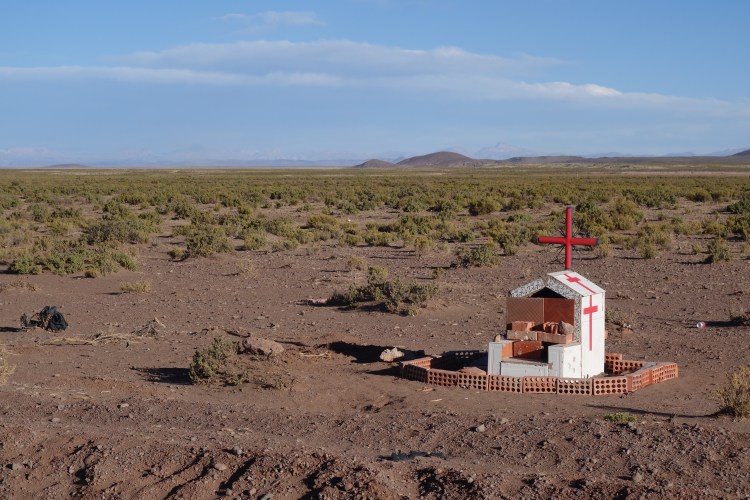
The first hour of riding after lunch was exactly what I’d hoped for; smooth, swift and sunny. With half of the afternoon’s distance under my belt, my mind turned to planning dinner. However, it was as if a higher power decided to teach me the lesson of ‘don’t count your chickens before they hatch’ or, in my case, ‘don’t eat the pasta before it has boiled’. In a matter of minutes the dynamic of the day changed entirely. As I was grinding up a small rise, a passing truck kicked up a stone which hit me square on the kneecap, drawing blood and and causing me to drop the bike and hop around like I’d kicked a tow ball. There was a sharp pain when I tried bearing weight so I pushed my bike the rest of the way up the hill. Just as I was about to saddle up again and roll down the other side, I was hit in the face by the afternoon’s next big surprise.
It was as though the world was just a globe on someone’s desk and they had decided to give it a quick spin. In the time it took to put on my helmet, the wind swung an entire 180 degrees. There were no significant landforms or encroaching weather systems to explain the change. It was simply like someone had decided I’d been doing it too easy and they wanted to see me dance for my dinner. The breeze which had pushed me all day from Uyuni was now doing everything in its power to stop me getting away.
The remaining 30 kilometres were a grind. I struggled to get my bike speed above 10-12km/h. The extra effort required to move forward quickly exposed how fatigued I was actually feeling. I considered camping on the exposed antiplano but a quick look at the way the wind was shearing through the tussocks suggested there was little chance of achieving much sleep in a tent. When the sun eventually fell over the horizon I discovered that my rear taillight was in desperate need of charging. It was a matter of minutes before the final skerrick of battery life had been sapped and I found myself riding along Bolivia’s most southerly trucking route without anything to warn drivers of my presence. Maintaining forward momentum had been challenging enough in the wind. However, when I had to begin stopping and getting off the road whenever I heard a vehicle approaching from behind, the riding reached a whole new level of demoralisation.
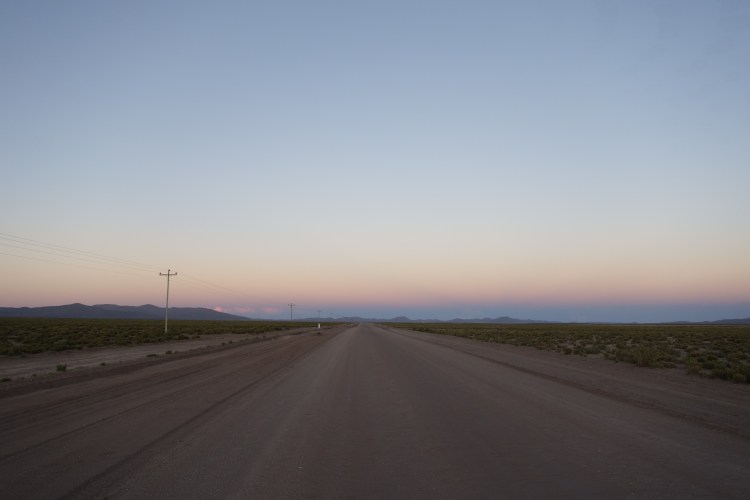
After 15 kilometres of stop-start riding in the dark, I finally saw the lights of Alota in the distance. It was 7.30pm when I arrived on the edge of town. Despite a considerable number of buildings in the town, very few were showing signs of life from within. My initial intention had been to find an accommodating local who might let me pitch my tent in the lee of their home. However, the first dwelling I saw with lights on inside conveniently happened to be a small hostel. When I knocked on the door, I was immediately led around the back to where I could leave my bike for the night. The owner, a stout older woman, seemed a little impatient as she waited for me to hurriedly unpack what I would need for the night. Clutching a bundle of gear in my arms, I chased her inside and upstairs, passing an extensive number of empty rooms. I can only assume that it is the low season for tourism, otherwise the hostel is definitely banking on a future boom in the industry. For whatever reason, the owner had a very specific room in mind, leading me to the end of a corridor where she stopped and proudly extended her arm prompting me to feast my eyes on the ‘deluxe suite’. Two single beds sat opposite one another, wrapped tightly in matching Rugrats quilt covers. As I was about to bid her goodnight and collapse onto the mattress, she announced that dinner would be served in in 20 minutes. Considering the distinct lack of guests on the premises, I felt an obligation to accept her hospitality. I cleaned myself up, fighting the temptation to lie down, and headed down to the kitchen.
The dining area was somewhat palatial with a high ceiling and sparkling tiled floor. However, the pastel green plastic furniture was a strong reminder that I was still in Bolivia. Surprisingly, there was another couple sitting at one of the many other tables. Peter and Paula, from Germany and Czechia respectively, were on an eight-day private tour of southwest Bolivia . Their sole objective was to climb as many volcanoes as possible, which seemed to be going relatively well based on their stories of summits, sunrises and only the occasional bout of altitude sickness. Their appetite for strenuous activity had clearly taken its toll on their guide, who was asleep at a nearby table. Peter worked as a banker and Paula with an NGO. In Paula’s words, her job offsets Peters’s capitalism so everything is ok. They asked if I was a millionaire being able to travel for five months. It’s a pretty accurate way to describe how I feel some days out here on the bike.
We chatted for the next hour or so as we navigated the food on our plates; mushy quinoa, topped with a slab of nondescript meat, washed down with a much more palatable bowl of fresh vegetable broth. As Peter and Paula were about to head to bed, they came over to my table and told me that they’d asked their guide about the route I planned on taking to the Chilean border. Expecting some advice or recommendations for the route, I sat to attention.
‘It sounds as though it will be very, very difficult’, Peter said with a concerned look on his face. ‘And, our guide wishes you luck.”
A second breakfast
Perhaps it was strange meat I’d eaten that evening, or maybe the 150 kilometres I’d ridden during the day, but I slept like a teenager. What felt like two minutes had actually been nine hours. I straightened the bed, packed my bags and headed downstairs to load my bike. The lady in the kitchen gave me a few bread rolls which paired perfectly with the jam I had in my pannier.
As I repacked bags, loosening and retightening straps, I became aware of my disjointed and jittery movements. I knew that the turnoff to the Lagunas Route was only a few hundred metres down the road, marking the beginning of several days in the harshest corner of Bolivia’s weather gnarled landscape. Thankfully, my trepidation was put on hold when I noticed another cyclist approaching along the main street. He rolled up to the hostel and propped his bike against the front of the building. The gravitational pull of another two-wheeled traveller was too much to resist and I made my way over with my bike.
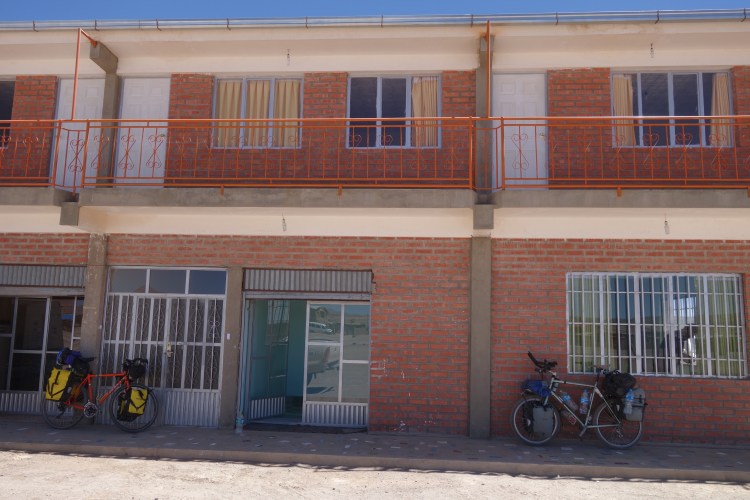
Standing well over six feet tall, the man leant forward and clamped my hand in his vicelike grip, introducing himself as ‘Wolfgang from Innsbruck’. Gauging by his weathered features and the way he had to look down at me over the glasses on the end of his nose, I put him at around 50 years of age. He told me that he had seen me pass by the night before in the dark from where he was camped. I was relieved to hear that he had experienced an extremely windy and disturbed sleep. However, his justification for stopping a few kilometres before Alota was music to my forever hungry stomach. He said that he always likes to camp on the outskirts of a town as it means he can have two breakfasts; one at camp and then another at a bakery an hour later. I knew we’d get along well.
I sat with Wolfgang as he finished his second breakfast, pretending to understand the route he was planning to take when in reality I had no idea what lay ahead. However, we managed to establish that our immediate plans for the day were the same and decided to ride on together. I waited for Wolfgang to call his wife who was at home in Austria; a non-negotiable. This is apparently a non-negotiable daily requirement whenever he is travelling. After he hung up, we straddled our bikes and rolled towards the outskirts of Alota where we reached a junction marking the beginning of the Lagunas Route.
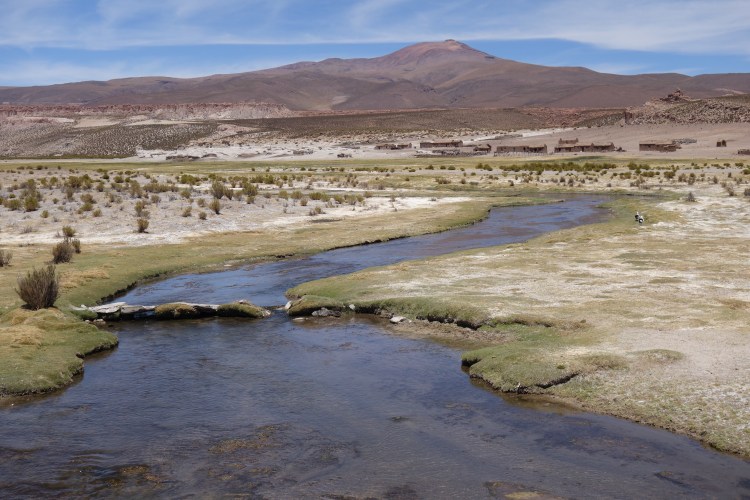
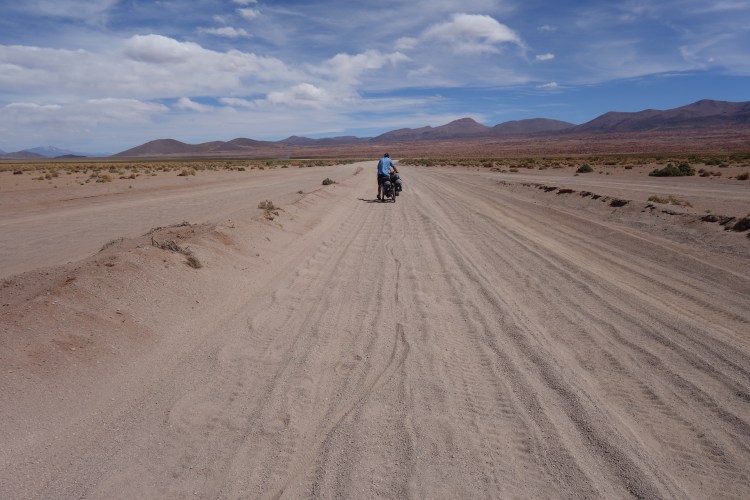
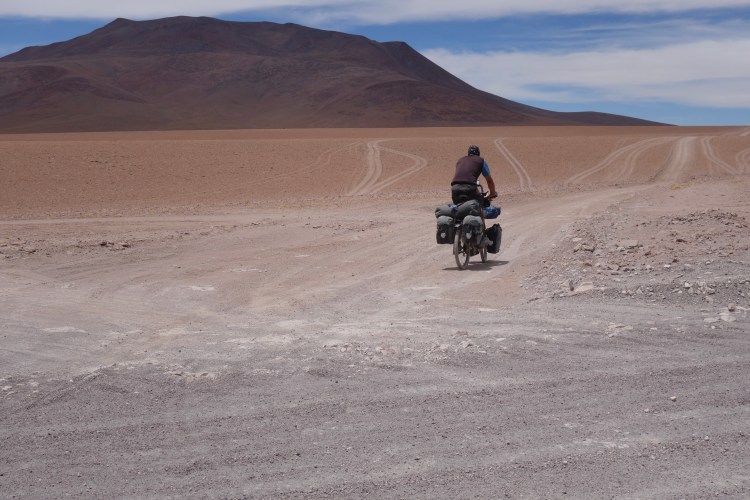
Within minutes of leaving the last sealed road until Chile, it became evident that the next several hundred kilometres were going to be tough. Our tires sank below the rims in the soft sand making it impossible to gain any momentum on a fully loaded bike. Fortunately, the novelty of the experience was enough to maintain our enthusiasm and resilience, at least for a few hours. The sandy road had been eroded to the width of a five lane highway by vehicles seeking the path of least resistance. We spent the morning doing exactly the same thing. Naturally gravitating to opposite sides of the road, we poured our energy and focus into trying to link up patches of hard-packed sand. We shouted gleefully to one another whenever we managed to string together a few metres of sustained pedalling. This would often lead to the other person optimistically, and somewhat desperately, crossing sides in the hope of enjoying the smooth riding on offer. More often than not, any length of easy riding would culminate in ruts of deep sand causing us to lose any control of our front wheels and end up standing over fallen bikes. Looking back down the road from where we had come, the crisscrossing tire marks told an elaborate story of struggle and failed circumvention.
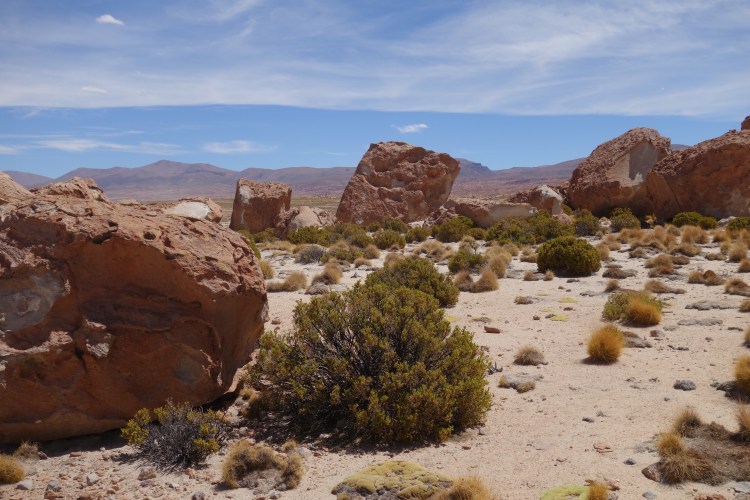
After three hours of ‘riding’ we had only managed 15 kilometres. A rocky outcrop beside the road presented the perfect opportunity for lunch, providing us with some reprieve from the wind which had stiffened considerably over the course of the morning. Tucked in amongst the boulders, we sat and ate in silence. Given the unexpectedly slow progress of the morning, I thought it best to begin rationing my supplies and only eat half of what I usually would for lunch. The morning had proved that it is pointless to calculate times and distances from a line of a map if that line is painted with deep, soft sand.
From our vantage point amongst the rocks, we noticed a growing number 4wds. The vehicles created long, straight clouds of dusts across the horizon as they hurriedly ferried groups of tourists between sites. Once back on our bikes, it didn’t take long to develop a deep fear of these vehicles. The strong wind whipping across the plains blocked out any other sounds. As a result, the first indication of an approaching vehicle was when it sped past within arm’s reach, leaving us in a cloud of shock, fear and dust. Fortunately, the quality of the roads improved over the course of the afternoon and we managed far more time in the saddle than walking. The barren landscape gave way to impressive ochre-stained cliffs to the west and the occasional oasis of green grass and clear pools of water, providing further distractions from the tedious riding.
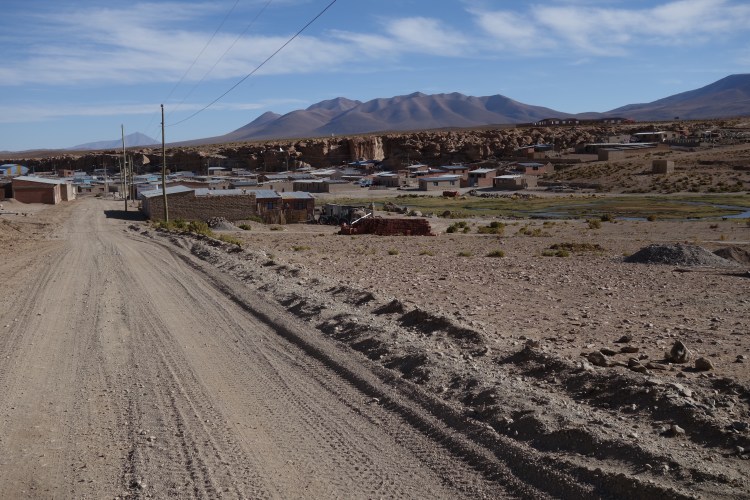
It was late in the afternoon when we first laid eyes on the settlement of Villa Mar. The town was nestled into a small canyon with the earthy coloured dwellings camouflaged amongst the rock formations. If it weren’t for the occasional corrugated iron roof reflecting in the afternoon sun, I feel as though we could have passed Villa Mar without noticing. Initially, we began looking for campsites on the edge of town to maintain Wolfgang’s double breakfast philosophy. However, it didn’t take long to realise why Villa Mar was hidden amongst the rocky gorge a few kilometres further down the road; it was the only feature in the surrounding landscape offering any protection from the wind.
When we eventually rolled down into Villa Mar, it was surprising to find a number of accommodation options. A handful of 4wds were parked outside each building with the tour guides busily unloading gear from the rooftop cages and attending to any mechanical issues that had arisen during the day. We managed to find a room for the two us for a grand total of 40 bolivianos ($8 AUD). After spending an hour or so sponging ourselves free of the dust and trying to clear our eyes of grit, we wandered throughout the town in search of some food in the hope we could save what we had in our panniers for the coming days.
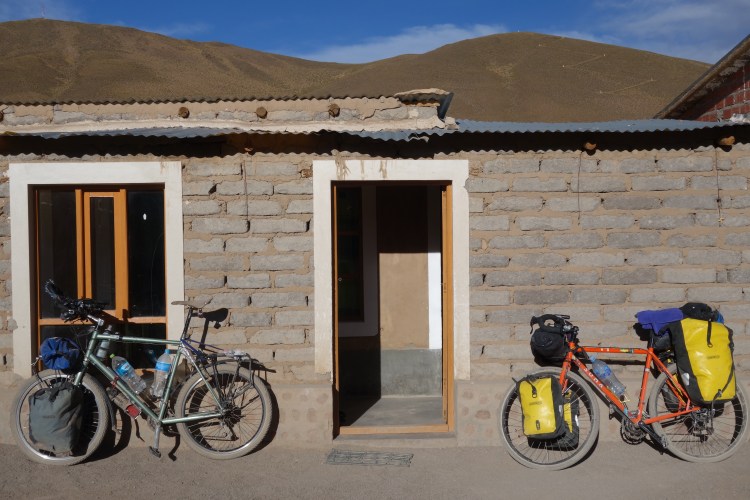
Over a meal of chicken and rice, Wolfgang and I were able to have our first lengthy conversation for the day. At 58 years old and standing at 6 feet and 7 inches, his physical presence and anecdotal wisdom were inherently engaging. The cold beer in his right hand appear novelty sized as he practically inhaled several plates of rice. Between serves of food, Wolfgang explained how he combines his profession as a furniture maker and artist with his passion for exploring the world by bicycle. His experiences and observations during extensive travels throughout Asia, Europe and Africa have woven themselves into his designs. Specialising in steel furniture, his designs clearly reflect both the harshness and subtlety of the landscapes he has cycled through. I could tell from the way he scanned every scene and building that his perspective of the world was constantly evolving.
In addition to taking ideas from his time abroad, he has also spent taking his art on the road. In 2012, he dedicated a year to cycling from his front door in Innsbruck the entire way to Laos. He used this journey to complete a project titled ‘Track Marks’. Carrying small squares of white card embossed with the pattern of his rear tire tread, he would get everyone he met to write their name and a little bit about themselves on the piece paper. He would then ride over each piece to create a location-specific ‘track mark’. He collected 300 cards along the way, using them to develop a visual representation of the connections between the people he had met and the places he had visited. In the first few weeks of this 2012 journey, Wolfgang was contacted by a university in Innsbruck asking him if he could also collect small soil samples each time he completed a track marks card. In the years following, these samples were incorporated into various research projects by microbiology students at the university. The results of these studies have since deduced that soil variation around the world is declining as a result of globalisation and increased travel.
I spent most of the evening listening to Wolfgang’s tales of travel and trying to understanding his varied and diverse philosophies about life. As the beers kept coming, Wolfgang’s attempted Spanglish became increasingly cringe worthy. His favoured method of communication with the locals was simply raising his voice, applying a Spanish lilt to English words and using wild hand gestures. His token efforts were emphasised by the fact he was almost twice as tall as the locals, naturally standing over and talking down to them. It quickly became clear that his favourite icebreaker with the local women was to call senoras, senoritas. This would make the older ladies retreat into a giggly state, to which he would turn to me and say, ‘all ladies like to be told they look younger’. I would nod my head in obligatory acknowledgement, smiling uncomfortably and pretending to count the loose change in my wallet. An hour or so after we had finished our meal, the owner of the restaurant began vigorously cleaning the surrounding tables; a less-than subtle suggestion that it was time to leave. We took our time wandering back to the hostel, watched closely by small children with dusty faces.
We were woken the next morning by the sound of the tour vehicles starting their engines. It had been discussed over dinner that early starts were necessary to avoid the predictably strong afternoon winds. After quickly packing our bikes, we rolled back to the restaurant where we’d had eaten the previous night, indulging in another hearty meal of chicken and rice. An egg on the side indicated that this was the breakfast menu. Several instant coffees later, we were ready to see what the day ahead had in store for us. We had tried talking to some of the tour guides at the hostel, however each seemed to have a different idea regarding the quality of the road where we were headed. I was followed out of town by a playful young dog with piercing blue eyes and equally sharp puppy teeth.
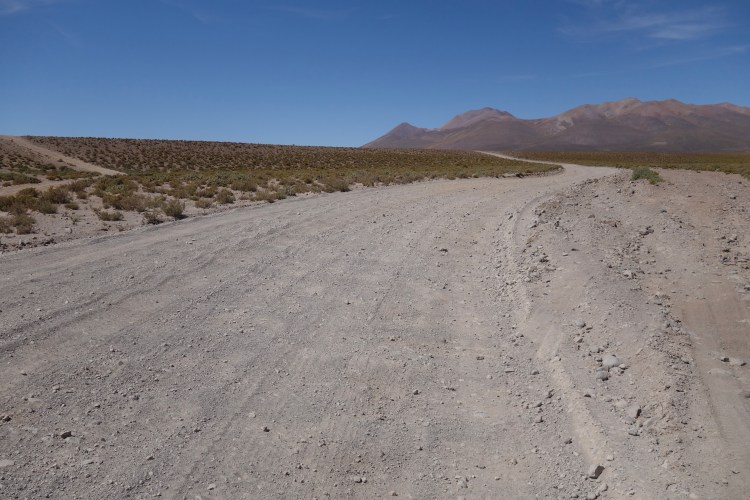
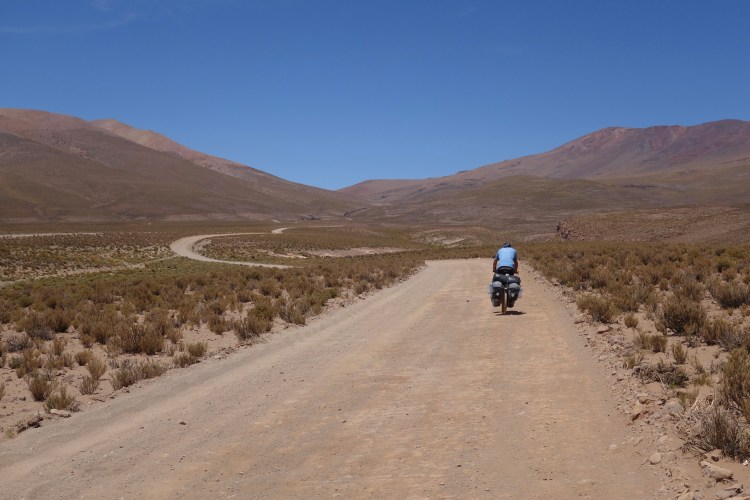
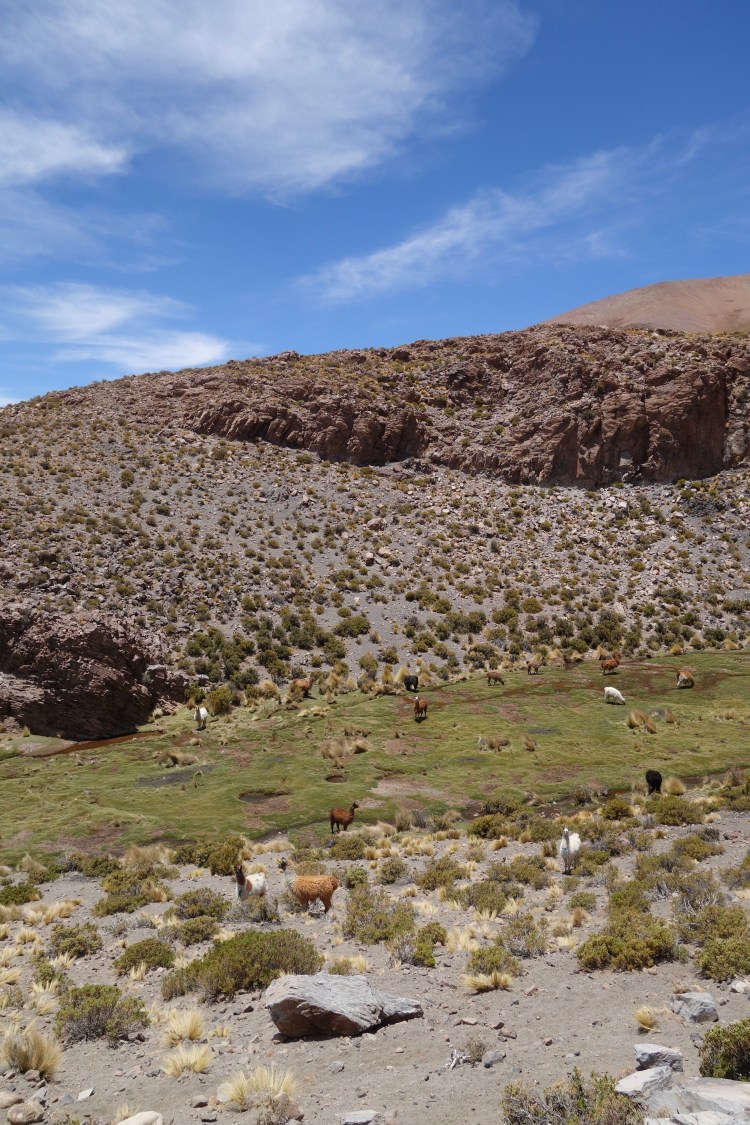
The road out of Villa Mar followed a small stream and some grazing llamas. The quality of riding picked up from where we had left it the night before. Weaving our way south along the road, we quickly became separated by a few hundred metres as we continued our search for the firmest surface. We’d been on the go for a few hours by the time I caught back up with Wolfgang. The wind had made its presence known causing course sand to sting the backs of our legs. We sheltered behind a small stone wall eating bread and jam and trying to avoid discussion about our agonisingly slow progress. If I had been on my own, I likely would have lay down and slept for the afternoon. In retrospect, I wish I had as the riding only got more challenging.
The kilometres ticked by sluggishly. The soft sand turned into coarse gravel, which then became small rocks. Corrugations in the road were truly bone rattling. For the first time in the last few months I began to dread the thought of any downhill. The heavily-laden steel frame beneath me was unforgiving over the rough terrain. We passed a lone cyclist from Argentina heading in the opposite direction on his way to Mexico. Looking at the state of his gear and the expression on his face, it was evident that the riding ahead wasn’t going to be getting better any time soon.
We passed through a lush canyon scattered with brown, white and tan coated llamas. The density of these animals emphasised how few places there are in the region that provide adequate shelter for man and beast. Reluctantly, we left the relative sanctuary of the canyon and commenced a long, grinding climb into a relentless headwind. There was a jeep parked at the crest of the hill with a group of tourist huddled in the lee of the vehicle to stay out of the wind. We asked them what the condition of the road ahead was like but they all claimed they had been asleep for the entire drive. Despite the lack of progress we were making and the sheer difficulty of the riding, it was satisfying to think how intimately we were acquainting ourselves with this remote corner of the world. Even though we didn’t feel alone given the number of tour groups on the road, we did get a sense that we were experiencing the Lagunas Route in a unique fashion, getting to know each rock and corrugation along the way.
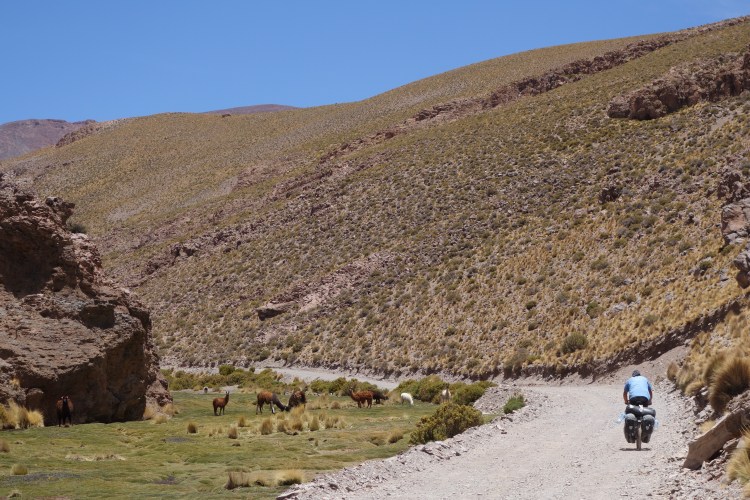
The afternoon only continued to serve up struggle; deep sand, headwinds, and 4wds showing little regard for cyclists. At one stage, I noticed a group of approaching motorcycle tourists on the horizon. As they got closer, I readied myself for a rest and some conversation with fellow overlanders. However, within seconds they had sped past without making eye contact. I looked at Wolfgang in disbelief to which he responded with, ‘typical’.
‘You see’, he explained, ‘those guys on motorbikes think they are having the adventure of a lifetime, living life on the edge. But when they see us on pushbikes, they realise they are not so tough after all. They are just intimidated by us.’
He told me later that this was a theory he formulated whilst cycling through central Asia. He described how he had developed a very negative relationship with motorcyclists as they rarely ever acknowledged people on two wheels without an engine. He went on to explain that his current theory helps him maintain a positive attitude towards motorcycle tourists when he is travelling. It was a strange display of empathy but I could see where he was coming from. There is a lot of time to dwell on small things whilst riding. Especially on days as mentally corrosive as the one we were having.
It was late in the afternoon when we came to the edge of Laguna Capina; a vast salt flat with sporadic pools of wind-lashed water and tall mounds of salt. A rusty processing plant stood on the shoreline indicating an industry of some sort. Given the large piles of salt dotted around the laguna, it appeared that either salt itself or another buried mineral was the sought after commodity in the region.
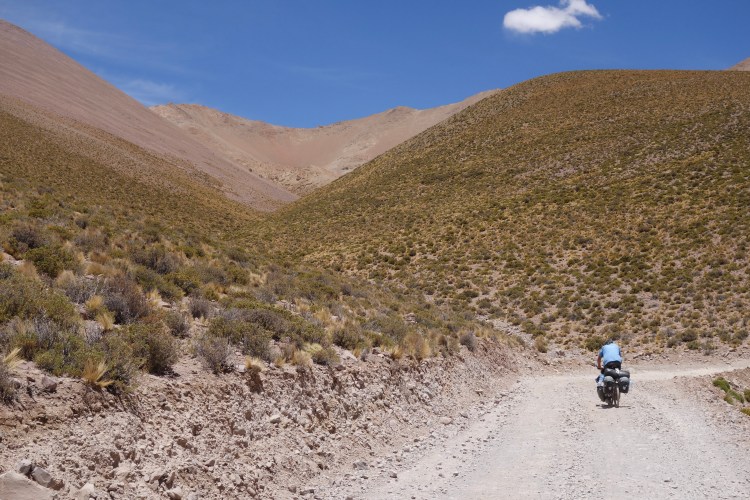
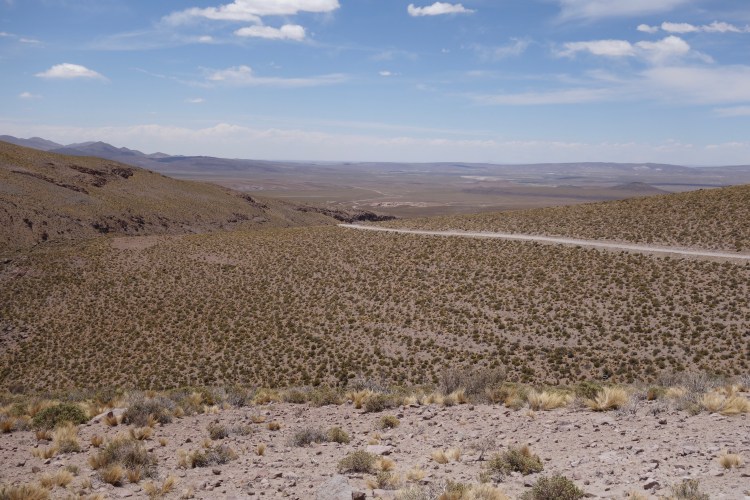
After 5 hours of ‘riding’ time, we had covered a grand total of 34 kilometres. The road ahead dissected a relatively featureless landscape. Grinding onwards into the relentless wind was something that neither of us were eager to pursue. The sandy ridge to the west of where we stood was scattered with windswept tussocks and low lying rock formations. To the fatigued cyclist, these features stood out as opportunities for a sheltered camp. We pushed our bikes through the sand and went in search of suitable sites to pitch our tents.
Wolfgang boiled some water for a quick packet soup before retreating into his tent for the evening. It was only 5pm so I tried to stay on the outside of the canvas for a little while longer. Crouched behind a rock, I ate some pasta and looked ashamedly at my poorly pitched tent, which sagged and lashed about in the breeze. As the sun dropped over the western horizon, shadows lengthened and the air began to chill. I was in bed by 7pm, where I looked over some photographs from the day only to discover that a slow crash from earlier had left a black spot on the sensor of my camera. My disappointment was dissolved by fatigue as I fell asleep with ease to flapping canvas and a very cold face.
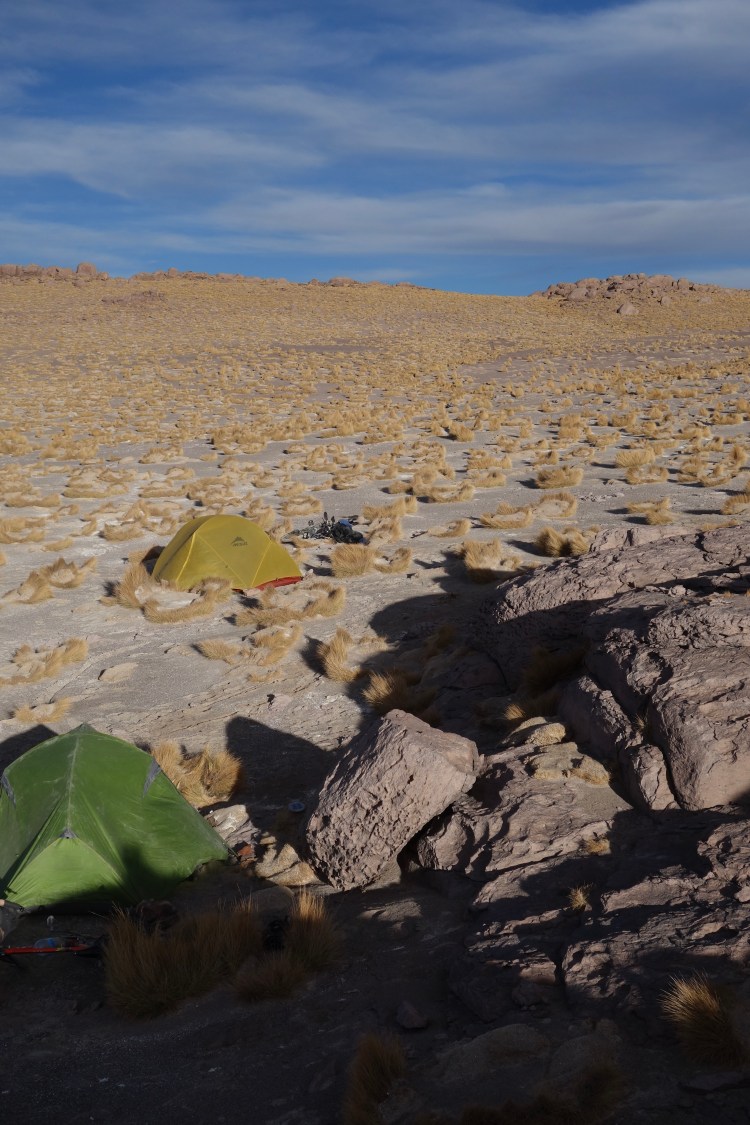
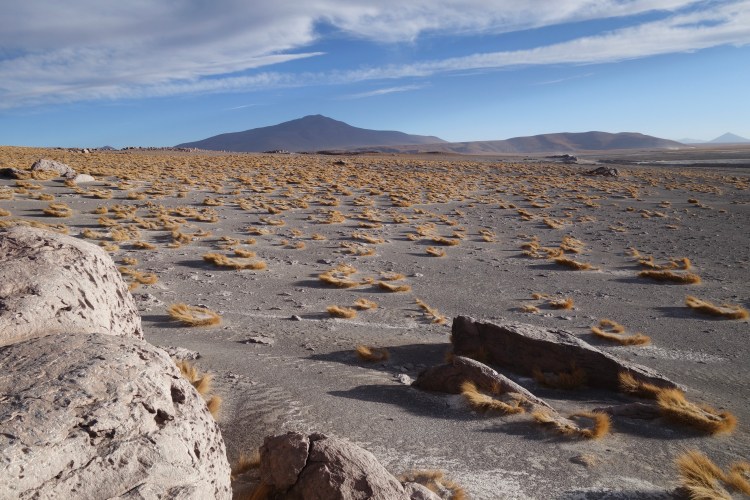
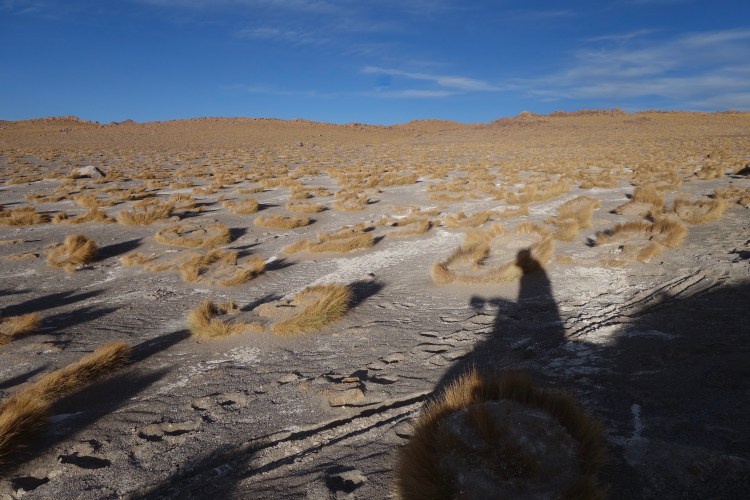
The following morning delivered frozen water bottles and a reluctance to get out of my down-filled cocoon. I lay motionless until the sun hit the tent, before unzipping the fly to reveal another still, cloudless morning. Wolfgang sat by his half-packed bike sipping coffee. It went without saying that I was the one dragging the chain. A few sweet coffees and a bowl of porridge later, I started to feel a little bit of energy flood back into my body. By the time I was packed, Wolfgang had been waiting patiently for almost an hour, pouring over his maps and trying to devise a plan for the day ahead.
From our camp, it was only a few kilometres of easy riding before we arrived at the official entrance to the National Park; Reserva Nacional de Fauna Andina Eduardo Avaroa. It was a bittersweet moment. A sense of achievement at reaching this point was matched by the trepidation of what was to come if the last two days of epic riding were just to get to the entrance. The National Park office was situated in the old salt refinery, where we were greeted by a jubilant lady named Roxanna. Adorned in traditional Bolivian fare, Roxanna’s hand was never far from the bag of coca leaves that hung from her right shoulder. She made us some tea whilst breastfeeding her two-month old daughter, Geraldine. Once the child had finished feeding, she was swaddled tightly before being swung onto her mother’s back in one smooth yet unnerving motion. We finished our mugs of tea, paid our entry fee to the National Park and each accepted a handful of coca leaves for the road, hopeful that we would experience their energising properties.
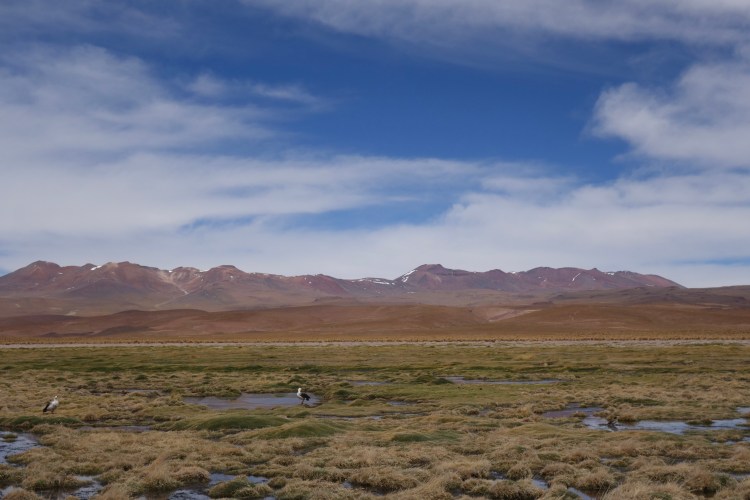
It was quickly evident that our park entry fees weren’t being put towards road improvements. Over the course of the morning we rode, pushed and struggled onwards and upwards. Flocks of Andean Geese watched us closely, more out of bewilderment and curiosity than fear. Patches of remnant winter snow increased in frequency as we climbed higher. With a notable increase in altitude, my tolerance towards 4wds rapidly decreased. I tried to distract myself with the views that were revealed with every additional metre of elevation gain. White, blue and pink lagunas dotted the landscape, with jagged rocky escarpments bursting from the plains to the south.
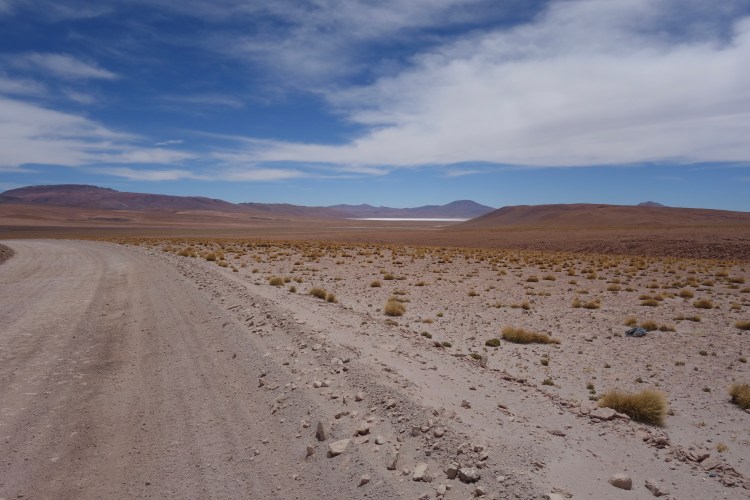
As we continued to climb, Wolfgang became fixated on his GPS. He began regularly shouting altitude updates into the wind which had now well and truly awoken from its morning slumber. He was clearly trying to distract himself from the trying conditions, however I distanced myself to avoid further irrational frustration. When I caught back up, Wolfgang was crouched behind a small rock wall at the junction of two roads that fell off the ridge in opposite directions. As I sat beside him to shelter from the wind and catch my breath, he announced that we had just reached 4800m. This explained my irritability and fatigue. In the same breath, he also mentioned that we had reached the place where we’d be parting ways. As I came to terms with the sudden loss of a riding partner, he explained that he was almost certain the road to the east was the he needed to take to get to Quetena. It was from Quetena where he would try to climb a volcano he had been told about by an Argentinian man he had met in Kyrgyzstan. I struggled to understand his rationale but accepted the fact we all have our own reasons and narratives for the paths we choose to take. Following a brief, yet heartfelt goodbye and the exchange of personal details, I sat and watched Wolfgang roll over a series of sandy undulations before dropping over the horizon and out of sight.
Solo, again
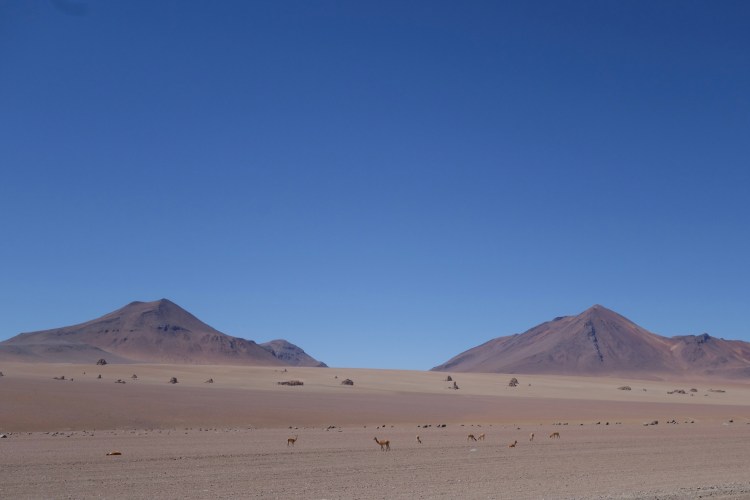
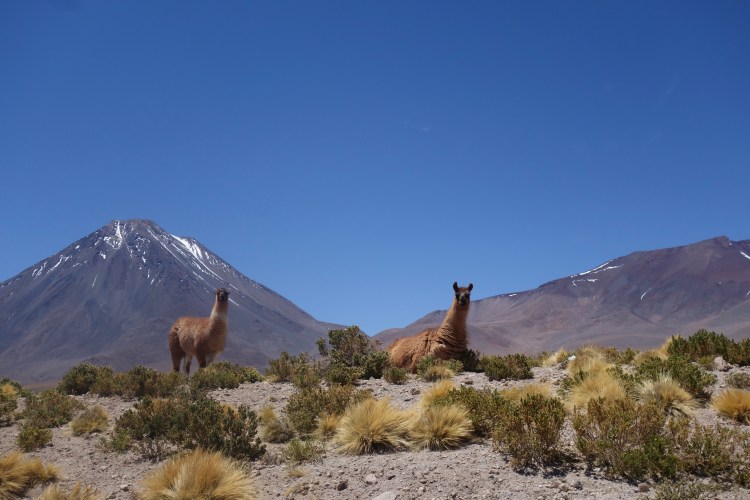
From the junction, the rocky road continued climbing to a maximum altitude of 4900m. Having ridden continuously uphill for three hours, reaching the top was an underwhelming affair. As I crested the rise it became obvious that we had been riding in the lee of the hill for the last few hours. I excitedly began the descent only to realise the full brunt of the southerly gale which rendered the riding as laborious as it had been coming up the other side. The road was corrugated, rocky and generally soul destroying. Taking my eyes off the road resulted in bone jarring collisions with potholes. To take in my surroundings I was forced to come to a standstill, relinquishing any momentum that I had managed to develop. Fortunately, the scenery over the course of the afternoon was nothing short of otherworldly. Pyramid-like peaks rose from the high plains, banded with earthy, vibrant tones as though a rainbow had fallen from the sky and stained the sand. Bouncing along the road, I spooked several groups of vicuna; one of two species of wild South American camelids living in the high alpine regions of the Andes. Despite adaptations to the harsh landscape developed over millennia, the vicuna’s long, thin legs and shaggy coats made them appear ungainly as they ran across the road with extended necks and wide eyes.
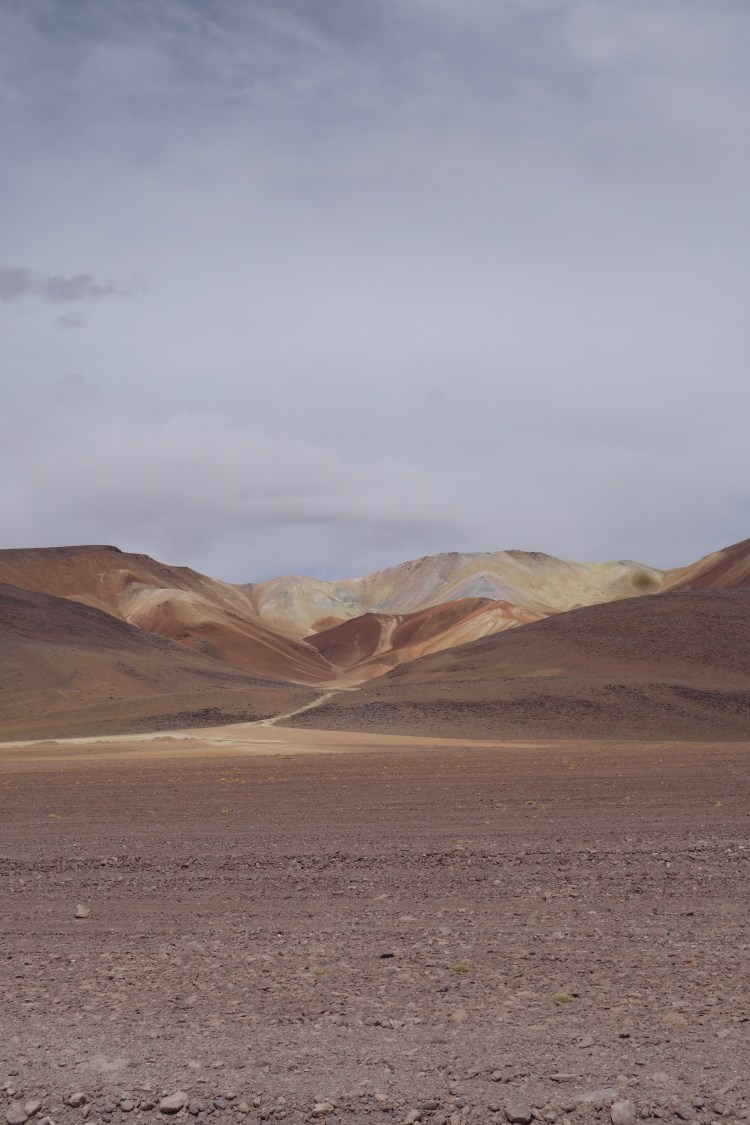
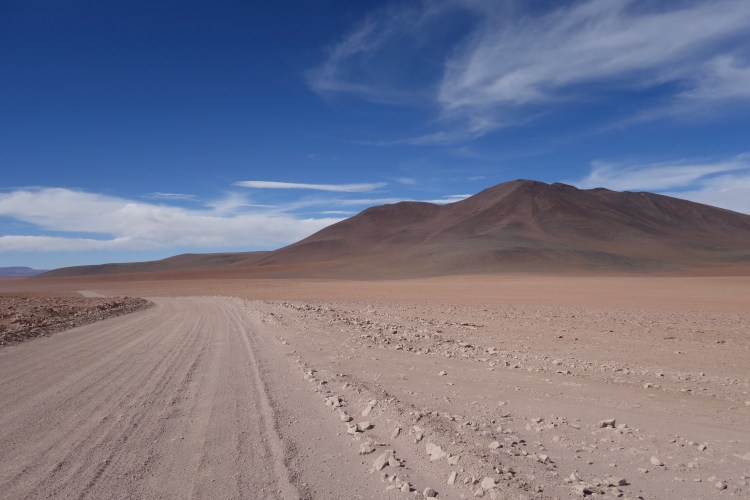
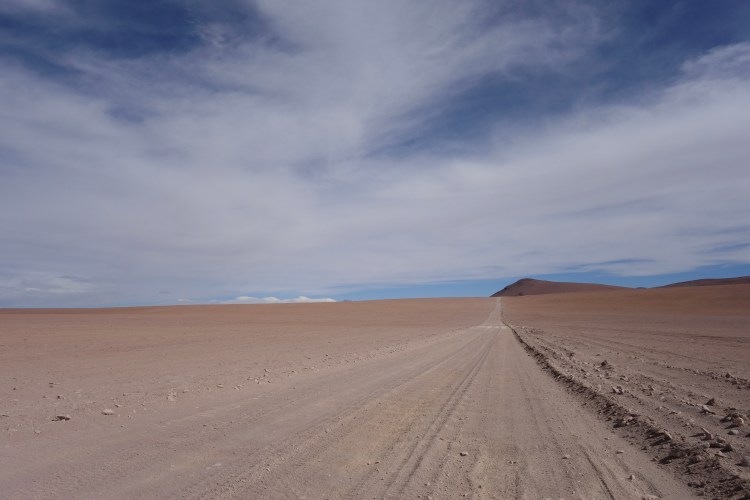
The afternoon’s riding presented some of the most mentally challenging hours I’ve ever experienced on a bike. It was a matter of one revolution of the pedals at a time. I promised myself I would establish camp at the next place offering shelter, only to reach a possible site and continue riding in the hope of finding something better. This cycle continued for hours, during which I pushed up every hill and battled into the wind along the straight roads counting my pedal strokes out loud. I considered it a win when I managed to string more than 20 consecutive revolutions together without being brought to a halt by the wind.
It helped to scream.
I had definitely hit the lowest point of the last few weeks. Fittingly, after a daily total of six hours of riding, I came across an excavated hole beside the road. I climbed down into the depression and lay on the ground, managing to get my entire body out of the wind for the first time all day. My odometer showed that I had covered 60 kilometres; an average of 10km/h was a significant improvement on the previous day which equated to 7km/h. I had to take a win whenever I could.
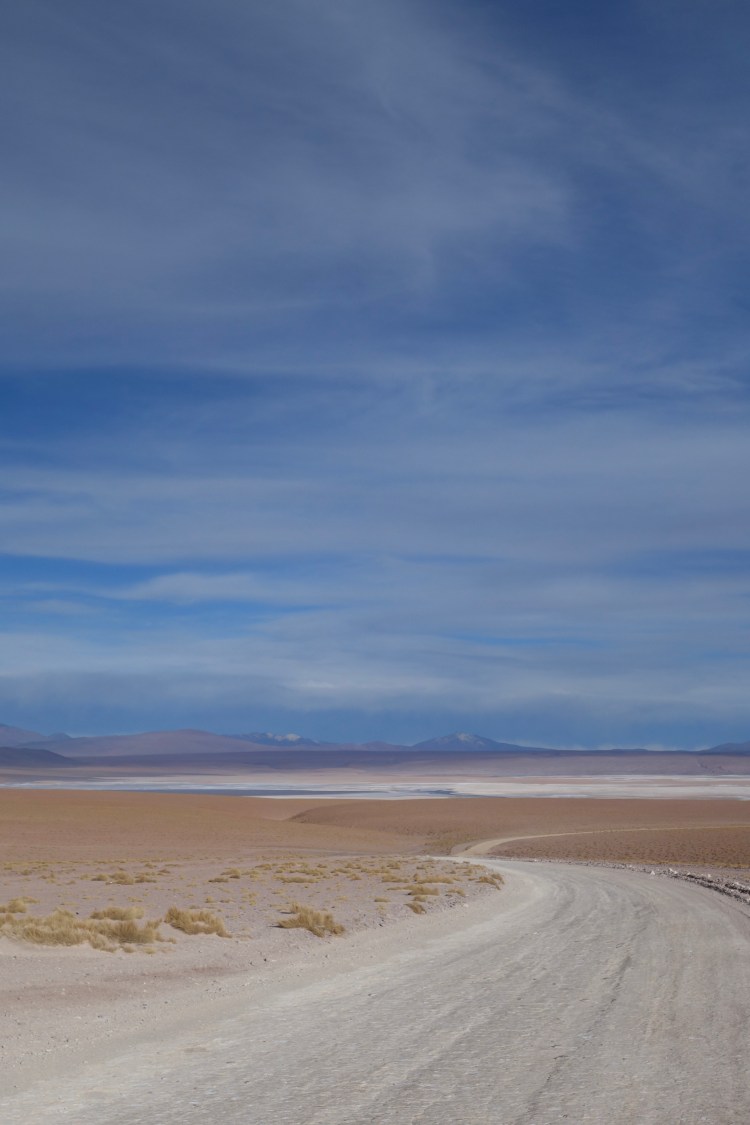
After collecting my thoughts and reluctantly deciding that the hole was too small to spend the night, I pulled out some maps to see what lay ahead. If I had learnt anything over the previous days, it was that distances meant nothing in this part of the world. However, I couldn’t take my eyes off the word ‘termales’ and the small symbol beside Laguna Chalviri which represented steaming water. It was still 15km away, but the thought of soaking my body in a hot spring washed away the memories of sand and suffering. That was until I climbed out of my hole and got back on the bike.
I lowered my head, gritted my teeth, and put everything I had into each pedal stroke. Gusts of wind had given way to a constant gale. After five kilometres I caught sight of a junction a few hundred metres ahead. The road split into two with one continuing in the same direction and the other swinging around a hairpin and down towards the lake below. I crossed every finger and toe in the hope that I would be taking the downhill option. Fortunately, things went my way for the first time all day. Upon rounding the corner I was not only greeted with a formidable, yet welcome, descent towards the lake, but I also had the luxury of a tailwind!
Again, I found myself screaming, but this time through ecstasy and relief. I can’t remember a day with such a spectrum of emotions.
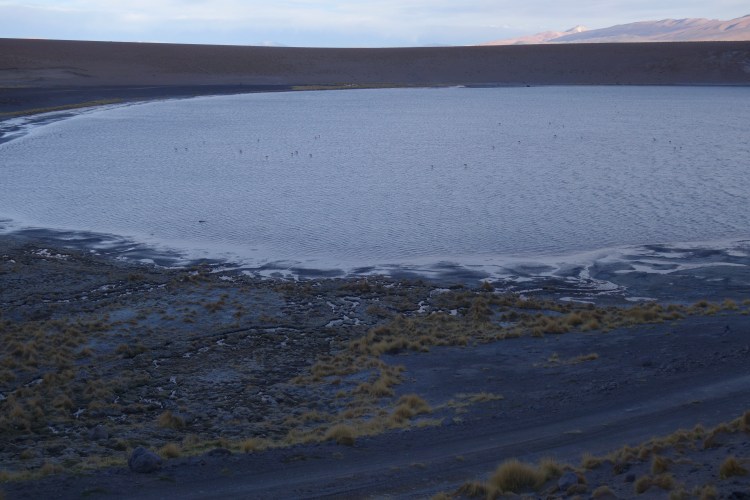
The next several kilometres disappeared with ease, transporting me to the shoreline of Laguna Chalviri. Beneath a cloud-laden sky, the laguna appeared cloaked in pewter; a commanding and mysterious vista. Scattered clusters of flamingos demanded my intrigue. Their ungainly appearance and flamboyant plumage seem both out of place and the perfect fit in such a wild, barren landscape.
The road hugged the shoreline and, despite a turn for the south, it was relatively sheltered from the wind. As I rounded one of the many bends I was hoping would be the last, I was shocked to spot the large overlander vehicle belonging to Joe from Germany. It had been about two weeks since I had first met him on the outskirts of Oruro. His rig was parked down on the edge of the water next to another well-equipped touring vehicle and a visible ‘no camping’ sign. I couldn’t see anyone so continued onwards, assuming they were sheltering inside from the wind and that I would catch them on the road the next day. A few minutes later, I was passed by a park ranger on a motorbike heading in the opposite direction. He stopped to briefly exchange pleasantries before telling me he had to go and tell some people they couldn’t camp the night where they had parked.
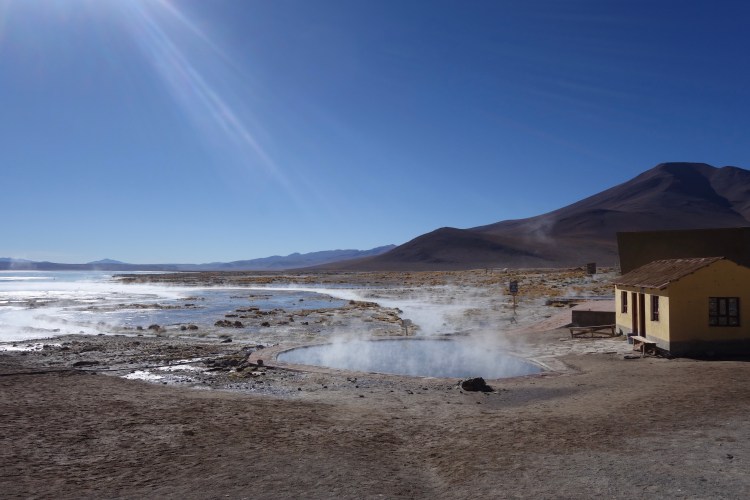
After a hard seven hours on the bike, I finally arrived at a small assembly of buildings marking the site of the thermal springs. A few locals stood in the doorway of the central building which appeared to be a restaurant. They applauded me and laughed as I pulled in and propped my bike against the wall. I’d like to believe it was an acknowledgement of my effort but it felt more like a mocking of my idea of a holiday. It was hard to disagree with them at that point in time, however, my self-pity was diluted by the site of steam rising from the pools down on the water’s edge. As I pulled out a jacket, the ranger on the motorbike reappeared and asked me where I was planning on staying. I told him that I was hoping to put my tent up somewhere nearby, to which he insisted I wait by my bike while he went inside to work something out for me. He returned with the owner of the restaurant and they lead me into a semi-detached room behind the main building. The interior was incomplete with exposed timber framing and a few freshly installed panels of plasterboard. The two men proudly gestured towards a mattress which lay in the corner of the room and told me that I was more than welcome to bring my bike inside and spend the night on a real bed. To show my appreciation, I said that I’d buy my dinner in the restaurant, to which the owner stressed would be served at 7pm sharp. With an hour to spare, there was only one option in the world; the thermal springs!
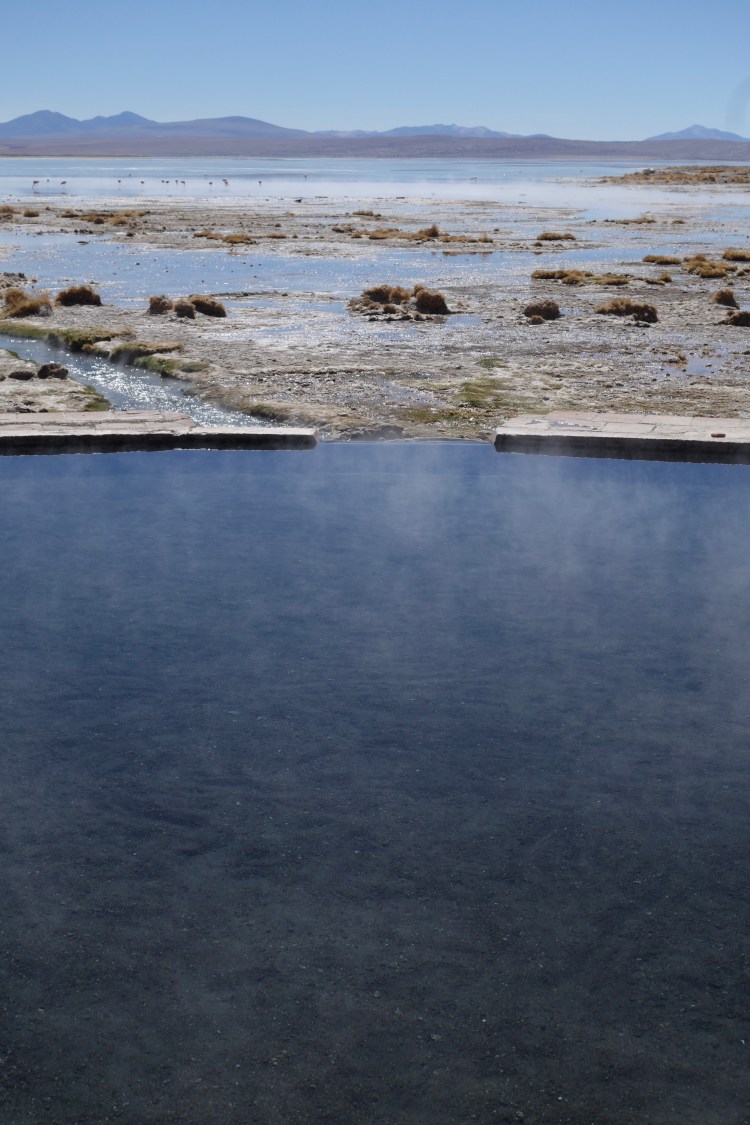
A number of tour groups had arrived in their 4wds and the pools were a hive of different languages and body types. I exited my clothes and entered the pool in a single movement. The temperature penetrated my muscles and I could feel the difficulty of the last few days leave my body and float away on the steam. I closed my eyes and drifted into a deep soak. Almost on cue at 6.30pm, the tour guides started the engines of their vehicles as a signal that it was time to leave to get to their evening’s accommodation. Within minutes, the pool was empty. I slipped deeper into the water, with only my nose and eyes above the water line. As the sun set over the laguna, the sky turned pink providing the nearby flamingos with a rare chance of camouflage. I lay still until the first star emerged overhead and my exposed forehead began to ache with cold.
I was the only one in the restaurant that night. Considering the relative remoteness of the restaurant, I was overjoyed with the amount of fresh vegetables that floated in the hearty broth that was delivered to my table. This was followed by a plate piled with rice, chicken and crunchy broccoli, washed down with a local ale. I returned to my mattress on the floor, giddy from the warm water, generous feed, alcohol and deep fatigue.
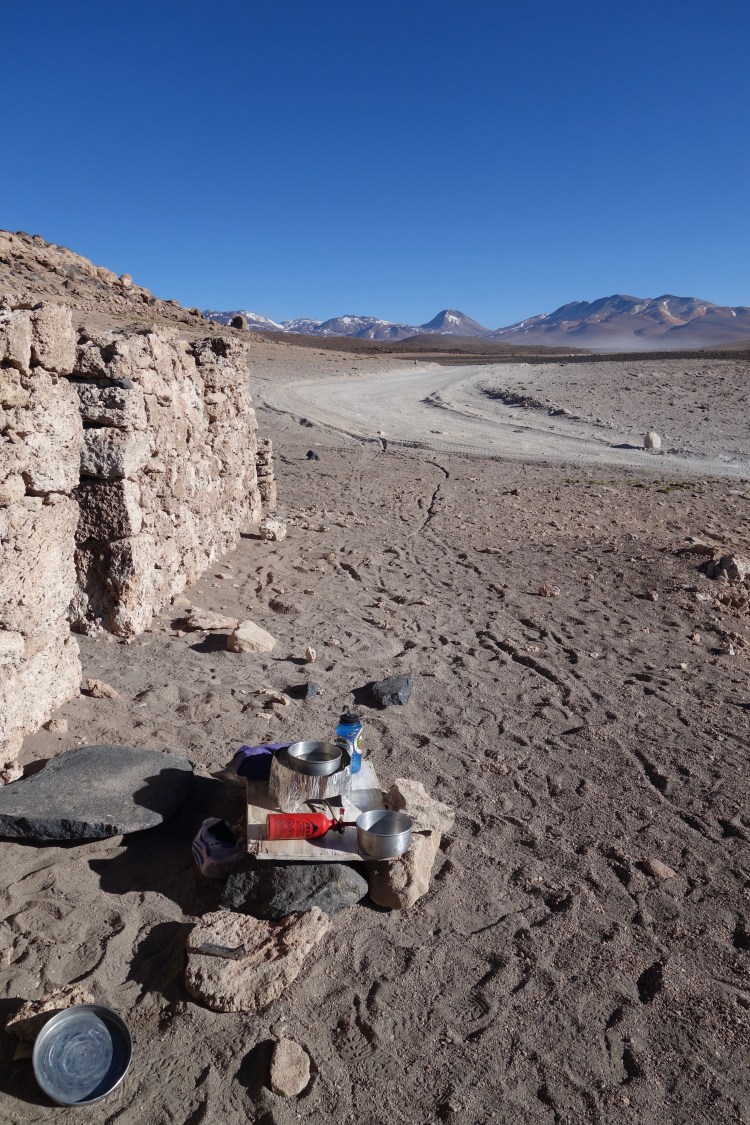
The hum of vehicles woke me from my deep slumber the following morning as the first of the day’s tour groups arrived at the thermals. Despite the growing crowd in the pools, I couldn’t deny my body the opportunity of a pre-ride, hot water immersion. Under a perfectly blue sky, the morning sun illuminated each individual water droplet that rose from the pool as steam. I felt like I was bathing beneath a sky full of diamonds. After returning to my deluxe suite and packing my gear, I rolled my bike down to a large concrete landing overlooking the laguna and assembled my stove to make a pot of coffee and some porridge.
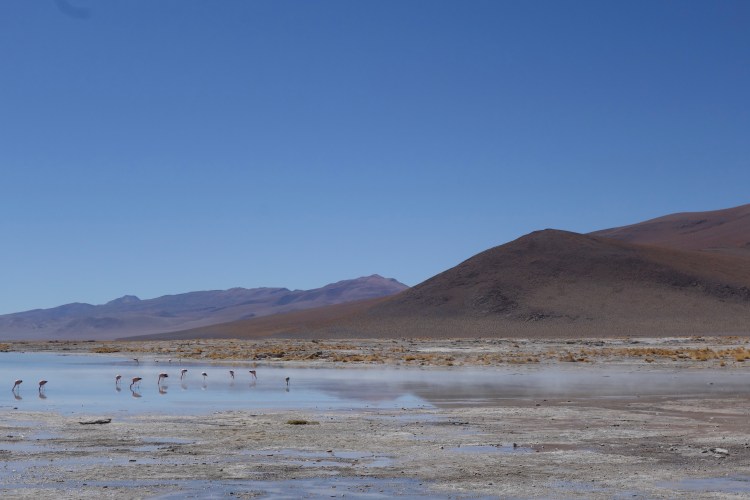
Following their eviction from their campsite the night before, Joe and the drivers of the other vehicle had ended up next to the thermals. Joe and I spoke of the routes we had taken over the past few weeks since our first meeting. He then introduced me to Andreas and Sandra; the German couple he was travelling with throughout Bolivia. They had all met in La Paz and decided it best to have two vehicles whilst driving through some of the remote regions of the country.
Sandra and Joe returned to their vehicles and left me chatting with Andreas for the next hour. He was a fascinating man. Back in Germany he managed a biotech organisation with a focus on developing immunisations. However, it had been over three years since he last worked. In April of 2016, he and Sandra had shipped their vehicle to Halifax and spent the following summer months driving throughout Canada and Alaska. When that first winter began to set in, they turned for the south and have since been driving towards Ushuaia. Their objective is to reach the southernmost point of the continent by Christmas. They will then turn north again with the plan to reach Uruguay by May from where they will ship their vehicle back to Europe. Apparently shipping from Uruguay is cheaper and less prone to corruption than from the larger ports in Brazil.
Conversation progressed from superficial recounts of our respective journeys to our philosophies and observations regarding tourism and conservation. Despite having developed a tolerance towards the constant stream of vehicles in this remote corner of the world, I still can’t help but question the sustainability of the local tourism industry. It appeared as though Andreas shared similar concerns.
Bolivia is the poorest nation in South America in terms of GDP per capita with Bolivians making an average of $7910 each per year. The growth and prosperity of the country is ultimately hindered by Geography. Bolivia once possessed a stretch of Pacific coastline but lost this territory to Chile during the 19th century War of the Pacific. Considering that any movement of goods between the major economic centres of Bolivia and the nearest ports involves crossing the Andes, Bolivia’s opportunities for trade are severely diminished. Interestingly, in 2010 Chile agreed to provide Bolivia with an internationally registered port near the Peru and Chile border. However, this promise and the subsequent hope never came to fruition. Just this month (November, 2018) the International Court of Justice ruled that, “…the Republic of Chile did not undertake a legal obligation to negotiate sovereign access to the Pacific Ocean for the Plurinational State of Bolivia”. Fortunately, three river ports on the Paraguay-Paraná waterway have recently been given international registration, meaning that Bolivia will soon be connected to Argentina, Brazil, Paraguay, Uruguay, and the Atlantic Ocean.
Given the economic and geographic disadvantage faced by the country, it is difficult to be critical of people trying to get ahead in life even if it is at the obvious expense of a finite resource. There is no mystery around why tourists are flocking to this part of the world. I am one of them. It is a seemingly unspoilt wilderness, a landscape like no other on earth, a place which forces you to question your understanding of biophysical processes and landforms. However, it is the privilege of the west that has enabled a desire in us to seek wildness and a sense of solitude. As a result, the remote corners of the world are now filling up with those wanting to avoid crowds. A true conundrum. As places like the Lagunas Route continue to grow in popularity and accessibility, the throng of tourists will begin to seek out the next untouched, rarely visited location. This is the nature of the industry. However, it seems so obvious that the locals who are capitalising on the boom through investing in vehicles and spending their days ferrying paying clients across the antiplano, will be left with salt, sand and empty 4wds. Andreas feels as though there is a strong disconnect between locals’ interest in money and their surrounds; a failure to recognise and appreciate that their income is directly linked to the quality of the environment. Years of economic struggle have resulted in a seemingly unregulated tourism industry where more equals better. Andreas continually brought the conversation back to his experiences in Guatemala, which he believed to be the polar opposite to Bolivia. He explained that Guatemalans are hesitant to engage in any activities that could jeopardise the quality of their own ‘backyard’. I can’t help but fear that through desperation and lack of regulation, the tourism industry in Bolivia will face a tragedy of the commons; overconsumption, underinvestment, and the ultimate depletion of a resource now relied on by so many. From the lithium mining to the burgeoning tourism industry, there are some major threats to the immediate and future livelihoods of people in Bolivia.
It was Andreas who eventually cut the conversation off by rolling out his yoga mat and telling me he needed to begin his daily exercise regime. I thanked him for the thought provoking discussion and packed my bike as he launched into some intimidating calisthenics.
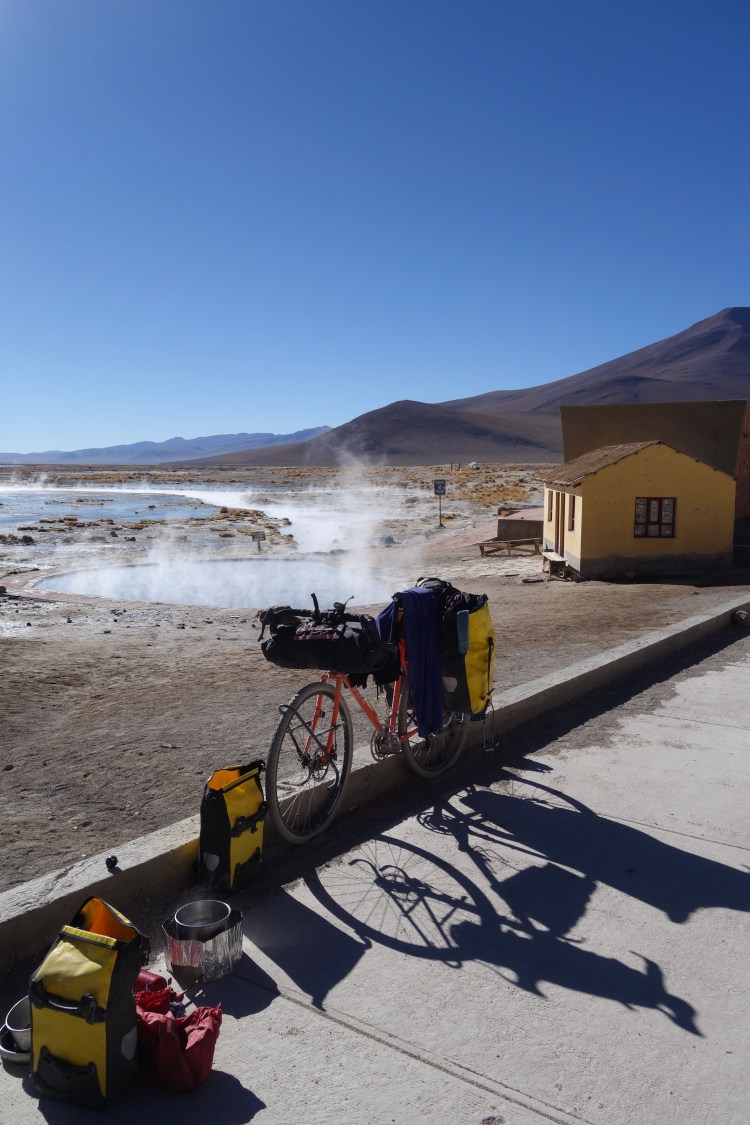
I found it difficult to begin riding. My body was quick to remind me of the difficulty of the past few days and the hot springs were now full of tourists in bikinis. Both my head and heart suggested I should take a rest day, but my stomach was the defining factor. At a stretch, there was about two more days of food left in my panniers and considering the remaining distance to the Chilean border, I had no option but to ride on.
The first half an hour was relatively easy. The lack of wind was both a welcome change and an unsettling calm. The thing about perfect weather is that it can only get worse and if the last few days were anything to go by, then the afternoon would be delivering a relentless breeze. I tried to remain in the present all morning, stopping to appreciate the sites along the way, such as Desierto Salvador Dali. The desert is comprised windswept hills, lifelike rock formations, and snow-capped volcanoes as far as the eye can see. The region is thought to resemble the scenes produced by the great surrealist. I definitely wouldn’t have a questioned a melting clock draped over a rock or a flaming giraffe galloping across the plains.
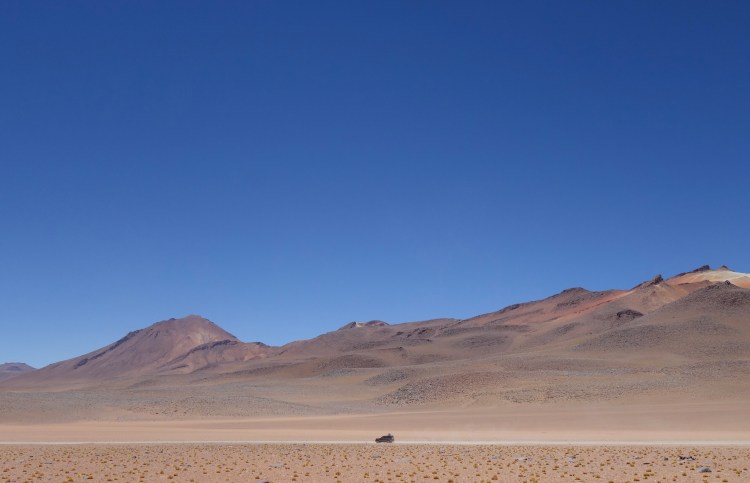
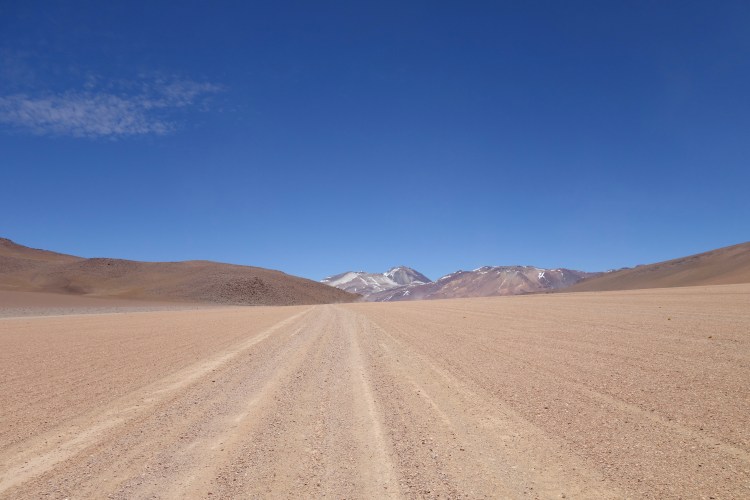
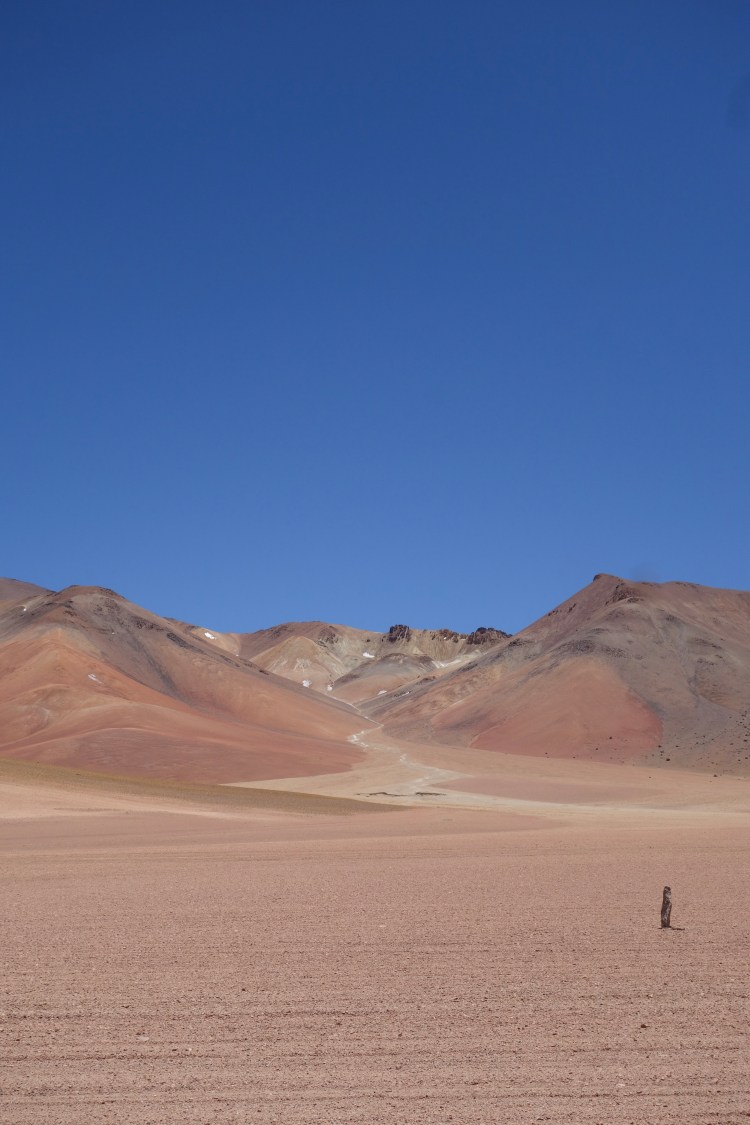
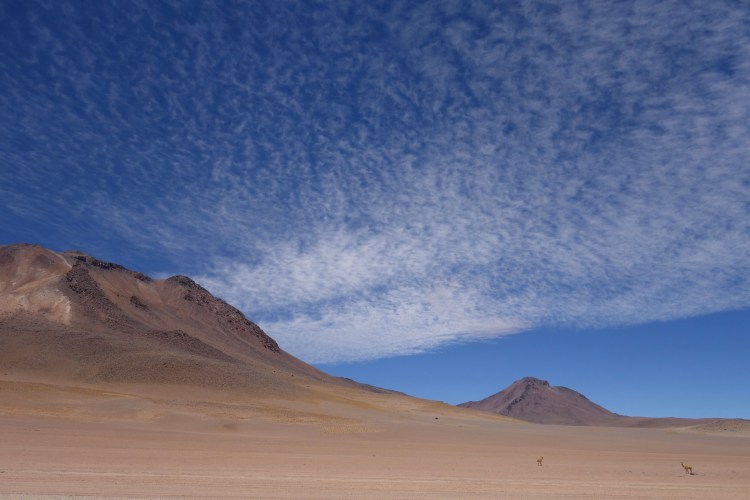
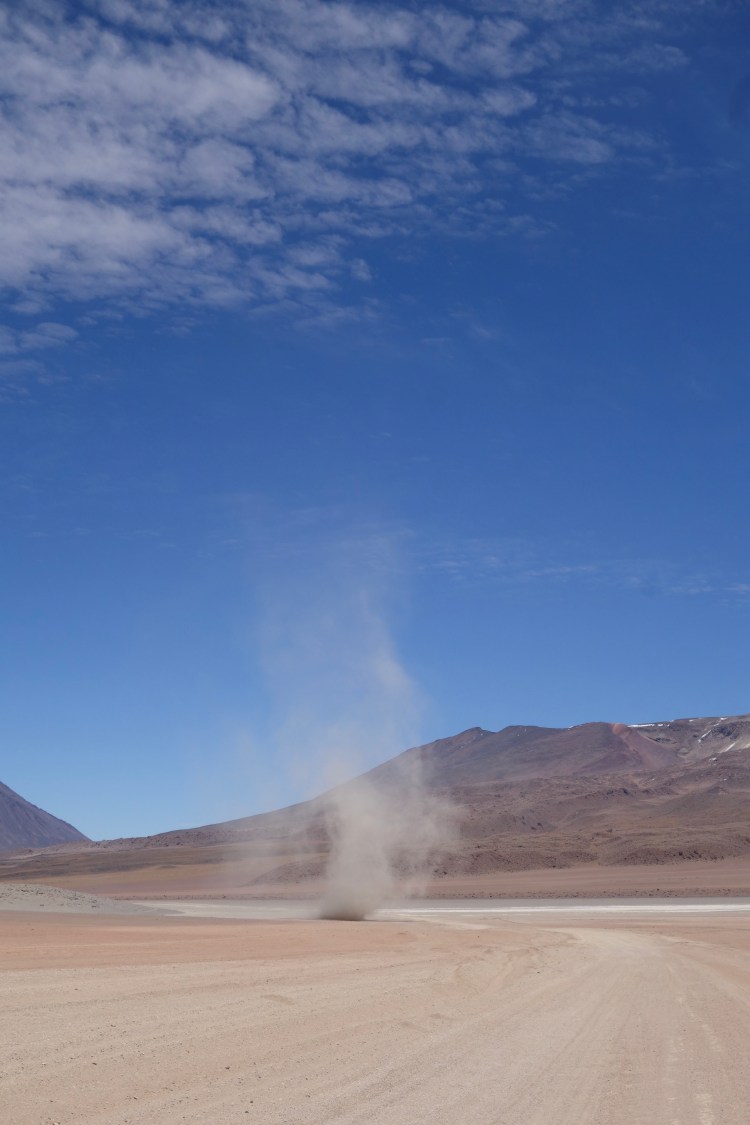
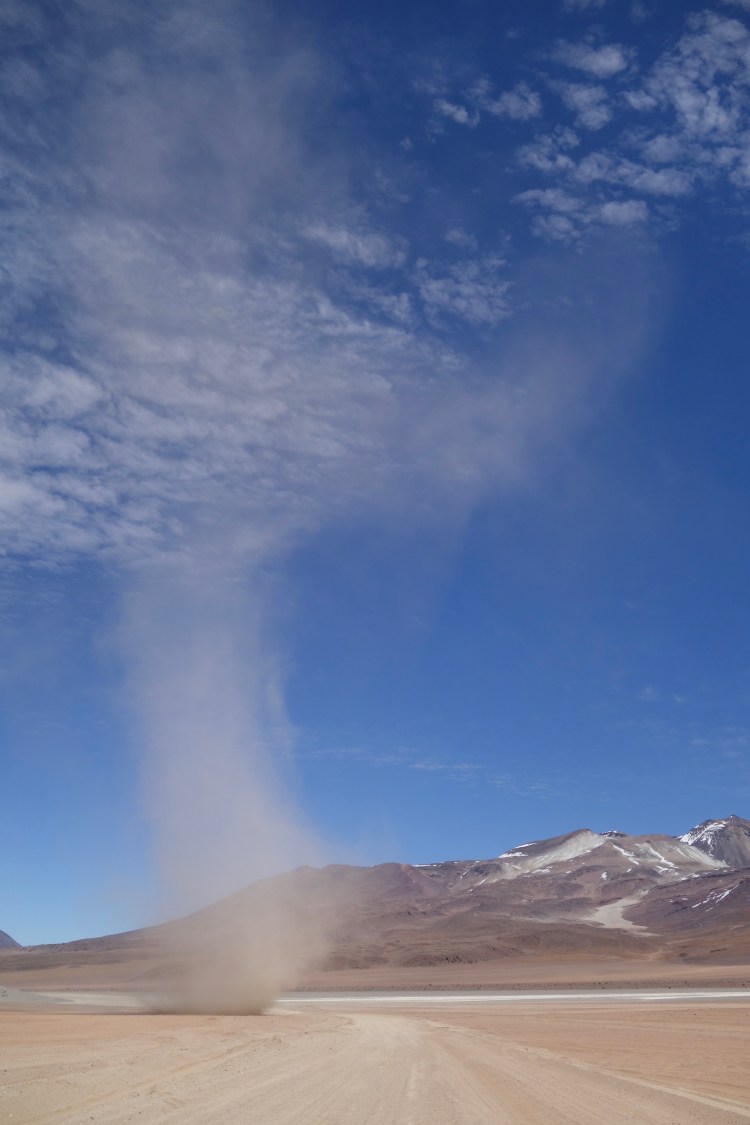
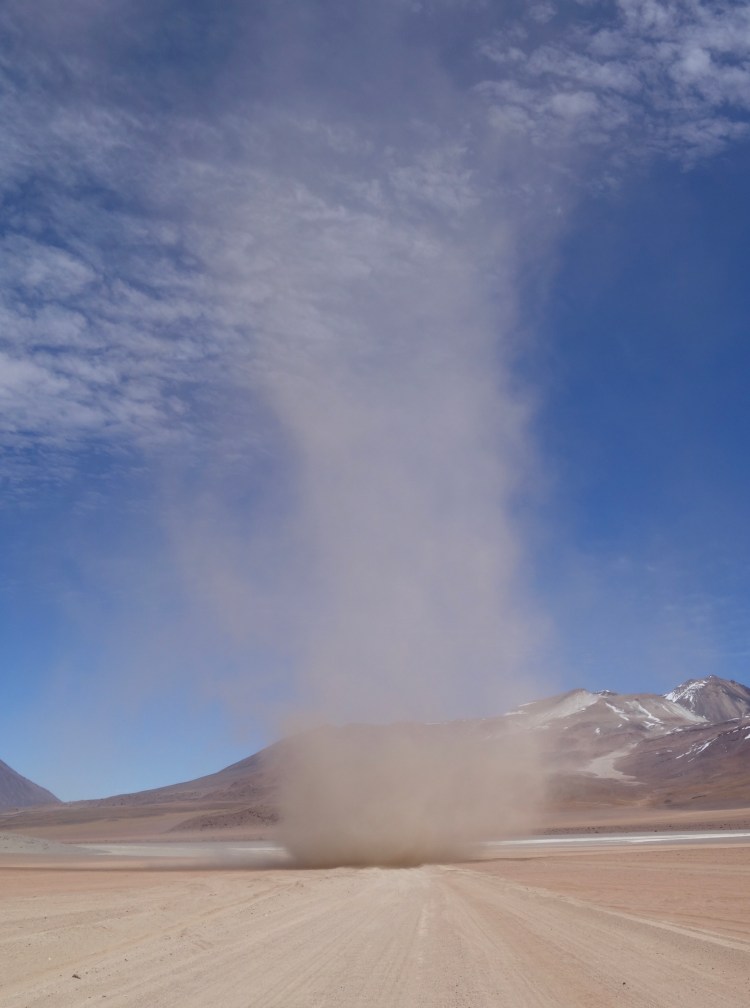
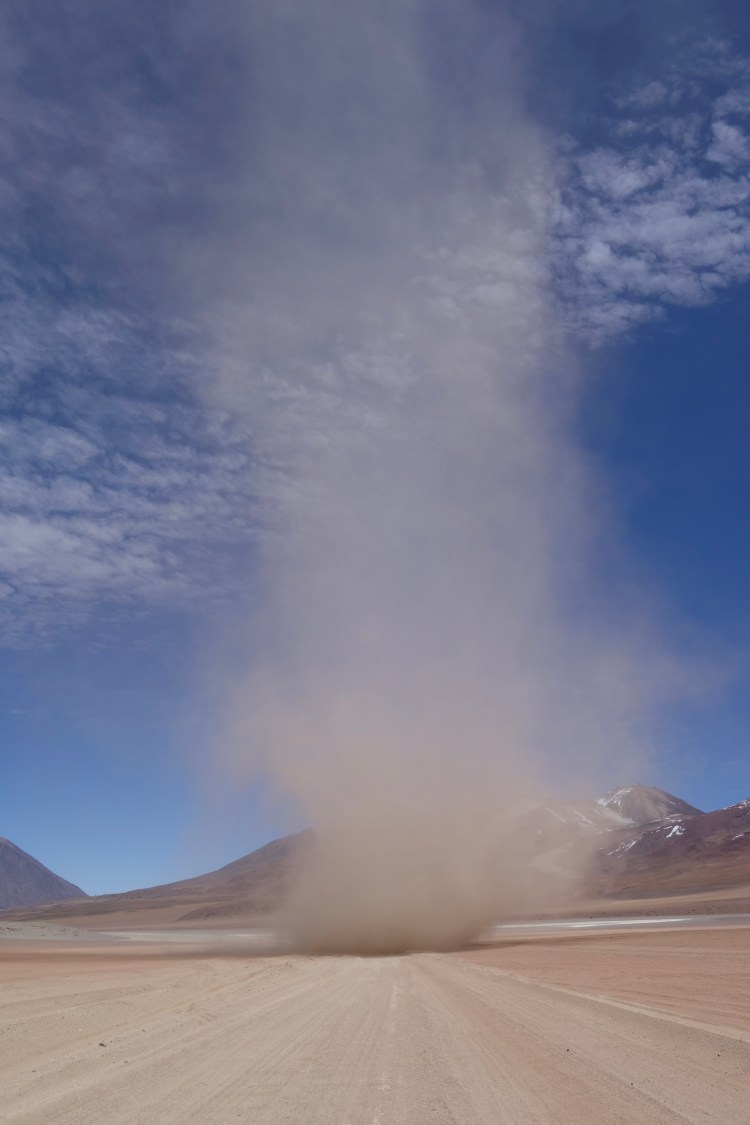
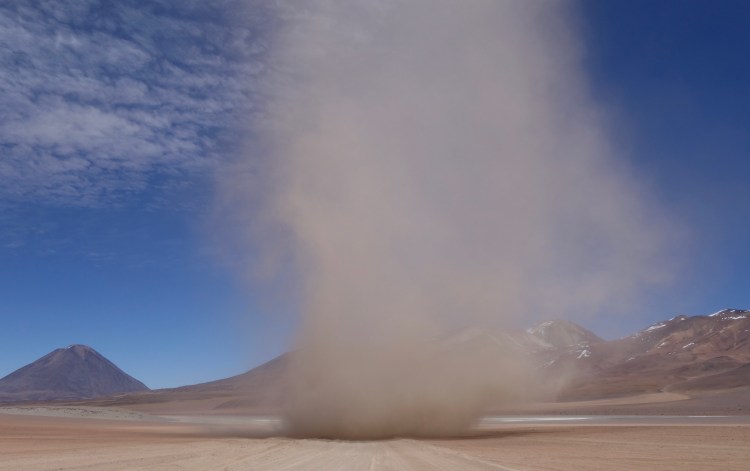
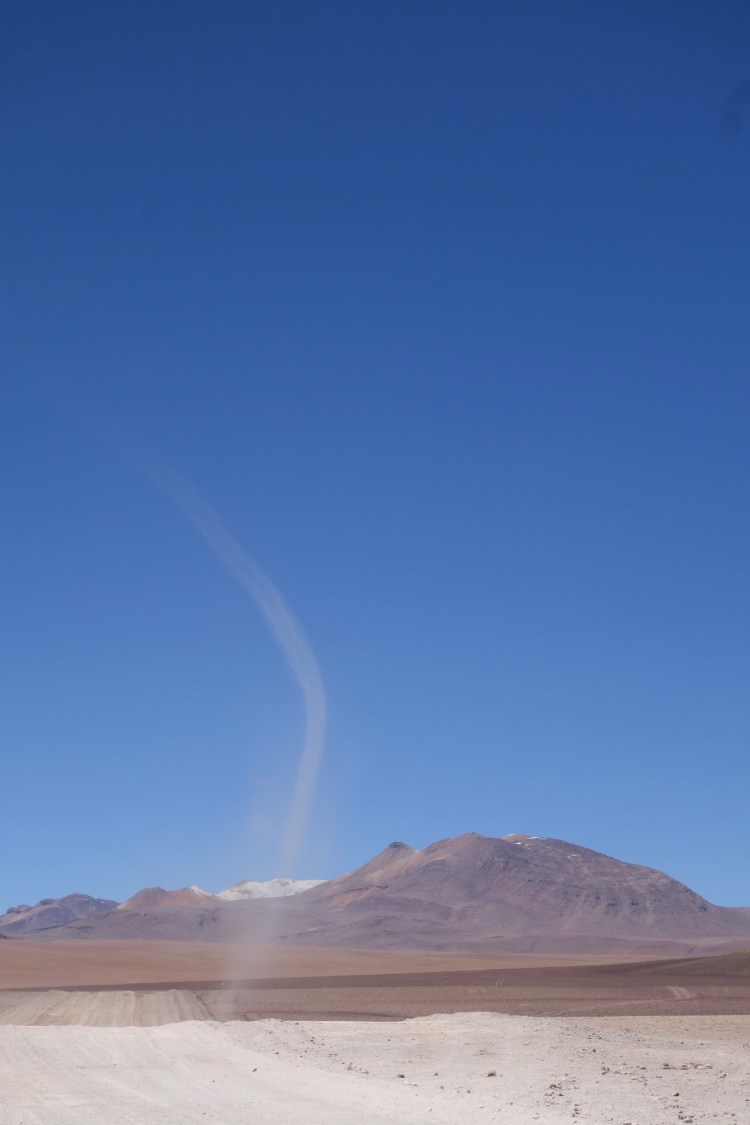
It wasn’t long before the sand began to swirl and my eyes began to fill with grit. The wind had arrived. I broke the afternoon into half an hour blocks, treating myself with regular breaks where I would hide behind rocks, read my book and slowly work my way through my remaining stock of chocolate biscuits. After a tough climb up to an exposed plateau, the burnt terracotta hillsides began to close in, funnelling the wind and making for a brutal kilometre. The road was rocky and laden with jeeps, each kicking up stones and blinding clouds of dust. When I emerged at the base of the descent and the landscape opened up again, I expected to experience some relative calm. However, I came to a complete standstill and watched with intrigue and trepidation as a sandstorm spiralled towards me. I managed to capture some images of its approach before hurriedly covering my face with my shirt and holding on. Gripping my handlebars tightly, the sand blasted me with such intensity that it drew blood from my knuckles. The sound of sand colliding with my bike’s steel frame and the thick PVC panniers was horrifying. The experience left me motionless in the middle of the road, unsure of what else I could possible experience in this far flung corner of Bolivia.
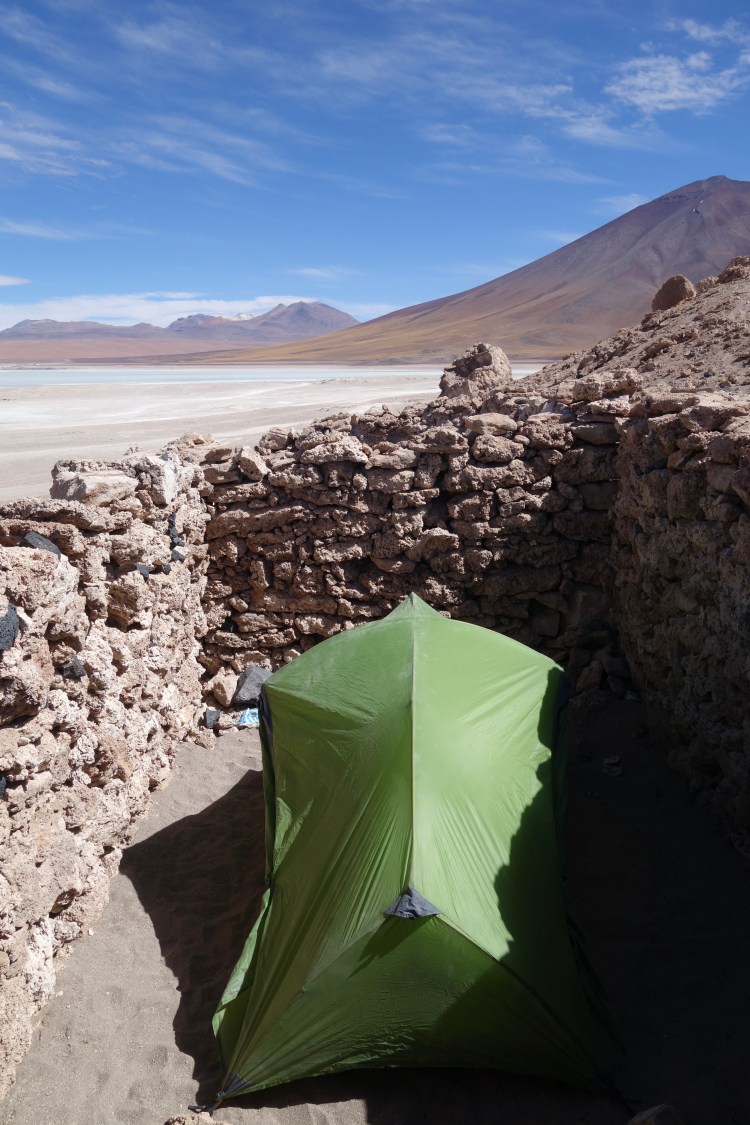
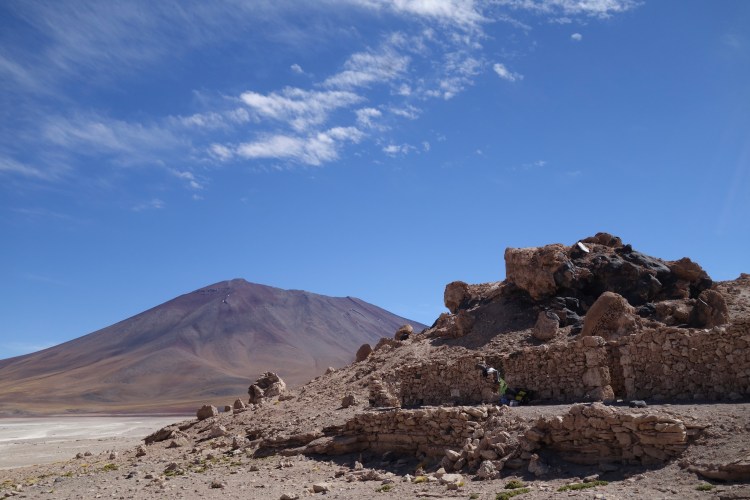
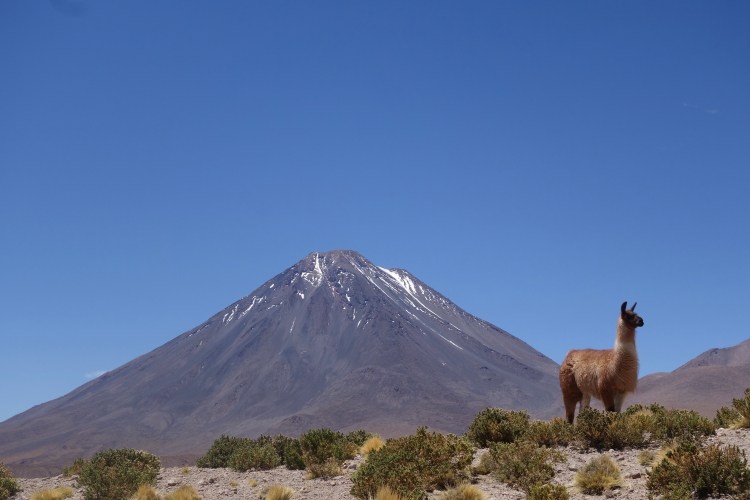
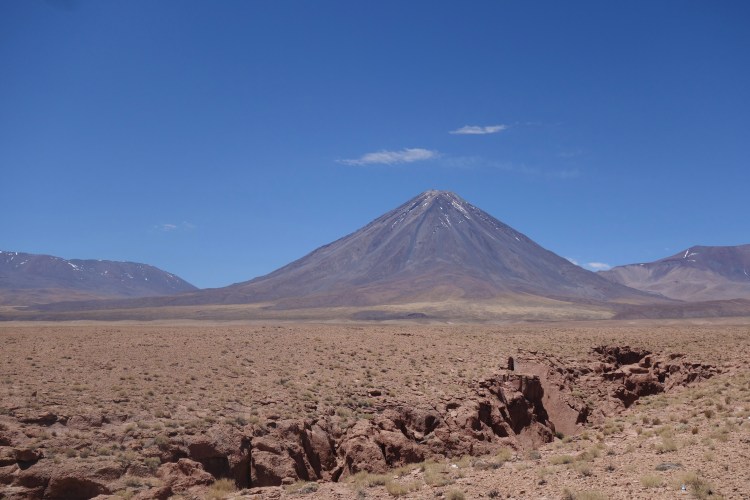
Occupying the most south western extremity of the National Park sits Laguna Verde. Named in honour of its swirling turquoise and emerald colours, Laguna Verde lies at the foot of the inactive volcano Licancabur; a perfectly conical giant standing a touch under 6000m. Looking at the map, it appeared as though the Chilean border was only a few hours riding from Laguna Verde. Camping on the edge of the lake would give me ample time to cross the border the next morning. An unnecessarily corrugated track carried me to a rocky outcrop on the northern shore, offering a pleasing amount of protection from the wind. I set my tent up amongst the mudbrick walls of some ruins and cooked up a pot of instant mashed potato and noodles. From my elevated position, I sat like Simba on Pride Rock and watched flocks of flamingos slowly making their way along the water’s edge, while 4wds raced towards the distant border crossing before night fall.
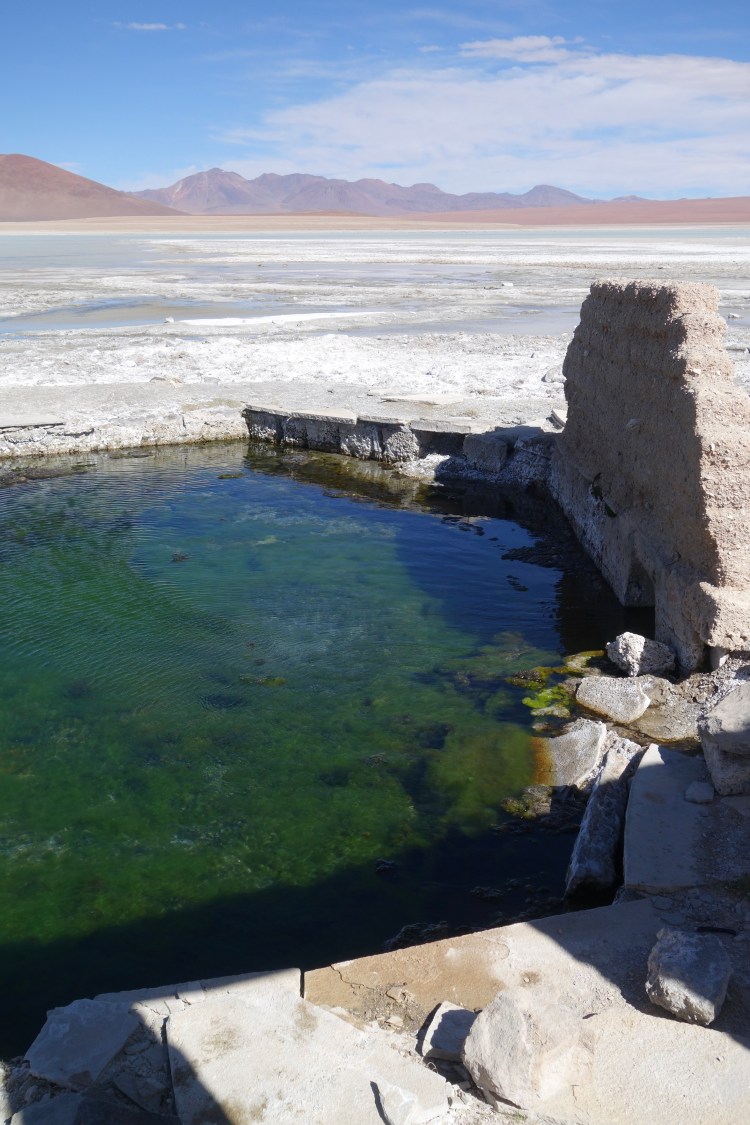
Interestingly, there were some nearby thermal springs marked on the map which piqued my interest as both the sun and temperature began to fall. I had read that as a result of its chemical composition, the waters of Laguna Verde can drop as low as -56 degrees Celsius and still maintain a liquid state. The idea of indulging in some extreme contrast bath therapy had my fatigued muscles tightening further in anticipation. Making my way along the edge of the water, I stumbled across some dilapidated infrastructure. A mudbrick wall suggested a dwelling of sorts, while a gangplank extended out from the shore towards a ring of rocks in the water. I stood on the edge of the constructed pool and dipped my toe into the thick layer of algae which was acting like a natural pool cover. The water was unbelievably warm. I stepped out of my clothes, used my hands to create a hole in the blanket of algae, and slipped in to the water up to my neck. The warmth caused an instant release of tension from my body as I revelled in the remoteness. I sat in stillness, making eye contact with flamingos and recognising that I would most likely never have an experience like this again in my life. With just enough natural light remaining to make it back to camp, I hesitantly climbed from the warmth of the water. I emerged from the pool wearing a cloak of algae, which had woven itself into my body hair. My testicles looked like fresh tennis balls; smaller in size but equally as green and fluffy. The air was freezing so I threw my clothes on and tried to think of the algae as an extra layer of insulation for the evening. I returned to the tent for a cup of tea, watching the earthy colours of the hills turn a plethora of unworldly colours beneath the moonlight.
Cruising altitude
Despite my dehydration, I had to get up to the toilet twice during the night. I’d like to think it was nature’s way of forcing me to admire the night sky. The stars were the most incredible I’ve ever seen in my life. The altitude, combined with the crisp, clear air made for a sky where stars seemed to occupy more space than the darkness.
I got up with the sun the next morning. My sky was dry and cracked and my eyes were aching. It had been a tough five days. As I ate the last of my oats, the number of 4wds crossing the landscape began to increase. In the crisp morning conditions, the trails of dust behind the vehicles hung in the air like terrestrial jet streams. I checked out from my private hotel amongst the rocks at 8.30am and bumped along the road for a few kilometres to the lookout over Laguna Verde. Unsurprisingly, I discovered a throng a tourists with their eyes firmly fixed on the vista. As if it had been position by an artist, Licancabur stood proudly on the western shoreline. The morning sun illuminated its flanks, creating the perfect inversed reflection of the volcano in the water below. I waved to Joe, Andreas and Sandra who were parked on a hill above the lookout, sitting in their camp chairs with coffees in hand.
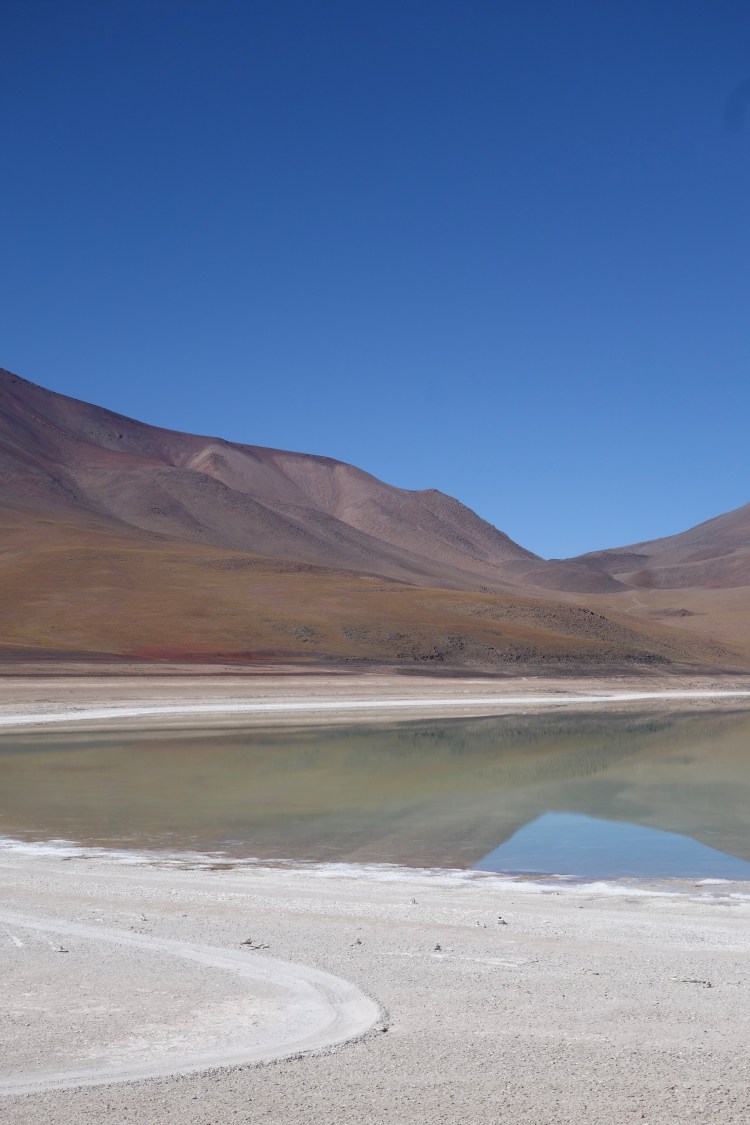
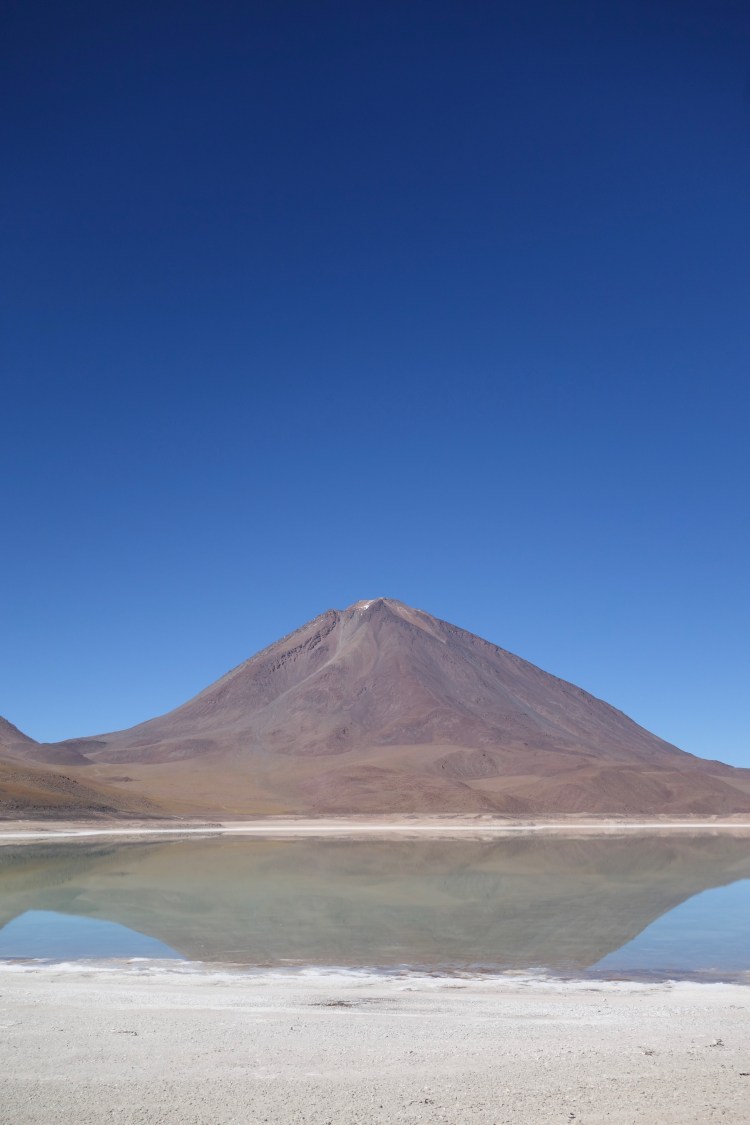
The final few hours of riding in Bolivia were sensational. The road continued south, following the shoreline of Laguna Verde. Progress was slow, but intentionally so. Every time I looked back from where I had ridden over the past few days, the view seemed to have increased in grandeur. A spine of snow-capped volcanoes extended over the red horizon. Two of the peaks were releasing a thin whisker of smoke into the sky; a subtle reminder of the volatility and power of the region.

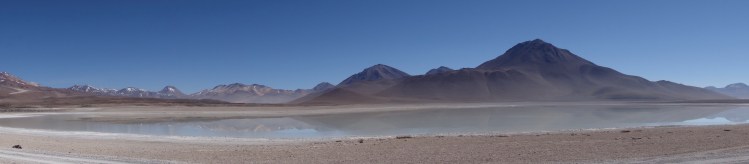
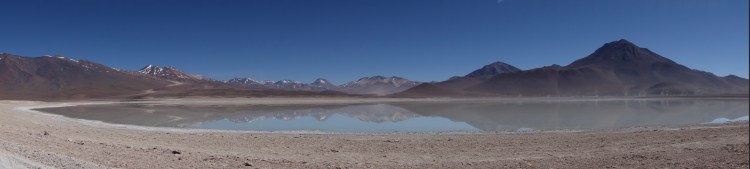
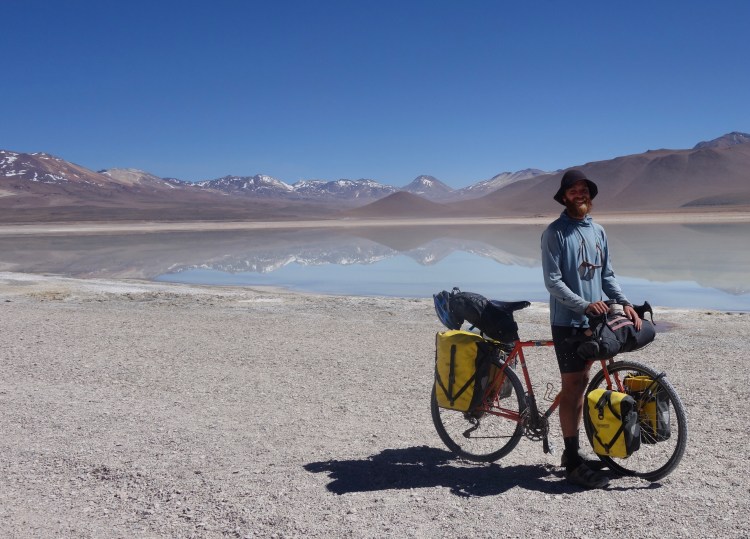
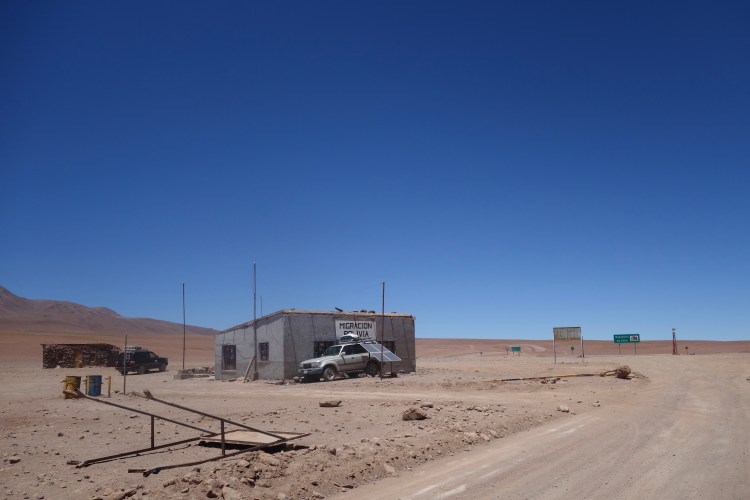
The Bolivian immigration building came into view an hour before I reached the front door. A long, straight and sandy climb was the final challenge posed by the country. I tried to frame it in my mind as a parting gift. Pushing open the front door of the simple mudbrick dwelling, I was greeted by three officials crowded around a single Apple Mac circa 1995. They all looked at one another as to say it wasn’t their turn to deal with the tourist. Few words were exchanged, my passport was stamped and I stepped back out into the wind to find an inquisitive Andean Fox edging closer to my bike.
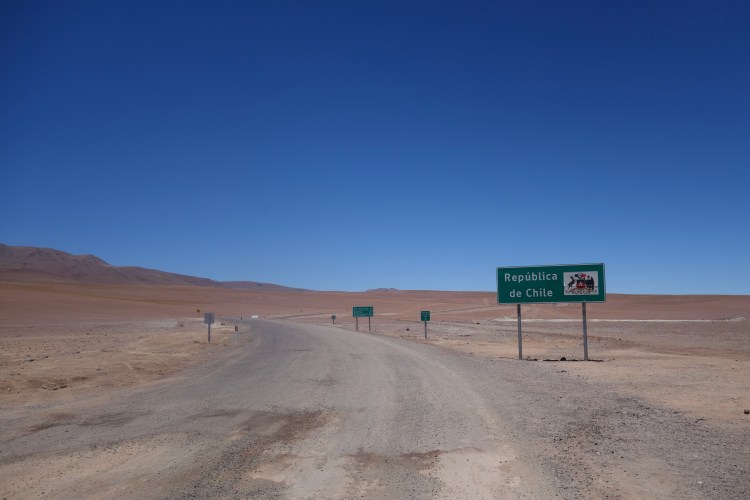
The ‘Welcome to Chile’ sign stood tall and proud. After almost a week of the roughest and toughest roads I’ve ever ridden, the dirt track instantly turned to smooth asphalt as I crossed the otherwise invisible border. I had never experienced such a stark and immediate contrast between two countries. The first few hundred metres of riding in Chile was on some of the smoothest roads I have seen during this entire trip. It was a reminder that I had just left the poorest nation in South America and ridden into the wealthiest.
Pedalling up to the border control on the Chilean side, I saw the two big German vehicles being inspected. Having seen each other three times in three days, it was nice to be able to consider other travellers as familiar faces. I discovered that Sandra and Andreas were also travelling with their dog. This obviously complicated border crossings even further, so they were pretty eager to get back on the road and find the quarantine office where the dog would be inspected. Despite the presence of a table tennis table in the middle of the building, the officials were definitely some of the most thorough that I have encountered. I was asked to empty all of my bags for inspection before being given the green light to continue into Chile. A Brazilian couple were also attempting to cross the border in their Kombi. They had been instructed to remove the bull’s skull which was cable tied to the front of the vehicle. Clearly distraught, they explained that it was a memento of the life they had left in Brazil where they owned and managed a farm. It was the 16th border crossing they had done since leaving Brazil a few years ago and it was the first time they had been questioned about the skull. They took some symbolic photos and drove away visibly upset.
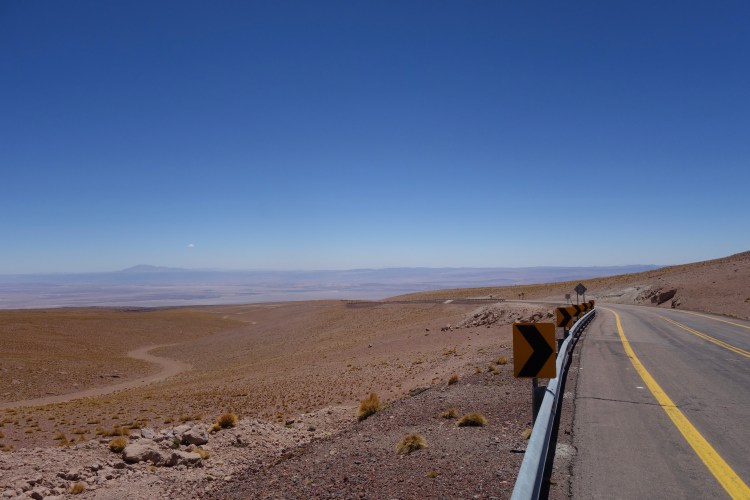
The final 45km of the day were utterly insane. The road was more or less straight and dropped over two kilometres in elevation. Reaching a top speed of 75km/h, it was as though I was in a plane coming into land. From the immigration building, the town of San Pedro De Atacama was a mere spot in the red desert landscape below. I raced paced grazing alpacas and was overcome by the immense temperature gradient I experienced the more I descended. The volcanoes I had been riding amongst in the morning rapidly became distant peaks behind me. Arriving in the dusty adobe town of San Pedro De Atacama was literally like coming back to earth; a confronting contrast to the desolation of the last few days.
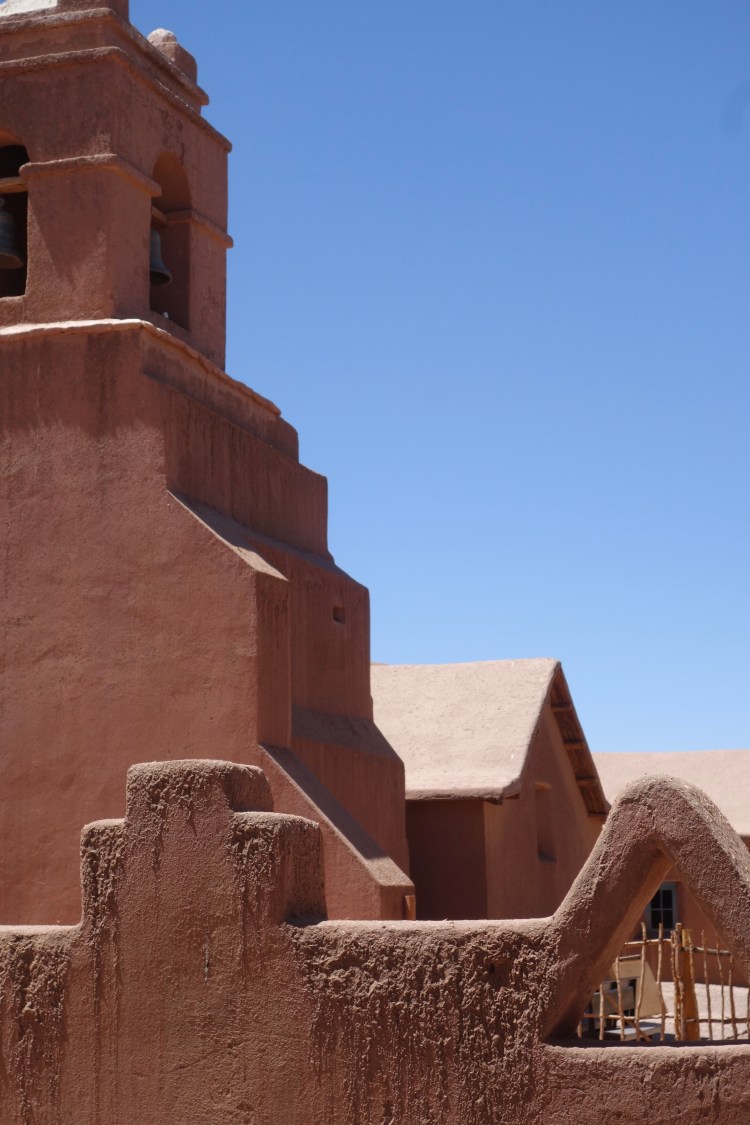
As the first major centre after the Lagunas Route, San Pedro De Atacama is one of the most prominent tourist towns in northern Chile. Despite being prepared for people, I coped poorly with the concentration of well-dressed couples milling beneath palm trees sipping cool beverages in the afternoon heat. I was instantly awash with post-adventure blues, pining for the loneliness of the Bolivian antiplano. Following a few aimless laps around town, I eventually found a hostel, a campsite and a street vendor selling fresh strawberries. I set up my tent and ate the fresh fruit in the shower before heading out in search of something for dinner that was not tomatoes, sardines and pasta.
Thanks for reading.

