It was mid-morning by the time we’d made our final visit to the buffet breakfast, packed the bikes, and decided what to do with the large cardboard box that Dad had used to transport his bike on the plane. After much deliberation and discussion, we left it in the room. Knowing how awkward it would be for those cleaning the room poked at Dad’s conscience for the remainder of the trip.
Dad’s first few laps of the hotel carpark with a fully loaded bike were momentous. In all the planning and preparation, it was the first time he’d filled the panniers and experienced the altered weight distribution. It would only be a matter of days before this became the new normal and riding an unloaded bike would feel foreign and unstable.
It was a grey, windy day but fortunately the breeze was on our backs as we rolled into town. We pulled into a supermarket where I left Dad with the bikes and headed inside to get some last-minute supplies. When I came back out, I found Dad in conversation with another cyclist. Originally from France, Thomas was explaining that he had been cycling since 2010. He had begun in Sao Paulo, Brazil, from where he had cycled west through the barren pampas into Argentina and onto Chile. He had just returned to South America having left his bike in someone’s shed and headed to Australia for a few months’ farm work to save money. His current plan was to head north for as long as his savings would allow. As he spoke, I could see Dad scrutinising Thomas’s bike. Frayed brake cables, bald tyres, and abundant rust were all indicators of many hard years on the road. Like at the beginning of any journey, one is super tuned into the performance, quality, suitability, and durability of their gear. As we had only travelled a few kilometres, Dad’s anxiety regarding all these factors would have been at an all-time high; I could recount how I felt leaving Bogota a few months prior. I think the state of Thomas’ bike provided Dad with a healthy dose of confidence in his own setup. It was also the first of many interactions we’d have along the road that would emphasise that a journey like this is certainly ‘not about the bike’. We chatted to Thomas for a while longer as we waited for a light shower to pass overhead.
Having spent a few days coming in and out of Puerto Montt from the west, it wasn’t long before we were travelling along new roads. Leaving the city to the east was seamless thanks to a beautiful bike path that followed the edge of the bay. With a stiffening tailwind and a smooth surface beneath our tyres, we made great progress. The weather was threatening all day, but the moody, tempestuous ocean was a stunning reminder of the wildness for which this part of the world is best known.
After 45 kilometres of increasingly undulating riding, we arrived at Caleta La Arena; a small town on the northern banks on the Reloncavi Estuary. It was hard to comprehend that we had been in the ‘city’ only a few hours earlier. Here, distant islands were just visible amidst the spray of the wind torn ocean, clear mountain streams cascaded from tunnels beneath the road into the waves below, and the tops of surrounding hills were lost in the mist.
Caleta La Arena was a point of interest for us as it marked the first ferry journey along the Carretera Austral. Without any planning, we timed it perfectly. The 3.30pm ferry was docking as we rolled into town. The only road into town ended abruptly at the water’s edge, with a line of parked vehicles ready to board. We took shelter at the ticket booth and put on some extra layers. While we were waiting, a driver of one of the vehicles got out and approached us. He recognised us from the buffet breakfast at the hotel that morning. I am pleased to say that I also recognised him, highlighting that I had eyes for more than just the food in front me. Upon hearing our plans, he ensured us that the road ahead would be lifechanging. He was from Santiago but had been working in Puerto Montt for a few weeks. With some days off from his job, he and some friends were heading south on a fishing trip targeting wild trout and salmon. I asked him about the quality of the fishing in the region and he laughed, before extending his arms to show the average size of the fish they were expecting to catch. If he was telling the truth about the aquatic beasts lurking in the lakes and rivers, I was going to have to reconsider any plans of going swimming in fear of being eaten. It also made me wish I’d packed a rod.
As the ferry pulled away from Caleta La Arena, a wet and windy weather front surged in over the ocean. I was much happier to be under cover on the ferry than still out riding on the road. From our position on the upper deck, our bikes looked incredibly meagre lined up next to a fleet of touring motorcycles and an array of other 4wd vehicles. I can only imagine that’s also how we would be described in our lycra, standing next to the leather-clad, burley motorcyclists who kept their helmets on for the duration of the ferry crossing. The touring cyclist/motorcyclist relationship was something that Wolfgang had reflected on during our time spent together on the Lagunas Route in Bolivia. It was also a phenomenon that would come to dominate my conversations with Dad along the entirety of the Carretera Austral.
The crossing only took 20 minutes. After disembarking at Caleta Puelche on the southern edge of the estuary, we took shelter and considered out next move. The rain had eased and from as far as we could tell looking out of the water, we had a good break in the weather. We pushed on.
Several kilometres later we came to a junction between the Carretera Austral and a smaller coastal road. We knew that the following night would be spent at Hornopirén; the departure point for one of the longer ferry crossings that only occurred once a day, leaving early each morning. With only a few hours of daylight remaining, we knew we wouldn’t make it to Hornopirén in time for the next morning’s ferry. As a result, we decided to take the coastal road in the hope of a longer, more scenic ride the following day.
Expecting this alternate route to be unsealed, we were pleasantly surprised to discover it was undergoing a substantial upgrade. The first 10km of the road were smooth, sealed, and sensational. Following the rocky coastline, we cycled passed several entirely wooden churches built in a style that perfectly mirrored the weather and landscape. I’d later read that the ‘Churches of Chiloé’ are a unique architectural phenomenon renowned throughout the Americas. Whilst the Chiloé Archipelago is a group of islands to the west of where we were, several influences from the region have made their way to the mainland. In addition to the unique architecture, the string of islands is known throughout all of Chile for their folklore, mythology, potatoes, and cuisine, all of which developed during centuries of isolation from mainland Chile and the rest of the Western world. Once colonised, however, the group of islands went on to become the last Spanish possession in Chile. The Chilean independence movement began in 1810, yet it wasn’t until 1826 that the Spanish were forced to retreat from the Chiloé Archipelago. In the 19th century, the largest of the islands, Isla Grande de Chiloé, was the major stepping off point for the Chilean colonisation of Patagonia. During this time, thousands of Chilotes migrated to the sparsely populated mainland to work on sheep stations or to become independent settlers, bringing with them their unique customs and architecture.
With the afternoon fading and drizzle settling in, we began thinking about a place to set up camp. We checked out a few small coves along the way but the rocky, mollusc encrusted foreshore didn’t look like it would bode well with the thin nylon floor of the tent. With our eyes peeled for potential campsites, we continued for a few more kilometres. The road wound its way down the coast past several small settlements. Fishing boats, some old and some in the process of construction, all rested on their hulls above the high-water mark. Mountains of sun-bleached mussel shells were piled along the road, exhibiting a seemingly endless bounty provided by the ocean to the several generations that have occupied the region.
Once the road turned to gravel, our search for a camp became slightly more desperate. At one point we stopped to survey a dilapidated bus stop; far from the accommodation I had envisioned for Dad’s first night on the bike. However, not much further down the road, I dropped my bike and investigated a worn path leading off into the bush beside a bridge. After 20 metres of tight scrub the vegetation parted, revealing an idyllic site. We set up the tent and tarp between some blossoming apple trees and cooked up a hearty pasta meal as rain showers blew in and out.
The following morning presented a wet tent but a cloudless sky. We made the most of the sunshine, letting it dry our gear as we indulged in porridge, fresh fruit, and Tasmanian roasted coffee. I read Dad a passage from ‘The Peregrine’; an obsessively observant and poetic account of the daily habits of a pair of peregrine falcons in eastern England. Written by J.A. Baker in 1967, it is book that forces the reader to pause and take note of the patterns that exist in the natural world; those that circulate in our peripheries yet may never be seen if we don’t take the time to observe. While reading, as if on cue, a buxom, ash-breasted Chilean hawk descended on a patch of grass in front of us. We watched as it clawed intently at a clod of soil. We spooked it before it could uncover the snack it was seeking, causing it to retreat to the upper boughs of a dead tree where it sat watching us until we left.
The first few hours of riding were slow and scenic. The potholed road dictated our pace as we passed through the communities of Aulén, Rolecha and Queten. Each settlement was centred around their own shingle-clad church and a small cemetery where assortments of bright, fake flowers stood out against the silvery headstones.
A highlight of the morning involved stopping to harvest mussels from the foreshore beside the road. As we were selecting a healthy serving of the biggest shells, a pod of playful dolphins passed within a stone’s throw from the water’s edge. Having been drinking cloudy water from gas stations in the desert less than two weeks ago, I felt as though I’d discovered nirvana. Further down the road we stopped for a lunch of bread, boiled eggs and avocado. As we ate, we watched a flock of black vultures tearing apart the carcass of a goat with relentless enthusiasm.
The coastal route re-joined the Carretera Austral in Huilaihui. The following kilometres were dominated by road works. Excavators were splitting rocks and workers were positioning new pipes which were to be covered with asphalt. The continual upgrade of the road, enabling greater access into the wilds of Patagonia, would go on to become a discussion point for the next few weeks.
Later in the afternoon we were faced with several climbs, the highest of which afforded views over the ocean to the west and snow-capped mountains ahead. A rapid descent into Hornopirén carried us over fast-flowing, crystalline rivers and through dense stands of gnarled conifers. Upon entering town, we rode straight to the ferry terminal where we seamlessly acquired two tickets for the morning service to Caleta Gonzala for the equivalent of AUD$10 each. A slow ride along the main street looking for somewhere to stay for the night proved relatively fruitless.
Cycling slowly through the centre of town, I looked back to see that Dad had struck up a conversation with a local man. I doubled back and pulled up next to them, where I quickly realised that Dad was being offered marijuana. His politeness coupled with a complete lack of Spanish had meant that he’d entertained the conversation for much longer than necessary. However, before parting ways with the prospective dealer, I did ask him about possible camp sites. Despite his disappointment that we more interested in his local knowledge than what he had in his backpack, he did explain that we could camp on the other side of the Rio Blanco; a major river that enters the sea at Hornopirén. We continued out of town until we found a bridge which delivered us to the large riverside reserve that I suspect he had been talking about. After a little scouting, we struck gold and set up camp on a luscious patch of grass amongst a tall stand of trees.
A cup of coffee and a healthy serve of fruit cake later, we wandered to the river for a wash. Dad had a bit of a whinge about walking on rocks with bare feet which resulted in me running back to camp to get his sandals. This particular moment provided me with endless amusement and ammunition for all future discussions regarding ‘toughness’. Back at camp, Dad put his soft little feet up while I made a few chairs out of old pieces of timber and wire lying around. It wasn’t long before he verbalised what we were both thinking and offered to go in search of some beer.
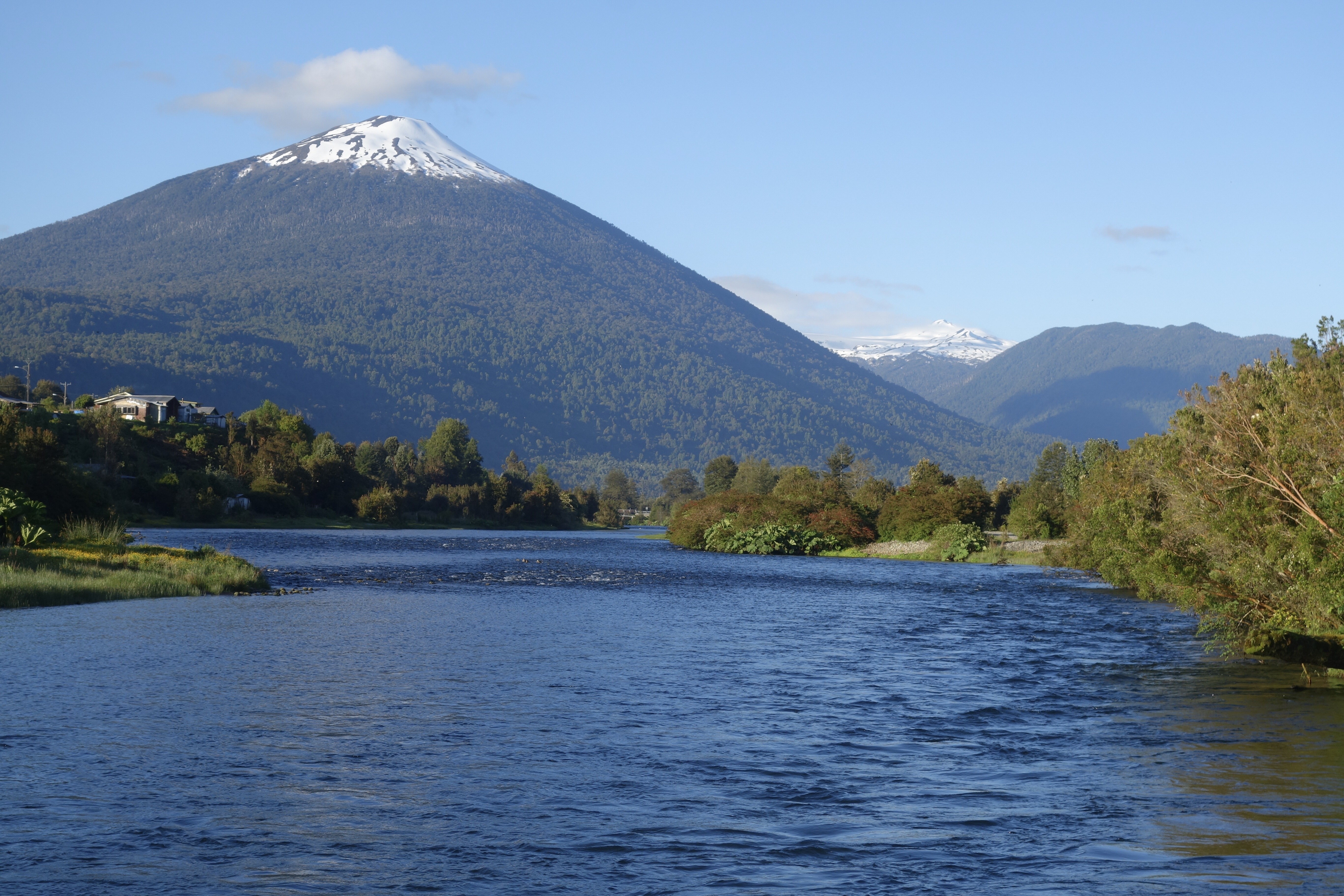
Under the mighty presence of Volcán Hornopirén, we drank a six-pack of cheap beer and cooked an indulgent, yet well-earned, fresh mussel paella. 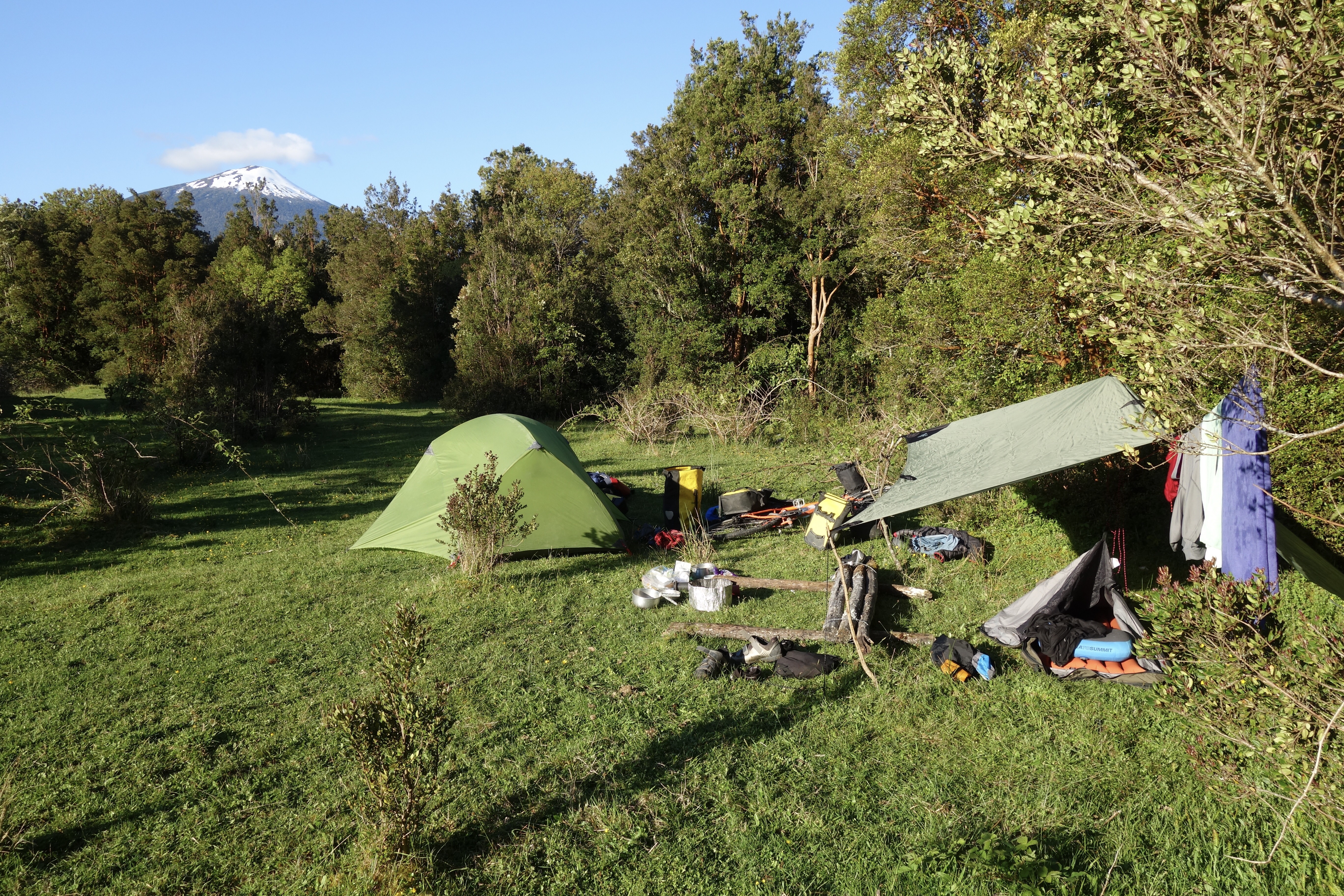




The sound of an alarm was a foreign yet necessary cause to wake up the next morning. With the ferry departing at 7.30am, we concurrently broke camp, ate breakfast, drank coffee, and packed the bikes. Dad was still struggling slightly with the impacts of jetlag and summarised his night by saying that he ‘had a terrible sleep but a great lie down’. We made it to the ferry terminal in time to get a cup of super-strength Nescafé and a bunch of bananas before rolling the bikes on board and climbing to the top deck.
The crossing from Hornopirén to Caleta Gonzalo was scheduled to take approximately five hours. As the boat pulled away from the dock, bow pointed south to where mist emanated from mountainous valleys, our sense of remoteness and adventure grew immensely. The air chilled our faces as the boat cut through an otherwise breathless morning. The inky water responded like silk as the vessel dissected the serene and uninterrupted fjord. Dozens of salmon ponds floated inconspicuously throughout the waterway and densely forested slopes rose steeply from the rocky shoreline. The knowledge that this region was only navigable by boat was humbling. I feel that we’ve come to take roads for granted; endless, interconnected thoroughfares from wherever we are to wherever we want to be, with little recognition given to the immeasurable effort required during their construction. However, when a road simply ends where the water begins because there is simply no other option, it is impossible not to feel respect and humility towards the surrounding hills, rivers, and forests.
Throughout the morning, other passengers emerged from inside to take in the views on offer. Most notable of the other people on board were several cyclists. We had seen a few loaded touring bikes on the lower deck but were yet to come across their owners. Knowing that it was a long ride, we’d both put pants on when we’d boarded the boat. With the possibility of some rougher water beyond the estuary, we didn’t want to add to anyone’s seasickness by parading around in our lycra. The other cyclists, however, were embracing both their skin-tight attire and evident lack of insecurities. This unique garb did allow us to easily identify the owners of the bikes and strike up conversation over our shared mode of transport.
The first couple we spoke to were from Oregon. Both teachers on sabbatical, they were planning to use the following six months to ride from Puerto Montt to Ushuaia (the world’s southernmost city) and back again. They had left Puerto Montt the day before us and were forthcoming in highlighting their lack of experience. Dad chatted to the man over their professional commonalties (both woodwork teachers) while I spoke to his wife who was a theatre teacher. I could tell that Dad was fascinated by their drive and desire to undertake such a trip. After they had retreated inside to the warmth, he expressed his amazement, which I perceived to be reflective of several factors. Firstly, despite riding for fitness on a regular basis, he’d never actually travelled by bike. His decision to acquire the necessary equipment for cycle touring and join me on the other side of the world required an enormous belief and level of risk. He had mentioned several times, both before and since arriving, that if he can’t keep up or is holding me back, we can split up and arrange to meet later. In addition to his lack of experience, it is not something any of his peers had ever done either. Perhaps it wouldn’t have been such a monumental decision earlier in his life, but at 61 years old, it was a concept that was also hard to sell to friends and family before leaving home. As a result, I can imagine he felt relatively alone in his physical and emotional preparation for the trip. And, up until boarding the ferry from Hornopirén, he would have felt like the only 61-year-old in the world riding his bicycle through the wilds of southern Chile! Meeting similar aged, like-minded people was empowering and, over the course of the trip, contributed to Dad’s growing desire to see more of the world from the seat of a bicycle.
The next couple we met on the boat took Dad’s admiration to a whole new level. They approached us after noticing our helmets sitting on the ground. After introducing themselves, the man saw my drink bottle which had a sticker of a spotted quoll and immediately ascertained that we must be Australian. Dave and Nancy had been living in Sydney prior to their trip. However, Dave was originally from Oregon while Nancy hailed from the more northern latitudes, referring to Fairbanks in Alaska as home. Dave continued to display his powers of observation, speculating that I had been on the road for a while and that Dad had only recently joined. He said it was because of the superior muscle definition in my legs or something along those lines…
Dave and Nancy had left Alaska almost a year and a half prior, following the Pan-American highway south with the intention of reaching Ushuaia by Christmas before returning home to Australia. Their schedule had been disrupted up by previous winter, so they had settled in Mexico for three months of Spanish classes before continuing on to Central and South America. They told stories of bear encounters in the Yukon and were hoping to find cyclists doing their trip in reverse as they still needed to offload the bear spray canisters they’d been lugging since the start of their trip. Chatting about our respective journeys, it came to light that we’d met, or at least heard stories of, a lot of the same people out on the road. I’d been intrigued by rumours of a Singaporean man supposedly skateboarding the length of the Pan-American. Having met the guy in Peru, Dave quickly confirmed the rumours to be true, explaining how he was using a baby’s stroller to cart his gear. I still can’t comprehend how he made it up (let alone down) some of the hills in Peru (this link gives a little ore detail on the man and his journey). Acknowledging that we’d most likely see each other again over the next few weeks on the road, we said goodbye to Dave and Nancy and headed inside just as a strong breeze began funnelling in from the ocean. Within minutes of sitting down, Dad had succumbed to a much-needed sleep.
The captain of the boat employed the bow thrusters to execute a noisy, yet precise, reverse park at Caleta Gonzalo. The small bay marked the recommencement of the Carretera Austral as well as the entrance to the first of many national parks along the route. After a photo with the other cyclists, I ducked into the park office and purchased a more detailed map of what lay ahead. A motorcyclist about to board the boat and head north, made a strong point of giving us his left-over water, suggesting the road ahead would present us with a fair share of challenges.
It was early afternoon by the time we were back on the bikes and pedalling into Parque Pumalín; one of the newest and most significant national parks in Chile. In March of 2017, the park, which had previously been Chile’s largest private reserve, was gifted to the government with strict covenants in place to ensure its long-term conservation. The visionary behind the agreement was Doug Tomkins; the founder of outdoor clothing and technical equipment brand, The North Face. Two years after launching the brand, he sold his share for $50,000, using the profits to co-found the fashion house, Esprit. Within ten years of launching his second company, Esprit sales were topping $100 million a year. However, it was during this period of rapid growth and success that Tomkins became increasingly concerned about the mounting ecological impacts associated with the fashion industry. In the late 80s, Tompkins decided to leave the business world and by 1994 had sold all his interests in Esprit and many other entities associated with the major fashion label. It was then that Tomkins turned his attention to the conservation of the region through which he had developed a deep connection with over years of kayaking and climbing. Preserving the wildness of Patagonia became his sole purpose in life.
In 1993, Tompkins had married Kristine McDivitt who had once been chief executive of the outdoor clothing brand, Patagonia. Together, they formed The Conservation Land Trust (CLT) as a conduit for promoting the protection of large swathes of southern Chile which were coming under increasing pressure from logging. At the time, one of the most effective ways to achieve their goal was to purchase pockets of land. Initially, the private acquisition of land by Americans was divisive among the local population. Very few could understand, nor believe, why someone would purchase productive land to just leave it untouched.
TLC’s first significant project in Patagonia was Pumalín Park. Following the initial purchase of an abandoned farm at the end of Renihue Fjord (the location of Caleta Gonzalo), they proceeded to acquire an additional 280,000 hectares of mostly adjoining parcels of land to create Parque Pumalín. Following significant negotiations between TLC and the Chilean Government, it was in 2005 that the then-president, Ricardo Lagos, granted Parque Pumalín additional environmental and non-developmental protection by declaring it a ‘nature sanctuary’. TLC then donated the park to a local foundation called Fundación Pumalín, providing them with ongoing guidance in the development of public-access infrastructure such as walking trails, easily accessible campgrounds, and visitor centres. This was all part of Tomkins’ initial plan of ensuring long-term conservation by facilitating a deeper connection to country and strong environmental ethic in the park’s many visitors.
Tragically, Doug Tompkins died from hypothermia following a kayaking accident in southern Patagonia in 2015. However, it is impossible to travel along the Carretera Austral without being reminded of his commitment to environmental protection, an ethos which is still carried and promoted by his widow, Kris. In March 2017, the Chilean president, Michelle Bachelet, confirmed that the government would be accepting the gift of 400,000 hectares of land from Fundación Pumalín. Bachelet went on to announce that the newly gifted land would constitute an integral part of five new national parks in southern Chile, amounting to a total area of over 4 million hectares. In his establishment of these new parks, Bachelet aptly renamed Parque Pumalín to Pumalín Douglas Tompkins National Park. Our appreciation for such selfless and ground-breaking pursuits of environmental conservation would continue to grow over the coming days. As we rode through Pumalín Douglas Tompkins National Park, I couldn’t help but think about how the Tasmanian government is continually trying to devise ways of reversing, or at least loosening, the protective covenants on our national parks and world heritage areas. Determined to unlock the economic potential of these wild areas, few politicians seem to recognise that leaving these places in their natural, unspoiled state for all people for all of time, is by far the most valuable action.
Within 100 metres from the visitor centre, the asphalt gave way to gravel and the dense vegetation of the Valdivian temperate forest closed in either side of the road. Over the next few hours, we crossed bridges under which pellucid waters churned as they rushed down from the hillsides. Large lakes were visible from the highest points on the road. Energised by the wilderness, we left our bikes at a roadside trail head and walked up to a set of waterfalls which plunged into a cavernous gorge that roared from within. Rain showers came and went, feeling like a necessary component of such a verdant wonderland.
When we arrived at the first campground along the road, we found Dave and Nancy set up in what seemed to be the only sheltered site. Given the weather and the fact we were both loving the riding, we pushed on for another 10 kilometres to Lago Blanco. Once there, we discovered an empty campsite and indulged in the luxury of wandering throughout the various sites to select the best. And, as far as campsites in Patagonia go, it seemed as though it would be hard to beat. A hexagonal timber shelter perched on the edge of the lake, afforded us a dry area to cook and sleep whilst watching the light fade and sheeting rain dance between the mountains. Dad made the most of an early night to catch up on some sleep, while I sat and did some writing only to be distracted by the teasing rise of a trout metres from where I sat. Just on dark, I was joined by a tiniest hummingbird, which hung in the air long enough to extract a sweet dessert of nectar from a lone pink flower dangling over the water.
Light rain the following morning inspired a leisurely breakfast and several coffees. We packed up our gear which had completely dried out overnight in the shelter and left Lago Blanco around 11am. Gentle undulations punctuated by some short, sharp climbs made for great riding. With a longer ride planned for the following day, we only had about 40 kilometres to cover before arriving in the town of Chaitén where we’d spend the night. Considering the shorter day, we decided to take a detour to explore a small beachside settlement we’d seen on the map called Santa Bárbara. Perhaps it was the cool, wet conditions, but I was secretly fantasising that Santa Bárbara would be just like the sundrenched Californian city with same name.
Unfortunately, I didn’t pay enough attention to the map and after 10 kilometers we stopped to discover that we’d (I’d) taken the wrong road. Both feeling pretty hungry, we pulled up outside a small airfield and ate lunch in the gutter beside a wire fence which kept us from riding on the runway. It was a long way from California, but an egg and avocado sandwich distracted us from the cold wind.
On our way back the Carretera Austral, we located the actual turnoff to Santa Bárbara which was only 300 metres from the main road. We rode down to the beach and found a beautiful grassy park with picnic tables overlooking the ocean and the unique black sands. I’ll keep it in mind for next time.
It was 3pm by the time we rolled into Chaitén; a sizeable town situated strategically close to where the Carretera Austral heads inland. This position makes Chaitén a significant trading port and a popular option for those who want to catch a ferry directly from Puerto Montt before continuing south via bus. The town was remarkably quiet when we arrived. We had become increasingly aware that the peak tourist season was a few months away, but the distinct lack of humans was still striking. Following two laps of the town, we stopped to ask two young Mormon missionaries if they knew of any cheap accommodation options. We mustn’t have looked impressionable as the elders were quick to point us in the right direction without any attempt at conversion.
We stood in the rain for a while before an old lady eventually opened the door of the double storey hostel on the main esplanade. She was as happy to have customers as we were to have a dry place to stay. She called for her husband who showed us to his large garage and made a point of emphasising how safe our bikes would be overnight. Once in the room, we strung up a line to dry our gear while waiting for the weather to clear before heading out on foot to explore the town.
It was a neat town of clean lines and tidy streets, hemmed in by steep forested hillsides. However, there were a few physical features that prompted further inspection, revealing an explosively traumatic recent history. Firstly, the ‘waterfront’ lacked water. The beach extended as far out into the bay as we could see, littered with driftwood and clumps of regenerating vegetation. The other confusing element was the course of the Rio Blanco; the main river running through the town. Rather than the town being built around the natural course of the river, the surging water appeared to slice directly through Chaitén. With heavily reinforced banks, the river almost appeared to have come after the town. Later that evening, I read about the history of Chaitén which provided an explanation for our observations, whilst instilling a deeper respect for the landscape and people of the region.
Settled in 1940, locals were completely unaware of what lay sleeping at the head of the valley behind their town until the night of May 2nd, 2008. It was on this night that an unnamed volcano burst to life, sending plumes of ash 20km into the sky and providing the rest of the world with the first ever footage of a rhyolitic eruption; a geological phenomenon renowned for violent and explosive activity. 4000 people were evacuated over the next 24 hours, as the volcano continued to splutter and cause pumice and ash to rain down over Chaitén. Impressively, there was not a single death.
Several days later, on May 12th, Chaitén was completely flooded. A violent form of mudslide composed of volcanic material known as a lahar, churned down the Rio Blanco river valley. This caused the banks of the river to overflow by 200 metres on either size, depositing the material at the then river mouth. This stopped the river from reaching the sea and raised the height of the pre-existing beach so that it was now above the high tide mark. Over the proceeding months, the Rio Blanco cut a new course through the centre of the abandoned town, essentially splitting the settlement in two.
The months and years that followed were plagued by uncertainty and controversy. In February of 2009, the Chilean government announced plans to completely rebuild Chaitén, 10 kilometres north at Santa Bárbara. As work began to build the town’s new administrative facilities, locals began returning to the ash-cloaked streets and showing resistance to the relocation of their home. In 2011, the government succumbed to local pressure and announced a program to rebuild the town on its existing northern half.
It was hard to comprehend that all of this had occurred within the last ten years. However, it provided us with more of an understanding of the town’s layout and reserved atmosphere. We bought a few beers and sat at the foreshore overlooking the dark volcanic sands, attempting to understand what the locals must have experienced on that night in 2008.
A little tipsy, we stopped at a small supermarket to stock up on a few staples for the coming days. As we were leaving, we ran into Dave and Nancy who had the same idea. We shared our plans for the coming days. Considering we were all following the same road south, our ideas were unsurprisingly similar. As we walked away, Dad’s competitive spirit, aided by some Dutch courage, snuck into the conversation.
‘We’ll put those two away tomorrow; no way they can keep up with us when we get to the real hills.’
We ate dinner that night at brilliant little restaurant called El Rincón del Mate. Sitting inside a large, canvas-covered geodesic dome, we indulged in woodfired pizzas and a pint of Patagonian Pale Ale. While eating, I paged through several books of local photography. Images of wild rivers, snaking mountain roads and glacial landscapes provided an exciting taste of what lay ahead on the Carretera Austral.
 Faults and Folds