Our night in Chaitén left me rested legs but painful stomach cramps. I managed to eat a little breakfast before we checked out of the hostel, cleaned our chains, and hit the road. The bent over position on the bike provided some slight relief but any real exertion caused the stabbing sensations to promptly return. Dad bought me can of Sprite at a roadside shop which seemed to kickstart a slow but positive recovery over the course of the morning. Fortunately, the riding was sensational and provided ample distraction from the pains within.
As part of Chaitén’s recent rebuild, the road out of town had been upgraded, providing a perfectly smooth surface for cycling. Aided by a stiff tailwind, we moved along the valley floor with relative ease. The road remained dry all morning, despite the thick cloud hanging to the peaks above threatening to dampen our spirits. After an hour of riding, we pulled into a bus stop where I lay down for a while seeking respite from the lingering stomach discomfort.
Following another hour of ceaselessly undulating riding, we arrived at the northern end of Lake Yelcho. As we rested in another bus stop (something that would become commonplace along the Carretera Austral), an elderly man slowly shuffled past. The hood of his jacket covered his eyes and a fishing rod rested over his right shoulder. His left arm hung by his side, holding a branch from which three enormous trout swung as he walked. With their heads near his hand, their tails brushed against his calf. It was one of the many times over the coming weeks that we would come to regret not packing a fishing rod. He nodded in our direction and left us fantasising about fresh trout cooked over an open flame. We finished our muesli bars and got back on the bikes.
The shoreline of Lake Yelcho was dotted with rustic fishing lodges, albeit all boarded up for the season. I imagine it would be wonderfully vibrant place to spend a few weeks during the summer months. Traversing the western shore of the lake took much longer than it should have as we were held up by road works. Crews were working to restabilise rocky banks and rebuild sections of washed out road. I got the feeling that this was a never-ending job in Patagonia; a region of climatic extremes and regular deluges.
The afternoon was dominated by the first significant climb of the Carretera Austral. The rain became steadier the higher we climbed. The road followed a creek which narrowed the closer we got to the watershed at the top of the pass. A few hundred metres before reaching the saddle, a ute pulled up next to us. The sound of the engine combined with the falling rain and a significant language barrier made it difficult to understand what the driver was trying to communicate. He spoke passionately, becoming increasingly frustrated by our incomprehension. A few words stood out in what he was saying; ‘Habitacion’, ‘matrimonial’, ‘amigos’, ‘Santa Lucia’…
From what I could tell, he was calling us his friends and saying that he had a hostel where we could stay when we arrived in Santa Lucia; the town we were aiming for that night. I thanked him for the offer and tried to communicate that we would see how the afternoon played out. He sped off up the road shaking his head.
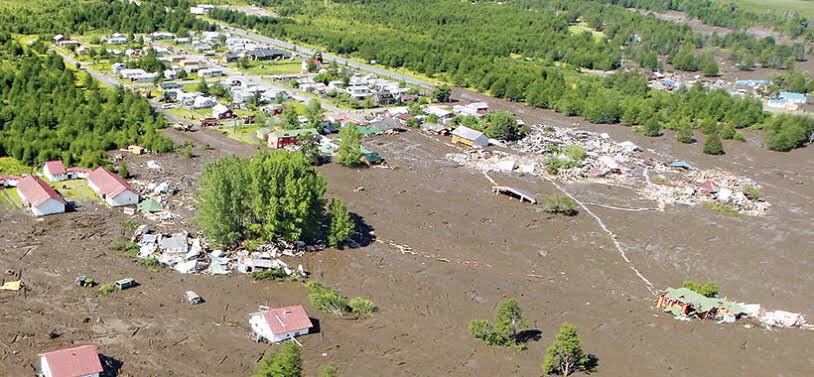
The descent from the top of the climb was wet and cold. After a few kilometres of riding through thick forest, we emerged into what appeared to be a clear-felled forestry coup. The gravel road dissected a monotony of mud, decomposing plant matter and fallen trees. We followed this trail of destruction for a few more kilometres of bitter riding, before gaining our first view of the devastation that was Villa Santa Lucia. Half of the town had literally been turned upside down. Houses were submerged in a turmoil of mud and debris, only their roofs exposed above the dishevelled landscape. Chilean flags that had once flown proudly from homes, now lay shredded in the mud. We would later learn that the scene before us was the result of a catastrophic landslide that had torn through the region in December of 2017.
It is believed a glacial outflow lake had burst eight kilometres up the valley from Villa Santa Lucia. Due to the steep gradient, a maelstrom of mud had made its way through the landscape, gaining velocity as it neared civilisation. The residents of Villa Santa Lucia were given little to no warming of the encroaching catastrophe. The slurry engulfed the lower lying half of the town, flattening everything before it and taking the 20 lives. This tale, combined with the story from Chaitén the previous night, rammed home just how volatile and powerful the natural world can be sometimes. Interestingly, the concept of bursting glacial outflow lakes is a topic I cover with my Geography class. As glacial melting and retraction increases with changes in the climate, there in a subsequent increase in the volume of meltwater at the terminus of a glacier. As a result, the lakes that store and slowly release water into the glacier-fed rivers below, are breaching their capacity. Consequently, the moraine that holds the water back can burst, leading to rapid, high-volume floods. This phenomenon is increasing throughout all the world’s glacial regions. And, when people live down stream of glaciers, as so many millions around the world do, they are at risk of facing disasters like the one experienced in Villa Santa Lucia. Governments the world over are investigating various ways of mitigating the risks of glacial outflow lake flooding, such as improved upstream monitoring and climate modelling, and physical intervention such as reinforced dams.
After riding through the remaining half of Villa Santa Lucia, we were surprised to find anything open, let alone somewhere to stay. Just off the main road, roughly 50 metres from where the landslide had passed, was a small hospedaje. A friendly older lady answered the door in baggy sweatpants and a thick woollen jumper. For approximately AUD$8, she was happy to rent us an upstairs room. The corridors were shoulder-width and we had to duck our heads to stand up in the room. Another room across from ours had the flue of the downstairs fireplace coming through the floor. The lady let us hand our clothes up in there overnight, acknowledging how wet and cold we looked. Downstairs, the fireplace was glowing, providing us with every reason not to head out into the cold, wet streets.

We settled in for the afternoon, indulging in few games of Scrabble on the iPad, followed by a long nap. When we woke the rain had eased, prompting us to go for a wander. I don’t think I’ve ever experienced such desolation while walking down the main street of a town. We found a shelter with some benches and tables where we could cook up some dinner. After getting the water boiling, I pulled out a small bottle of whiskey I’d secretly bought in Chaitén which instantly lifted our spirits.
As we warmed our cockles and let the soup simmer, our attention turned to another cyclist riding towards us. Seeing another foreigner, let alone a cyclist, seemed incredibly unlikely. He pulled over, sopping wet, and introduced himself as ‘Jeffrey’ in a thick French accent. He looked as cold as we had felt a few hours ago and was quick to ask where we were staying. We pointed him in the direction of the hospedaje and he headed off to get dry, telling us he’d be back for a stiff drink and a cigarette shortly.
We soaked up the soup with some leftover bread from breakfast in Chaitén, before washing it down with another whiskey. As I was doing to dishes, the door of the house next to us opened and, seemingly out of nowhere, emerged Dave. He was as surprised to see us as we were him, telling us that he had to step outside for some fresh air as the fire was simply too hot in his room. He went on to explain that he and Nancy had arrived in town around lunch time and had met a man who had welcomed them into his hostel for the night. I could tell Dad was wondering how we’d been beaten. Dave then said that he had told the owner of the hostel that there were two other riders (us) on their way to Villa Santa Lucia who would also be looking for a room. The owner had then apparently driven up the road looking for us to tell us that our friends had organised for us to stay in the hostel with them. This explained the interaction we’d had with the man at the top of the hill earlier in the day. A few minutes later, the owner pulled up in his ute. He seemed pretty put out to see us cooking dinner in the street outside his building and choosing to stay somewhere else, despite his efforts out on the road. I wanted to apologise for the misunderstanding, but the moment was well and truly lost.
Dave hung around for while telling us stories of his trip and reminding us of the horrendous weather forecast for the following day. He then said he needed to go and buy some ice cream for Nancy, again emphasising that it was like summer in their room. Just as he left, Jeffrey turned up. Despite the second-hand smoke from his hand rolled cigarettes, he was a breath of fresh air; charismatic, humble, and strikingly honest. Hailing from Montreal, hence the French accent, this was his first cycle tour. He had also started in Colombia around the same time as me and we quickly discovered we’d had several parallel experiences without ever crossing paths. As the rain set in for the night, we wandered back to the rooms, sharing new philosophies on life that have evolved from thousands of kilometres on a bike. He told us that he had bought his bike new for the trip and planned to hand it on to his son so that he can have a similar experience one day. After a long pause, he added that he doesn’t have a son yet but thinks it could happen one day.
In the morning, the sound of rain on the tin roof resulted in several alarm snooze cycles. We eventually dragged ourselves out of bed and migrated downstairs to the fireplace, where the old lady offered to cook us breakfast for a small additional fee. A spread of toast, jam, eggs, and coffee filled the small vinyl covered table. Jeffrey joined us after a while having been out in the rain fixing a flat tyre. Despite the suboptimal weather, he was beaming with excitement. He’d read the news earlier that morning and discovered that Canada had just announced the legalisation of recreational marijuana. With plans to return to his job as a civil engineer in January, he was confident that the legal personal quota of 30 grams would make the transition from a life of travel back to work much easier.
Decked out in our wet weather gear, Dad and I eventually left Villa Santa Lucia around 10.30am. As is always the way when stepping out into inclement weather, it’s never as bad as you think it’ll be. 15 minutes down the road, sunshine broke through forcing us to stop and remove the additional layers of clothing. Over the course of the morning, regular breaks in the clouds provided us with glimpses of the enormity and grandeur of the surrounding landscape. Distant white lines connected earth to sky as waterfalls tumbled from unknown heights. Snow-capped mountains reminded us that Summer was still a few weeks away. As we moved further inland, rolling green meadows, timber cottages rich in character, and the occasional soggy cow displayed a change in industry from fishing to farming. We found a bus stop for our daily coffee break but ended up sitting in the middle of the road, relishing the lack of traffic.
The weather changed for the worse over the following hour. At one point, a car slowed down beside me, and the back window rolled down. It was Jeffrey. His repaired tyre had only lasted a few hundred metres, so he had waved down a lift to get to the next town to try and buy a new one. We agreed on having a beer the next time we saw each other. Unfortunately, whilst we’d continue to hear tales of Jeffrey along the Carretera Austral, it was sadly the last time we saw him.
We pushed on to the town of La Junta where we planned to find something for lunch and decide on a plan for the rest of the day. The entrance to La Junta was marked by a dazzling orange suspension bridge over the turbulent Rio Palena. I paused in the middle of the bridge, mesmerised by a small cottage that sat atop a rocky outcrop above the river, half buried in the lush forest. I couldn’t imagine a more tranquil abode from which to watch the world drift past.
With the rain now lashing down and wind gusting through the valley, we settled into the first restaurant we could find. The owner tentatively let us hang our sopping jackets by the wood fire before fixing us some coffees and completos. I think the Wikipedia definition of a ‘completo’ says it best:
‘a hot dog variation eaten in Chile, usually served with ingredients such as chopped tomatoes, avocados, mayonnaise, and sauerkraut. It can be twice the size of an American hot dog.’
We were joined by a friendly young Swiss couple, as we lounged by the fire digesting our meals and contemplating the next move. They were spending the next few weeks driving the Carretera Austral, with the intention of doing as much hiking and sightseeing as possible. Unfortunately, on their first hike in Pumalín Douglas Tompkins National Park a few days prior, the girl had slipped and broken her arm. She was sporting an oversized plaster cast but was certain that it wouldn’t slow her down. They offered to drive our bags to the next town to make the ride easier which was a tempting idea. However, it would have been crazy to commit to a destination given the weather. I could imagine accepting their generosity then encountering a mishap and ending up separated from our belongings. We thanked them before they put on their jackets and rushed across the street to get into their dry car.
From La Junta, it was 45 kilometres to Puyuhuapi; a small settlement at the head of a fjord of the same name. After considerable deliberation and hesitation, we decided to push on. It would take the daily distance to 120 kilometres; a considerable effort given the weather. We put our jackets back on, smashed some chocolate, and rolled out of town.
The weather was strange out on the road. The trees on the ridge high above the road were being buffeted with what appeared to be a strong northerly. However, at road level, the wind and rain were in our faces, blowing in from the south. Knowing that we had a big afternoon ahead, we pushed hard, covering around 25 kilometres during the first hour of riding. The road passed by three thunderous waterfalls which provided a silver lining to the amount of rain that had been falling over the previous few days.
With 16 kilometres to go the road surface changed from smooth asphalt to muddy gravel, dramatically slowing our pace. Fortunately, the surrounding wilderness provided a great distraction from our tired, wet bodies. The road followed the western shore of Lago Rispatron; a mysteriously beautiful lake, hemmed in by forested hills that rose abruptly into the clouds. The occasional trout rolled in the shallows, exposing a silvery belly and disturbing the otherwise halcyon water.
It was 6.30pm by the time we eventually rode into the misty, rain-drenched town of Puyuhuapi. We scouted a few campgrounds on the water’s edge, but quickly agreed that the soggy ground squelching beneath out wheels was less than ideal for a night in the tent. We rode back along the quaint main road, unsuccessful in our search for somewhere to stay. Finally, a helpful local lady pointed us in the direction of a hostel called Augusto Grosso.
Within minutes of arriving we had been welcomed into what felt like an instant family. The door was opened by the owner of the hostel who was a delightfully kind woman. She led us inside to where the warmth from a central fireplace filled the room. Sitting around a large wooden table were the three other guests staying that night, all eager to introduce themselves and make us feel welcome. Helen and Adrian, an older couple from the Netherlands, were also cycling the Carretera Austral. Melissa, a Swiss girl in her early twenties was attempting to hitchhike her way back to Puerto Montt. She was quick to explain that she’d been trying to leave Puyuhuapi for a few days but hadn’t had any success due to a lack of passing traffic and the endless rain. The owner showed us to the last available room; a 4-bed dorm embellished with hand crafted, rustic wooden features. The bunk beds were framed with polished tree trunks while the walls were clad in roughly milled timber boards. The entire atmosphere left us glowing with warmth and appreciation. While Dad showered, I put my jacket back on and headed out to find something to cook for dinner and, more importantly, something to help wash it down. I returned with some fresh produce and a few local brews, excited by the prospect of having access to a fully equipped kitchen. With our bowls full of roasted vegetables and topped with some fresh boiled farm eggs, we sat and chatted to the other guests around the table.
Tall, slender, and silver-haired, Adrian had an engaging presence. He told his own stories, and listened to those of others, with equal patience, respect, and interest. He was recently retired from his job at Nederlandse Spoorwegen; the state-owned, principal passenger railway operator of the Netherlands. Having worked in IT, he explained that his major accomplishment had been the automation of ticketing in Dutch train stations. Later in his career, he had worked on developing an online, nationwide network of real-time delays and alerts for train passengers. Helen was an occupational therapist, working primarily with disabled children. She said it will be a few years yet before she retires as she just loves her job too much.
As the evening wore on, our eyelids became heavier and our faces were reddened by the heat from the fire which Adrian ensured was always burning. The radio had been quietly playing in the background since we had arrived. At one point, Adrian sprung to his feet as though he’d been electrocuted. He turned up the radio with great excitement.
‘This song is by Goyte. He’s Australian!’
It was the internationally recognisable track, ‘Somebody That I Used To Know’. The song, released in 2011, had reached the top of the charts in 24 countries.
‘Do you know the singer’s real name?’, Adrian asked.
I was confident in my answer. I’d seen him perform live several times.
‘Wally de Backer’, I stated with confidence.
‘Ah, yes. But his actual name is Wouter De Backer. Wouter is a Dutch name. Don’t you think it’s amazing that a song by an Australian with a Dutch name is playing on the radio in Patagonia on the night we have met each other?!’.
I loved the way Adrian’s mind worked and would have loved to hang out all night. But, it was 10pm and Dad and I had become rudely tired. We thanked everyone for their company and retired to our room; the timber dream factory.
Sleep came easily that night. It was still raining when I woke to Dad pinching my foot from his bunk like a bored classmate on a school camp. Before arriving in Puyuhuapi, we had already agreed that it was where we would have our first rest day of the trip. However, when we got up Melissa was quick to tell us that there had been a landslide overnight, taking out a section of road 20 kilometres to the south. We were staying put whether we liked it or not. Melissa was in tears, as she had booked a bus so that she could finally get out of town, but now the bus couldn’t get through and she had to stay for another day. I didn’t have much patience or empathy for her distress at getting stranded in a remote Patagonian village. To me, it seemed like a dream scenario. I left Dad talking to Helen and Adrian and went back to the small convenience store around the corner to buy ingredients for pancakes. If we were having a rest day, we were going to do it properly.
Adrian and Helen, also stranded due to the landslide, spent the morning moving hostels. They had run out of cash and Augusto Grosso didn’t have the facilities to accept card. Fortunately, we had enough pesos to stay a few more nights if necessary. Throughout the morning, the hostel owner’s predictions of when the road would be passable varied from one day to a week. The situation was out of our hands, and with cabin fever beginning to set in, we headed out for a stroll.
We made it a few hundred metres before being forced to take shelter as another squall blasted up the fjord. An undercover area decked out with an assortment of outdoor gym equipment provided an hour of entertainment. Between leg presses and pull ups, we read some of the surrounding interpretation boards to gain a better understanding of our location.
Like most settlements in Patagonia, Puyuhuapi is a product of perseverance and tenacity. However, the history of the town was somewhat distinctive. The colonisation of Puyuhuapi began in 1935, driven by the vision of two young Germans; Otto Uebel and Karl Ludwig. Motivated by their adventurous spirits and a fear of war unfolding in Europe, Uebel and Ludwig emigrated from Germany with their families. At the time, colonisation policy in Chile basically stated that land would be granted to anyone who could make it productive and habitable. With this opportunity in mind, the Germans set out with the grandiose intention of gaining complete sovereignty over the vast and unpopulated region of Patagonia, starting with Puyuhuapi.
The head of Puyuhuapi Fjord offered a sheltered location for an initial settlement whilst remaining easily accessible by ship. The two men were guided by Augusto Grosso (the namesake of our hostel!) who they had met in Santiago. Grosso had previously explored the area they were wishing to establish and provided the men with invaluable knowledge of the local climate and methods for dealing with the impenetrable vegetation; namely, how to effectively wield a machete. As they sailed south from Puerto Montt on an old sheep transporting vessel, they enlisted the help of several men from the Chiloé islands. Chilotes were hard workers and would provide a valuable labour force when it came to construction and land clearing.
The settlers faced considerable challenges over the first few months. They had decided to construct homes out of the reeds that grew prolifically in the shallows of the bay. However, these structures were no match for the first floods that swept through the valley. By the time they were ready to welcome more German colonists, the political climate had changed considerably back in Europe. Now on the brink of World War II, Germany needed to retain as much youth as possible, subsequently denying any further applications for emigration permits.
The war in Europe also created changes in Chile. The immigration and colonisation laws were practically reversed. When Uebel and Ludwig had first arrived in South America, colonists had had more freedom than Chileans when it came to land rights. However, with the outbreak of the war, new legislation meant that the men had to go through the process of becoming official Chilean residents in order to remain entitled to their land.
Having satisfied the necessary bureaucratic procedures, the Germans returned to Puyuhuapi to continue developing regional industries. Successful farming and forestry operations saw the growth of the area, as more Chilotes and some ex-pat Germans arrived in search of new opportunities. As the community grew, so did the need for new economic activity. With knowledge acquired in Germany, and the skilful handiwork of some local Chilote cabinet makers, the settlement of Puyuhuapi developed a series of semi-mechanical looms and what became a burgeoning textile factory. Cloth and carpet made in Puyuhuapi became known all over Chile. The growing demand for these products resulted in the employment of many Chilote women who used the new looms to produce traditional rugs known as choapinos.
Following a few great years, the factory and most of its looms were destroyed in by a fire in 1958. As a result, the economy and population of Puyuhuapi lay dormant for two decades until the Carretera Austral reconnected the village with the rest of Chile in the late 70s. Puyuhuapi is now home to a permanent population of roughly 600 people who still rely on farming and fishing. However, it is the tourist season that provides the greatest economic stimulation each year as more and more people from around the world set out to experience Patagonia.
The rain was relentless that afternoon. We returned to the hostel and had a lunch of toasted sandwiches and scrambled eggs, before watching the clock until it was an appropriate time to make dinner and have a whiskey.
The following morning brought more rain and increased anxiety regarding the state of the road. As we were eating breakfast, the owner of the hostel came into the kitchen to discuss our plans, becoming noticeably concerned when we showed interest in possibly leaving later that day. To help communicate her position, she used her mobile to call in backup. Within minutes, her neighbour Phillip walked in looking slightly frustrated at having been made to walk in the rain. Phillip could speak English quite well, but still used his phone to translate the most important points in the conversation. He explained that crews were still working to clear the road, but he had also heard of some smaller vehicles getting through earlier that day. However, he went on to emphasise that there was an enormous, unsealed climb waiting for us just past the site of the landslide, which would be incredibly difficult in the current weather conditions.
It’s always difficult when a non-cyclist expresses trepidation towards road conditions and topography, especially when you know from experience that it probably won’t be that difficult. You must demonstrate respect for their concerns and try not to leave them feeling disrespected when you choose to go against their advice. After hearing Phillip’s description of the hill, I had a quick look over a map and worked out that the climb was around 9km long and gained roughly 500 metres of elevation. It certainly didn’t seem that significant on paper. We thanked Phillip and let him know that we’d consider everything he told us as we made our decision.
Following another coffee, we decided to give it a crack. The rain was still falling when we walked outside to get our bikes. Having thanked the owner for her hospitality and care, we wheeled the bikes out to the street prepared for whatever lay ahead. It was then that Phillip reappeared from the house next door, waving his hand while still talking on his mobile phone. He came over and told us that the road had been closed again and that there was no chance of getting through that day. It was bittersweet. We were able to return to the warmth of the fire, but sheepishly had to ask the owner for another night’s accommodation.
We spent the afternoon at Scarlet Café which was the only shop in town serving coffee. We’d only been there for ten minutes when Helen and Adrian walked in. Having also been told about the road closure, they’d been to our hostel to see if we wanted to get a coffee. When they couldn’t find us, they naturally went in search of coffee. We whiled away the next few hours with conversation as rain lashed the windows and a pot boiled continuously atop a woodstove. Adrian described the foreign concept of long-distance ice skating. Every few years, an arctic blast will freeze all the rivers in their region, creating skateable highways between neighbouring villages. When this occurs, there is a 200-kilometre race that takes place. Helen added that Adrian often performs well in this race. He argued that it was thanks to his supreme fitness, but she suggested it was only because his legs are longer than everyone else’s. Regardless, the thought of hundreds of kilometres of frozen rivers blew my mind.
Helen and Adrian sent a text to another cyclist they had met a few days earlier, who they’d heard had just arrived in Puyuhuapi, inviting him to join us. 15 minutes later, we had been acquainted with the unforgettable Detlef. First impressions of Detlef left me wondering how he’d made it this far. He was rather rotund and made a point of ordering a hot chocolate with extra whipped cream. He had arrived in Puerto Montt around the same time as Dad and was hoping to also make it to the end of the Carretera Austral. He talked openly of the struggles he’d had over the first few days and I couldn’t help but worry about him going forward. But, as we eased into conversation, his dry sense of humour and unflappable determination began to shine through. He epitomised the adage of ‘slow and steady wins the race’. Not only had he made it to Puyuhuapi, he had made it to South America. I run the risk of writing in clichés, but Detlef, like all of us in that room, had already achieved the often-insurmountable task of committing to an adventurous idea. Age, body-type, and affinity for whipped cream aside, we were all bound by the simple fact we were there.
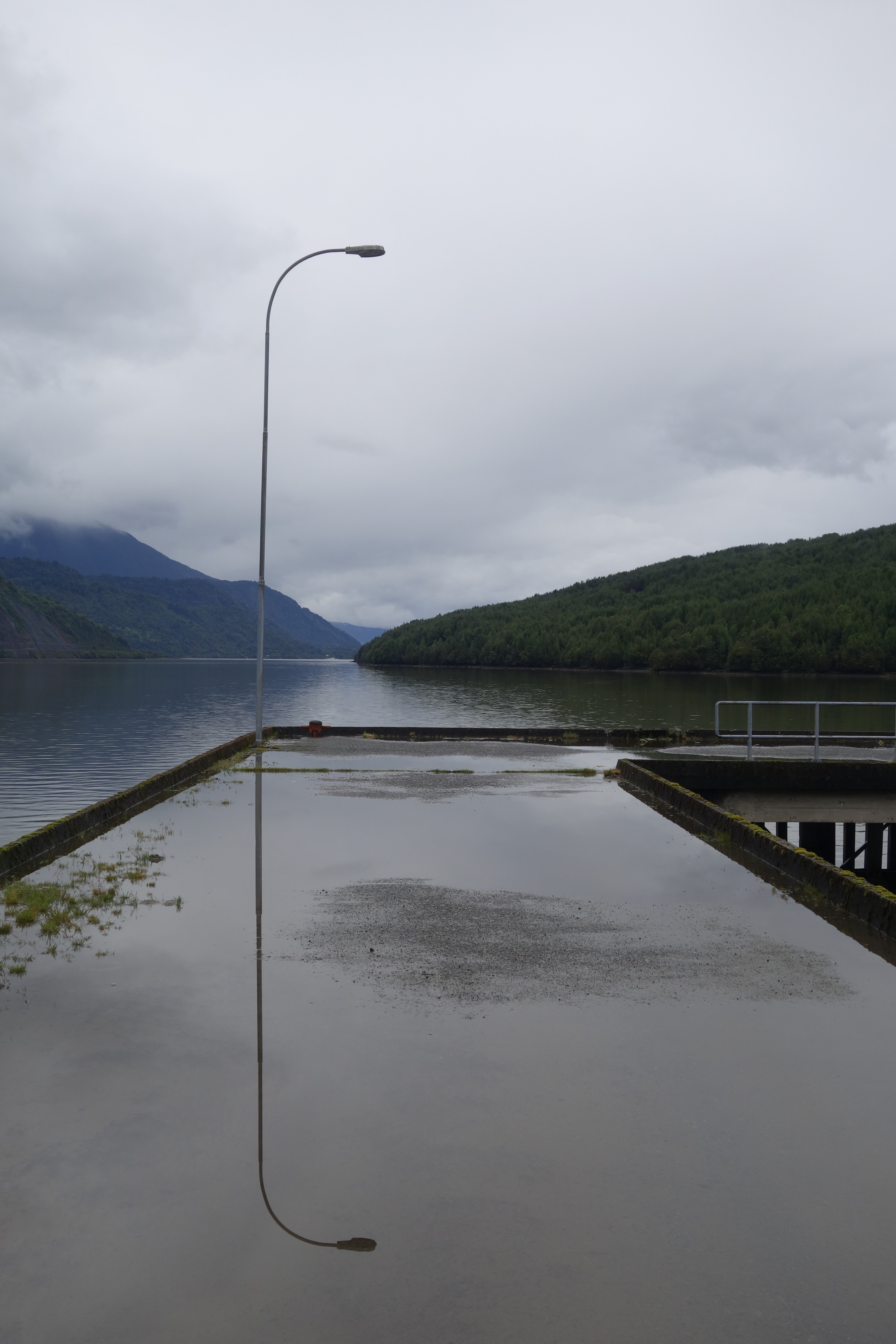
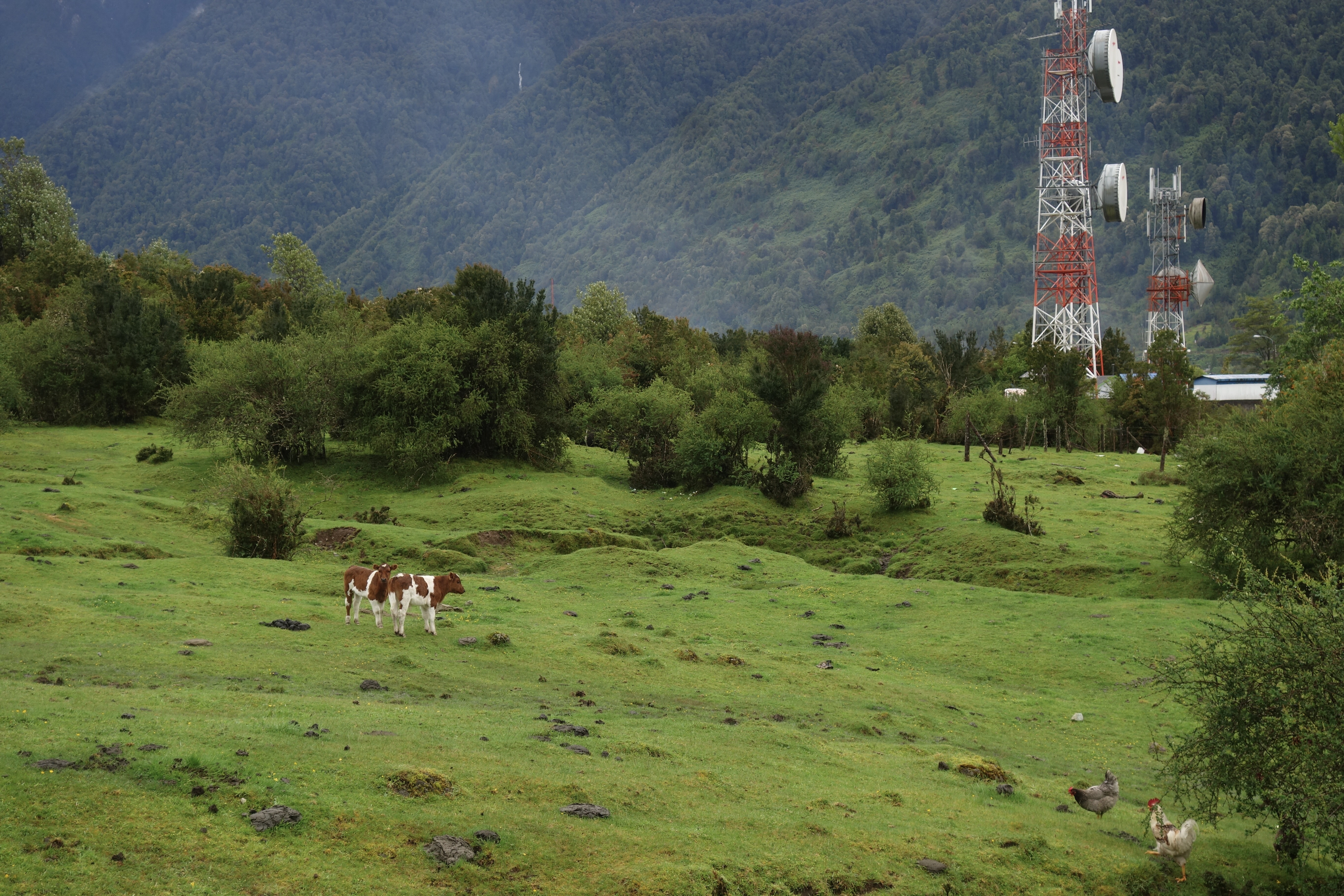
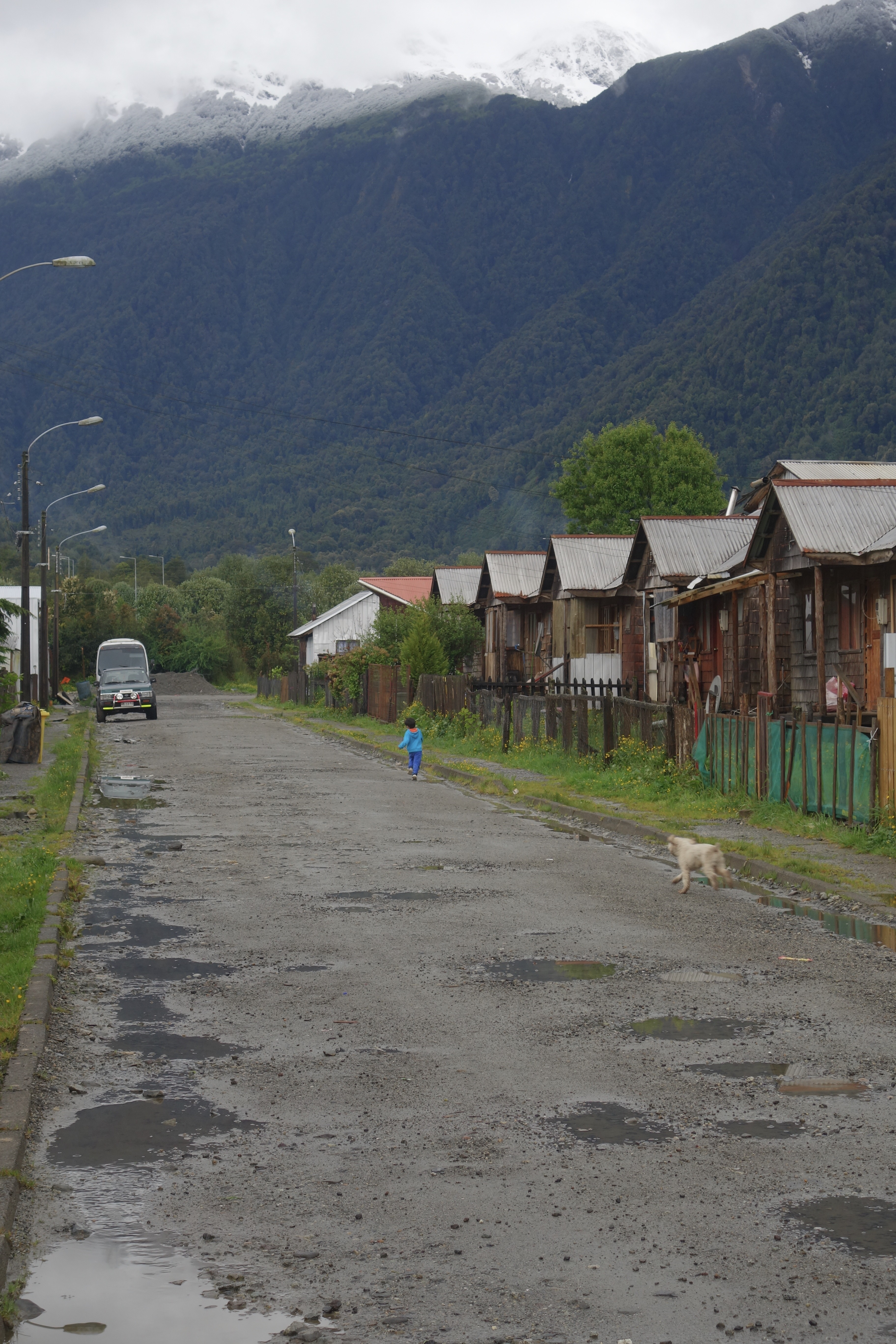
The rain eventually eased enough for Dad and I to get out for a proper walk. We meandered along the foreshore, past neglected fishing boats, decaying timber homes and some miserable, soggy dogs. The contrast between old and new was evident; forsaken buildings beside imposing mobile phone towers. In the same way that weather events hampered the first homebuilding efforts of Uebel and Ludwig in the 1930s, I got the impression that the local climate has a severe impact on the lifespan of buildings in Puyuhuapi. There were, however, a few well-maintained timber churches in the unique Chiloé style; a legacy of the workers that helped colonise the town.
We followed some signs to a walking trail that lead up into the forest above the town. Ducks and horses watched on as we tried to keep our footing while walking through a paddock. Our intentions were halted by an old farmer who wandered over and said that it would be impossibly wet and slippery further up the trail and that we should come back in the morning when the ground has dried out a little. As we returned to the hostel, the clouds parted and the afternoon sun struck the surrounding hillsides for the first time in days, highlighting a notable blanket of fresh snow on the upper ridgelines. That evening was spent cooking a wholesome vegetable curry, playing scrabble, and preparing for our second attempt at leaving Puyuhuapi.
Thanks for reading.
 Faults and Folds