It was clear when Dad woke up that he was anxious to get to a bike shop. We knew that the road quality was due to deteriorate south of Coyhaique and that ensuring our wheels were strong and able was paramount before continuing. However, cycle touring offers an unparalleled sense of freedom, so being reliant on the services of others felt relatively incarcerating. We broke camp and ate breakfast with terrifying efficiency for what was meant to be a holiday!
It was 8am when we arrived at the bike shop with the best online reviews. Unfortunately, we weren’t given the chance to experience their highly touted services as there was a sign hanging in the window indicating that Monday was for riding and they’d be back in business on Tuesday. It was a good thing that we had located all Coyhaique’s bike shops the previous day. We rolled down the street to our second choice, where this time an ‘open’ sign hung encouragingly above the door. I approached the front desk with confidence, ready to explain what we needed. The man behind the counter barely looked up as he told me that the mechanic doesn’t start work until 3pm! We were hoping to be many kilometres south by 3pm. I could sense Dad’s fear of being forced into another rest day. In a bizarre moment of Patagonian serendipity, Helen and Adrian pulled up as we stepped out of the shop. They told us of a great bike shop a few streets over and invited us for a coffee with them and Detlef. Our number one priority was getting the bike fixed but we promised to swing by the café afterwards.

We followed their directions and found Patagonia Cycles with ease. Within ten minutes of arriving, a chubby, tattooed mechanic had replaced the spoke, trued the wheel and pumped up the tires, all for AUD$15. It was a sensational result and injected the morning with a much-needed dosage of positivity. We arrived at Café del Mayo just as a hot chocolate with extra whipped cream arrived at the table for Detlef. The sun-filled café provided a great space to hang out and discuss our respective experiences from the previous few days. At one point, Detlef explained with admirable nonchalance, that he was due to be back at work the next day – in Germany! He went on to say, smirking with a cream-covered top lip, that he had intentionally booked his return flight for two weeks after the date he was due to start work. Two weeks annual leave wasn’t going to be enough time to complete his dream of cycling in Patagonia. He was supremely confident that he’d be able to get a doctor’s certificate in Punta Arenas and slip back into the office without anyone questioning his absence. His priorities were inspiring!

Helen, Adrian and Detlef were planning on staying in Coyhaique for at least one more night, so we exchanged details in case it was the last we saw of each other, before finding a local park to get changed into our cycling attire. Ironically, given the urgency of the morning, it was 2pm by the time we rolled out of town. This was still an hour before the mechanic at the first bike shop was due to start work so we counted it as a win.
The weather was superb! The riding felt effortless as the road traced a meandering line between rolling hills. Bridges carried us over several rivers and the snowy, jagged horizon had us spellbound. Following a long and gentle climb we embarked on a thrilling descent, reaching speeds of 75km/h which, on a fully loaded touring bike, is exhilarating! The hills continued for the rest of the day, albeit mostly in an upward direction, with the last climb stretching out for a sustained 15 kilometres. As we gained elevation, the road dissected dense pine plantations and open fields flooded with yellow dandelions. Remnant snow clung to shady southern slopes, fighting the heat of the encroaching sun path as summer drew nearer.

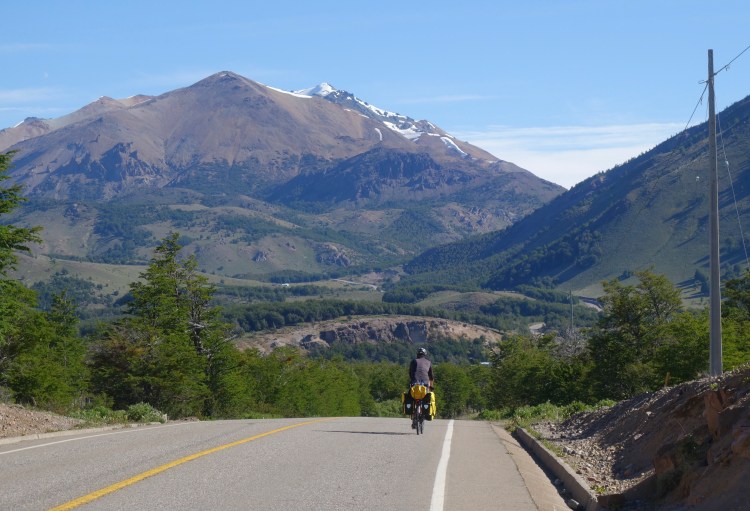
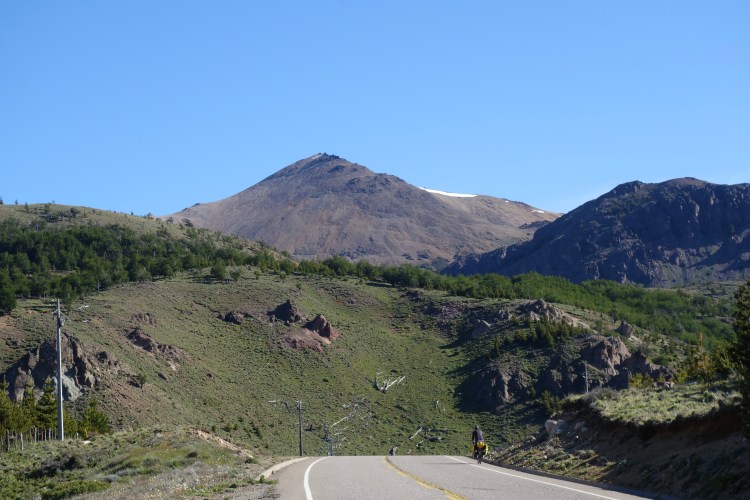
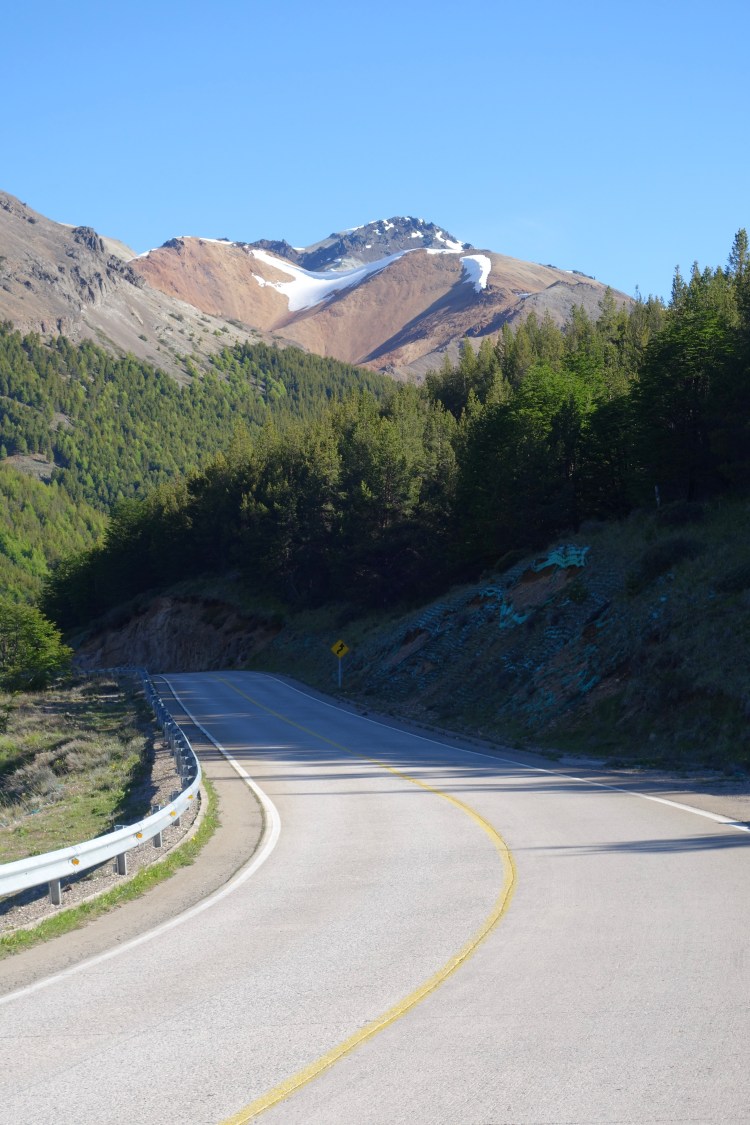
It was 6.30pm when we cycled past a sign welcoming us into Cerro Castillo National Park. ‘Castillo’ means ‘castle’ in Spanish, and the namesake of the park is a 2675 metre peak whose sheer basalt walls and jagged rocky summit appear like a citadel overlooking the region. We dropped into the ranger’s station where we were lucky to catch Paulo, the volunteer ranger, as he was locking up for the night. He welcomed us to the park and explained our camping options. We opted for the closest campsite, a few hundred metres further up the road, situated in the forest beside Laguna Chiguay. We paid the incredibly small fee to Paulo and left him to finish closing the visitor centre.
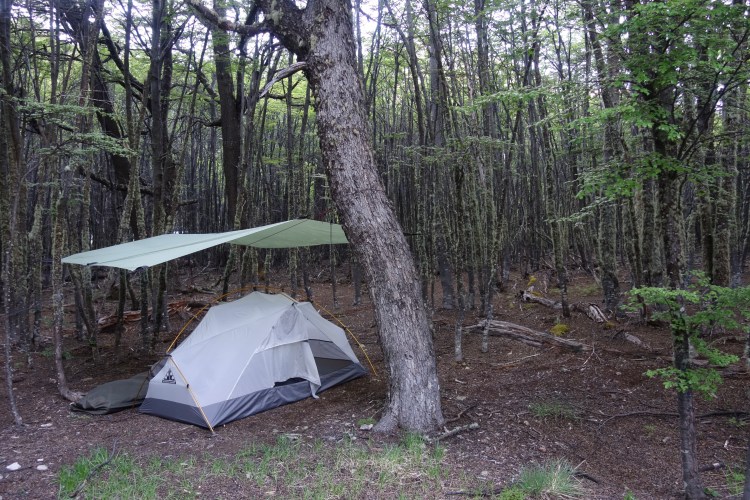
Once again, we found ourselves in the luxurious position of having an entire campground to ourselves. Several small sites, each with a rustic wooden shelter and a picnic table, were tucked privately within stands of old beech trees. The presence of nothofagus trees provided a beautiful reminder of the ancient Gondwanan rainforests of Tasmania. I made some coffee while Dad lit the fire in the toilet block which was designed to heat hot water for the shower. By the time we had set up camp, and transitioned seamlessly from coffee to whiskey, the hot water was ready. The combination of tired legs, the smell of the rainforest, and the sound of a crackling wood heater resulted in what will forever be one of the most memorable showers of my life. Following the transcendent experience, and another whiskey, I was sufficiently warmed from both inside and out. Add in a soft layer of beech leaves beneath my mattress and sleep came very easily that night.

By the time I woke up, Dad had already lit the fire for a morning shower. It was great to see that we were on the same page. As we were eating breakfast, we were approached by two French girls who had cycled in on dark the previous evening. They were riding the Carretera Austral in the opposite direction to us, from El Chaltén in Argentina to Puerto Montt. Both girls were doctors working in different areas of the French Alps and had managed to wrangle time of before the approaching winter ski season in Europe. That morning, while preparing their stove for breakfast, one of the girls had pressurised the fuel bottle without closing the fuel line. Consequently, this flooded the line with fuel and, upon lighting the stove, caused a minor explosion. They were hopeful of replacing the fuel line in Coyhaique but asked if we could boil them some water for coffee and breakfast. We were glad to help.
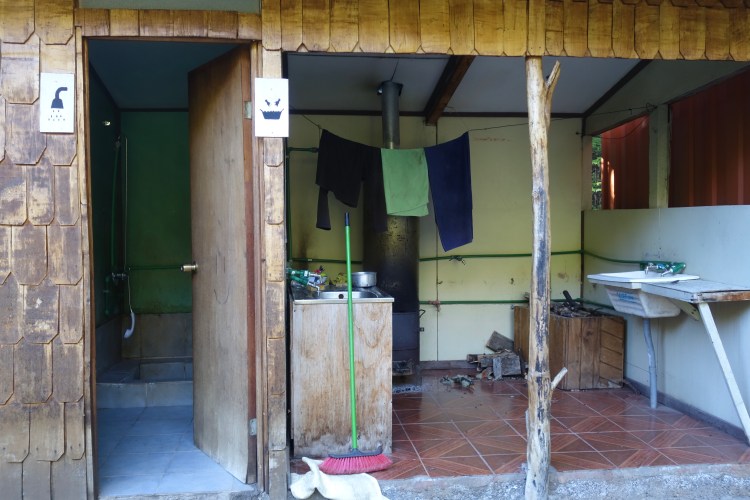
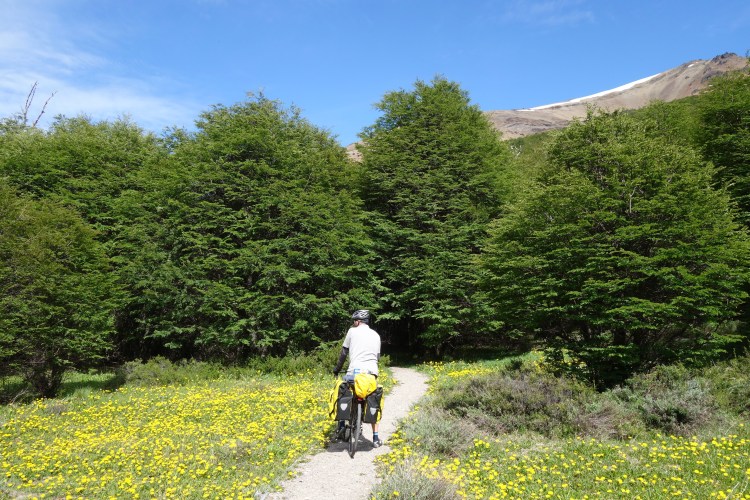
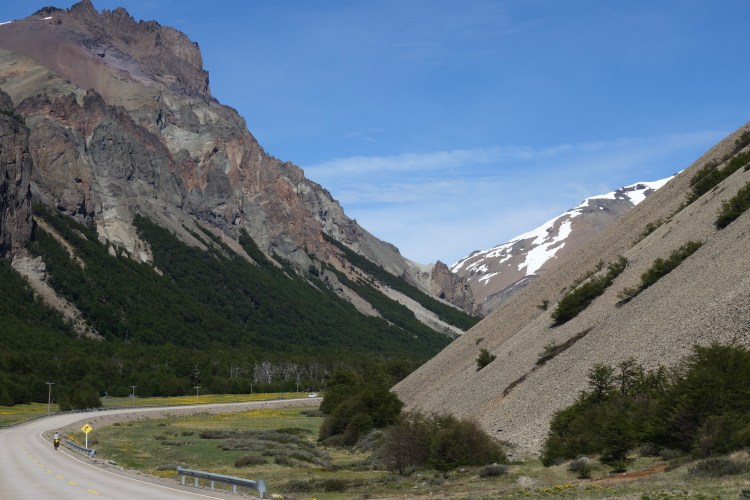
After breaking camp and packing the bikes, we went for a quick stroll around Laguna Chiguay. The aquamarine water, cloudless blue sky, and yellow dandelions created a palette of positivity and happiness. We rolled back to the main road and embarked on what was another remarkable morning of riding. The mountains to either side of us increased in grandeur and ruggedness the further we rode, while swallows playing high against the sun cast shadows ten times their size. Snowmelt from the higher peaks trickled down creases and folds in the hills, feeding clear rivers that raced over beds of ochre, slate, and mocha coloured stones. I could have easily set up camp on the grassy riverbank and spent the day stalking trout. The final descent into Villa Cerro Castillo was comprised of several fast, sweeping switchbacks. I watched on in both horror and total awe as Dad threw caution to the wind, lowering his body position to generate speed and overtaking a truck with ease! He looked so impressed with his renegade riding when I caught up with him.

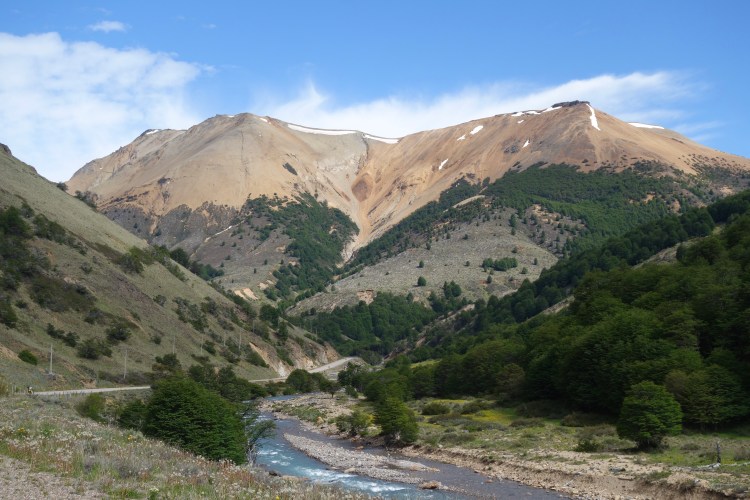
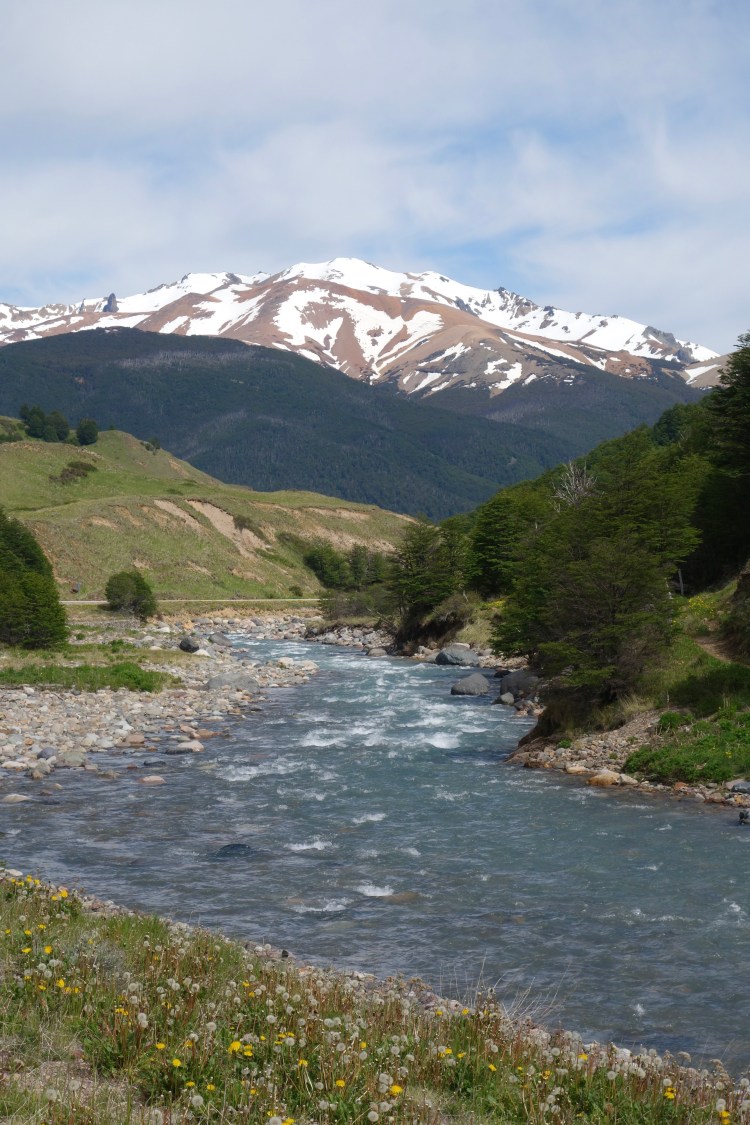



On the outskirts of Villa Cerro Castillo, we stopped to talk to an energetic young couple from Catalonia who were cycling from Ushuaia to Oregon. Their enthusiasm for life was almost tangible; I thought it best not to tell them of the enormous hill they were about to begin climbing. They explained that they were taking a photo of everyone they met while travelling, asking if we’d strike a pose. I can only hope that they captioned the photo with ‘this old man with silver stubble just overtook a truck’. Before parting ways, they convinced us to stop at a specific cabana in a few hundred metres and ask for a glass of calafate juice, promising that it would be life changing!
We took their advice and pulled onto the gravel beside the humble roadside hut. The owner was a delightful lady who took great pleasure in preparing us a glass of fresh calafate juice. Native to southern Argentina and Chile, the calafate berry is small and deep purple in colour. Supposedly tasting like blueberries, only better, we sipped with profound anticipation. However, as hard as we tried, we were unable to conjure the same excitement as the Catalonians, primarily due to the amount of seeds that were left stuck in our teeth. It was refreshing nonetheless, and in addition to its reputation as a culinary delicacy, I would later read that the calafate berry also serves as inspiration for one of the region’s most prevalent mythologies. Local legend says that anyone who eats a calafate berry will return to Patagonia’s captivating landscapes again in their lifetime. For this reason alone, it was worth stopping for a juice.
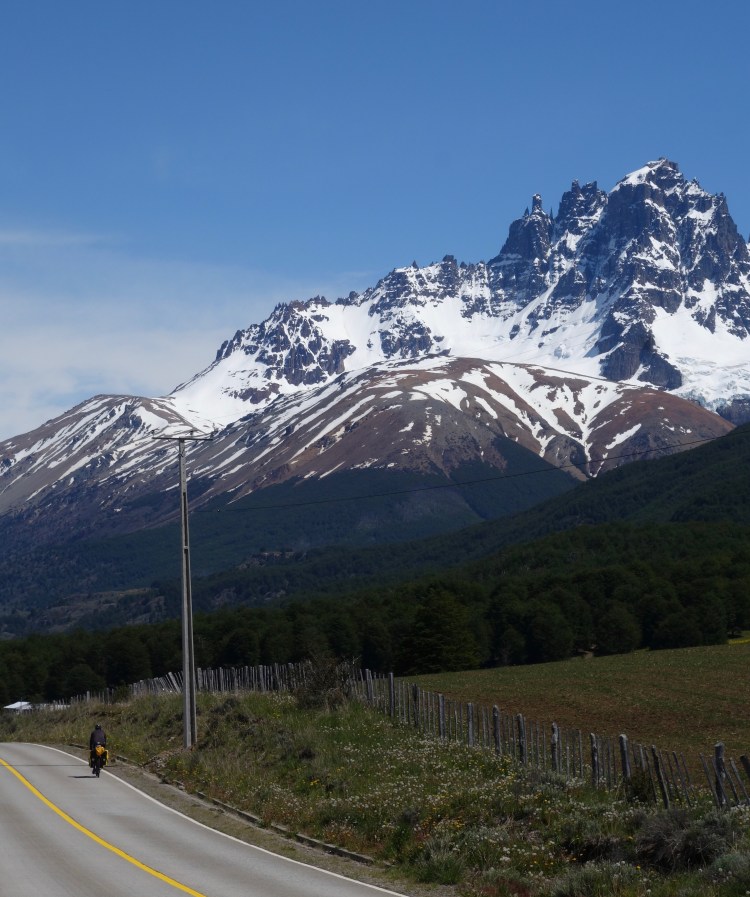

The humble town of Villa Cerro Castillo sat at the foot of the foot of the mountain after which it was named. This was a significant point on the map as we had been informed that this is where the pavement stopped. We had already observed that roadworks are an omnipresent feature of the Carretera Austral. It is the continual goal of local and national governments to seal the entire highway as a means of enabling greater access and trade opportunities for many remote communities. The asphalt snake had recently reached Villa Cerro Castillo from where it would continue surging south over the coming months and years. But for us, the reminder of the road would be comprised of gravel, which in Spanish is referred to as ‘ripio’. Interestingly, ripio is also a slang term in Dominican Spanish, meaning ‘penis’. This is ironic as it is the part of the body that would often hurt the most after some of the roughest sections of ripio.
As we were preparing ourselves to leave, we noticed a lone girl on a touring bike emerge from a side street. She saw our bikes and made her way over to say hello. Sophie was from Belgium and had been stranded in Villa Cerro Castillo for a few days trying to sort out some mechanical issues with her bike. She had flown into Balmaceda, a town near Coyhaique which is home to the region’s largest airport, and was planning to reach Ushuaia by early January. Upon first impressions, Sophie was an unassuming cyclist. Her heavy, over-loaded bike and rigid, upright riding position could have been interpreted as signs of a cycle-touring novice. How wrong we were! Over the following days, we would become mesmerised by Sophie’s unflappable demeanour, admirable self-efficacy, and unrelenting drive.
We used the chance meeting with Sophie as an excuse to further delay our foray south onto the ripio. It was only natural to ask what had prompted her to fly from her hometown of Brussels to Balmaceda to ride alone in Patagonia. To a cyclist with a penchant for adventure the scenario needn’t require justification, it sounds like paradise! However, I am always intrigued by the various reasons people provide for wanting to undertake such journeys. Sophie told us that ten years ago, she had quit her job and taken a year to cycle from Egypt to Singapore. It was her first experience travelling by bicycle and the trip had such a profound impact on her life that ever since she has saved all her annual leave to undertake a long trip each year. Over the last ten years she has cycled through countries including Colombia, Cuba, Bolivia, and Ethiopia. She was adamant that Patagonia would be her last trip on a bike; the rationale being she’d simply had enough. Interestingly, she told us that she doesn’t ride a bike in Belgium and that her touring bike had stayed in a box for 10 months after her last tour. Getting it out for one big ride each year probably explains why she had experienced major mechanical issues in the first few days! As we readied ourselves to leave, again, Sophie order lunch and calmly said she’d see us at some point along the road.
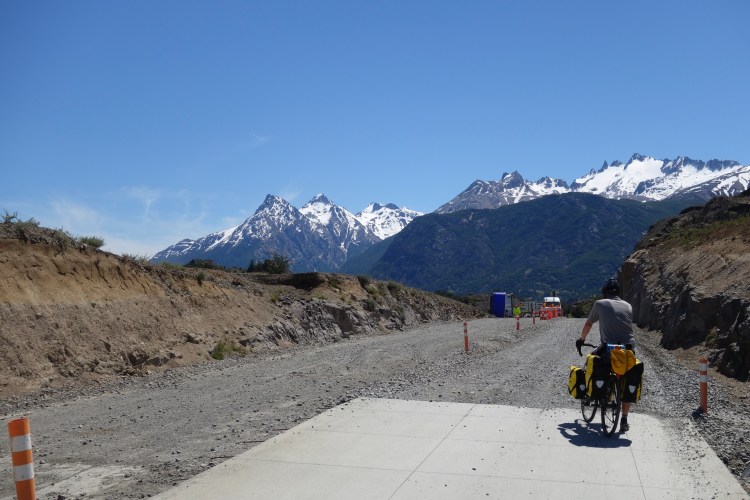
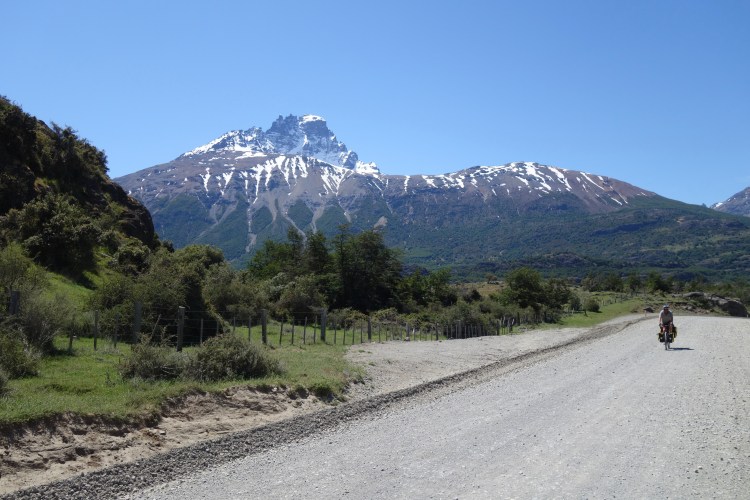
We were introduced to ripio as soon as we passed the speed limit sign on the edge of town. Dad was anxious about the strength of his repaired wheel but, after a couple of bone jarring corrugations, all concerns soon went out the window. Fortunately, the grade of gravel increased, and the road became smoother after a few kilometres. An hour after leaving Villa Cerro Castillo, we rounded a corner to discover that the road was closed due to rock blasting. A man in a hardhat regurgitated a spiel he had clearly been instructed to give everyone who was forced to stop.
‘Road is closed until 5pm. Please wait patiently. Too dangerous to pass’.
With an hour and a half to wait, we strung up the tarp between some trees for sun protection and made a pot of coffee. Sophie’s prophecy of catching us came to fruition and she joined us beneath the tarp until the road was reopened at 5pm, exactly. Sophie rode off while we packed up the tarp and generally fluffed about. As we rode by the extensive excavations that were taking place, I was left to ponder the potential implications of such major road improvements. With better roads come more people, more frequently, leading to a plethora of possibilities. Of course, the upgrades would provide the more remote communicates with greater opportunities in an age where globalisation and interdependence are paramount to economic growth and success. However, it was becoming increasingly clear as we travelled deeper south that the continual development of the Carretera Austral could lead to Patagonia’s own tragedy of the commons. These concerns have plagued my mind ever since.
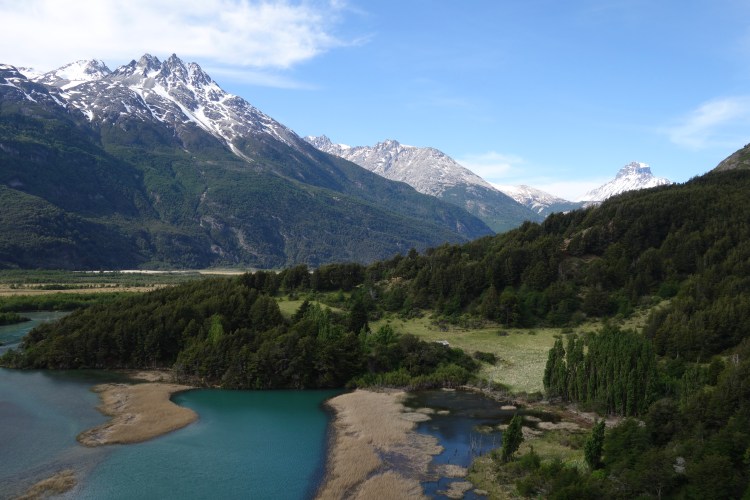


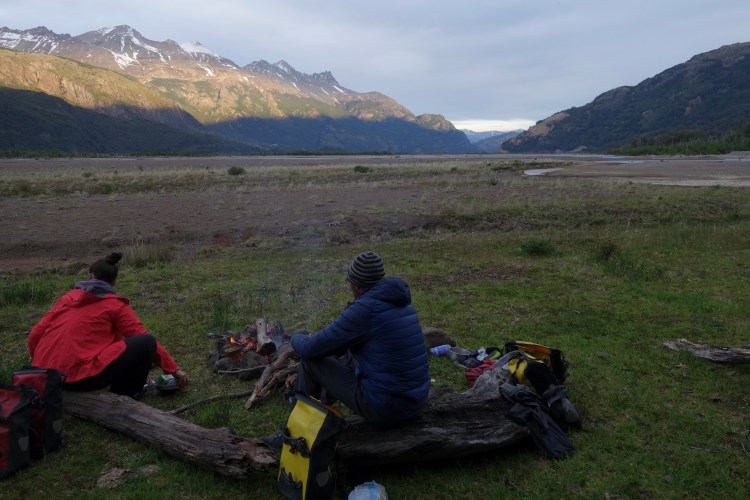
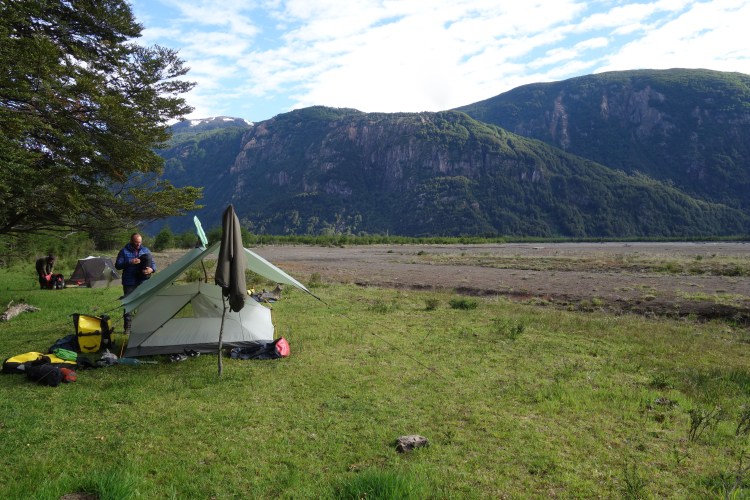
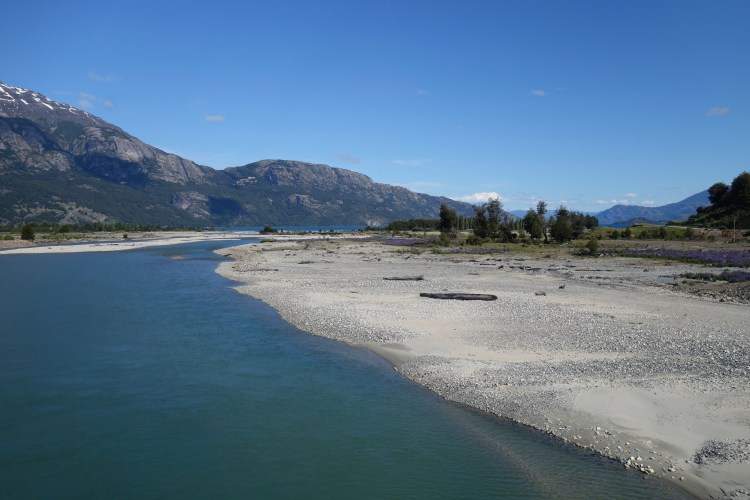
A slow, steep climb followed by a reciprocally fast descent, lead us past the turquoise waters of Laguna Verde and onto the floor of the expansive Rio Ibáñez valley. The Rio Ibáñez is a major tributary to the famed General Carrera Lake further south. The braided streams meandering through the valley were again indicative of the monstrous flows that must torment these areas each spring. The mountain views from the valley were utterly mind-blowing. We soon caught Sophie who initiated the conversation of where to camp. Collectively, we began riding with eyes peeled until we found a lush meadow that was hidden from the road and had an icy cold creek flowing past. An hour later, we had set up camp, taken turns to wash in the creek, and built a firepit from river stones. Conversation was gentle over the course of the evening as we gazed upwards towards the thick blanket of stars in the moonless sky. As we were heading to bed, I asked Sophie how old she thought Dad was. Without hesitation, she accurately guessed ‘60’. I lay in my bivvy, looking up at the stars and listening to Dad complaining from his tent that the days are over where people are shocked when they hear his age.
‘People always think I’m in my 50s…perhaps all men in Belgium look younger than they are…maybe Sophie accounted for that and thinks I look 50 so must be 60…’.
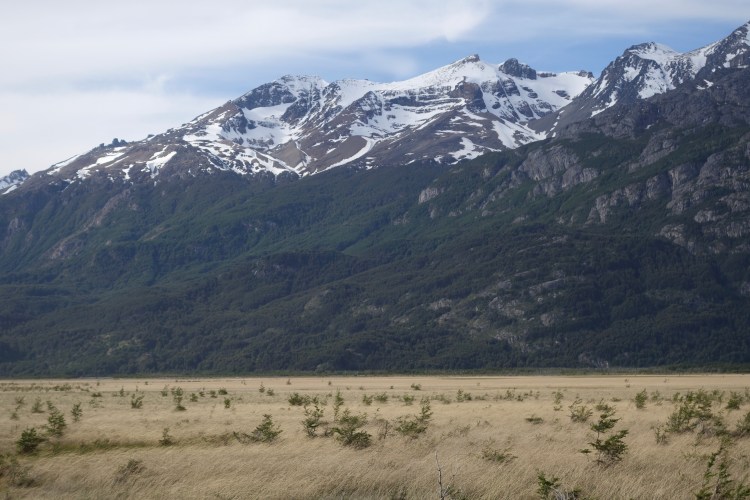
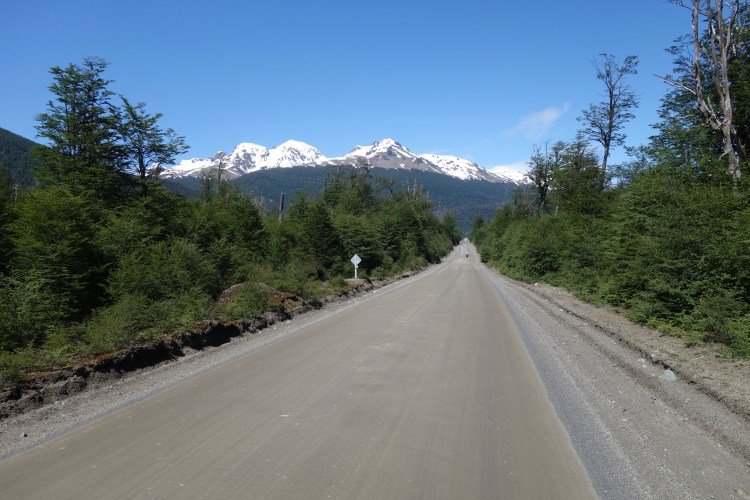
The next morning, Sophie was quick to pack up camp. Her efficiency was testament to her experience, but still left us feeling tardy. It was almost an hour after she left that we eventually got on the road. We rolled slowly along the valley floor for a few kilometres, allowing our legs to wake up, before making a turn for the hills. Each switchback provided a new perspective on the surrounding peaks and the deep rifts in the landscape created by rivers. The mountains were all capped by light grey shale where winter snow had restricted any plant life from establishing, creating a clear delineation between the rocky peaks and the dark green vegetation below the snowline. The contrast of light and dark made the lower valleys and the treelined flanks of the mountains appear in perpetual shadow.


We passed Sophie towards the top of the climb, where she was sitting beside a small waterfall having lunch. It was an idyllic spot, but we were lured onwards by the ensuing descent into the next valley. The gradient of the rough road varied between false flats and steep, slippery sections of gravel. Rare breaks in the trees provided views down over the tangled braids of the Rio Murta which, like the Rio Ibáñez that we had left that morning, was another significant tributary of General Carrera Lake. We eventually joined the valley floor and took shelter from the wind behind a pile of driftwood on the riverbank. It was a welcome snack break, but we were sure we could find a more pleasant spot for lunch.
The next 30 kilometres of riding provided sensational conditions for gravel grinding. With the wind behind us, we lowered our heads and made great time racing down the valley, fixated on selecting the smoothest lines in the road. The glacial green Rio Murta grew in width and volume the closer we got to the lake. It was hypnotic riding. We eventually stopped for lunch at a junction between the Carretera Austral and a road leading to the lakeside settlement of Puerto Murta. In the centre of a roundabout stood a large wooden bus stop with a loft. Our childish instincts kicked in and Dad passed our gear up the ladder so we could make coffee and prepare food in our own little treehouse. Sophie soon caught up, in what was turning into a classic tortoise and the hare situation. She was quick to query why we were hiding in the attic. In classic George Mallory fashion, I uttered the only fitting response; ‘because it was there’.



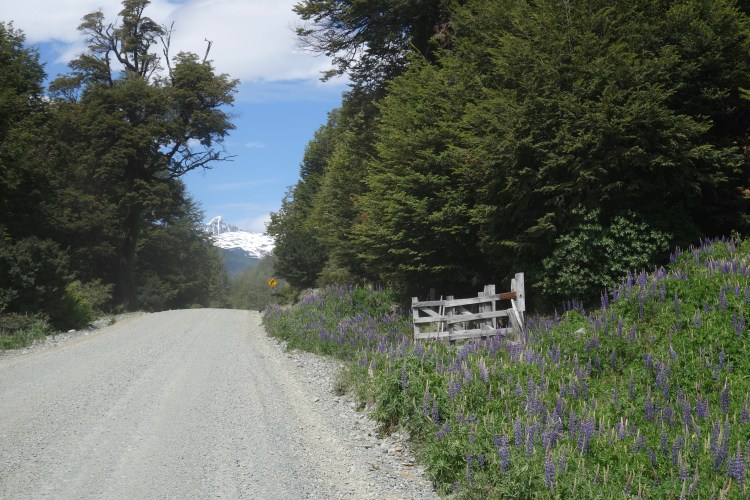
We all seemed to be on the same page, happy to push on for another 30km to the popular summer tourist destination of Puerto Rio Tranquilo. Again, we left Sophie to ride at her own pace and resumed riding. Within minutes of leaving, we were gifted spellbinding views over Lake General Carrera. As the second biggest lake in South America, it is shared between Chile and Argentina, taking the name of Lake Buenos Aires in the Argentine part. Enticingly, the lake it renowned for its sunny microclimate, distinguishing the settlements along its shores from the generally wet and cold surrounding regions. We stood in awe of the glacial blue expanse which was illuminated by the sun. Scattered clouds cast spotty shadows over the surface of the electric blue lake. Small timber cottages sitting amongst lush fields dotted the shoreline.

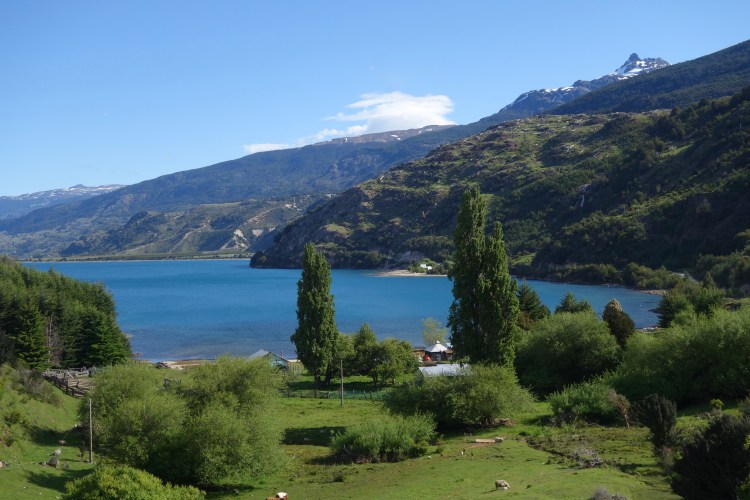
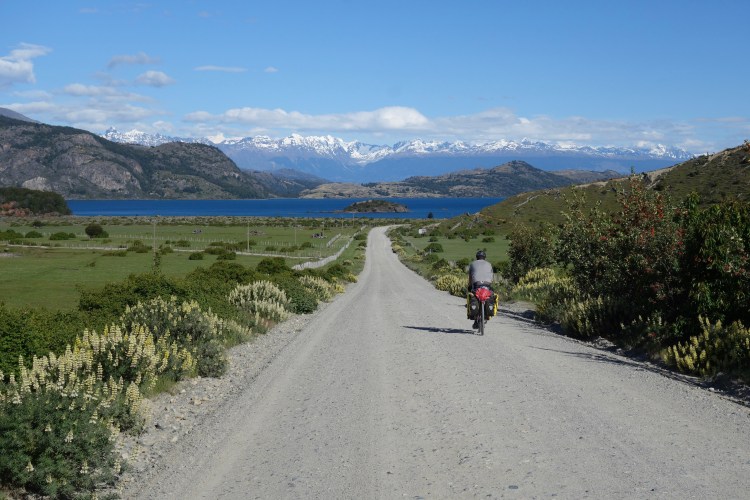
The kilometres dissolved with ease as the lake views demanded all our energy and attention. We soon arrived in the seemingly quiet Puerto Rio Tranquilo and, following a quick lap of the town, stopped at a small tourist information booth. They recommended we check out Camping Bellavista; a site supposedly designed with cyclists in mind. Sophie arrived as we were getting back on the bikes and thanked us, with a grin, for finding out where to stay. Together, we rode to the edge of town and located the campsite and hostel. With grassy sites, showers and a common kitchen area built around a large stone fireplace, it was perfect. Plus, we were offered a discount for travelling by bike! We set up the tents and went in search of fermented hydration.
Our interest was piqued by a small, yet seemingly popular, pizza restaurant down by the foreshore. It was perfect as, like every day before, we had carbs on the mind. The pizzas were great; served in rectangular pans, with supremely thin crusts and the perfect amount of topping. However, the drinks trumped the food. The restaurant brewed their own beer, known as Cerveza Arisca. Not that we needed an excuse to try the local brew but, coincidently, arisca is Spanish for the word ‘surly’ which is also the brand of Dad’s bike. It seemed like a bad omen to not raise a glass to the road behind us and the journey ahead. When the barman explained that the three beers on tap (a wheat ale, American pale ale, and a porter) were representative of the tan, red and dark coats of wild Chilean horses, it seemed wrong not to sample the entire herd. We left the restaurant sufficiently fed and satisfyingly tipsy. After a hundred kilometres of gravel roads, three beers were all our heads could handle. I walked ahead of Dad and Sophie on the way back to camp, leaving him to perform the cardinal responsibility of all Australians abroad; explain the rules of AFL.
The first thing I saw the next morning was Dad’s head poking out of the tent, looking up to the sky then looking back at me.
‘Rest day?’, he questioned.
Despite what would have been an epic tailwind, it had been drizzling consistently all morning and didn’t look like giving up anytime soon. So much for the sunny microclimate! I liked his thinking and responded by simply nodding and settling back down into my sleeping bag for another hour.
A slow morning ensued; breakfast, brilliantly hot showers, checking emails, and intermittent snoozing. We were also presented with a conundrum that evolved into an interesting discussion point. One thing that you cannot miss in Puerto Rio Tranquilo are the numerous travel agencies promoting boat trips to the Cuevas de Marmol, or Marble Caves in English. We had observed long, open speedboats leaving town regularly, ferrying tourists to these otherwise inaccessible caves that have gained recent notoriety thanks to Instagram no doubt. Over the last 6000 years, the Patagonian wind has whipped up waves which have eroded cavernous spaces and shaped mesmerising features from the marble deposits that line the lake. On calm, bluebird days, it is said that light dances between the water and the marble walls, creating a kaleidoscope of otherworldly colours. The various posters and signs around town contributed to a slow-burning guilt in both of us; the caves were the major drawcard of the town, we were in town for the day with nothing to do, we would most likely never be back there in our lives, yet neither of us were particularly interested in making the trip. Sophie had left early that morning for a tour that she’d booked the night before. Would we come to regret not doing the same?
Although it was relatively easy to make the decision to stay on land that day, the situation reminded me of a topic I studied at University. Within a subject exploring human nature connections, we were set several readings extracted from John Urry’s book, ‘The Tourist Gaze’. Originally published in 1990, Urry builds on the work and ideas of the French philosopher, Michel Foucault. In the 1970s, Foucault penned the concept of ‘the medic gaze’ or, in French, le regard medical. He used this concept to explain a doctor’s ability of being able to objectify the body of a patient as separate and apart from their own personal identity. Furthermore, he acknowledged that the physical and intellectual structure of the clinic is what enables the examination, analysis, and diagnosis of a human body. However, he argued that the clinic also materialises socio-economic division and uneven distributions of power. Foucault’s concept suggests that when a patient’s body enters the field of medicine, they are also entering into a sphere of power in which the patient can be manipulated by the authority of the medical gaze. In his 1976 book, ‘Birth of the Clinic’, Foucault states that ‘the clinic was probably the first attempt to order a science on the exercise and decision of the gaze’.
Acknowledging the work of Michel Foucault, John Urry adopted the concept of the ‘gaze’ to better understand tourism. ‘The tourist gaze’ suggests that tourism, as both as an industry and a leisure activity, is structured by the ‘exercise and decisions of the gaze’. Essentially, Urry argued that tourism is predominantly a visual practice; a way of seeing where companies promote and supply visual experiences, and tourists consume them visually. Travel and tourism to Urry, is what the clinic was to Foucault; platforms to look upon something that is foreign and new to oneself and, at the end of the day, are enabled by privilege and power.
I attempted, albeit poorly, to explain this idea to Dad. We discussed the ways in which ‘cycle touring’ challenge the concept of the ‘tourist gaze’. Over the past few weeks together, we had built a collection of memories. Amongst these, of course, were notable visual scenes; images that you’d see in a magazine and immediately want to view for yourself. However, we concluded that the most impactful moments of our trip so far included boiled eggs at bus stops and woodfired showers. Neither of these things were particularly visual. This discussion emphasised to us that the consumption of visual products, such as the marble caves, were not what was driving us to break camp each morning and cycle along gravel roads for 100 kilometres. Simply knowing what we had experienced physically and emotionally to arrive at a location filled us with gratitude and admiration for place. This was enough.

It was great to be able to discuss these thoughts with Dad. Over the previous few months alone, I had come to similar conclusions, all of which flirted with the cliché that ‘it’s about the journey, not the destination’. However, it was energising to be able to share such an experience with Dad; not just the kilometres on the road but the emotional and psychological developments that come with cycle touring.
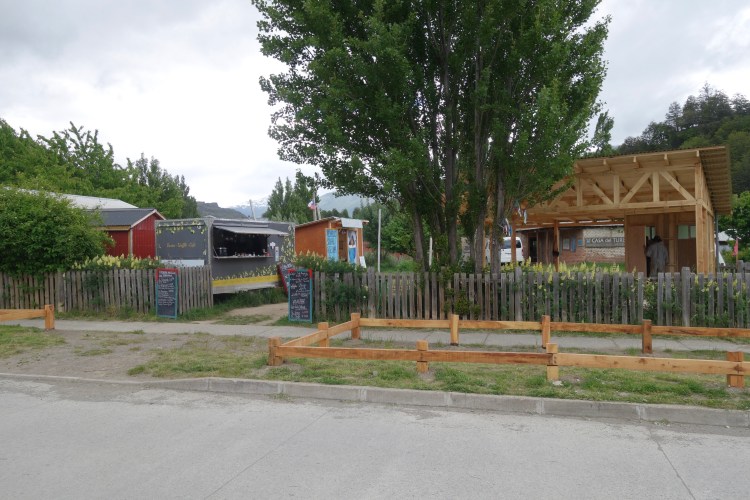
Our afternoon was spent wandering. We walked out to the edge of town and sat on a small concrete pier watching sheets of rain drift across the whitecapped lake. On the way back, I spent time spotting trout from a stone bridge over a shallow stream. The highlight of the day was undoubtably the discovery of a petite crêperie run by an alluring French girl and her Chilean husband. Charlotte and Gabriel had met in Cairns, while travelling around Australia, before returning together to Chile and settling on the shore of Lake General Carrera. Specialising in her favourite flavours from the south of France, Charlotte happily prepared us two bold black coffees and a delectable serving of Nutella crêpes. With a hand carved wooden spreader and tantalising technique, she evenly distributed the batter over a cast iron pan. It was a culinary siren song, clearly impacting Dad as he even said the tattoos covering her hands were ‘nice’. Charlotte was working out of a caravan while Gabriel was in the process of constructing a ‘brick-and-mortar’ next door which will have a commercial kitchen and much greater seating capacity. We were the only people sitting on the picnic table beside the caravan, so it was hard to comprehend Charlotte’s response when asked if they get very busy in summer. She explained that at the peak of the tourist season, 2000 people per day take boat trips to the caves. The town is so overrun that tourists are forced to sleep in their cars on the main street as there aren’t enough accommodation options. It was unimaginable, and again raised our concerns of how these small towns are going to cope with the continual improvement of the Carretera Austral. Food drunk, we sat and watched as Gabriel took a break from the tools and joined Charlotte on the grass to play with their black puppy, Truffet.

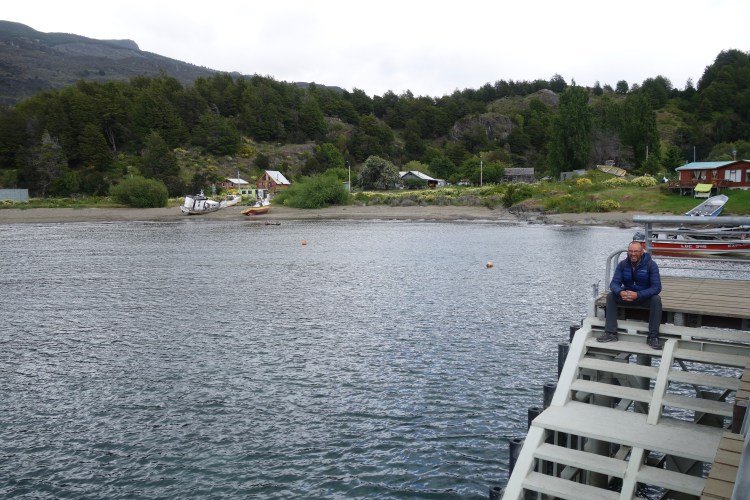
Walking back to the campground, we ran into Sophie. She said the caves were beautiful, but the boat trip was terrifying. Waves had broken over the bow the entire journey, leaving her soaked and freezing. It made us feel even happier with our decision to stay grounded for the day. Dad spent the afternoon having a snooze while I did some route planning for the coming days. Shortly after he woke, it was agreed that a pre-dinner beer was in order. We found another small restaurant offering local, unfiltered beers, and a view out over the lake. Conversation was slow and Dad was especially quiet. Eventually, he slid his unfinished beer towards me and said he wasn’t feeling too good. We walked back to the tent with purpose, where Dad was quick to get horizontal. Within minutes of arriving, he peered out of the tent, looking pale and dishevelled.
‘Mate, I’ve left my bag at the restaurant’, he uttered helplessly.
I quickly got on the bike and rolled back into town, aware of the potential impact that a lost wallet and passport would have on the trip. I pushed open the door and went straight to the table where we’d been sitting. It wasn’t there. The waiter who had just been serving us came over.
‘We left a bag here. We were sitting there. Have you seen it?’, I spurted.
‘No bag, not here’, he responded with a disinterested look on his face before turning to wipe a table.
My heart sank. A pregnant pause filled the space between us. With perfect comic timing, he swung around, and his face exploded into a smile.
‘Just joking! Nothing ever gets stolen in this restaurant’, he exclaimed proudly while pointing at the several security cameras positioned around the room. He lent over the front desk and grabbed the bag, handing it over and wishing us the best for the rest of the trip. I considered a similar delivery of the news when I got back to Dad. However, when I arrived, his face was grey, and he explained that he had just vomited. He was stoked to have the bag back (mostly because we didn’t have to tell Mum he’d lost his passport) but decided he was going to try to get some sleep. I ate dinner alone and headed to bed hopeful that we would be able to continue south the next morning.

Thanks for reading.
 Faults and Folds