The alarm sounded particularly obnoxious the next morning. I must’ve been in the depths of my sleep cycle, as when I was jolted back into consciousness, I quickly became aware of the abundance of noise throughout the hostel. Heavy footsteps up and down the timber corridors, the rustling of gear being wrestled into backpacks, audible whispering from those trying to act politely, and careless laughter from others pretending they were actually happy at this of the morning. Morning had certainly broken, and we had a ferry to catch.
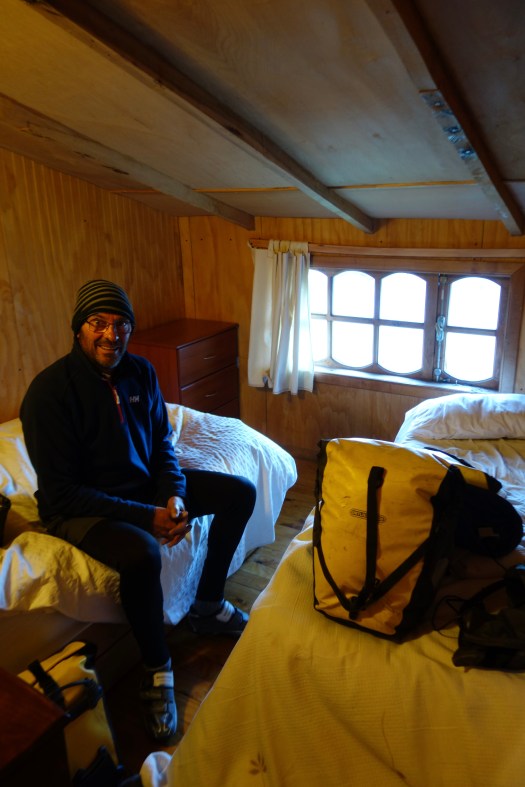
I dragged myself from the warmth of my sleeping bag and out into the frigid bowels of the hostel, hopeful of finding an empty shower cubicle. Standing with my eyes closed, I allowed the heat from the water to sting my skin and slowly seep into my bones. Partially awake, I dried myself, got dressed, and moved into the communal kitchen where a stovetop percolator was just coming to the boil. I took a seat by the window waiting for the sun to appear from over the horizon and the coffee to complete the waking up process. Dad soon appeared from the room and we indulged in the hostel’s inclusive breakfast of toasted cheese jaffles and scrambled eggs.
Staff at the boking office the previous night had stressed that the ferry would be departing at 7.30am, sharp. Giving ourselves half an hour to cover the few remaining kilometres from the hostel to the ferry, we were on the road by 7. Having been riding alone for a few days, we were somewhat surprised by the number of cyclists that had a similar plan. With the weather having kept the ferry docked for the last week, there had been a bottleneck of itineraries and adventures at Villa O’Higgins. We had become so engrossed in our own plans and progress that it was strange to think there had been others only a day ahead or behind having congruent experiences. Amongst the peloton making their way to the ferry, there were a few familiar faces, as well as many new and intriguing personalities.
One face that we recognised was that of Maria, the German girl that we had met briefly near Rio Cisnes as we sheltered from the rain in a bus stop with Adrien and Helen. She had been visibly shaking from the wet and cold decent. However, our lasting memory of Maria on that day had been her tenacity, rejecting the offer of a hot drink and being visibly excited by the prospect of riding on into the rain for several hours. As we pedalled slowly into the morning and towards the ferry, Maria told us that she was lucky to have made it this far. On the approach to Cochrane, she had been rear ended by a distracted driver. She explained, with remarkable objectivity, how the car had propelled her forward with enough force to give her whiplash. Somehow, she had managed to stay upright. However, her back wheel had been crippled by the impact. As we listened to Maria, who would’ve been no more than five feet tall, we were again struck by her drive and resilience. It was an important reminder that toughness is only a mindset. From Maria’s report of the incident, it sounded as though the driver of the car had fared worse than she had. After consoling the driver who had been in a state of shock, Maria had been given a lift into Cochrane where she had been able to purchase a new wheel and continue riding the very next day.

We arrived at the ferry to find a human chain comprised of cyclists, hikers, and sightseers, all working together to move bags from the dock to the front deck of the boat. We unloaded our panniers and passed them down the line to where they were added to the pile. Once the luggage was onboard, we joined a line of riders in precariously shouldering our bikes and carrying them down a steep gangway to the bow. Crew members then made their way around to make sure each bike was securely strapped down to the deck. I appreciated the care they seemed to have for our bikes, but looking out into the fjord, there wasn’t a breath of wind nor a skerrick of swell that threatened to cause a lumpy and treacherous crossing!
By the time passengers and gear were loaded, I had broken into more of a sweat than I did riding to the ferry. As the crew dropped the lines and we pulled away from the dock, everyone was ushered inside to take a seat. A hush swept through the cabin as the weathered captain passed the wheel to one of his underlings. He slowly walked between the seats, stroking his beard, and counting the passengers. Looking confused, we watched on as he engaged in an intense conversation with an official-looking man in mirrored glasses who appeared equally perplexed. They looked at each other then back to the shrinking dock, before undertaking one final headcount of the obedient passengers. It appeared they were missing someone and had commenced the passage prior to a final count. The captain didn’t look like a man who liked to be embarrassed by incompetence. I’m not sure whether they resolved the issue, or their pride got the better of them, but the captain soon returned to his position at the wheel and seemingly forgot about the possible stranded passenger back on land. Back in his chair, he leaned to his right and hit play on pre-recorded safety briefing which was repeated in several languages.
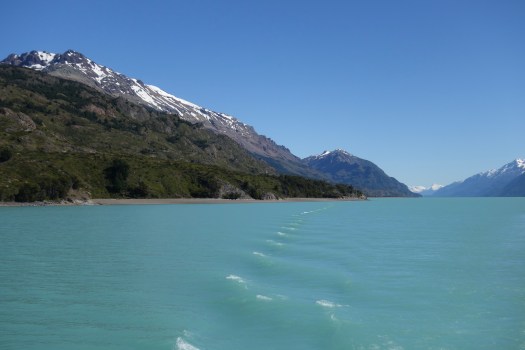
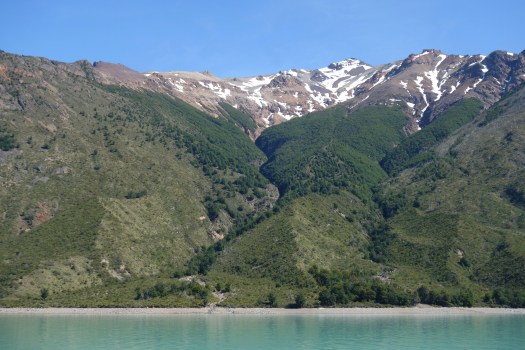
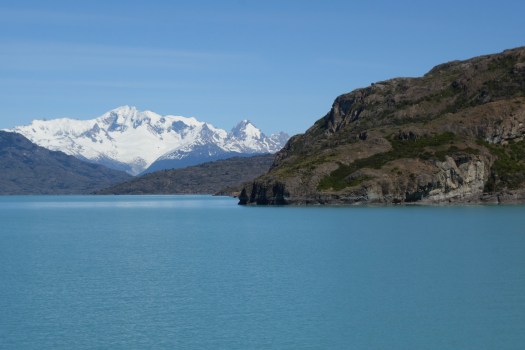
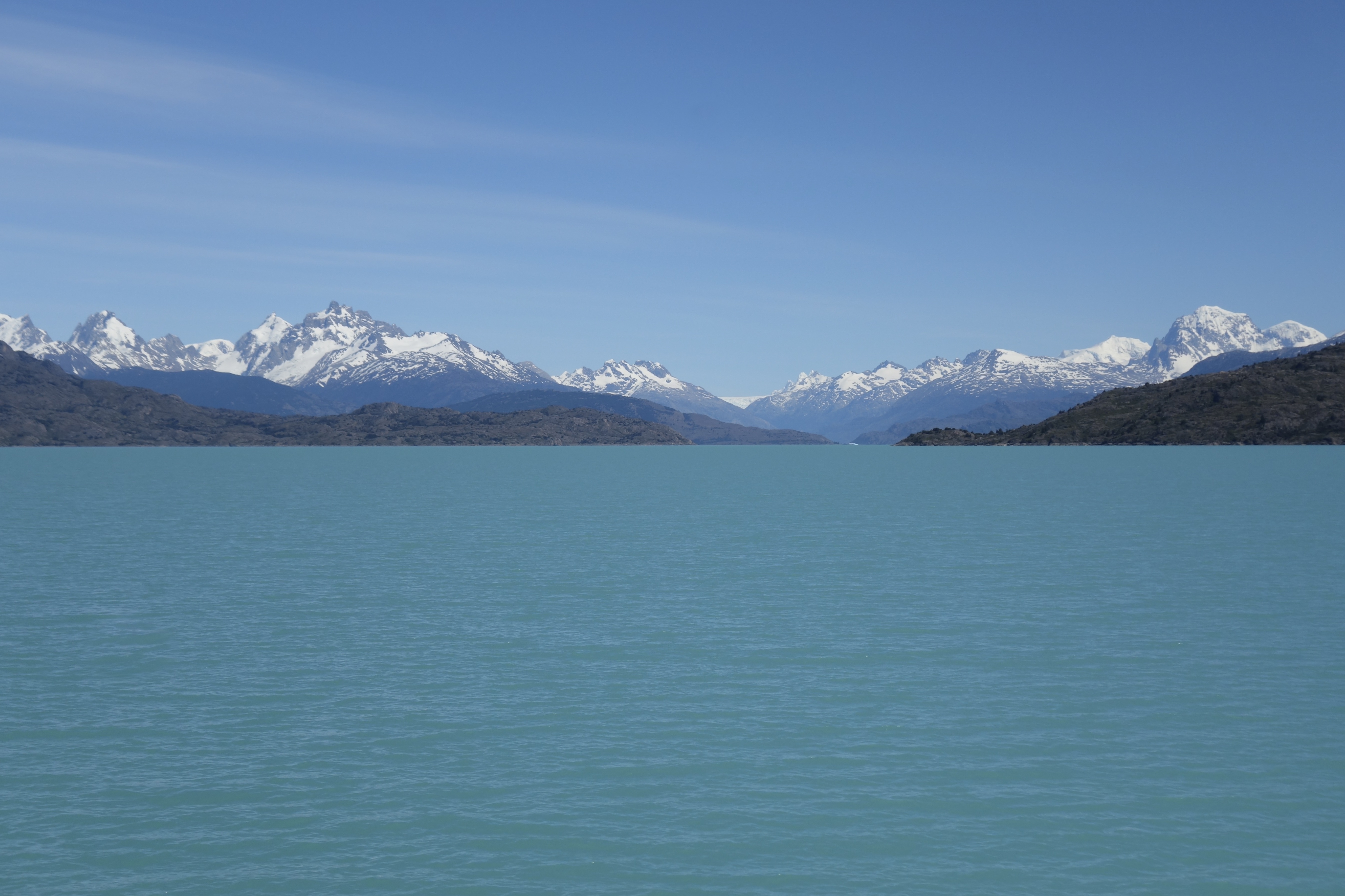
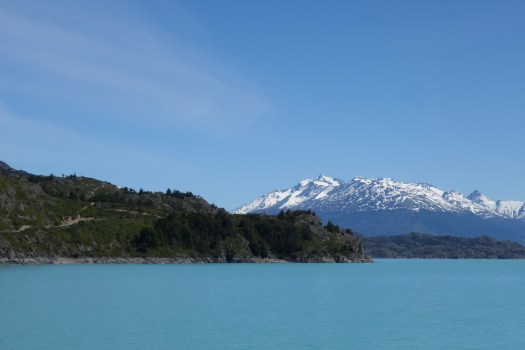
Adequately briefed on the location of life jackets, yet aware of the fact we’d be lucky to survive more than 10 minutes in the frigid glacial waters, we moved to the upper deck of the ferry. There was the temptation to snooze in the warm cabin for the next few hours, but the desire to indulge in the fresh air, snowy peaks, and verdant hillsides was stronger. We sat with Maria and got to know each other a little better. We told her about Tasmania and our humble existence as teachers, before asking how she spent her time in Germany. The succinct response she gave further encapsulated the sharpened motivation and drive that we were coming to recognise.
“I live in Berlin but travel internationally twice a month for work. I studied sociology and now work for an international corporation where I’m trying to improve the economic structure and stability in Eastern European territories”.
A quiet life, basically.
Since arriving at the ferry, I had been drawn to the dynamic presence of four friends riding together. Despite the odd encounter with other solo riders over the previous few months, I really hadn’t come across any others that seemed similar in age to me. I’d noticed a marked difference in the experience I was having travelling with Dad compared to being alone. It is possible to share images and tales of travel with friends upon arriving home, but the deep understanding and bond developed with those experiencing the same highs and lows of each day is indescribable. intrigued to discover how it had been riding the Carretera with three other friends, I introduced myself to one of the guys in the group, Nick.
Within a few minutes of meeting, I got the sense that Nick and I were remarkably similar in the ways we viewed, and engaged with, the world around us. It turned out that we’d had relatively parallel experiences over the past few weeks, unknowingly separated by no more than a day for the entirety of the ride from Puerto Montt to Villa O’Higgins. Nick soon introduced us to his three friends: Rob, Aidan, and Shay. They’d all recently graduated from college in different parts of Canada, before meeting each other doing tree planting work over the previous summer. It had been in the forestry camps where the idea of a cycling trip (a first for each of them) in Chile had been conceived. They’d now been on the road together for around two months having started their trip in Santiago. Naturally riding at different speeds, they explained how they often broke up over the course of a day before coming together each night to swap tales from the road. Nick encouraged Shay and Aidan to share an experience they’d had on their approach to Villa O’Higgins a few days earlier. As they began setting the scene, it was clear both were still trying to process was had occurred.
‘We’re both vegan’, Shay was quick to state.
It seemed a questionable point in the story to introduce morality. However, the relevance of this information ended up being paramount, as the tale they indulged us with was a quintessential vegan nightmare.
Since the road had turned to gravel, Shay and Aiden had both been struggling with punctures, having to patch their inner tubes several times a day in some instances. I silently paid thanks to the road and rubber gods as they outlined their misfortune. I’d only needed to repair one flat tyre since departing Bogota, which was months ago now! Shay went on to explain that she had been exhausted on the final day riding towards Villa O’Higgins. When she had heard the all too familiar sizzle of air escaping the patchwork inner tube of her front tyre, she too felt completely deflated. Still with around 40 kilometres left to ride, knowing that Nick and Rob were most likely ahead and waiting for them, Aiden and Shay had decided to wander down a nearby driveway to see if there was anyone around who would be open to driving them into town.
They pushed their bikes along the tree-lined drive to a modest farmhouse in the middle of a large clearing. The crunching of the gravel beneath their tyres had notified the occupants of the house of their arrival, with the door swinging open before they’d had a chance to knock. Aiden described the two men who had greeted them as ‘classic Gauchos’. The bearded men, both wearing weather-beaten ponchos and black wide-brimmed hats, had ushered the two cyclists inside and urged them to take a seat at the table where they were half-way through a roast lunch. Aiden had managed to explain their predicament and the men had been more than obliging to drive them to Villa O’Higgins as they were planning on heading to town later that day anyway. However, they just had a few quick jobs to do around the farm first. In the meantime, Aiden and Shay were offered generous glasses of wine to keep them hydrated whilst the men finished their meal.
As the language barrier between guests and hosts limited the depth of conversation, they resorted to nodding while constantly sipping at the wine. However, the quick drinking was met with equally quick refills. A combination of politeness, dehydration, fatigue, and red wine resulted in near instant drunkenness. As the room started spinning, the two men slurped the last of the food from the plates before coaxing Shay and Aiden outside to where the story becomes increasingly visceral and confronting.
Brimming with wine and bravado, the Gauchos led the two drunk Canadians to a dilapidated corral, in which stood a lone calf. Over lunch, Shay and Aiden had been able to ascertain that the two men needed to transport a cow to Villa O’Higgins that afternoon, hence the willingness of the ranchers to give the cyclists a lift. Assuming this was the cow that was being relocated, they expected the animal to be apprehended and loaded onto a nearby small truck equipped with a cage. In essence, this is what happened. But the outcome for the cow was a far cry from what they’d envisioned.
The elder of the two Gauchos removed his poncho and drew a large blade from a sheath that had been concealed beneath the woollen blanket. He calmly stepped into the pen with the animal while his compatriot closed the gate with a look of excitement and anticipation painted across his unshaven face. The man had turned to the Canadians, encouraging them to watch what was seemingly a special performance, just for them. Shay had turned away in tears, but Aiden explained that he kept his eyes on the event out of courtesy and a fear of disrespecting a man with a large knife.
Hardly a fair matchup, the man in the ring proceeded to back the cow up to the cage with a series of non-lethal swipes of the blade across its neck. Following an unnecessary volume of stabs, slashes, and suffering, the backyard matador turned to face his appalled audience of two, before returning to the weakened calf and finishing the job with a final swipe of the blade. The collapse of the beast was followed by the vigorous applause of the other man watching on in awe.
As Aiden consoled Shay, the two men heaved the body of the slain calf onto the back of the truck. They then took the liberty of loading the two bikes with panniers on top of the corpse. It sounded as though the language and cultural barriers had resulted in an uncomfortable afternoon for all involved. On their ride into Villa O’Higgins, the two men had managed to communicate the impressiveness of killing an animal with a single blade without getting a drop of blood on one’s shirt. The performative execution had no doubt been to impress the guests. I’m sure the response of the vegan cyclists, silent and aghast on the back seat, was far from what the Gauchos had intended.
The story came to an end along with our boat ride. Most passengers were staying on board for a full day cruise up Lago O’Higgins. Aerial photographs of the region revealed a remarkable glacier at the head of lake; one of thousands of frozen tendrils of the Patagonian Icefield responsible for dissecting mountains, scratching out valleys, and keeping the waterways flowing for generations. As we unloaded our bikes, I overheard one passenger asking a crew member if it was true that they’d be drinking whiskey poured over glacier ice with their lunch (apparently it was included in the advertising material). I’m sure this is the type of freedom and luxury Bernard O’Higgins had in mind as he fought to liberate Chile from Spanish rule. Nothing better than ending a hard day of war, fighting for independence, with a stiff scotch poured over the ice of a glacier that now belongs to you.
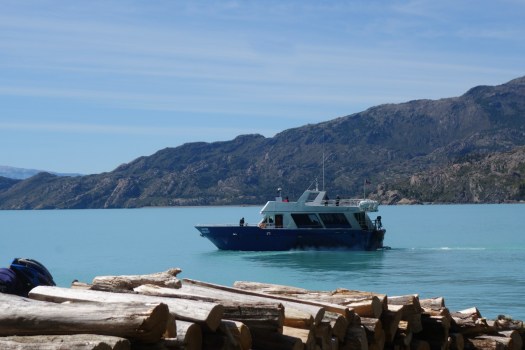
Dad and I sat by the lake and brewed a coffee as the other cyclists rushed to get to the nearby Chilean customs office and begin the highly anticipated border crossing. When we had boarded the boat that morning, we were still undecided if we’d begin the trek into Argentina immediately or just have a lazy day by the lake. However, we hadn’t even finished our coffees when we’d decided there was no point waiting around. The cloud cover had scattered, allowing the sun’s rays to penetrate the cyan depths of the lake. With the knowledge that some of the world’s most magnificent and revered peaks lay just over the hill, our fatigue was quickly replaced with enthusiasm.
It was an easy roll along the lake’s edge to the customs building. The obligatory flagpoles and neat lawns of this Chilean administrative outpost were in stark contrast to the rugged surrounds. As we parked the bikes and dug out our passports, we were approached by a laid back South African guy who had just completed the border crossing in the opposite direction. He played down the difficulty of the trek from Argentina, although I couldn’t imagine he was the type of person to get worked up or overwhelmed by anything. Having worked in Chilean mines for the last ten years, he told us that he was now living a much more relaxing life in Guatemala where he works as the photographer on a fishing charter boat chasing sailfish. As it was currently hurricane season in Central America, he’d decided to come back down south for a cycling adventure. We soon learnt that he was riding with a Chilean friend, who was inside the customs building being interrogated for failing to get exit stamps on his passport when leaving Argentina earlier that morning. Bureaucracy reaches the wildest places.
Fortunately, not all customs officers were involved in the interrogation process and we found someone who was happy to complete the uncomplicated task of stamping our passports and wishing us a safe onwards journey. As we rode away, the Chilean cyclist appeared from inside, visibly dejected, and broke the news that he was required to walk back to Argentina to get a stamp. We offered a clumsy commiseration, before turning for the hills, curious if this administrative frustration would be enough to crack the free-spirited façade of the South African man.
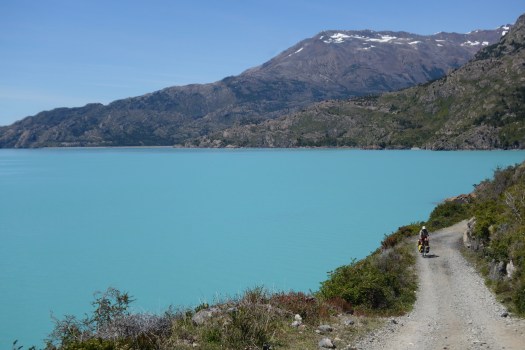
The track instantly deteriorated as we began the climb from the tranquil lakeside location of the customs building. Loose gravel, tight switchbacks, and a lot of walking ensued for the next few hours. It was tough going and it didn’t take long until we began questioning our decision to give up an afternoon spent lazing by the lake. Dad was visibly cooked, yet as stoic as ever. I turned back to check on him at regular intervals, only to be told that he was fine and that he was in fact smiling not grimacing. Behind him, the cerulean waters continued to intensify in colour as the cloud cover continued to dissipate. The views were as breathtaking as the climb.
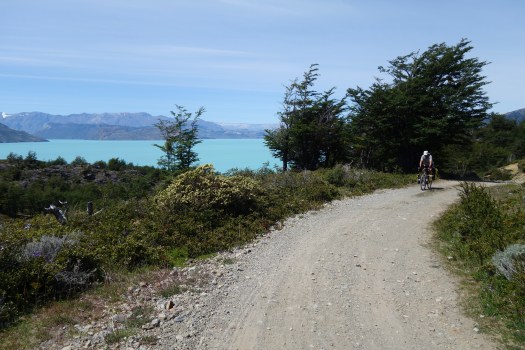
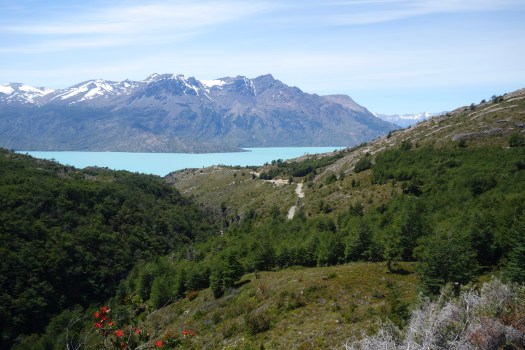


The trail eventually began to plateau, and we were able to get back in the saddle and begin making more encouraging progress. I was a few hundred metres ahead of Dad when I first laid eyes on the unmistakable granite towers of Cerro Fitz Roy. Across the valley stood a peak that I’ve ascended countless times in books and films alongside some of the world’s most notable alpinists. It was like meeting a hero.
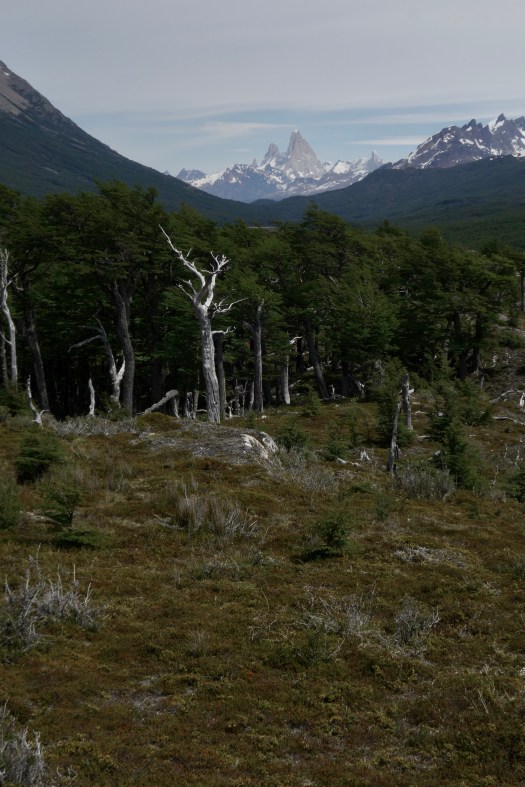
Fitz Roy was named in honour of Robert FitzRoy, the captain of the HMS Beagle, who in the 1830s had charted vast swathes of the Patagonian coast. To the indigenous people of southern Patagonia, the Tehuelche, the mountain is known as Cerro Chaltén meaning ‘smoking mountain’. This title acknowledges the common occurrence of cloud forming around the peak. The fact we had an unobscured view of the entire range made the situation even more remarkable. Being in the presence of such a revered mountain, through both natural history and anthropocentric lenses, instantly justified every pedal stroke I’d taken to get to that point. Dad, who admittedly wasn’t as well versed on the significance of Fitz Roy in the climbing world, was equally as gobsmacked by the view, highlighting the objective grandeur of the skyline.
The views dissolved our fatigue, and we rode onwards with renewed energy. The rocky trail was soon swallowed by forest and we found ourselves riding in silence along a soft carpet of beech leaves. Over the course of the next hour, a perplexing ‘knocking’ sound resonated throughout the forest, as though someone in the distance was throwing stones at hollow tree trunks. When I thought I knew where the sound was coming from, I would hear it again from the opposite direction.
Later, we took a break beside a tannin-stained creek which cut a meandering path through the forest. Idle and quiet, it wasn’t long before the origin of the mysterious percussion was soon revealed. Startled again by the knocking, we looked above us to see a black bird with a crimson head clinging to the side of tree and repeatedly smashing its beak into the trunk. I’d never seen a woodpecker before, but there was no denying that’s what we’d been hearing for the last hour or so. I’d later read that this bird, the Magellanic Woodpecker, is the largest living species of the genus Campephilus. The bright red head indicated that this bird was a male, as the females are predominantly black all over. Fascinated, we watched on as the woodpecker slowly worked its way up the trunk of the tree, tapping as it went to identify any hollows or rotten timber where wood-boring grubs and beetles might reside. When reverberation indicated empty space, the bird would go to town on the tree, hammering with concussive ferocity until its beak penetrated the bark and it was hopefully able to extract some hidden protein. The process, repeated countless time, was captivating.
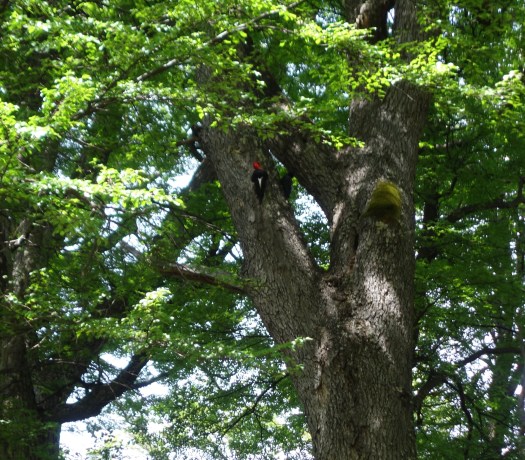

When the bird was at rest, the forest returned to a silent state. During one intermission, we heard some vexed voices in a familiar accent. Looking down the trail we caught site of a couple of cyclists, just in time to observe the woman throwing her bike to the ground in evident frustration. We sat frozen to avoid being seen and to minimise her embarrassment when she discovered there was an audience. After some terse yet encouraging words from the man, the couple seemed to regather themselves and they continued pushing their bikes in our direction.
Hailing from Sydney, this was the couples’ first day cycling having left El Chaltén that morning to begin the hike from the Argentinian side of the border. They were planning on spending a few weeks riding the Carretera Austral from south to north. Unaware that we’d witnessed their recent lapse in enthusiasm, they feigned exuberance and remarked at the beauty of the forest. We exchanged obligatory sentiments for each other’s onward journeys before continuing in opposite directions.
For the next 10 kilometres, the trail maintained a rideable gradient through a dense beech forest that reminded me of home. At one point, the vegetation gave way to a narrow clearing about 100 metres in length. The presence of a tattered windsock hanging from a rusting pole was the only evidence that this gravel strip was a remote runway. A lack of tire marks and a smattering of weeds suggested that it had been a long time since anything had landed. We lined up and had a sprint from one end to the other, revelling in the obscurity of racing each other on our bikes along a runway in the forest on the border of Chile and Argentina. With panniers loaded with gear and legs loaded with lactic, there was little to no chance we’d reach enough speed to take off.
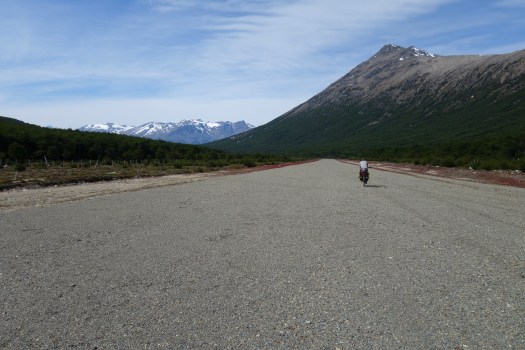
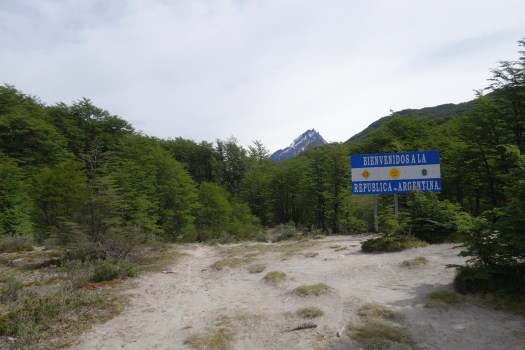
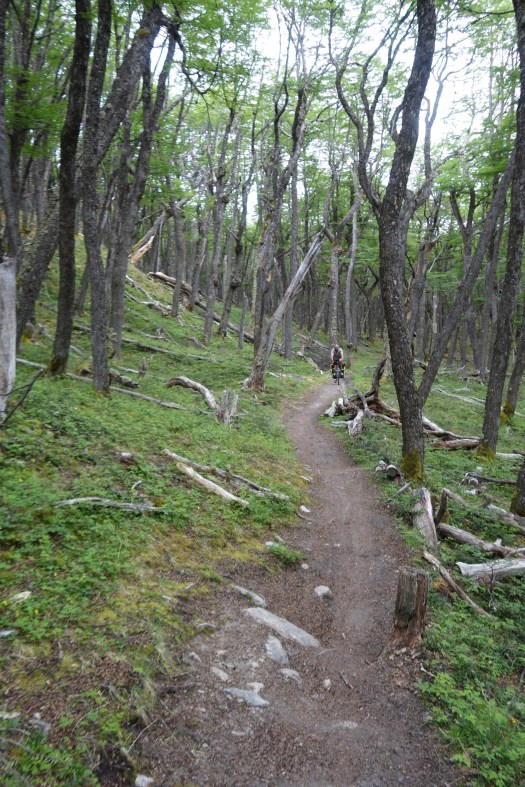
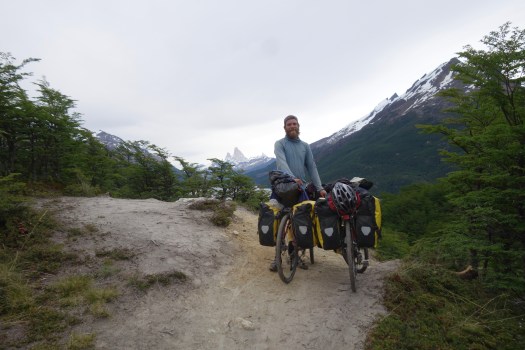
Figuring we should probably use our remaining energy to make it to Argentina, we left the landing strip and continued down the road. Within minutes, the well-formed trail through the forest turned abruptly to a rough walking track, barely wide enough for a bike. We soon came across a sign indicating that we had reached the official border. The dilapidated sign, coupled with an absence of infrastructure and officials, gave the border crossing a sense of illegitimacy. We knew this wasn’t the case, but we embraced the opportunity to feel like fugitives for a few moments. Sitting beside the sign, we ate lunch and pondered on what the remainder of the day would hold. It was well-documented that from the border the following six kilometres were unrideable. Despite this, we set off after lunch, confident that ‘surely’ we’d be able to roll slowly along the trail.
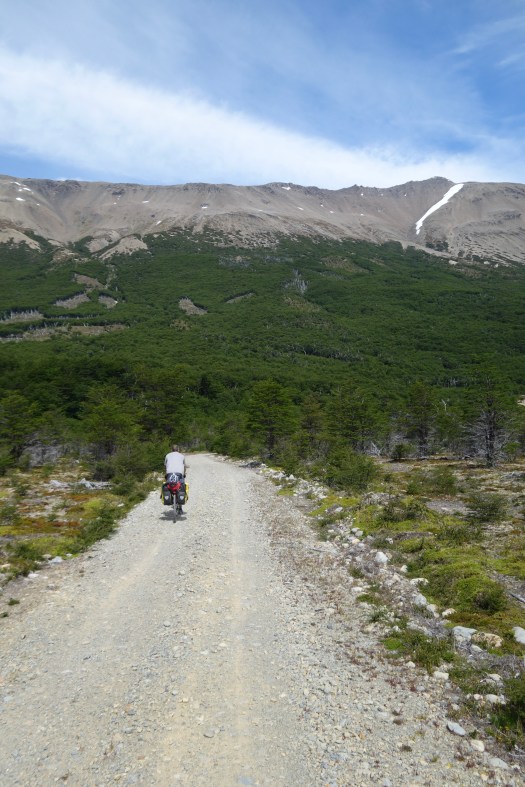

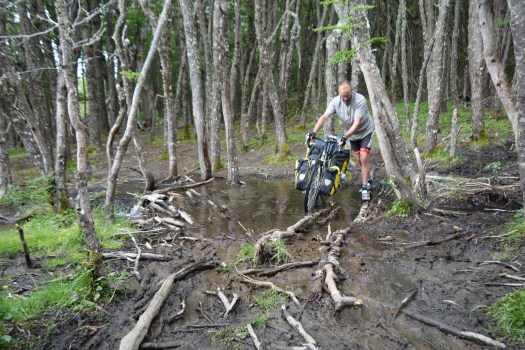
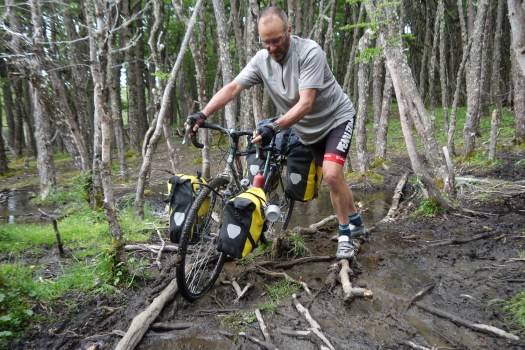
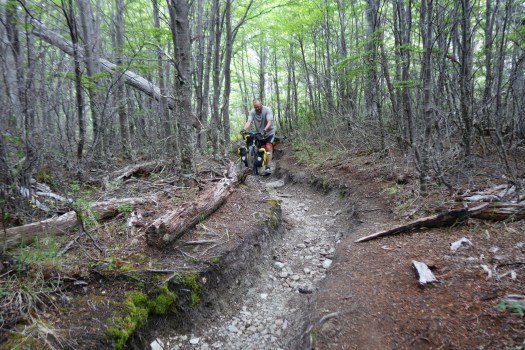
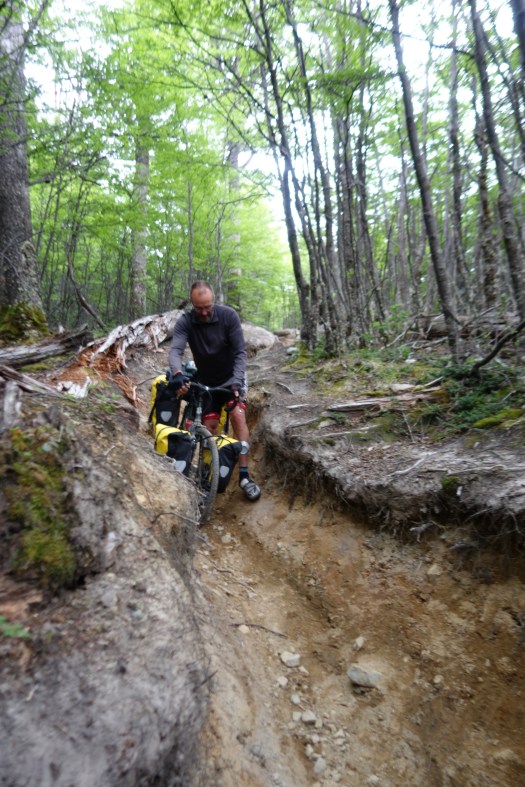
Unsurprisingly, we were soon humbled by the terrain and discovered why this section of the crossing was deemed ‘unrideable’. It would’ve been great on a lightweight mountain bike, but on a rigid, steel frame touring bike with full panniers and one-inch tyres, any attempt to ride this section would end in disaster. In the few hundred metres that we did manage in the saddle, Dad wore through the remaining rubber on his brake pads as he tried to maintain control of his steed. We figured a conservative approach was best for the longevity of our bikes and bodies. For the next hour, we pushed our bikes over rocks and logs, and through creeks and bogs. One section of trail was so steep and eroded that we needed to unload our panniers and undertake several trips to ferry gear from the top to the bottom. The slow pace and convoluted movement left us a little lost in time and space. The trail eventually relaxed, and we were able to remount our bikes and wind our way through the most wondrous section of forest. Crossing a small creek, I spooked a sizeable brown trout. This luscious corner of the world was so full of life, filling me with so much happiness.

It was almost 5pm when we broke from the forest and were confronted with the immigration building and startling views of Fitzroy over the velvet water of Lago Del Desierto. We were welcomed inside by a friendly customs officer who stamped our passports, making our arrival in Argentina official and ending our time on the run. The officer followed us outside, pointing to where we could set up camp and explaining what time the boat would be arriving in the morning to ferry us and our gear to the other end of the lake. We thanked him for his warm welcome to the campsite and his country and headed towards the sprinkling of other tents on the lake’s edge.

A vacant patch of grass on the fringe of the forest met our needs and we went about setting up camp. As Dad was setting up his sleeping gear in the tent, I reached into one of my panniers with trepidation. I’d been carrying a few cans of beer for this moment but had failed to consider the roughness of the terrain which we had to traverse to get here. The fear of discovering a watery massacre of hops, yeast and wheat was real. Remarkably, the tins were intact, and I slipped them into a small bag before inviting dad down to the jetty to take in the view.
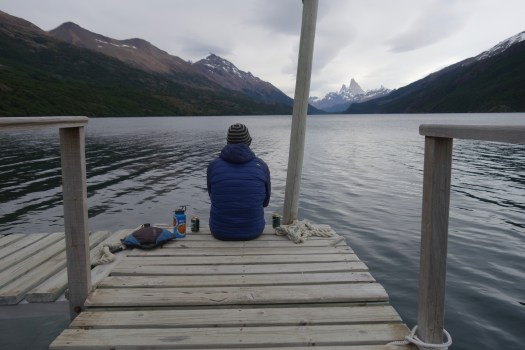
With our feet dangling above the clear water, I pulled out a beer and handed it to Dad. The fatigue from the last few weeks, combined with the dramatic scene before us, had stripped him of any inhibitions. With beer in hand, I thought he was going to cry. I wasn’t far from doing the same having realised one of my life’s goals; to view the saw tooth horizon of the Fitzroy Massif with my own eyes. We let the over shaken beers settle for a while before leaning back on a pylon and letting the alcohol go straight to our heads, sipping in silence as the evening glow settled over the alpine nirvana.
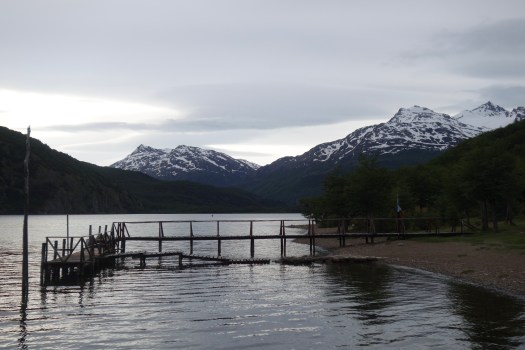
On the way back to camp, we detoured to visit the Canadians who were set up a little further down the lake. Nick had also succumbed to delirious state of wilderness-induced ecstasy which was reassuring. As we cooked a simple pasta dinner back at the tent, we were joined by two French hikers, Ed and Cyril. Ed, with long brown locks and a smooth, deep voice, worked as a cultural tour guide in Paris. In the minds of many, and the dreams of some, Ed was the quintessential Parisian. Cyril was clean cut and dressed to match. He had been working an office job in NZ for a few years and was heading home to France. An offer to join Ed for a hiking holiday in South America on his way back home had been too good to refuse. The boys had been walking in the region for a few days and were full of recommendations of trails and mountains we should check out while we were there. As had been the case for my entire trip, I quickly got the impression that it would take a lifetime to truly get to know this place. Last light was at 11pm. We went to bed only once the views had been completely swallowed by the darkness, not wanting to miss a minute with these mountains.
Crawling from the tent the following morning, I had woken from one dream and stepped into another. The clear skies, sunshine, and presence of Fitzroy rendered us speechless, again. A slow, silent breakfast followed by a couple of coffees was enough to dissolve the morning. Suddenly, we spotted the ferry slicing the calm and realised that a few hours had disappeared without trace. We packed carelessly and rushed to the jetty dishevelled and adversely caffeinated. The boat was a catamaran that sat high in the water and had an elongated bow for bikes and gear. With a penchant for anything well-designed and purpose-built, Dad loved it. After stacking and tying down the bikes, we joined the four Canadians inside and settled in for the ride.
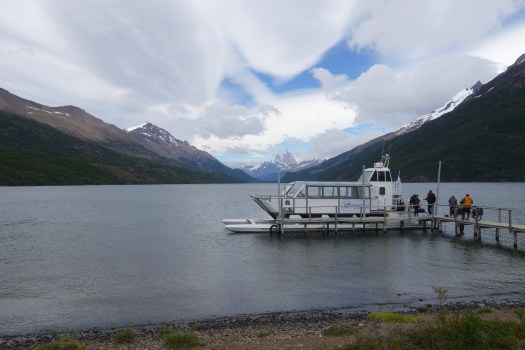
Within minutes, both the boat and our conversation were at full speed. Again, I felt energised in the presence of Nick and the others. They were perceptive, observant, and fuelled by the wilderness. As we shared anecdotes from lives lived in different hemispheres, the boat cruised past unobstructed stands of beech that blanketed the hills from the snowline to the lake’s edge. High above, hanging glaciers clung to rocky peaks, desperate to hold tight until next winter.
After unloading the bikes and bags at the other end of the lake, we said goodbye to the others, positive we’d catch up again during the coming days. Our rushed pack up that morning meant we were much slower to get our bikes packed and ready for the road. With our gear strewn out across the gravel parking lot, Dad decided to replace his brake pads while he had the chance. He was in the middle of the task, tools out and brake cables loosened, when we were approached by a young park ranger. He explained that his boss was in the nearby building and that he wouldn’t like seeing us and our mess. It was suggested that we move ourselves and our gear around the corner, solely to keep the boss’ view free of any vagrants. We were the only people around, so it wasn’t as though we were ruining business! Dad wasn’t impressed with the request and I’d never felt so ostracised! To appease the young amenable ranger, we agreed to pack up and move. I shuffled bags around to keep him happy and buy Dad a few minutes to finishing fitting the brake pads. Soon enough, the bikes were loaded, and we rolled away much to the relief of the young ranger, who’d remained at the office door fixated on our every move.
We knew we had 40 kilometres of riding between the lake and the town of El Chalten, yet the effort required took us by surprise. After almost 5 months on the road, I had been conditioned by distances. By the book, a 40-kilometre day on the bike was a breeze. However, it was this kind of disrespect that led to complacency, resulting in shorter days turning out to be some of the biggest psychological battles of the trip. This was one of those days.
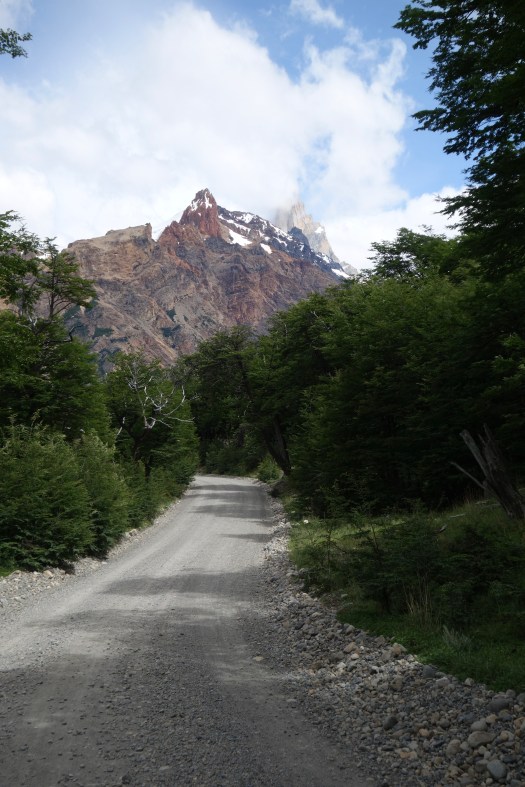
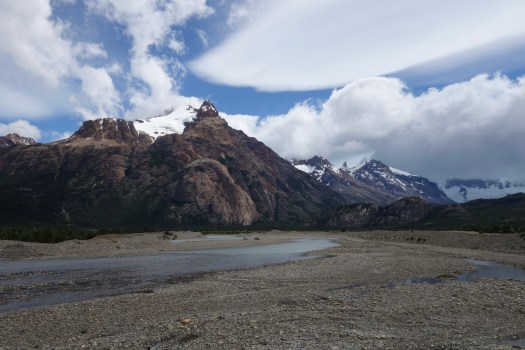
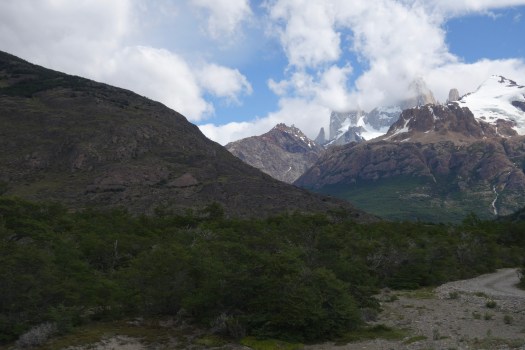
The first few kilometres provided superb riding. A smooth and meandering hard-packed dirt road guided us along the bank of a crystalline mountain stream. The fishing potential had me making mental notes, scheming my future return with rod and reel. Fine, feathery clouds danced between the granite peaks of the Fitzroy Massif, the grey, white, and gold tones of the alpine crown contrasting the emerald canopy below. At the bottom of the valley, we emerged from the forest and were greeted with expansive alluvial plains and a stiffening head wind. We took advantage of some remnant roadside shrubs and had lunch out of the wind. In dire need of restocking, we scraped the bottom of the panniers and indulged in some instant noodles, followed by a competitive round of pebble throwing.
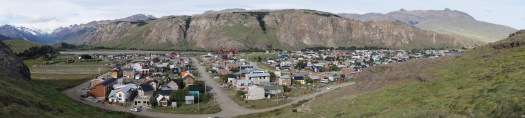
A less than nutritious lunch combined with a humbling headwind and bone-jarring corrugations made for a tough afternoon. Dad really struggled, voicing his opinion several times that this was the most difficult riding of the entire trip. The numbers said it all, with the final 30 kilometres taking almost three hours. We stopped briefly to chat to a fit and friendly Polish couple who were walking back to town after a few days out in the mountains. We made the most of a short rest and interesting conversation before continuing, grateful that we would be drinking a cold beer long before they arrived in town under the weight of their packs. The Las Vueltas River valley that we’d been following all afternoon gradually began to narrow as the hills closed in on either side. Seemingly out of thin air, we turned a corner to discover the town of El Chalten nested between cliffs on the opposing banks of the river. A main street dissected the town and any urban sprawl was strictly dictated by the geography. The sight and sensation of asphalt was indescribable. It was the silence beneath my tires that alerted me to the changed surface, prompting us to reflect on the last time we’d ridden on a sealed road. It was more than 500 kilometres ago.
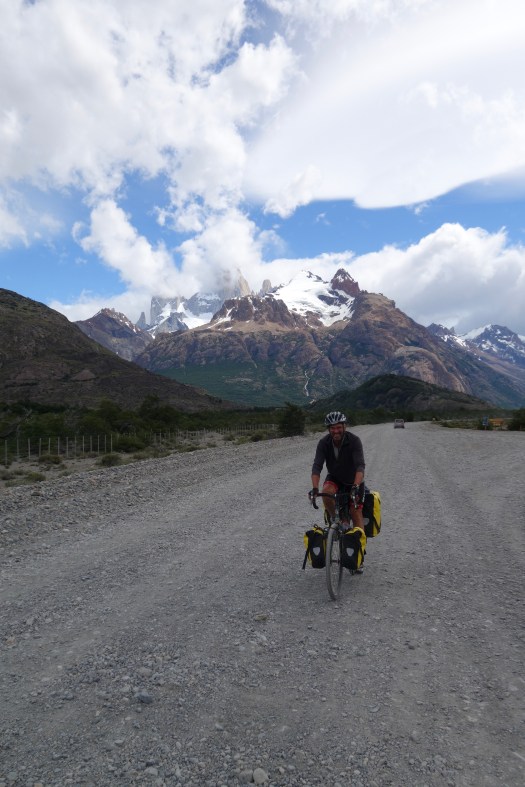
Rolling down the main street, all our senses were overwhelmed by the wide array of eateries. Signs for burgers, bakeries, beers, and pizza made it incredibly hard to keep our eyes on the road. Despite the culinary siren songs wafting through town, there was a more immediate task that needed to be addressed – cash money. Having crossed the border in the forest, we were yet to get our hands on any local currency which, unless I restored to begging, was the only way I was going to satisfy my stomach. After a fruitless visit to a tourist information office, we soon discovered that Argentinians had little time for Chilean Pesos. We were informed that there was nowhere in town that would exchange our remaining money and that we’d have to wait until a major city. Thankfully, Dad had a secret stash of crisp USD deep in his panniers and soon enough we found a receptionist at a hotel who was happy to swap them for some Argentine Pesos.
Cashed up and desperate for a shower, we agreed that finding accommodation was a priority. Our morale was tested over the next hour as every hostel or guesthouse we stopped at was either fully booked or only had one bed available. Eventually, we stumbled across a quaint little B&B called ‘Nothofagus’. We initially baulked at the price ($50 AUD per night) as it was far more than we’d been paying over the course of the trip and not the type of accommodation we’d planned on frequenting. However, after being shown the room (and the shower) we weren’t going to turn it down, quicky justifying it to each other as a well-earned treat! Plus, the Gondwanan nomenclature and imagery on the sign out front was an emotive and timely reminder of home.

The room was essentially a loft, entirely timber clad and incredibly cosy. The shower was better than heroin. It took immense willpower to drag ourselves off the beds and back out to the main street. During our search for accommodation, we had made a mental note of a bar called Vinero. The venue had caught our attention with a sign for ‘Happy Hour’ between 5-9pm. Having just gone 6, there were still three hours of happiness on offer which seemed too good to ignore.
Arriving at Vinero, we soon discovered that it was the place to be. The sun-drenched beer garden was heaving with outdoorsy folk. Hikers, climbers, and bikers, all sharing tales from their respective days in the mountains or scheming their next adventures. As we looked around for somewhere to settle in with the crowd, we heard our names being shouted. Like moths to a flame, the Canadians had also discovered the cheap beers during their first few hours in town. They had a table with a German couple and shuffled in tighter to make room for us. The Germans were in town for a few weeks climbing and quizzed us extensively when they heard we were from Tasmania. They were planning to come for a climbing holiday the following summer and wanted to know everything from the best rental car company to the best beer (a detailed account of the North-South/Boags-Cascade division was more than they bargained for). Over the course of the twilight hours and fun conversation, I was keeping one eye on the imposing summit of Fitzroy which towered over the town. It was a surreal backdrop, continually shifting between purple and pink hues as the last light caused its giant granite face to blush. After three pints, great banter, and face red from the afternoon glow, the daylight eventually moved on to a different time zone. It was a good excuse to make a move in search of dinner. We said goodbye to everyone and continued down the main street, stopping at the first place we saw for a burger. Fatigued and tipsy, we ate dinner in silence. On the walk back to the room, I picked up a bottle of imperial stout at a corner store as well as a few small bakery treats. The excessive consumption continued. Sitting on our beds, we sipped at the rich nightcap and considered setting an alarm to make the most of our time in El Chalten. We both agreed it would be a good idea but neither of us were willing to hit the button, eventually falling into a deep and uninterrupted sleep.
Aside from good shower pressure and a private room, the main perk of paying more for accommodation in South America is often the included breakfast. Aware of our dishevelled facial hair, chapped lips, and clothes overdue for washing, we positioned ourselves deep in the corner of the dining room. Several couples were scattered throughout the room dressed in neat and expensive hiking gear and politely nibbling at embarrassingly small portions. With the intention of practising our best dining etiquette, we carried our small plates up to the breakfast bar where we were confronted with a spread consisting of cornflakes, milk, yoghurt, warm bread rolls, cheeses, jams, butter, juices, and coffee. It was too much for our hungover heads and tired legs. Other guests came and went over the next hour as we continued working our way through the food. Sipping on a final coffee, we turned our chairs towards the dining room window. A view of Fitzroy’s northern flanks catching the morning sun provided the perfect dessert and encouragement to get outside.
The primary intentions for the day were rest and washing. Our first stop along the main street was to drop off a few kilos of clothes at the lavendaria. We had deliberately dressed light, so that we could wash as many items as possible while still avoiding having to spend the day naked. It is a fine balance that takes supreme management. With several hours to dissolve before the washing was ready to collect, we ambled onwards with little direction. A few shopfronts provided distraction before a rustic waffleria on the edge of town proved too difficult to walk past. It was positioned right where the asphalt met the corrugated gravel road we had ridded along yesterday. Dad was still visibly traumatised from the rough riding and showed very little interest in walking any further. Naturally, we settled in at the waffle shop with some milkshakes and watched the world roll on by for the next hour.
When it came time to pay, the waiter, having talked to us extensively about our trip, cunningly gave us the opportunity to pay with some of our remaining Chilean Pesos. We jumped at the offer, having experienced the town-wide hesitancy to accept the currency the day before. However, when he showed us the exchange rate, we calculated that the bill would nearly double which seemed absurd. With little use for the remaining Chilean currency, we reluctantly handed over more than we’d be prepared to pay. We went in search of somewhere with a better exchange rate to rid ourselves the neighbouring country’s currency which, like the night before, was seemingly impossible. Eventually, we found an incredibly helpful receptionist at a large hotel. He said they could exchange currencies, but it would be at the same exchange rate we’d been presented with at the waffleria. He asked us about our onward journey and provided some sage advice. As we’d be entering back into Chile in the coming weeks, he suggested we just hold on the money we had. He also informed us that it is illegal in Argentina to charge tourists tax and that it is mandatory for all restaurants and hotels to have Visa facilities.
We stashed the remaining Chilean notes and coins deep in our bags and withdrew money from an ATM. After buying some bread and cheese for a simple lunch, we climbed to the top of a wooden fort in a nearby playground and ate in silence. The remainder of the afternoon was absorbed by bike maintenance, calls home, and several cups of tea in the hostel garden. Dad settled into a hammock and I attempted to catch up on some writing, both inspired and distracted by the grandiose alpine vista.
Despite the elation we felt having made it this far, it still felt necessary to lift our spirits with another happy hour. We wandered into town to pick up our clean washing before settling in at Vinero for a few pints as the sun went down. As we were leaving, we ran into Maria who was just returning from a day of hiking. Her time in the mountains had left her red-faced and ecstatic, and she was brimming with recommendations for trails that we should explore the following day. As we parted ways, Dad again expressed his infatuation with Maria’s tenacity and vigour. Raising a beer glass was the most energy we’d exerted all day. Hearing about Maria’s 12-hour walk certainly evoked some guilt within as we chowed down on a burger for dinner. As we left the restaurant, we crossed paths with Nick and Rob. They’d been in touch with Byron; the Geordie cyclist we’d met near Puyuhaupi, who was on a formidable mission to reach Ushuaia within the following two weeks. He’d apparently ridden 230km that day into a headwind. As impressive as it sounded, we really couldn’t comprehend the extent of this feat until we experienced the same road and winds during the next stage of our ride.
Old habits kicked in and we bought an ice cream for the rest of the walk back to the room. I ordered a scoop of ‘aphrodisiaca’ which, upon reflection, was a strange choice from a son travelling with his father. However, the combination of almonds, cinnamon, and hazelnuts, was a vivid reminder of mum’s Christmas cake. I was hard to comprehend that it was only a bit over two weeks until we’d be returning home to the real thing.
We left our accommodation around 8am the next morning. The weather was sublime and we had once again eaten our fair share at breakfast. Since arriving in El Chalten, the Fitzroy Massif had felt like a mirage; teasing and unobtainable. It was hard to comprehend that we were about spend the day in the presence of the granite giants that have occupied my dreams for years. We marched up the main street with purpose, stopping only to buy some bread, cheese, and muesli bars at the supermarket.
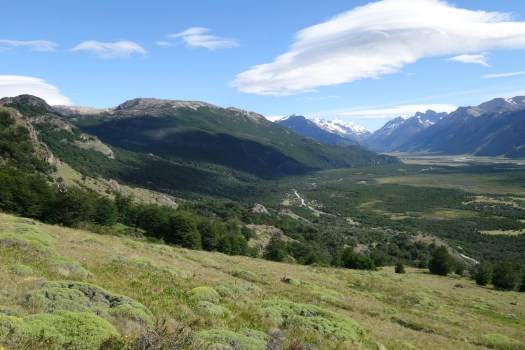
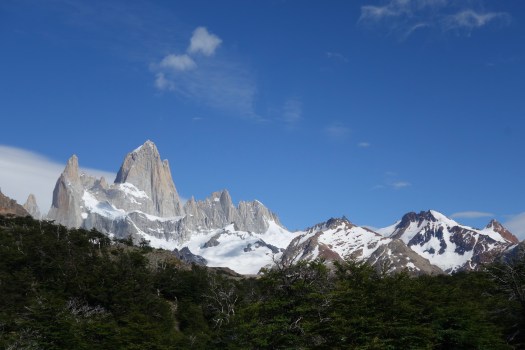
The Lago De Los Tres trailhead was located a few hundred metres from the edge of town. From the road, the trail climbed gently and offered views back down the valley we’d ridden along a few days earlier. Ducking in and out of stands of gnarled beech trees, the trail crossed countless crystalline creeks and skirted glacial tarns of varying blue and green hues. All the while, Fitz Roy’s arresting rocky spine loomed on the horizon. After a few hours of pleasant walking, the trail passed through a campground where a number of people were setting up tents, including the four Canadians who were planning on spending a couple of days on the trail. We chatted for a while, acknowledging that our itineraries were unlikely to cross again and thanking each other for the company.
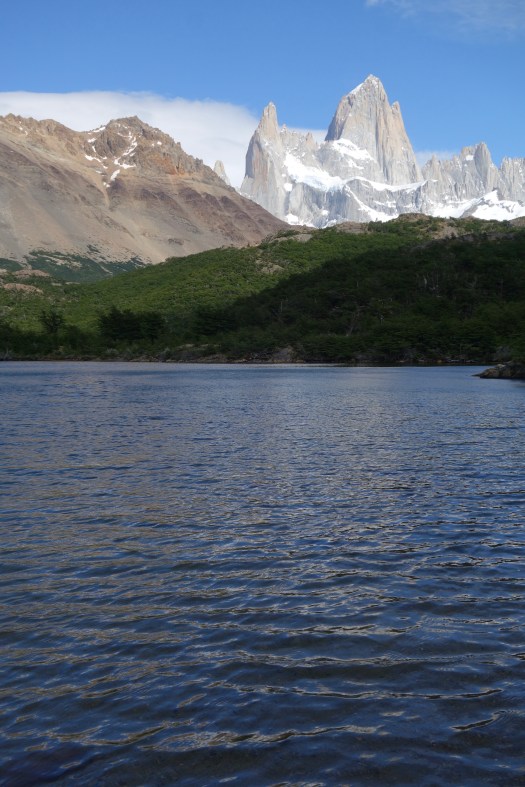
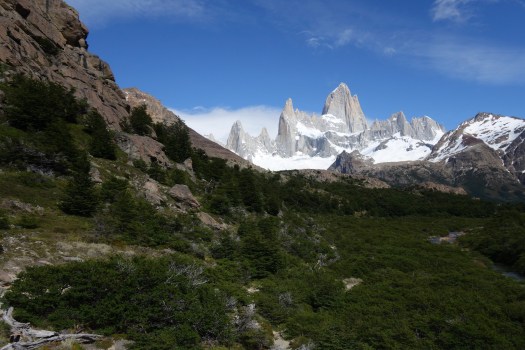
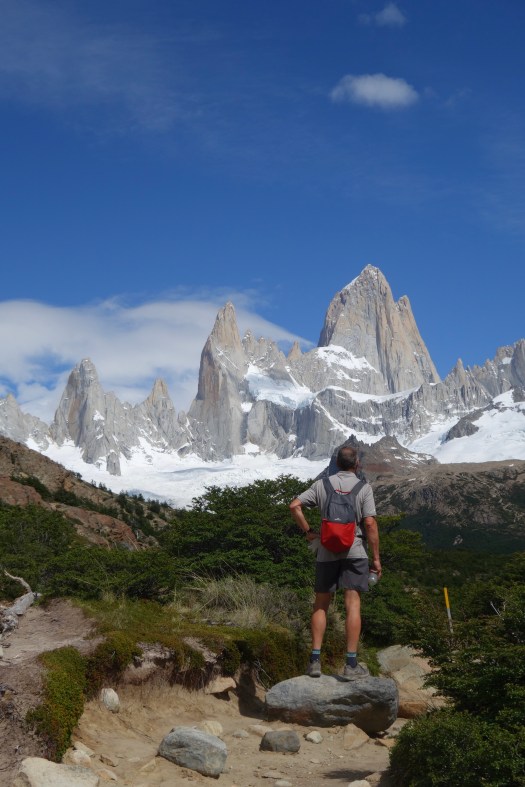
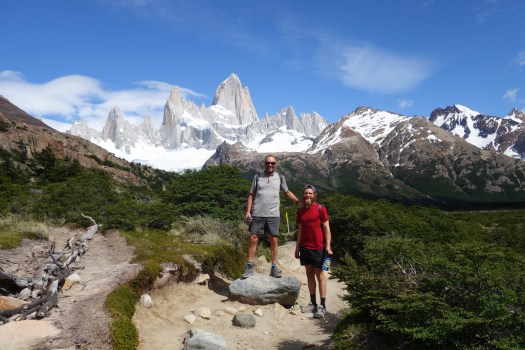
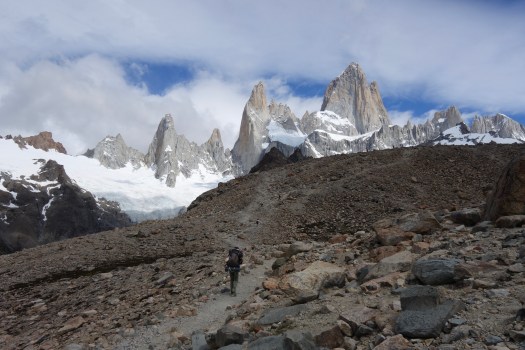
From the campsite, the gradient increased and we finally felt like we were climbing. The surrounding landscape became more barren as we crossed the winter snow line. Large, smooth rocks acted as sturdy steps amidst the loose gravel, while the woody trunks of any remaining vegetation had been polished by thousands of hands clawing for support. As with any ascent, especially in the mountains, every metre gained in elevation allows you to peek just a bit further over the horizon. Every step of the climb required a new assessment of our awe-inspiring surroundings.
Step. Stop. Spin. Smile. Repeat.

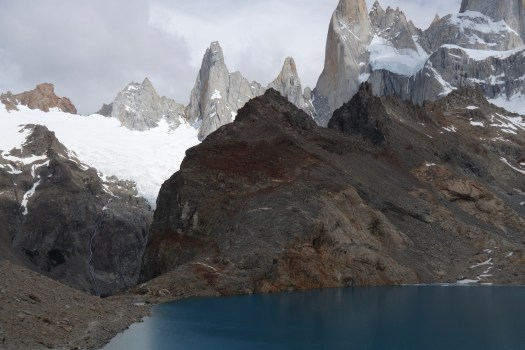
Despite a morning of some of the greatest views of my life, neither of us were really prepared for what lay over the final crest of the climb. The landscape dropped away at our feet as the hill we were standing on plunged down into the milky blue Lago De Los Tres. Large blocks of winter ice remained suspended in the frigid glacial water. The lake, however, was merely the garnish for the visual feast that loomed behind it. We were now face-to-face with the various peaks and spires that comprise the mighty Fitz Roy Massif; Guillaumet, Mermoz, Poincenot, and Saint-Exupery. At the centre of these mountains was Cerro Fitz Roy itself, reaching 3375m into a near-cloudless sky. It was remarkable. We sat behind a boulder, obscuring our view of other hikers to create the illusion of being alone with the mountains. It was another moment on the journey where I was so grateful to be sharing the experience with someone else, let alone with my dad.
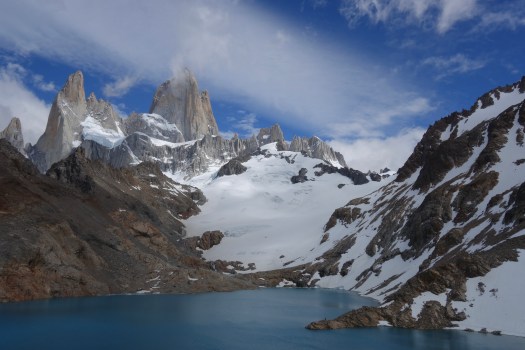
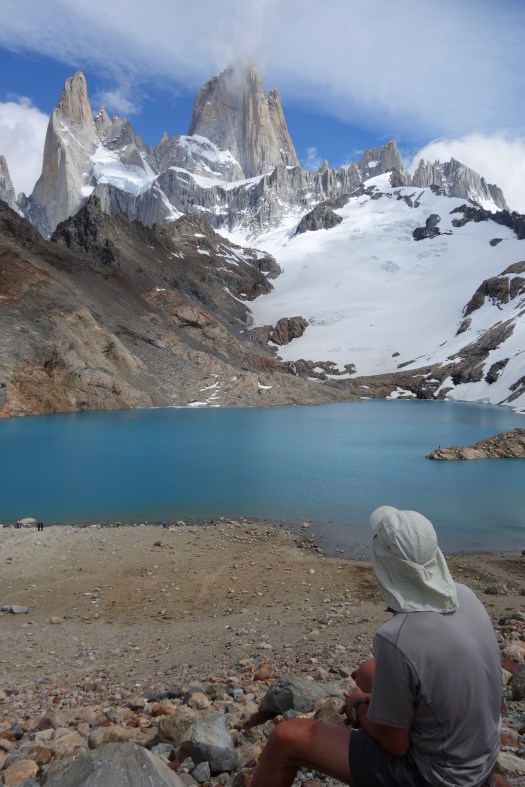
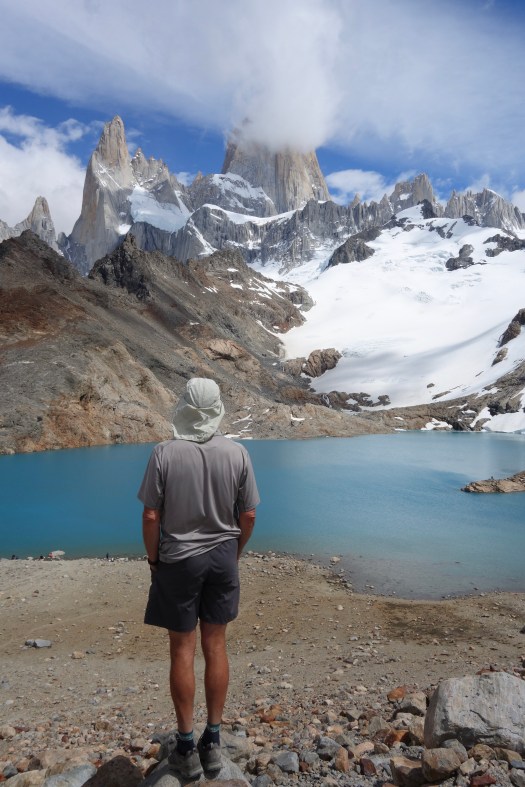
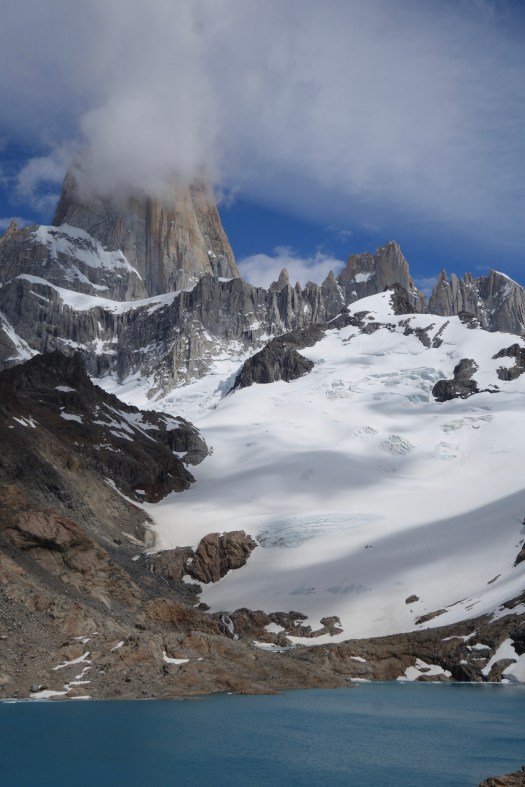
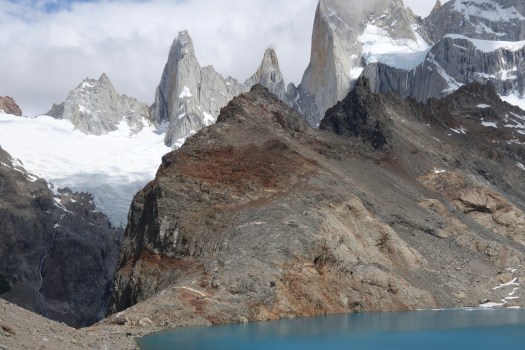
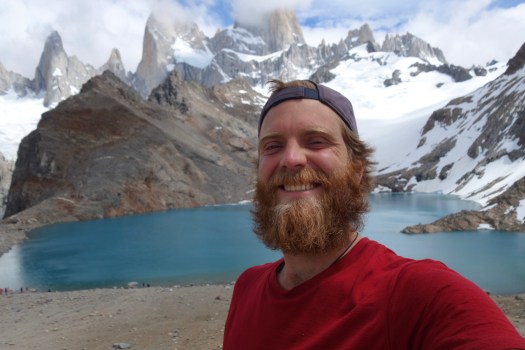
We spent an hour staring into the mountains, trying our best to permanently imprint the view into our psyches. From the top of the hill, we backtracked for a few kilometres to a junction. Rather than return the way we had come, I was eager to visit Lago Torre which lay a several kilometres further south. We both felt fit from the riding we’d been doing. However, the motion of walking was testing a few body parts that had been underutilised over the previous few weeks. After several hours of walking, including a relentless descent back to the track junction, we were both feeling it in our feet. Once we were on the new trail, we found a sheltered clearing for lunch, making the most of the break to take off our shoes!

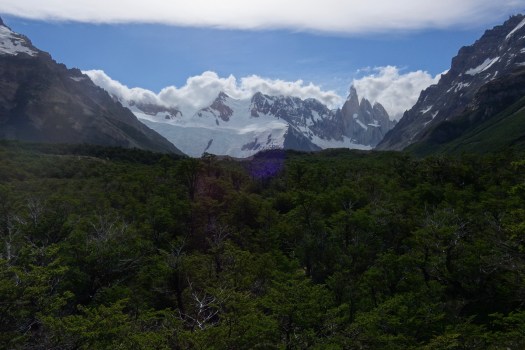
The walking after lunch was beautiful. We wandered along another valley floor, between beech forests and grassy meadows, and through open, fairy tale-esque woodlands. There were no sightings of Hansel and Gretel, but every time the canopy thinned, we could see we were still under the watchful eye of Fitz Roy.

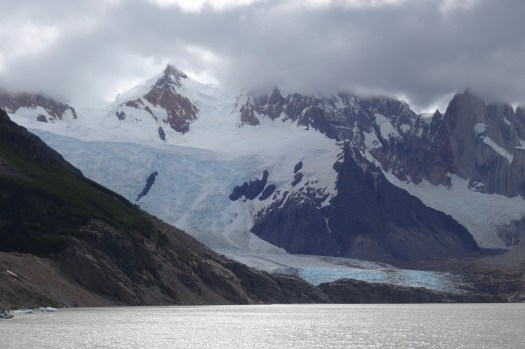
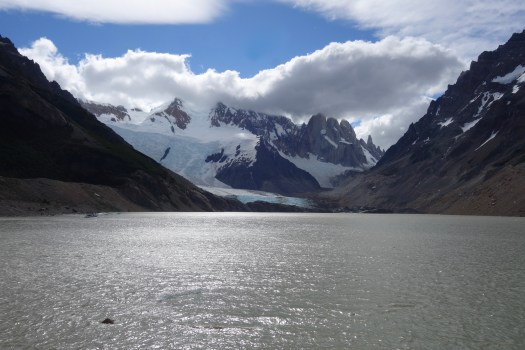
It was mid-afternoon when we arrived at another junction. Dad decided to head back to town and let me explore Lago Torre alone. It was another 4km of walking through more beech forest and along the bank of a churning, turbid river that drained from the lake. I eventually came to the terminal moraine that marked the edge of the lake. The weather had changed over the course of the afternoon and a cold wind tumbled down from the glacier on the opposite shore. Short, sharp waves lapped the rocks at my feet, trying their best to break large chunks of ice that rolled around in the shallows. Unfortunately, cloud had now filled the valley and the mountains above the distant glacier were now obscured. One of these peaks, Cerro Torre, holds a special place in climbing history, and I was eager to spend time in its presence. Jon Krakauer, author of ‘Into the Wild’, wrote about Cerro Torre in his book, ‘Into Thin Air’. Describing notable climbing accomplishments in his life, Krakauer explained how he has once “scaled a frightening, mile-high spike of vertical and overhanging granite called Cerro Torre; buffeted by hundred-knot winds, plastered with frangible atmospheric rime, it was once (though no longer) thought to be the world’s hardest mountain“. A friend from Tasmania had also summited a few years earlier and I was eager to pay a quiet homage to his achievement. I sat for a while, breathing in the glacial air and trying to picture the granite finger of Cerro Torre pointing to the moon on a cloudless night.
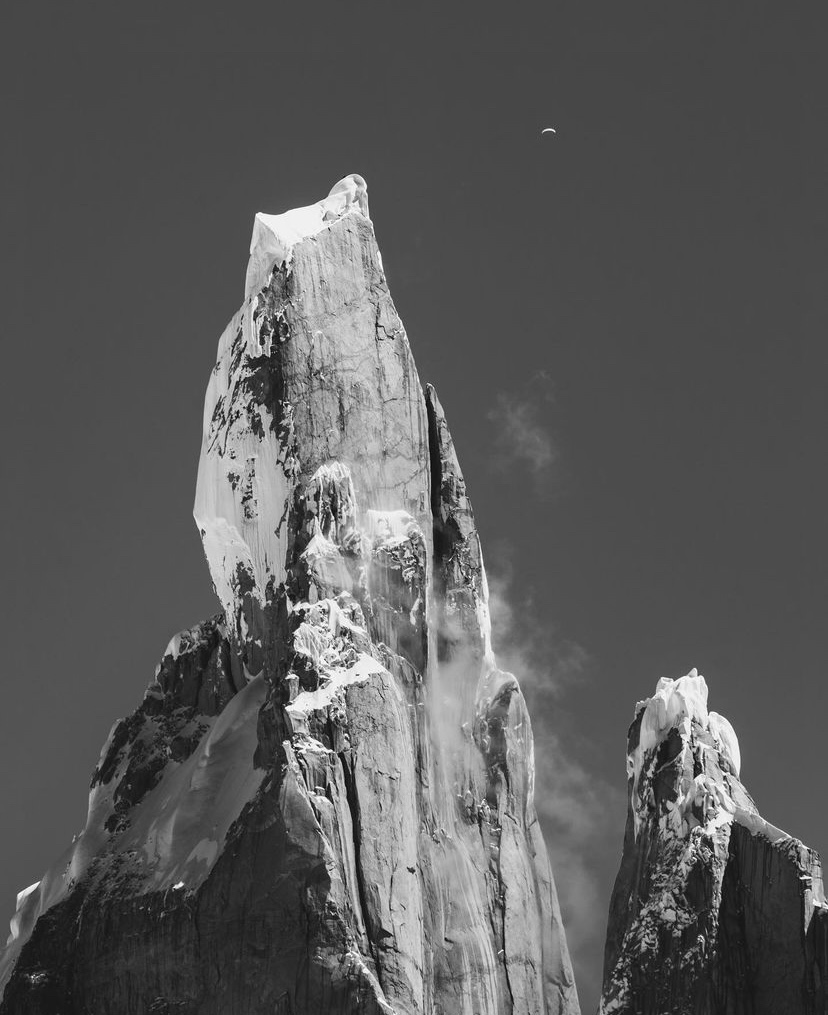
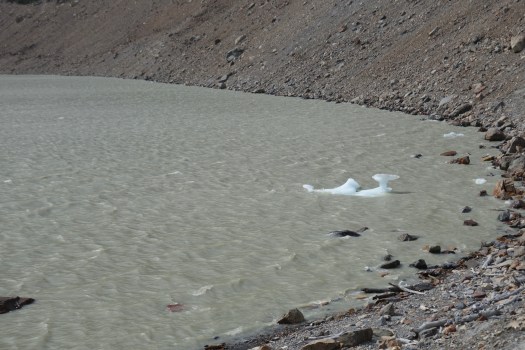
I jogged back to El Chalten, arriving back at the room around 8pm after nearly 40km on the trail. After a shower and an obligatory happy hour beer at Vinero, we went back to the burger joint from the previous night. This time, however, I felt like we deserved the fat and carbs. The TV in the restaurant was playing a well-known mountaineering documentary called ‘Line Across the Sky’. The film follows two climbers, Alex Honnold and Tommy Caldwell, in their epic pursuit to traverse the Fitz Roy massif in a continuous push. This skyline, visible in the logo of clothing brand Patagonia, is a thing of beauty. It was truly surreal to watch them ascending and descending the various peaks of the range out of one eye, while looking at the actual mountains out of the other eye.
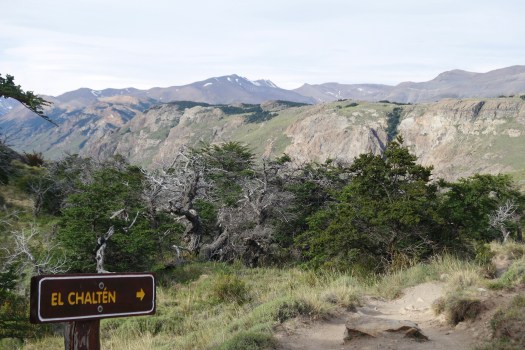
We bought another ice cream for the walk back to the room, enjoying the routines that we’d established over the last few days in El Chalten. This town and its surrounding landscape had been in my dreams for years. After the day we’d just had, I have no doubts I will continue dreaming of this place for the rest of my life!
Thanks for reading.
I highly recommend watching this condensed (free) cut of the ‘Line Across the Sky’:(https://www.youtube.com/watch?v=ZOScetWwEwc)
 Faults and Folds