The wind had already begun to blow when we emerged from the tent, both of us suffering from a ‘Tyler Hamilton hangover.’ Knowing that we were leaving town in the same direction from which we’d arrived, the swirling leaves and swaying trees fuelled us with excitement rather than fear. We broke camp and rolled down the road to a supermarket to buy some supplies for the coming days. Food and accommodation options on the road ahead remained a bit of a mystery so we stocked up in preparation for some wild camping. A German bakery lured us in for a pastry and a coffee, providing the energy and motivation to continue the ride south. As we cycled towards the outer limits of El Calafate, we pulled into a petrol station to top up on some fuel for the stove. Sheepishly, we joined the long line of gas guzzling SUVs and tour busses and waited for a chance to fill our 500ml fuel bottle. It was a beautiful reminder of how travelling by bike allows you to take so much from the world while using so very little.
The 32 kilometres from El Calafate to the junction with the Ruta 40 took us a touch over an hour; a stark contrast to the three and a half hours it had taken us in the opposite direction. We passed a couple on a tandem who looked to be having as much fun as we’d been having a few days earlier. Our routine two-hour break was spent atop a small hill that preceded the long climb of the day. We ate some biscuits and savoured a few squares of chocolate, cognisant that it might have to last a few days, before tackling the hill.
The climb was sensational. The gradient was gentle and the asphalt was like silk. A subtle 700 metres of elevation gain over 10 kilometres allowed us to breathe in the landscape that unfolded in all directions. The pampa was a palette of mauve, teal, gold, and rust. At the top of the climb sat a perfectly positioned stone wall, providing protection for a wholesome lunch of baguettes filled with avocado, cheese, and salami.

The descent granted us further opportunity to absorb our surroundings. The pampa extended to the horizon. Featureless at first glance, a deeper focus on the windswept plains revealed complexities and nuances that kept us intrigued and excited for what was still ahead of us on this ride.
With the day’s climbing behind us, we raced along the flat. Rhea trotted beside the road with purpose, and flighty guanaco scattered from their peaceful grazing locations. It was 5pm when we reached a significant junction. Having covered 100 kilometres over the course of the day, we had a decision to make. The road heading south, the Ruta 7, cut a few hundred kilometres of the journey if we were to stay on the major Ruta 40. The Ruta 40, which continued east before a sharp dogleg back to the west, clearly wouldn’t exist if the Ruta 7 was a ‘good road’. There was clearly a reason that most traffic opted for the extra few hours of driving rather than taking this shortcut and we had our suspicions that it might have something to do with the quality of the road.
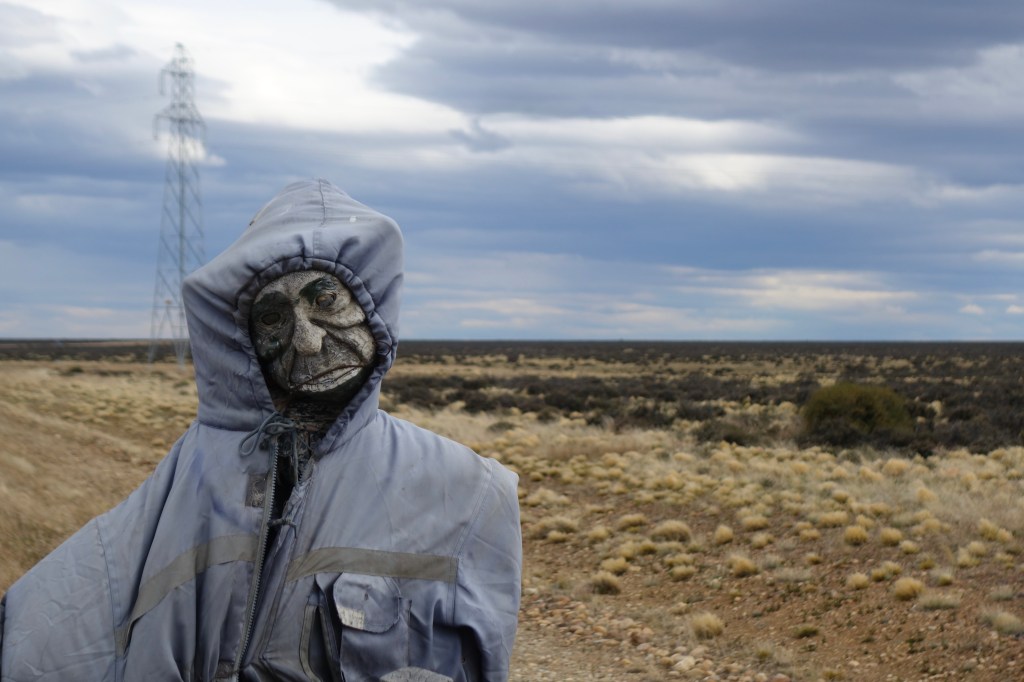
Despite our concerns, we committed to the unknown and turned onto the Ruta 7. A haunting, weather-beaten scarecrow hung from a post beside a cattle grid, marking the beginning of the ripio. The road was indeed horrendous. Coarse gravel and unforgiving corrugations providing limited options for smooth lines. We tried riding in the ditch beside the road but would lose control of our front wheels in the deep sand. There was no choice but to embrace the bone-jarring path forward and keep our eyes peeled for a suitable campsite.

An hour down the road we spotted a tent tucked into the shrubs. The rattling of our panniers roused the occupants of the tent and two heads rose above the vegetation. We pulled over, eager for a rest and nonchalant about small talk. The two men made a strange pair; one tall and bone thin, and the other short and stout. They were from Italy and had just completed their first day of riding on what was to be a month-long trip from El Calafate to Ushuaia. They emphasised their exhaustion and explained that they’d been hoping to make it to an abandoned police station for the night. Apparently, the police station, only another 10 kilometres down the road, was a pretty common refuge for cyclists. We thanked the men for the intel and left them to rest for the evening. We decided to push on to the police station, to at least check it out as neither of us (if we’re both telling each other the truth) had ever spent a night in a police station.

Perhaps it was knowledge that we were almost done for the day, but the remaining few kilometres were smooth and enjoyable. The road descended into a valley which was a clear product of glaciation with visible bands of sedimentary rock, eroded by an ancient tongue of ice. A turbid river flowed along the floor of the valley and a few carloads of men sat on its banks, fishing and drinking beer.
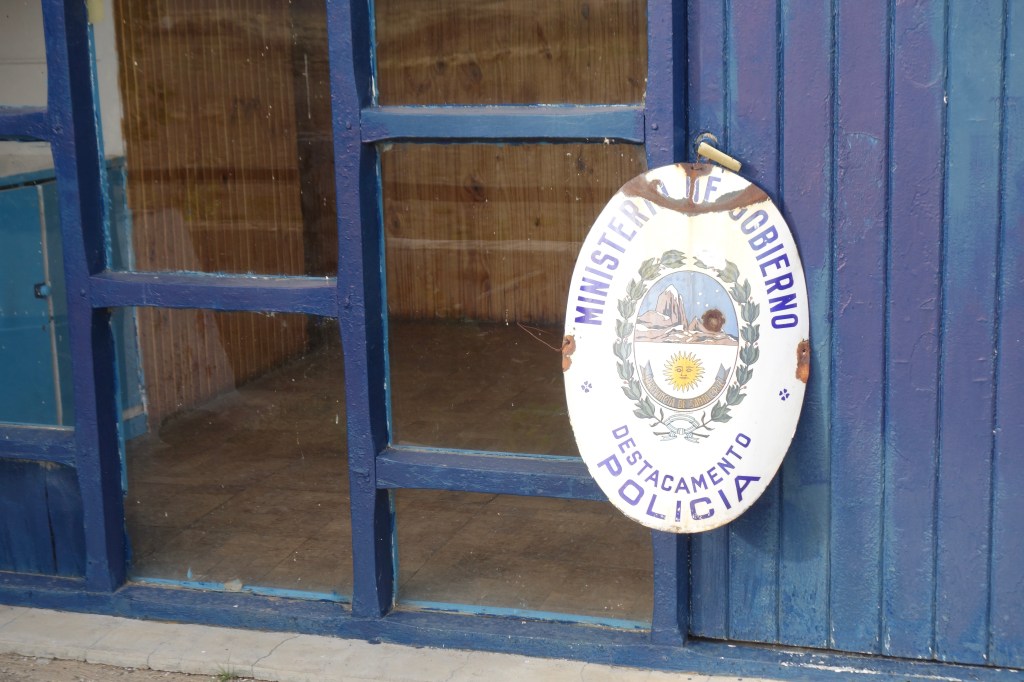
The police station was unmistakable. It was the only building in the valley and a wooden police badge hung above the front door. Broken windows and holes in the walls gave us confidence that there wouldn’t be any constables arriving later in the evening. We managed to pry open the back door to take a look at the sleeping options. Unlike the pink restaurant, this place had been trashed. The toilet was overflowing with excrement and rubbish covered every inch of the floor. We wandered the perimeter of the property looking for a reasonable campsite, hoping to at least use the police station as a windbreak. A shingled stable towards the river caught our attention. Its wooden doors hung from rusty hinges and sheets of roofing iron flapped in the breeze. Retrospectively, it was textbook creepy. But we were tired and eager to settle down for the evening. I swung the door open to find man sitting in the corner of the shed, clearly as startled as I was. He quickly stood up and walked out into the fading light of the evening. Standing a little over five foot tall, he was thin, clean cut, and had piercing blue eyes. He spoke frantically.
In a thick French accent, the man explained that he was walking from Ushuaia to Quito. Earlier that day, he had passed some cyclists who had told him that they had been camped at the police station the previous evening when a black van arrived. Several men with guns had emerged from the van. Posing as police, the men had searched the cyclists before piling back into the van and disappearing as quickly as they had appeared. The French walker said that when he heard us, he had assumed we were the ‘police’ returning, so he had hidden in the shed. When I asked why he had decided to camp here, knowing this story of the van and the guns, he told us that he was walking without a tent so needed a shelter. As we had also discovered, the police station and surrounding sheds were the only buildings on this stretch of dirt road. He also highlighted that he didn’t have a stove and was living on dry biscuits. He was proud that his backpack only weighed 5 kilograms. It was admirable, in a sadistic, Christopher McCandless kind of way. It came as no surprise when he told us that he had started this walk with a girlfriend who had since decided to take a different path (and mode of transport).
We invited the Frenchman to join us for dinner but he said he was going to sleep. He had covered 50 kilometres that day and wanted to do at least the same tomorrow. Darkness had swallowed the valley by the time we had finally set up camp on a concrete slab beside a woodshed. A dinner of mushroom gnocchi and generous swig of red wine did little to settle our nerves before bed. Not only was the story of a vanload of men with guns doing little for our cortisol levels, but a persistent and distressed meowing coming from within the shed had our minds racing. Dad convinced himself that it was a puma cub waiting for its mother to return from a night of hunting.

Disturbing dreams and broken sleep led to a slow and dysfunctional morning. We saw the two Italian men ride past as we ate breakfast, confounding our feelings of lethargy and inefficiency. We never saw the Frenchman again, who no doubt had been on the road since sunrise, fuelled by dried biscuits and fears of gunmen. As we loaded our panniers, a family of malnourished cats emerged from the woodshed in search of any scraps we may have left on the ground. Hardly the pack of bloodthirsty pumas that we had envisioned, we rode away from the police station a feeling hungover from a night of irrational thoughts.
Our leisurely start to the day proved to be a monumental error. We were welcomed back out onto the ripio by a stiff headwind, suggesting that we were in for a tough day on the bikes. Dad was taking a while to warm up, riding slower than usual. I was unnecessarily irritable. We rode separately for the morning.
Dark, moisture-laden clouds were draped over the horizon in all directions. A small hole in this nimbostratus blanket allowed sunshine to light up the earthen palette of the surrounding pampa. The local fauna kept my destructive thoughts and the deteriorating road conditions from completely derailing the day. Guanaco and flamingos stood tall against the wind on their spindly legs, while birds of various sizes appeared suspended and motionless in the sky. The occasional South American Fox, or zorro in Spanish, was seen devouring decaying roadside carcasses. Their penetrating eyes would watch us until we’d completely passed by and could be eliminated as a threat to their meal. We rode past flocks of merino sheep with enviably weatherproof jackets. They scattered at the first sight and sound of us, the mothers leaving their long-tailed lambs to frantically chase after them.
Dad and I came back together around midday. Despite the rubbish conditions, the medicinal benefits of cycling had taken affect and we were both in better moods. We stopped for lunch beside a large and seemingly futile white pole that was cemented into the ground. Besides the rough gravel road, this pole was the first human feature we’d seen all morning. We battled the wind and tied the tarp between the pole and our bikes, pegging it out on a 30° angle from the ground to create a low wedge-shaped wind break. We lay down to eat lunch and have a snooze. My right knee had been playing up all morning, with each pedal stroke causing a sharp pain beneath the kneecap. The day before had been bigger than usual, riding in a higher gear with an extra eight litres of water on board. As we rested after lunch, I checked the map to see that we were only 20 kilometres from the junction with the Ruta 40.
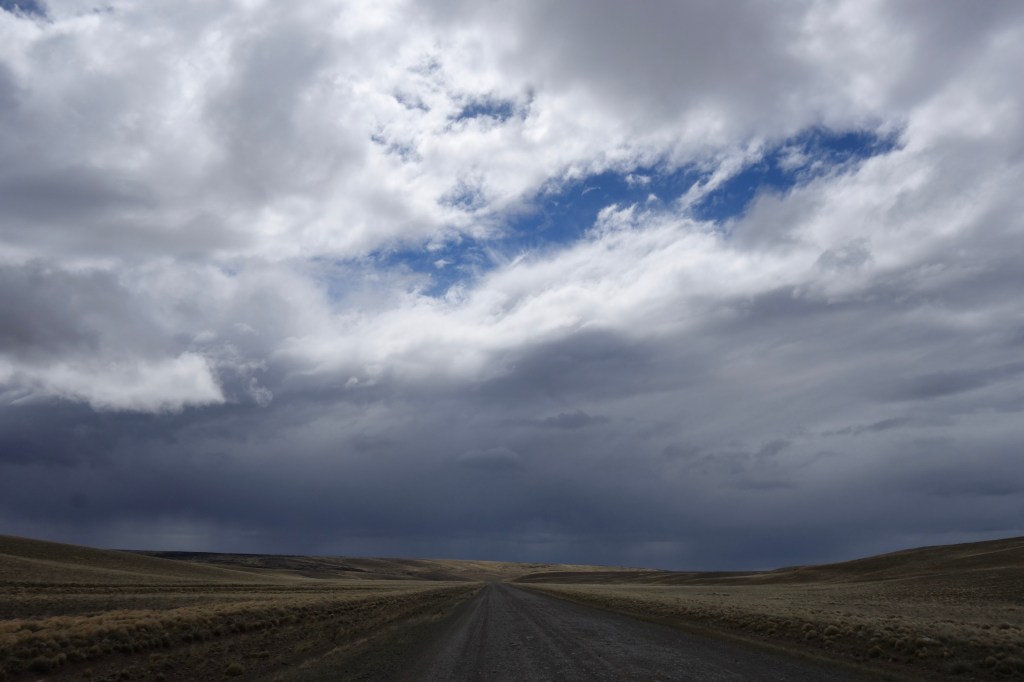

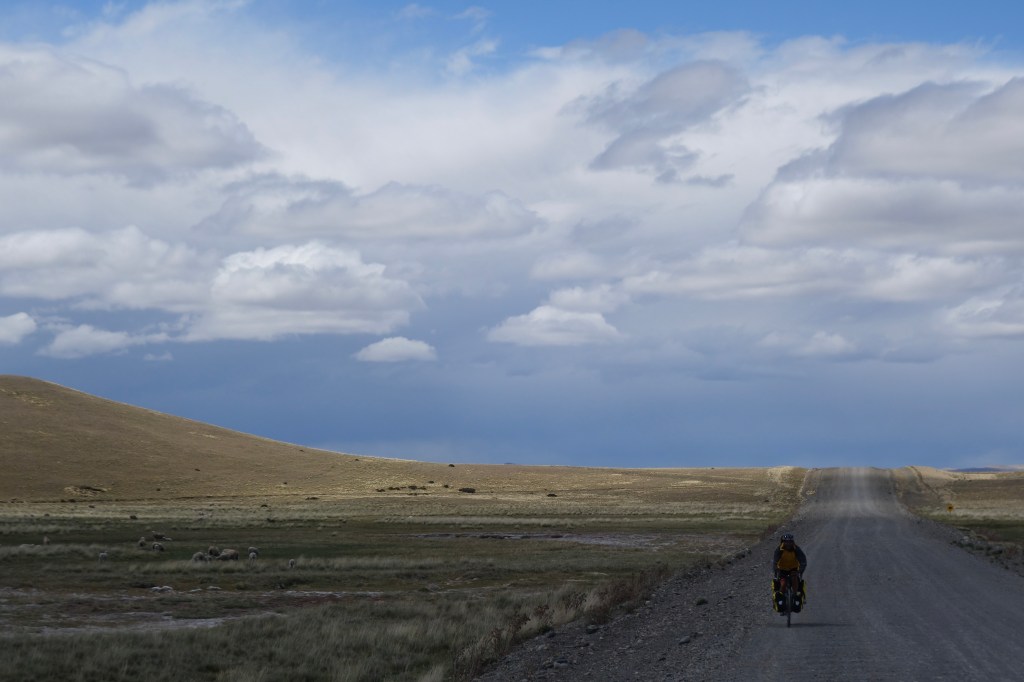
Gritting our teeth (not to the extent of Tyler Hamilton), we pushed hard for another two hours. Ears ringing from the wind, and our bodies shaken by the corrugated road, we arrived at the junction and took shelter in a petrol station. We refuelled with coke and chocolate while exploring the shop’s front window which was completely covered with stickers from passing travellers. Chatting to the lone man working at the shop, we mentioned how strong the wind had been out on the road. His response was emotionless and dismissive; ‘That’s Patagonia’. He told us that we should be able to stay in the place across the road next door to the new police station. We were uneasy about another night beside a police station, but the bare, wind-swept landscape provided limited options for a peaceful night in a tent.
We pushed our bikes across the road and knocked on the door. An old man in grease-smeared khaki overalls answered and asked us to follow him without asking any questions. We clearly weren’t the first cyclists he’d had knock on his door, desperate to escape the Patagonian winds. He led us around the back of the building to a converted semi-trailer that had several sets of metal stairs leading to small rooms. He climbed up and opened a door for us to inspect one of the rooms. Smoke-stained vinyl covered the floor, walls and ceiling, and the rancid aroma of nicotine was overpowering. We tried our best to politely decline staying in the trailer and asked if there might be somewhere we could pitch our tent that would be sheltered from the wind. Eventually, after much discussion, he said we could stay in his big shed. I think his hesitation was reflective of the concern he had for our wellbeing, rather than being offended that we’d turned down a night in his trailer. He told us to come to the main building for showers once we’d set up camp.
The shed was enormous. Big enough for several tractors, it was dark and home to what seemed like hundreds of roosting pigeons. The wind outside slammed against the thin iron walls of the shed and sunlight pierced through rusted holes. Gravel covered the ground and the smell of diesel hung in the air. But it was out of the wind. We set up the tent inner and headed back to the building to take up the man’s offer of a shower. He said we could camp for free but wanted 100p (around 50c) for the showers.
Following the shower, Dad was visibly perturbed. He asked if mine had been hot, which it had been.
‘Mine was bloody freezing’ he said. ‘I had the F tap turned on full and let it run for ages but it just stayed cold’.
Quickly working out what had happened and trying to keep a straight face, I asked him what he thought the ‘F’ on the tap had meant.
‘Who knows, but I just wanted a hot shower so I wasn’t turning the cold tap on’.
After letting him simmer in his frustration and disappointment for a little while, I reminded him that the word for cold in Spanish was frío (F), and that the word for hot was caliente (C). He was soon warmed through with embarrassment.
We sat and talked with the old man for a while. He had since changed from his overalls into a clean shirt with braces holding up a pair of thick woollen trousers. He was excited about having company and told us, in detail, how he is responsible for looking after the surrounding roads during winter. We’d noticed a mammoth pile of salt behind the shed we were camped in, and he explained how he uses this this salt to spread on road ice. As we were talking, I bumped a scab that had developed on my leg and a slow trickle of blood began to flow down my shin. Our host, eager to take care of us, jumped to his feet and returned with a bottle of rubbing alcohol that he generously poured over the wound. The stinging rocked me to my core. Hopefully my grimace and back and forth rocking was lost in translation, perceived as a smile and a vigorous nod of gratitude. He was so excited to be helpful.
We returned to the shed and cooked a simple pasta dinner while plotting an early start the following morning to have at least a few hours of riding without the wind. The sun was still up at 10.30pm but the shed provided enough darkness to sleep. I stepped outside for a toilet break a touch before midnight and was treated to a view of Torres Del Paine on the horizon. The formidable granite spires were illuminated by the fading twilight glow.
Awake at 6am, we ate our preprepared porridge, filled our water bottles, and packed our bikes. Outside of the shed, the air was glacially cold but at least it was still. It was a matter of when, not if, the wind would rise from its evening slumber. Wearing our warmest layers, we made good time along the Ruta 40. The smooth asphalt was a welcome change from the harsh conditions of the previous few days. However, a better road equals more traffic, and as the morning wore on, we were joined on the road by an increasing number of speeding cars.
We stopped after an hour for some biscuits and so that I could tend to my knee which was continuing to give me grief. There was little I could do but have a stretch and give my kneecap a vigorous rub to bring some heat into the area. I knew that letting it cool down might lead to further stiffness and soreness, so I was eager to keep moving. As always, there were enough distractions along the way to take my mind off the persistent and niggling pain. The surrounding plains were pockmarked with small tarns. While some still had water, many were empty. Those with water were populated by flocks of Andean geese and the odd flamingo. The antithesis to camouflage, these brilliant pink birds appeared like wildflowers in a desert.
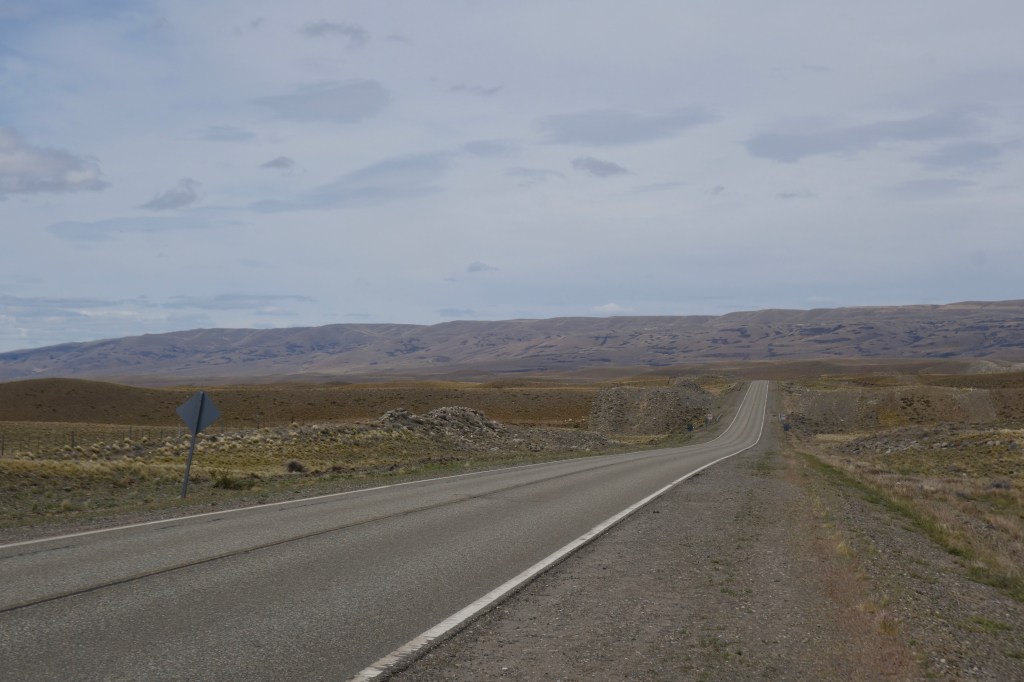
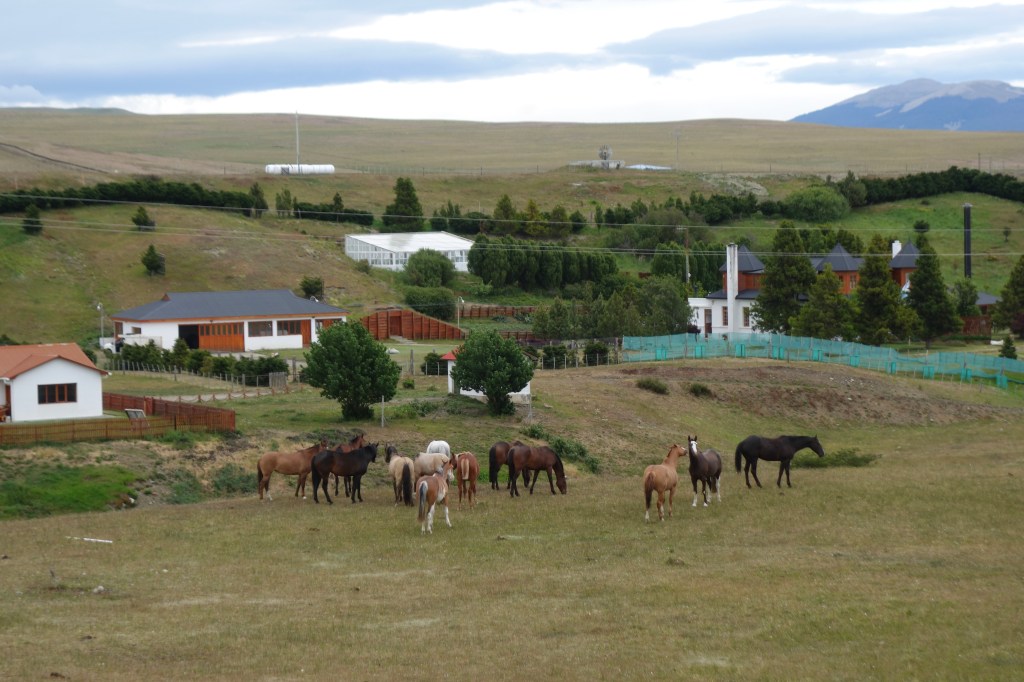
It was midmorning when we arrived at the turnoff to Chile. The road to the border crossing was unsealed but it was all downhill. We rolled past fields of luscious pasture, hemmed with beautifully crafted wooden fences. One particular paddock was home to a flock of the most magnificent looking horses I’d ever seen. Silky coated bays, grays, and chestnuts, cantered proudly with each flick of their tails catching the morning sunlight. Speckled pintos grazed contentedly, creating a majestic final memory of our time in Argentina.
Sitting on a step beside the emigration building, we gathered our passports and collected our thoughts. As we were making our way inside, a bus pulled in and we heard our names being called out. We turned to see Nick and Rob, the Canadian boys from El Chalten, emerge from the crowd of passengers who were piling off the bus. They had stayed longer than expected in El Chalten to do some more hiking and were now travelling towards Punta Arenas to catch their flight back home. Our rendezvous appeared bittersweet for the boys. After months of cycling and hiking, this was their first bus ride. They attempted to articulate the challenge of watching the outside world race by the window. Stretches of road that on a bike would have consumed countless calories and prompted profound ponderings, were now spent scrolling phones and snoozing. Nick summed it up pretty well.
‘The moment you sit down on a bus you become oblivious to everything that you spend your days thinking about on a bike; the wind direction, where to shelter from the rain, the gradient and surface of the road, how much food you need to carry. It makes you immune to the things that keep you living in the moment’.
We chatted for a while before they were gently encouraged by their driver to hurry through emigration so that the bus could continue onto Chile. We said our goodbyes, again, and promised to keep in touch.
Having our exit from Argentina made official, we rode another few kilometres to the Chilean immigration buildings. Entering Chile was a far more bureaucratic affair than departing Argentina. We were required to put our panniers and bikes through luggage scanners. I declared a knob of ginger that I still had in my bag and hadn’t felt like consuming before the crossing, like we had done with most other food items. A customs official held up the piece of ginger for further inspection, his eyes darting between me and the contraband in question. Still not convinced of the innocence of this root, he broke the specimen in two before sniffing both halves. Seemingly satisfied that the pieces of ginger posed no threat to the country, he nodded sternly and waved us through to collect the rest of our possessions.
Having now formally entered Chile, the final country for this journey, we rode into the border town of Cerro Castillo. It was around midday and the wind was now whipping up dust in the streets. We found a small café to take shelter and develop some sort of plan for the afternoon. Stepping out of the elements and into a quiet, warm space brought our fatigue to the forefront of our minds. We sat in silence and tried desperately to extract energy from a slice of banana bread and a cold can of coke.
As well as accommodating Chilean immigration and customs buildings, the town of Cerro Castillo is also the closest community to the Torres del Paine National Park. Our sights were still firmly set on visiting this iconic park, world-renowned for its repertoire of mountains, rivers, glaciers, and unique plant and animal species. We’d spoken to a guide at the border crossing who had suggested we spend a few days riding through the park, following an anti-clockwise loop from Cerro Castillo before continuing south to Puerto Natales. Following our lunch of banana bread and coke, we looked over some maps and agreed that this was the best plan. With a sense of purpose, we stepped out into the wind and set off to stock up on food and fuel for the stove.
Within five minutes of riding around the small hamlet, we discovered that there was only one small convenience store in town. We bought a packet of pasta, some tomato sauce, and a few packets of sweet biscuits to get us through the following days. After another few minutes pedalling around town, we then learned that the closest place to buy fuel was 100 kilometres to the south. With panniers full of dry pasta and no fuel to cook it, we felt a little beaten. The relentless wind was causing a rapid onset of irrationality and an inability to problem solve. Slumped over our handlebars, neither knowing what to do nor having the energy to make a decision, we spotted three other cyclists rolling slowly down the street looking as lost as we felt. They saw us and pulled over for a chat.
Two of the riders were a Colombian couple who had been on the road for several months. They had ridden south from Buenos Aires to Ushuaia and were now on their way back home to Colombia. They had recently been joined by a friend from Chile and the three of them had spent the last few days riding through Torres del Paine. They explained how strong the wind had been and there was no way anyone could ride into it, which is exactly what we had been planning to do. These comments were all the encouragement we needed to call it a day and spend the evening working out what to do next. The Colombians said that they’d heard there was only one hotel in town and were on their way to check it out. We followed.
Arriving at the hotel, we found the two Italian men sitting in the lounge drinking red wine. We also discovered that it would cost $US150 to stay for the night. Given our appearance, I don’t think the hotel staff had ever thought of us as potential guests so they weren’t surprised when we said we’d camp upon hearing the price of a room. They were still willing to help, however, and kindly offered us some fuel for free and told us of a playground nearby where people often camp.

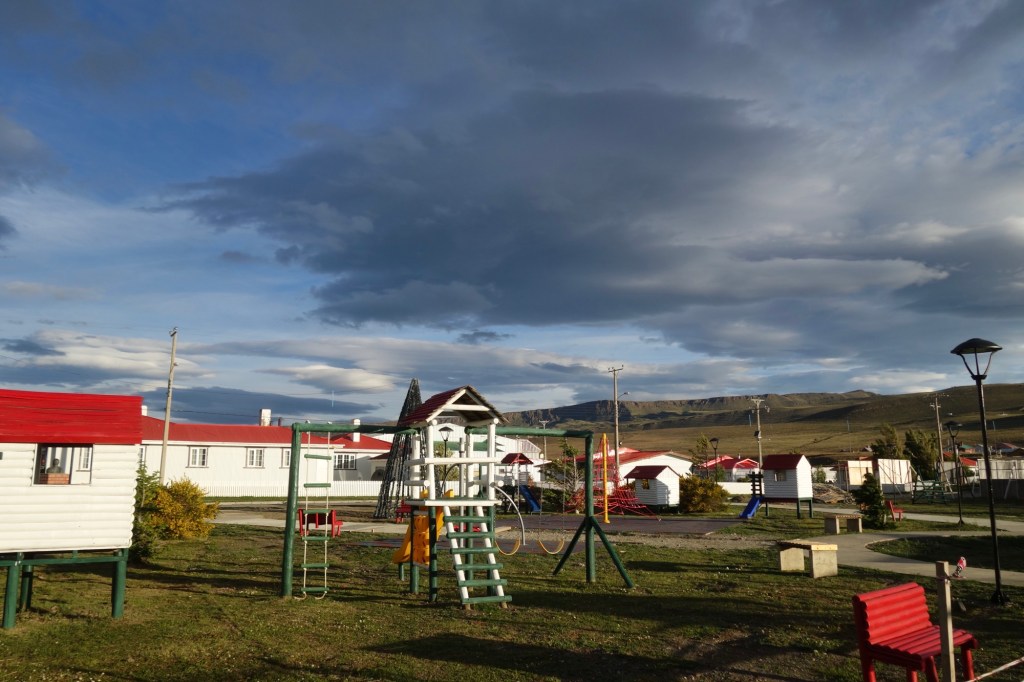

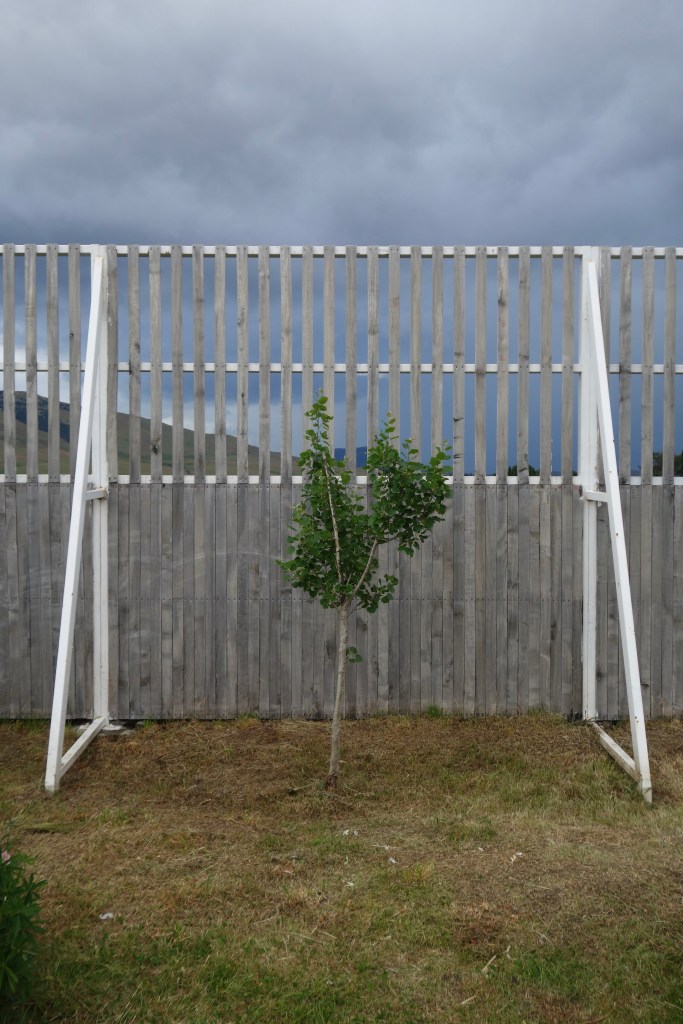
The five of us rode to the playground to discover a beautiful park full of purple lupins and manicured grass. The most remarkable feature, however, was a five-metre-tall timber fence that ran along the entire southern and western sides of the park. Reinforced by closely spaced steel beams, the only purpose of this impressive piece of infrastructure was to shelter the park from the prevailing winds. An investment such as this fence highlighted the fact that these fierce winds weren’t an anomaly in the area. We took advantage of this gargantuan barrier and set up our tents amongst the flowers, listening to the gale-force wind pounding the fence, squealing as it squeezed though any small cracks.
It was a relatively peaceful afternoon in the park, aside from some infuriating children that came to use the playground. Dad had set up the stove to make some hot drinks and was using the end of the slide as a seat. When this group of boys arrived, he tried to move as quickly as he could, extinguishing the flame and relocating pots of boiling water. Rather than wait for Dad to finish moving, the lads began using the slide, kicking dirt into the hot water and knocking over the fuel bottle. They continued playing without any acknowledgement of the frustration they were causing Dad. On top of that, the young lady who was supervising them also seemed oblivious to their behaviour. After they boys left, the Colombian cyclist came over and sat with us. He told us how he had quit his job as school psychologist in an all-boys high school before coming on this trip. He planned on returning to work as a psychologist back in Colombia but wasn’t going to go back to work in schools. ‘Did you see those boys?’, he exclaimed. ‘They behave the same everywhere you go’. Dad nodded and let out a big sign. I could tell he was leaning more and more towards retirement the further we travelled.
It was around 9pm by the time we’d finished dinner were getting ready to crawl into our sleeping bags. Sitting on the swings sipping the last of the red wine we’d lugged from El Calafate, a lone cyclist appeared on the far side of the park. As they got closer to where we were camped, they became more familiar. The child-sized bike, the white jacket, the red cheeks, and the foggy glasses. It was unmistakeably Maria, the tenacious German lady we’d met in the freezing rain that afternoon near Rio Cisnes on the Carretera Austral. The same Maria who we rendezvoused with on the Ferry from Villa O’Higgins, hearing how she’d been hit by a car and had her back wheel mangled.
She recognised us and rode over. Her first words, after dropping her bike on the ground and taking off her glasses, were ‘fucking ripio’.
Maria had ridden over 100 kilometres, starting at the old police station and battling the gravel and wind that we’d endured a few days earlier. She said that the road from the police station to the junction with the Ruta 40 was in her top 5 worst roads ever ridden. We left her to set up camp and invited her to join us in the last of our red wine when she was ready. She declined the wine, instead pulling a bottle of whisky from her bag. She was completely spent and could only manage 15 minutes of conversation before needing to go to bed. As we said goodnight, she verbalised a thought that she’d had during what had been a tough day.
‘I should probably go on a relaxing holiday with my boyfriend next year’, Maria muttered, sighing as she got to her feet.
‘Does he ride a bike?’, I probed.
‘Oh yes, he loves riding his bike’, she responded. ‘But this isn’t just riding a bike’.
As we wandered around the park brushing our teeth and looking for somewhere to go to the toilet, Dad expressed his admiration for Maria. Little did she know it, but she had just been promoted to the stroke seat of Dad’s fantasy rowing crew, ‘The Patagonian 1st VIII’, that he’d been quietly building with the various characters we’d met along the road.
We said goodnight to each other, still unsure of what tomorrow held. I could hear Dad’s heavy breathing within minutes of him getting into the tent. As sleep began to take a hold of me too, I was jolted awake by the presence of a person leaning over my bivvy.
‘Hello. Hello. Awake?’, the female voice queried softly.
I unzipped myself clumsily and looked up at the woman’s face. I recognised her from earlier in the afternoon. She’d been looking after the boys that had caused Dad’s blood pressure to spike.
‘So sorry about boys’, she whispered in broken English.
She explained that they were on a school trip and had been stuck on a bus all day. They were staying in a hall down the road and had just finished dinner.
‘This is for you. Sorry again’, she said, passing me a large hot bowl of spaghetti bolognaise, before jogging back through the park.
Yes, I’d just had dinner and brushed my teeth. Yes, I could have just declined her kind gesture. Yes, I could have woken Dad to share the meal. But it was late and I couldn’t leave food out in the open all night. There might be animals. I scoffed the delicious second dinner that had arrived like a dream and settled back into bed.
I had to come clean the following morning when Dad asked if I’d been talking to someone in the night, and why there was an empty bowl next to by bed.
A fear of the wind, arguably the most humbling of the elements, was now living in us. In a state of present-traumatic stress and desperate to experience stillness, we were packed up by 5am. By 5.15am, the trees were dancing and a heavy drizzle had settled in the valley. We moved into a small shelter and ate some oats in silent deliberation.
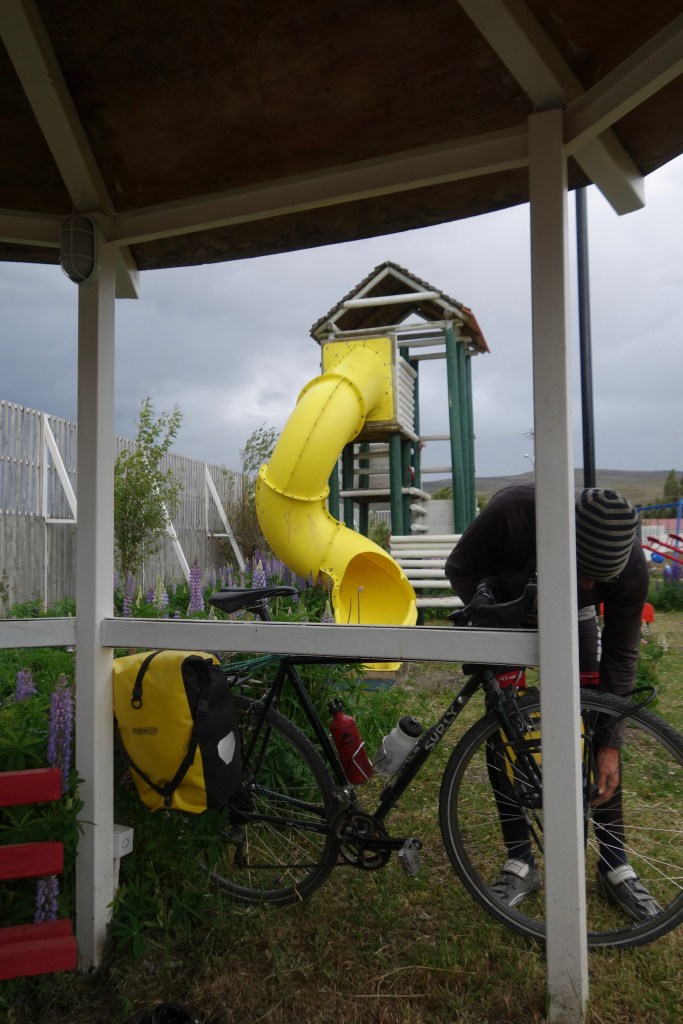
Factors including the wind, rain, a sore knee, and Maria’s forecast of further bad weather, all helped in making our decision. After brewing a second coffee, we officially acknowledged that a visit to Torres del Paine would have to wait. The Colombian couple were also awake and preparing to continue north. They said, pointing towards Argentina, that if we needed anything they’ll be just up the road. We said goodbye to Maria through her tent and impressed ourselves by being on the road by 6.30am.
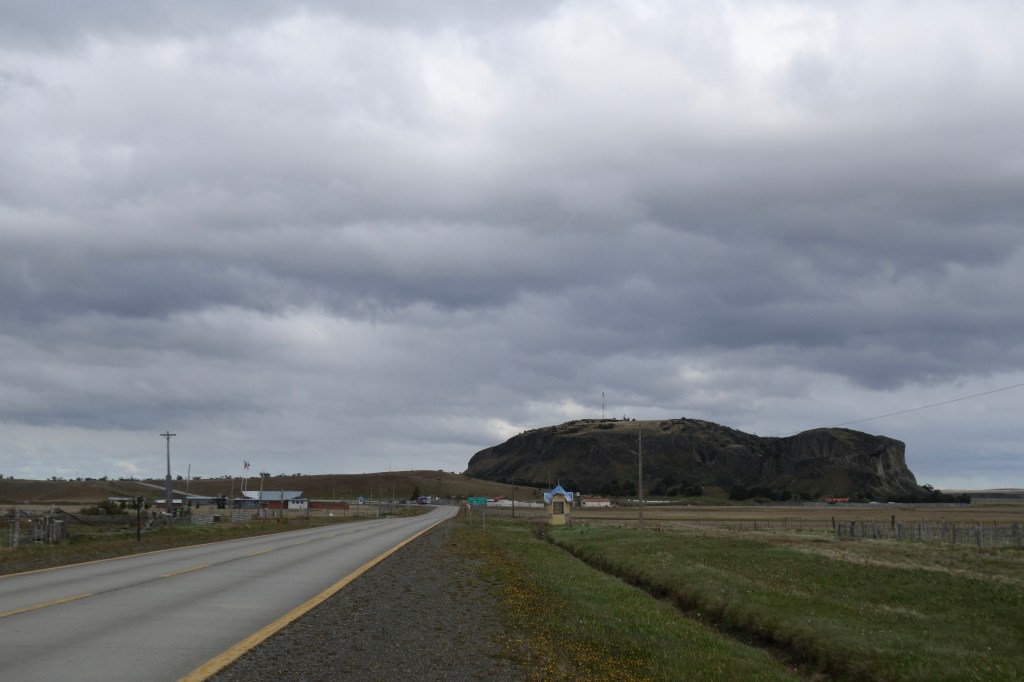
Riding away from Cerro Castillo, the remoteness of this small outpost town became increasingly evident. Rolling grasslands, shaped by the elements, extended in every direction as far as we could see. We spent the first hour entertaining a menacing headwind. Condors hung in the air, scouring the landscape for carrion. Falcons sat atop fence posts, feigning poise as they struggled to remain balanced in the wind. We began to observe small roadside shelters every few kilometres. With decorative window frames and conical roofs, these small pagodas provided options in where to take pause from the weather. The choice plagued us and the reliability of shelters resulted in us actually taking less breaks.
‘Let’s stop at the next one’…’keep going, I can see another in the distance’…’in five more we’ll have a longer stop and make a coffee’…
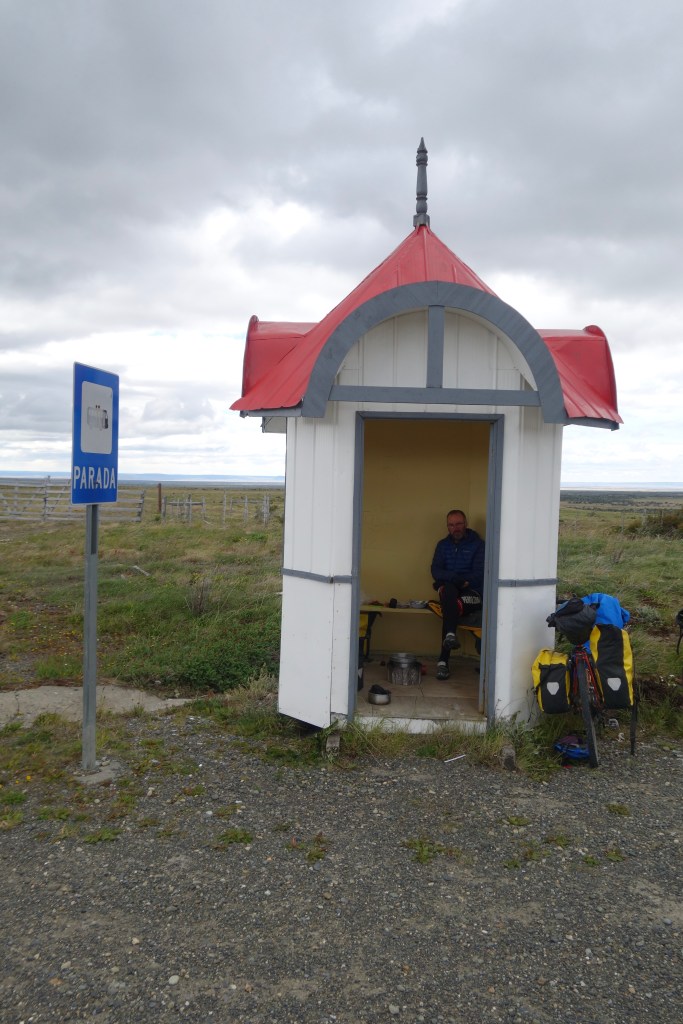
This dialogue continued until starvation and dehydration forced us to take a break. The next available shelter happened to be beside a small lake. A concrete floor littered with cigarettes and empty wine bottles suggested some other riders may have spent the night there trying to shelter from the wind. We sat in silence eating sweet coconut biscuits. Mesmerised by the dark gusts of wind racing across the lake towards us, we found ourselves subconsciously holding our breaths in anticipation until the wind slammed into the walls and strained the remaining panes of glass.
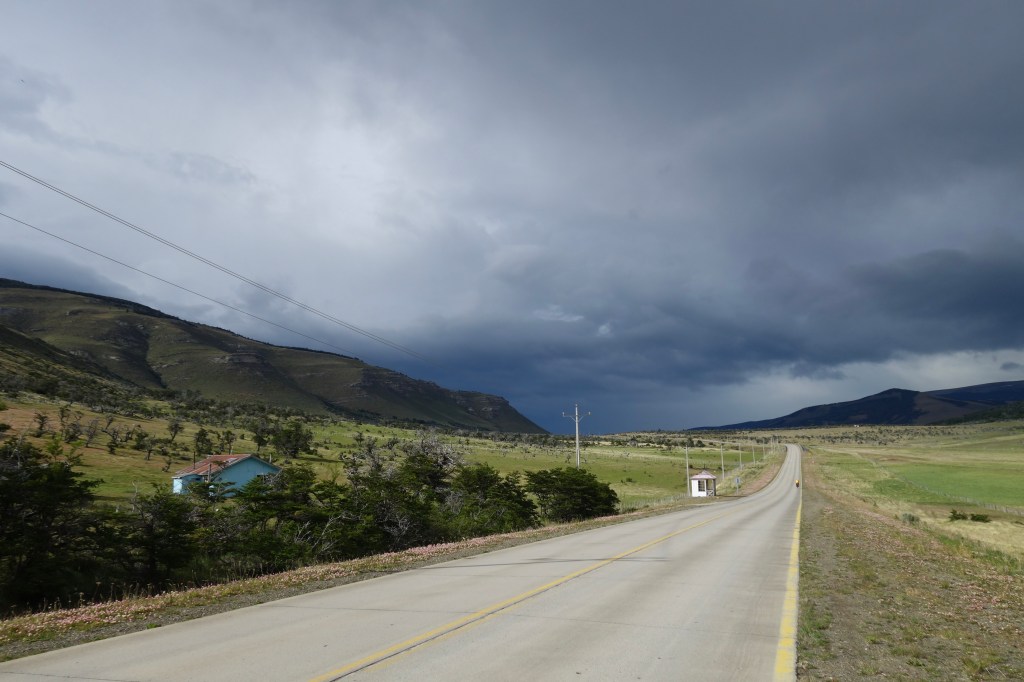
We rode on beneath ominous skies. Every pedal stroke sent pain from my kneecap to my toes. It was sharp and distracting. As the first drops from an intimidating rain front hit our helmets, we arrived at an oddly located café/restaurant/hotel. It was the only building in the valley and it was open. We took the opportunity of a shelter as the rain began to sheet down, blown horizontal by the wind. A leather couch beside a simmering fire beckoned for our occupation. We ordered the cheapest coffee on the menu and gazed south through the antiquated, timber-framed windows. The view down the valley appeared smudged by the bands of rain that were sweeping over the hills.
Eventually our path cleared and were prepared ourselves to leave. Despite being the cheapest item on the menu, the coffees were the most expensive we’d had in over a month. As I scoured my wallet for the correct assortment of coins, the waiter did little to hide his disgust at our mud-sprayed jackets and windswept hair. He took our money without verbal or physical acknowledgement. I took his displeasure at our presence as permission to pocket a handful of untouched pancakes from an uncleared table on our way out. We rolled away with one hand on the handlebars and the other stuffing someone’s leftover breakfast into our mouths.
The same wind that hand blown the rain clouds out of the valley now blew us south. At times, my speedometer showed that I was travelling at 45km/h on flat roads without pedalling. Moments like these made me wonder why anyone needed a car. When the road reached the coast, the dance between the elements increased in tempo. The tangle of fjords and islands to our west funnelled the wind in crisscrossing gusts across the bay. A confused sea swirled and smashed into the barrier of rocks separating the water and the road. The foamy peaks of waves were sliced off by the wind and sent flying across the road as ghosts of spray. It was wild and invigorating.
Carried south by the wind along a coastal road, we arrived at Puerto Natales by mid-afternoon. A central village green offered a sheltered bench in the sun where we boiled some eggs for lunch and swigged the remaining red wine from a bottle we’d been carrying for the last few days. As we ate and drank, the park slowly filled with locals who began setting up various marquees for an afternoon of festivities. The wind caused havoc for those trying to peg down flapping canvas; wind that would cause an event to be cancelled at home. Their persistence and jovial demeanour further highlighted that this weather was the norm for those living in the deep south. Lightheaded from the wine and red-cheeked from the westerly winds, we went in search of a campground we’d seen on a map.
The Yellow Plum Tent House was the most perfect urban camping facility we’d experienced. For around $10 each, we were offered a lush grassy site to pitch our tent, access to a beautiful outdoor kitchen, unlimited coffee, hot showers and a heated bathroom, wifi, and breakfast. Plus, the site was surrounded by high fences, completely sheltering us from the wind and allowing us to bask in the still, warm air. We were shown around by the owners; a beautiful young couple who had been gifted the property by the girl’s grandmother. After looking around town at other accommodation options for travellers, they decided to convert the property into the ideal campsite with everything they’d want if they were travelling. I’d say they had succeeded in this mission!

Following a rejuvenating shower and a viscous cup of instant coffee, we prepared ourselves for a slow amble into town. As we were about to leave, another cyclist arrived sporting a blue bike adorned with an array of blue panniers. Upon saying hello, we were engulfed by the man’s warmth and fervour. He eagerly introduced himself in a palpably thick Scottish accent.
Steve, proudly 64, hailed from the golfing mecca of St Andrews on east coast of Scotland. He revelled in the knowledge that he lived only a half-hour drive north from the portside town of Kirkcaldy where my mum was born. Being the same age (apologies to mum for disclosing this information), it was warming to consider the similarities in their respective childhoods that had occurred just down the road from each other.
The new appearance of Steve’s bike was misleading. He excitedly told us that he had now been on the road for 19 months, riding around Europe and uncovering the joys of life on a bike. Being a retired architect, he sketches as a way of documenting his thoughts, experiences, and the inspiring buildings that he discovers along the way. He was loving the various forms of Chilean buildings, inspired and dictated by the surrounding environment and natural forces. His last professional assignment, which had left a bad taste in his mouth, was to design a new wing for Scottish parliament where the brief was solely to make it ‘terrorism proof’. Steve emphasised that the last year and half of traveling by bike had rebuilt his belief in, and love for, humanity.
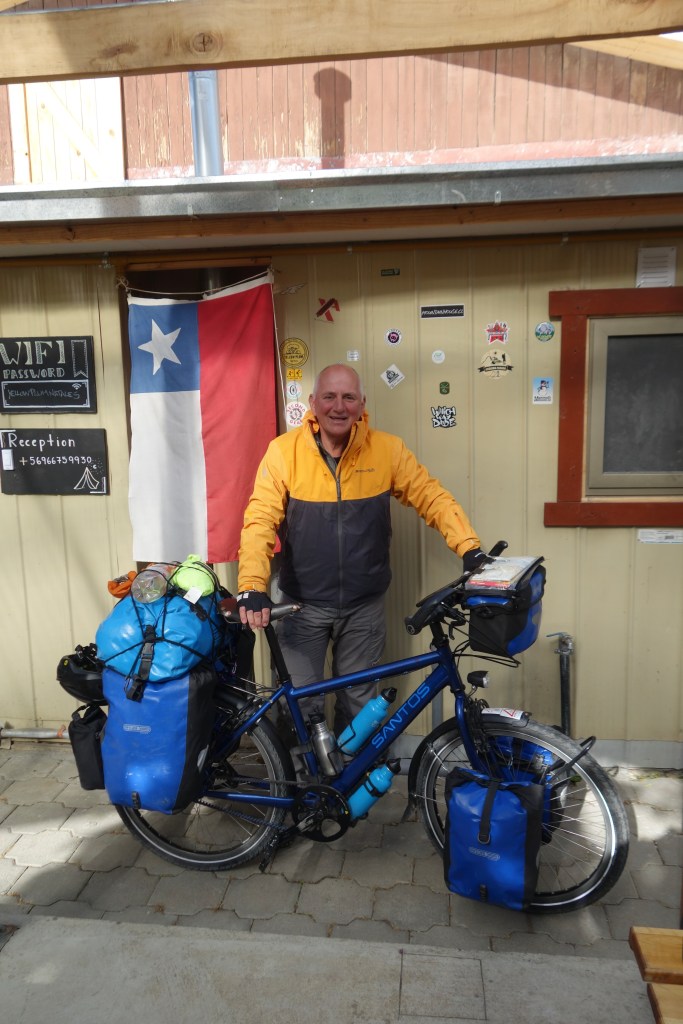
We stood chatting for a while longer before the siren song of the hot showers became too much for Steve. As we headed for the front gate, the owner of the campground reminded us that there was going to be a barbeque that evening in case we wanted to contribute some food and join them for an evening around the fire.
Our hunger levels were peaking by the time we reached the centre of town. We commenced our usual method of exploring a new place; letting our stomachs dictate a walking tour around the town as we wandered from bakery to supermarket to roadside stall. Following a healthy serving of waffles, empanadas and tortillas de patatas, we bought a bag of cherries with loose change and sat on some steps overlooking the bay. We sat in silence, chewing and sucking the sweet flesh from the pips, before squeezing the pips between thumb and bent index finger, shooting them towards the water. As the light began to fade and the wind continued to intensify, we zipped up our jackets and wandered to the closest supermarket to pick up some food for the barbeque.
On the walk back to the campground, our eyes and minds were drawn to a small corten steel sign on the corner of a weathered brick building. The sign read: ‘The Last Hope: The World’s Southernmost Distillery’. An arrow pointed down the adjacent alley. We turned in unison without dialogue or eye contact. After several weeks on the road, we were in sync.
As we climbed to a seat at the rustic wooden bar, we were handed a leather-bound menu by the girl preparing drinks. The first few pages explained how the owners of the distillery, which was still in its infancy, were focussing on producing and selling gin as they wait for their whisky to age. As we perused the menu, the girl delivered us two samples to assist in the decision-making process; a straight dry gin and another distilled with the region’s native calafate berry.
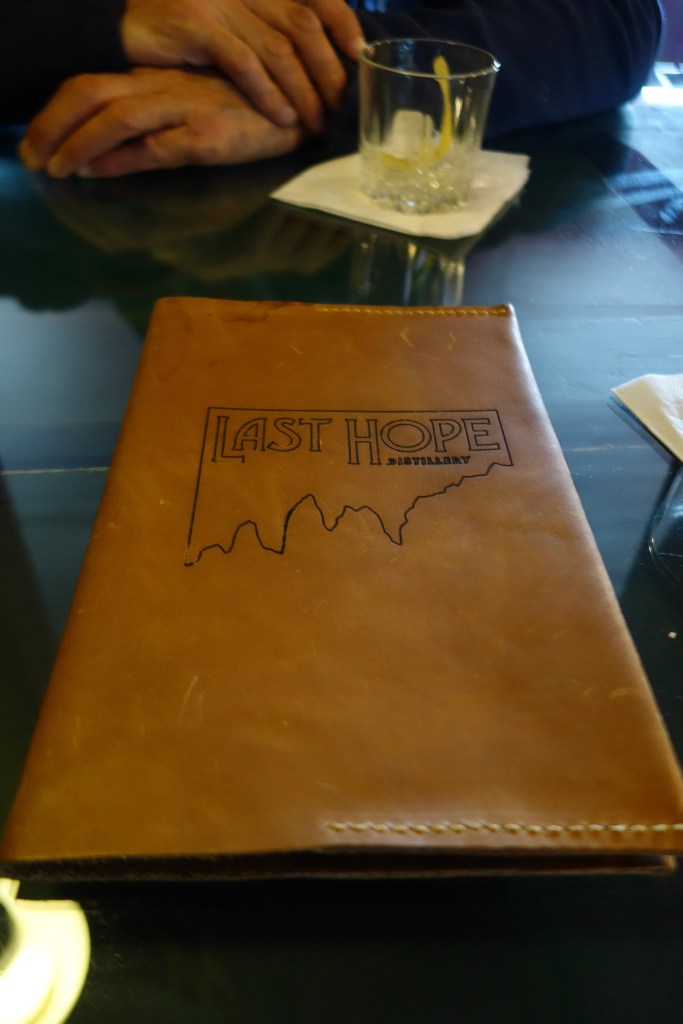
The waitress soon returned and introduced herself. In less than a minute, we were deep in a ‘small world’ moment with Kira. Her Australian accent prompted the obligatory conversation starters.
‘Where’s home for you?’, I asked.
‘Melbourne. You guys?’, she questioned in reply.
‘Tassie’, I answered, instantly bringing our lives to within a few hundred kilometres of each other.
‘Where in Tassie!? she queried excitedly.
Launceston’, I said hesitantly, conscious of the direction the conversation was heading.
With our island home being relatively small in size and population, it’s accepted that there are often fewer than the usual seven degrees of separation between people. Some even argue that the gene pool is also narrower but that’s not a conversation I’m willing to enter. Despite being a small place, it was still unbelievable to discover that I had gone to the same school as Kira’s best friend and, to add to the eeriness, she is now one of dad’s colleagues. This wildness of this connection was intensified by the fact we were sitting in the world’s southernmost distillery, half a world from home.
Kira talked us through her and her partner’s last few years; travelling together through South America, spontaneously purchasing a property in Argentina, returning to Australia, conceiving the idea of a distillery, quitting their jobs, relocating to Argentina, learning as they went to renovate the building and construct the distillery, learning how to distil, and finding very little time to be still. The couple’s story was a remarkable example of a ‘fresh start’.
We strayed from our standard order of cold beer and ordered two ‘Wildfire’ cocktails; a decadent mix of scotch, local mate bitters, and elderberry liquor. Sipping mindfully, we sat quietly taking in the evolution of the bar and its owners. Eventually, our glasses were empty and the natural light coming through the windows was beginning to fade. We said goodbye to Kira, reiterating our admiration for her adventurous undertaking. We were both feeling a little lightheaded as we walked back to the campsite. The buzz was mostly attributed to partly the cocktails. However, we also walked a little taller from the realisation that if someone can move to Argentina to build a distillery with no experience in building or distilling, then the life changes we were respectively considering were more than achievable.
The atmosphere at the campsite was homely. We grazed on barbequed meats and fresh salads, quenching our thirst with a cheap bottle of local red wine. Despite countless references to alcohol throughout my writing, neither of us really consume that much. The fear of hangovers and a preference for bed often trump the desire to continue drinking. So, when dad leaned over and asked if I’d mind doing a beer run, I knew that he was genuinely having a good time and that we were settling in for the night! I happily obliged and rode down the street in search of a tienda selling cold beer.
We spent the evening with Steve and a Swiss couple who had also just cycled the Carretera Austral. They were planning to catch a ferry north to Puerto Montt before continuing their ride to California over the next six months or so. As Steve got increasingly drunk and chatty, the previously quiet Swiss guy gained bravado. At one point, he interrupted Steve mid-sentence, simply to say that prior to that night, he didn’t even know Scotland was a real place. Steve took the bait and the nationalist arguments ensued for the remainder of the evening. The laughter was as warming as the fire that continued to glow despite a gentle rain that encompassed the town.
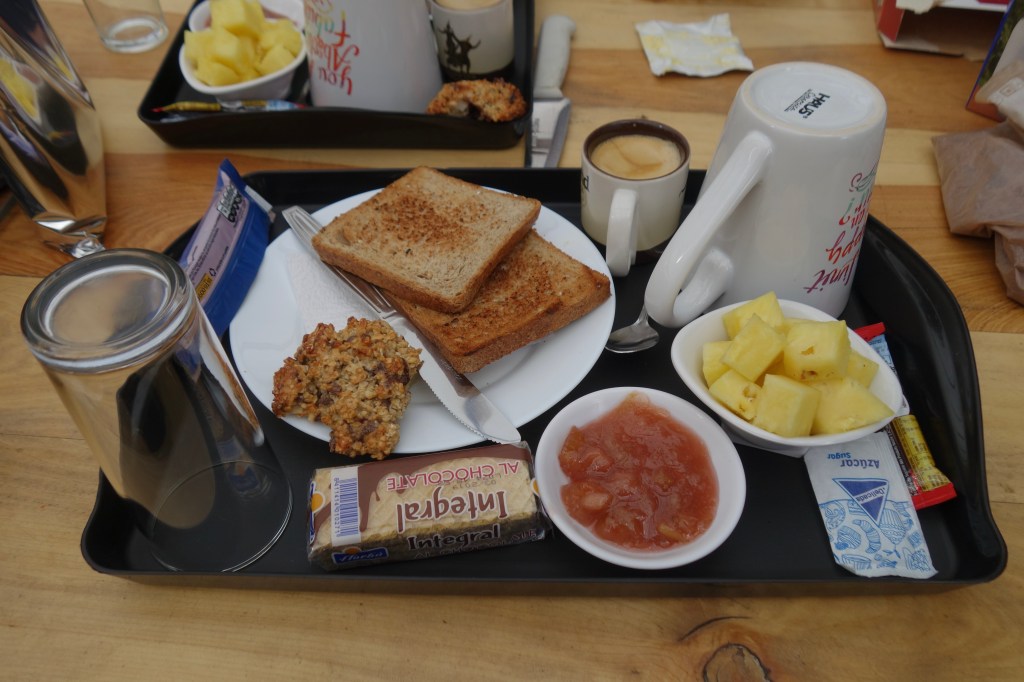
The smell of coffee lured us from the tent the next morning. Several large pots sat steaming on the tables a few metres from where we were camped. Following a shower, we settled in to the complimentary breakfast. The company was the same as the previous night, albeit slightly subdued as we waited for the coffee to enter our bloodstreams. Conversation was slow as we enjoyed each bite of toast lathered with homemade rhubarb jam, every slice of warm banana bread with melted butter, and each handful from the bottomless bowl of fresh cherries. It was 11am by the time we began to consider how we wanted to spend the rest of the day.
Emerging from the sheltered garden of the campground, we were struck by a jarring southerly wind that was being delivered fresh from Antarctica. With our hands tucked deep into our jackets and beanies pulled down to our eyes, we walked along the foreshore of Puerto Natales. Dodging clouds of sea spray being blown over the breakwater, we explored the local port and warmed up by running around an empty skatepark. Having gained our fill of fresh air, we found respite in a rustic timber café called ‘The Coffee Maker’. The café delivered on its promise, producing two large mugs of strong black coffee that we sipped slowly, sitting by the window watching bullets of wind tear across the bay.
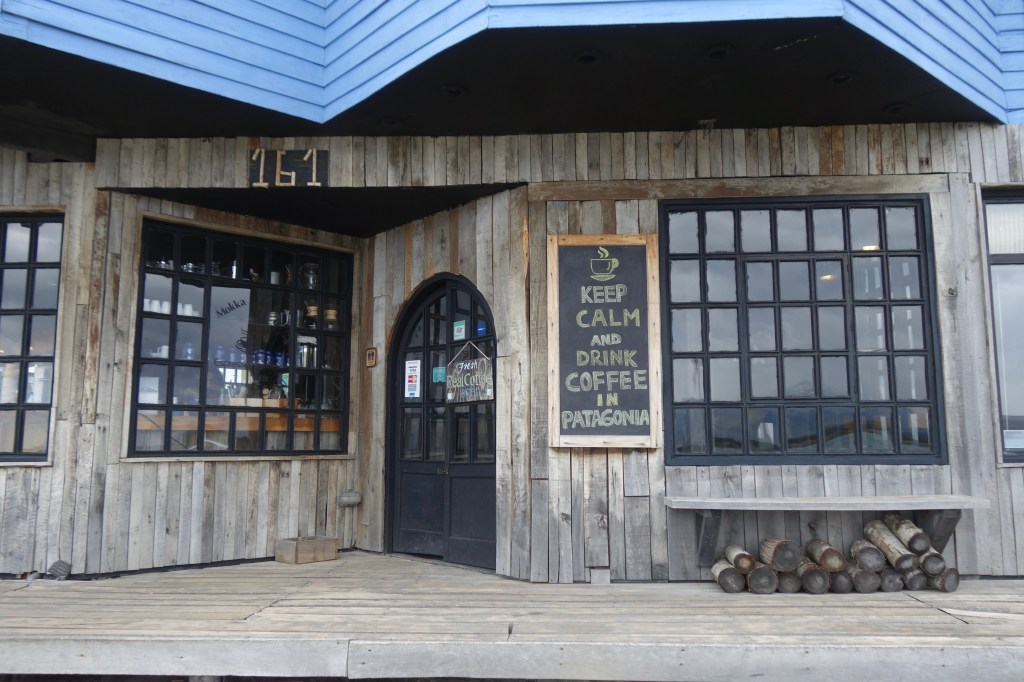
I used the down time to catch up on some journaling as Dad used his index fingers to slowly tap out an email to Mum. After ordering a second coffee, we spent an hour adding to Dad’s fantasy rowing crew. The crew grew from just the rowers to the extended coaching team and administrative staff. It was hilarious and warming to reflect on some of the quirky, inspiring, and genuinely unforgettable characters we’d met over the previous few weeks. As part of this reflection, we stumbled across some of Canadian Nick’s writing. His ways of thinking, observing, and attempts to make sense of the world resonated with me. Reading his work was a reminder that he is one of the people I’ve met along the road that I must keep in touch with in the future. (I recommend checking in out: https://medium.com/@nickharrison_57535)
We stepped back out into the slicing wind and wandered back towards the centre of town. Our conversation focussed heavily on Dad’s pending transition into retirement. Having worked consistently for the past 45 years, the thought of ending something without a clear plan appeared to be the biggest barrier to him taking the plunge.
‘Relief teaching? Bus driving? Building?’ he questioned aloud.
Less a conversation and more an opportunity for Dad to voice his thoughts and concerns, we continued walking while he talked and I listened. It became clear to me that there was an underlying fear of downtime; days without plans, routines, and structure. He was trying to write the next chapter before finishing the remaining pages of this one. I’m equally as guilty of this way of thinking, unable to make decisions unless there are ample safety nets in place to avoid temporary discomfort. Choosing the unknown, with all its possible disappointments and enriching surprises, has never been a strong suit. However, listening to someone talk in the same way you often think holds up a mirror, allowing for some healthy self-reflection. I was reminded of the frustration I used to experience when living in Melbourne and using public transport. When the doors of a fully loaded tram opened, I was always astounded when awaiting passengers attempted to load themselves on before letting others off first. The whole operation was held up and everyone was left feeling overwhelmed, rushed, and unnecessarily stressed. I got the sense Dad was approaching retirement in a similar way. He needed to let his current job come to a stop and for all his present stressors and concerns to disembark, making room for new opportunities to come aboard!

The remainder of our day revolved around naps and food; a true rest day. I spent some time catching up in my journal before Steve returned to the campground, eager to connect over a cup of tea or five. He convinced me to help him set up a blog which, upon reflection, was an effective tactic to keep me chatting for a few hours. Dad eventually rose from the tent, providing an excuse to pause the conversation with Steve as we headed out to get a few ingredients for dinner. We returned to cook up a hearty vegetable curry in the camp kitchen, washed down with mugs of juicy Chilean cabernet.
We rose early the following morning, making a point of packing our bikes before settling into the breakfast table; it’s the small wins that count. After brewing up a fresh pot of coffee, one of the owners of the campground, Carlos, came and sat with us for a while. We complimented him (again) on the set up and atmosphere that he and his partner had created. He explained that their vision was to provide a hotel experience for campers. Having toyed with the idea of building additional cabins, they eventually decided to focus on developing a ‘tent only’ site as they want everyone who comes to stay to have at least one thing in common.
It was hard to leave the Yellow Plum Tent House. We exchanged contact details with Steve and wished him well for the coming months, years, or however long he continues to explore the world by bike. We were genuinely intrigued to hear how his journey unfolded. There was a uniqueness to his story and his willingness to open his mind to the world was inspiring. Our own world views, ambitions and fantasies evolve from the interactions we have with others and the stories we hear. Steve and his approach to post-retirement life was another encounter that appeared to break down Dad’s self-imposed boundaries on what his own future might involve.
As we shook hands, Steve seemed vulnerable and distant, compared to the effervescent presence we had come to expect. I could empathise with what appeared to be some trepidation regarding his onward journey. The promise of loneliness, exhaustion, and the unknown is an intimidating prospect to wake up to each day.
The magnetism of creature comforts had become stronger the further south we travelled. Venturing into the unknown was less desirable since leaving the more mountainous, verdant, and ice-laden regions to the north. The open windswept plains had their charm, but we were tired. What could have been a quick departure from Puerto Natales ended up taking a few hours. An unnecessary supermarket shop rolled into a final visit to The Coffee Maker café. Already caffeinated up to our eyeballs, we opted for a couple of fresh juices. We sat in a glazed stupor, watching as the wind whipped the bay into a frenzy of foam, hoping that the weather would be travelling in our direction today.
It was 11.30am when we began pedalling south. Still technically the morning, we counted it as a win. Some rolling hills and dense local traffic made for an unpleasant departure from the streets of Puerto Natales. Once we’d cleared the outer suburbs, however, the topography and the wind became much friendlier and we were ferried south on a stiff breeze. After an hour of pedalling, we stopped for a snack and to put on our jackets as the clouds darkened and the wind gained ferocity. The sky possessed a tangible energy. The road soon swung to the west which turned the tailwind into a menacing sidewind. With heavily loaded bikes, sidewinds demand greater bike control and even greater concentration. Conversation slowed as we rolled on through a barren landscape of estancias and grasslands.

The highlight of the day came when we noticed a dog curled up beside the road. Given the remoteness and lack of any other animals in the area, we pulled over to check on the wellbeing of the dog. As soon as we came to a halt, the dog leapt up and smothered us in licks as it almost wagged its tail off its body. It wore a collar, looked well-fed and was clearly happy, so we assumed it had a home and owner somewhere in the surrounding hills. We gave it a final pat and continued riding down the road. A moment later, the rapid tapping and scratching of toenails on the tarmac alerted us to the presence of the dog which was bounding along behind us, its tongue flapping beside its ear and a big smile on its face. Unbelievably, this continued for about five minutes. My speedometer showed we were rolling along at 40 km/h which appeared to be easy work for this dog that only a few minutes earlier had been snoozing beside the road. As suddenly as it had begun chasing us, the dog returned to a slow trot and veered off happily into the grassland. The pure joy flowing from the dog was infectious and we rode on smiling and laughing; the human equivalent of a wagging tail.
Our routine two-hour break came at a good time. My knee was throbbing and a slow leak in my front tire could no longer be ignored. We took shelter from the wind behind a grand brick entrance to an estancia. Unable to locate the leak in the tube, I decided to replace it with the spare I’d been carrying for months now. Considering how long I’d been on the road it was remarkable that I was only reaching for the spare now.
After another 10 kilometres of riding, the road made a sweeping turn to the south. The wind was now coming from directly behind us and, if the map was correct and the wind didn’t swing, it would remain that way for most of the day. It was exhilarating riding. We celebrated our 2000th kilometre together and overtook Luigi and Giuseppe (this may or may not have been the names of the Italian cyclists) who were having a snack beside the road. After covering an easy 40 kilometres in an hour, we treated ourselves to a cheese and salami baguette and a coffee in a roadside shelter. The wind roared outside and the shelter’s remaining window panes hummed. We took our time, neither of us willing to rush the other. We watched the Italians ride past, letting the wind do all the work as neither of them pedalled. It was 5pm when we stepped back out into the wind and straddles our bikes. We were treated to a long descent with a ferocious tailwind which, like all good things, soon came to an end.
An ancient volcanic plug, Morro Chico, forced the road to veer to the east and we were soon reacquainted with the sinister sidewind. At around 7pm, we came across the Italians sitting on the side of the road. They were desperate to make camp but were unable to find any trees to break the wind. I introduced them to the world of iOverlander, highlighting a refugio in another 7 kilometres, which gave them enough motivation to push on a little further.
We persevered for another hour as the wind swung from the side to the front and back again. It was 8.30pm when we arrived on the outskirts of Villa Tehuelches; a small village of approximately 150 people that serves as the capital of the larger commune of Laguna Blanca. Steve had recommended that we stay here as it was the only place to find shelter and food on the final push to Punta Arenas. Specifically, he had told us to look out for a bus stop on the edge of town. Like most structures in this part of the world, over engineering and reinforcement against the elements takes priority in the design process. The bus stop was no exception. Steel framing, double glazed windows, and walls that felt a metre thick. It was a more of a bunker than a bus stop and more of a hotel room that the roadside squat we had envisioned. Given the abundance of bus stops along the road, we pondered the lack of busses. We hadn’t seen one in days, and even then, it had been a tour bus which wouldn’t be stopping to pick up locals. Despite this absence of busses and the consequent lack of passengers waiting in the bus stop, it still felt as though we should ask permission before rolling out our mats and claiming the shelter as ours for the night.
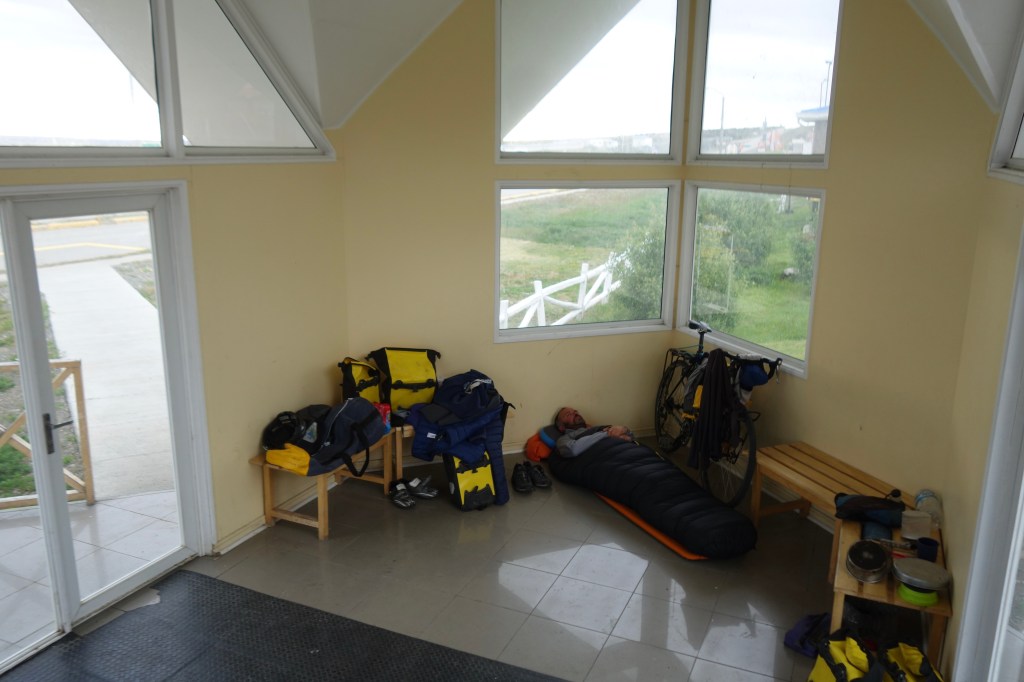
We got changed and left our bags in the shelter before wandering towards the only shop that still appeared open. The owner, an elderly man, was in the process of packing up for the day but was still eager to chat. He happily gave us permission to stay on behalf of the entire town and said that a lot of cyclists sleep in shelter. We thanked him for his hospitality and began to walk back to bus stop before we heard the man shouting something in our direction. We turned and walked back, patting our pockets as we were certain he was calling out that we’d left something in his shop. However, when we got back to him, his casual, easy going attitude had changed and he was now in full businessman mode. As we’d walked away, he must have seen a missed opportunity; a bygone chance to capitalise on the courtesy of two conscientious travellers seeking his permission to use a public facility.
‘You can stay in the shelter tonight’, he reiterated. ‘But you must buy something from my shop before you leave in the morning’.
We laughed and promised him we’d be back to see him the following morning. His posture relaxed again and he smiled at the efficacy of his business strategy. As we walked away for a second time, I’m sure he was ruing that he hadn’t held us to a more lucrative deal.
Back in the shelter, we put on some tunes, strung up a line to air some clothes, set up our beds, and reheated some curry I’d carried from the previous night. With some warm food in our stomachs, we soon began to feel the effect of the day’s efforts. We’d travelled 155km from Puerto Natales; the biggest distance since Dad had joined me on this ride. We lay in bed listening to some foxes screeching as they fought over the contents of a nearby rubbish bin. However, the high-pitched trills from this squabbling choir were trumped by fatigue and I have no further recollections from that night.
We were slow to rise the following morning. When I did eventually sit upright and rub my eyes, I noticed a hoard of people standing outside the shelter, presumably waiting for a bus. A little embarrassed that our takeover of the bus stop had left the town’s locals waiting out in the wind, we were quick to pack up and make room for anyone who wanted to enter our bedroom. We wheeled our bikes down to the shop to fulfil our promise to the shopkeeper from the night before. Upon seeing us, his face stretched into an enormous smile and he rushed to arrange us two plastic chairs. Clearly surprised that we had returned and cautious that we may get up and leave at any time, he hurriedly prepared a plate of cheese empanadas and two cups of black coffee.
We paid the man and thanked him for letting us spend the night in the town bus stop. As we were turning to leave, he sheepishly asked if we had any spare change from Australia before holding out a tip jar labelled ‘so I can remember you’. The jar was full of coins of various currencies. I was surprised that we were both able to produce several Australian coins from our wallets, lamenting the fact that we had unknowingly carried these extra grams for hundreds of kilometres.
A gentle cross breeze, coupled with a rolling hills and courteous drivers made for relatively easy riding that morning. After two hours, we began looking for an adequate place for our morning break. The wind had begun to blow a little harder so when we spotted a small wooden shelter beside a body of water, we were quick to tuck in behind it and crack a fresh packet of biscuits. We sat on the ground and threw stones at a metal pole that jutted out of the water, contemplating whether to fire up the stove for a hot drink or try and get a few more kilometres under our belts. Deciding to make the most of the good conditions, I walked down to the water to fill our bottles so that we could have a coffee when we got to our next stop.
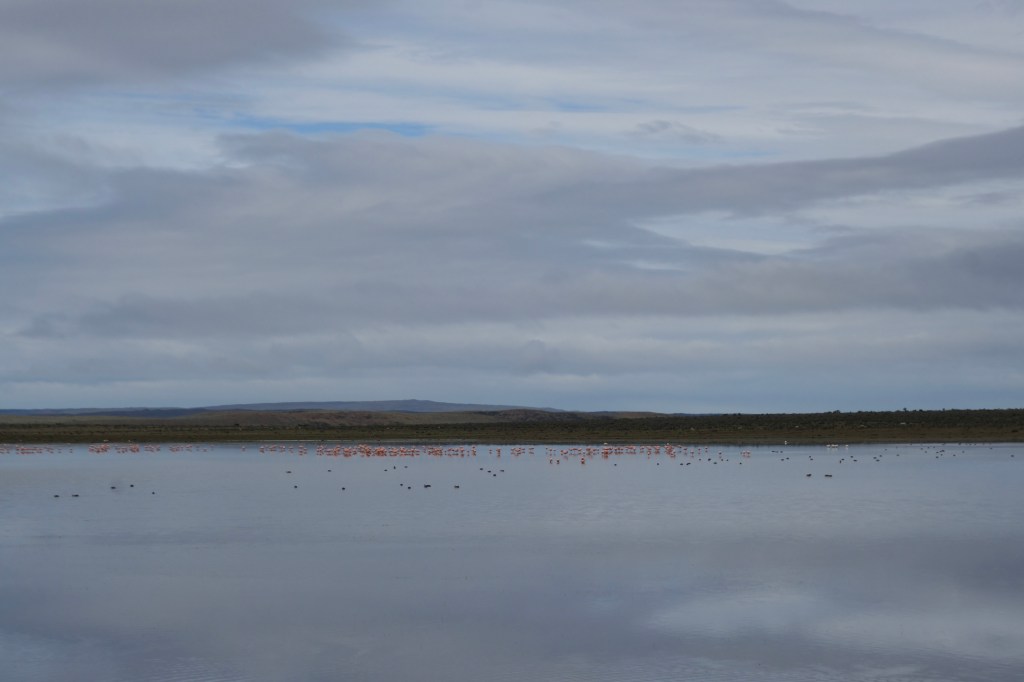
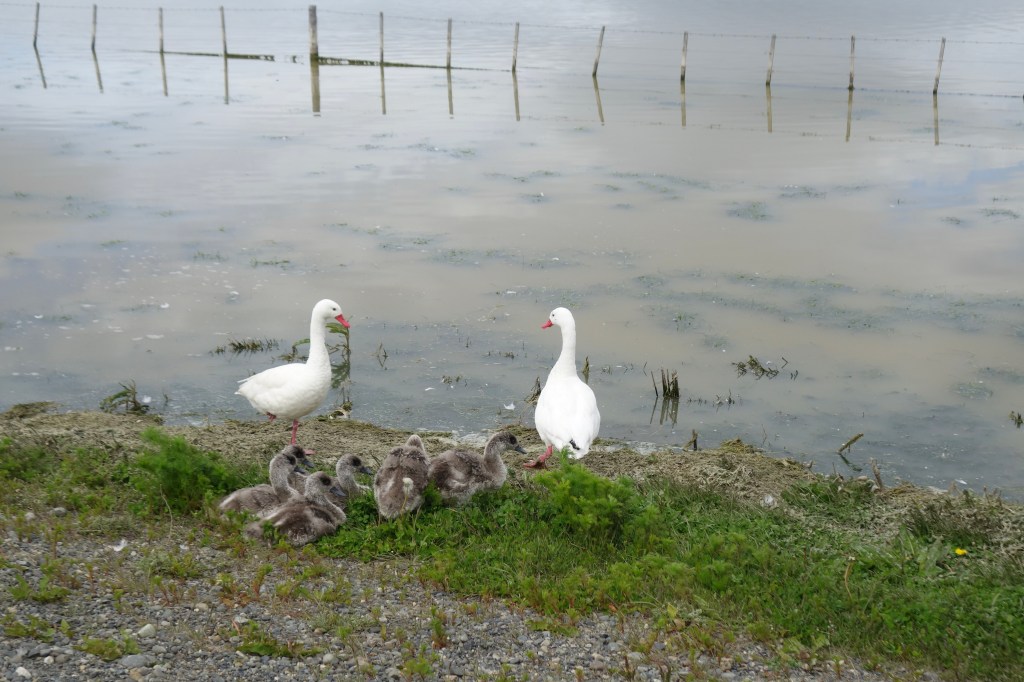
For several kilometres, the road meandered between two bodies of water. Flocks of birds, neatly separated by species, were busy feeding in the shallow bays beside the road. To the south, large, down-laden geese bobbed and waded contentedly. To the north, a dense congregation of coots were diving beneath the surface to feed amongst the weeds. One would vanish in a swift movement leaving a subtle swirl on the water, only to be replaced on the surface by a friend coming up for air. The westernmost bay of the larger lagoon was home to a by a spectacular scene. Hundreds of flamingos were scattered along the shoreline, somehow holding strong against the wind in their iconic one-legged pose. The avian palette of grey, black and pink beneath a moody mauve sky seemed to cast us into our own deep states of contemplation.
For the next hour or so, we rode separately. We stopped once to talk to three French guys who were riding north. They had left Buenos Aires three months earlier, pedalling south around Tierra del Fuego, before turning for Colombia. They also appeared to be riding along separately. Riding side by side is nice, sharing small observations along the road and engaging in conversation to pass the kilometres. But there are certain landscapes and weather conditions that prompt oneself to turn inward and let your mind and body lead you on an adventure.
Around 50 kilometres from Punta Arenas, I was overtaken by a car that then quickly pulled over to the side of the road. Before I had time to slow down, the driver got out and stood by the car with an outstretched arm. Yelling encouragement in a distinct American accent, he handed us each a chocolate bar as we rode past! We continued riding, ripping the chocolate open with our teeth and gobbling down this perfectly timed sugar hit. This beautiful gesture was enough to carry us on to lunch, fuelled by sweetness and good feels. We both decided we should make sure we always have a few chocolates in our own cars for when we see people cycle touring around Tasmania!
Traffic became increasingly congested the closer we got to Punta Arenas. When the road eventually reached the coast beside the Strait of Magellan, we veered west and found ourselves riding with a strong tailwind. Ready for lunch, we were fixated on finding somewhere out of the breeze to set up the stove for a coffee and a hot lunch. We eventually came across a small reserve with some concrete shelters spread out amongst the trees. The reserve was perched atop a headland overlooking the ocean. As we finished our final packet of biscuits while waiting for the water to boil, we spotted several whale spouts shooting up from the foaming, wind-whipped sea.
With the last of our drinking water now at a rolling boil, I got to making some coffees. We also decided to share a packet of mushroom risotto that had been floating around in the bottom of one of my panniers for a few weeks. As this was our last day on the road, we figured we’d better try and finish everything we were carrying. As the rice began absorbing the water, I handed dad a coffee. As he put it to his lips, a look of gratitude quickly turned to disgust.
‘There’s something not quite right about that, mate’, he said quietly while looking in to the cup in search of answers.
It was the same coffee we’d been having for days so I was a little perturbed by his staunch dislike of what I’d prepared. I picked up my cup and as soon as the liquid touched my tongue, I began experiencing the same vulgarity in my mouth. I turned to grab my drink bottle and lifted it to my lips. There was enough water left to get a few drops, which was all I needed to work out what was going on. It was salt water. Still unsure of how it could have happened, I opened a map to retrace our route to where we’d had our break earlier in the day.
I’m usually quite confident in my geographical understanding of my immediate surroundings. This was a significant oversight on my behalf. The map didn’t lie, clearly showing that the ‘lake’ where I’d filled up our drink bottles was in fact a narrow inlet extending from the nearby ocean. Having been surrounded by lakes, rivers, and snow-covered peaks for the last few weeks, I’d clearly lost touch with our impending collision with the coast.
We tipped out our coffees and resorted to the only remaining liquid in our possession to appease our salty mouths; two warm and well-shaken beers. I was still optimistic that the salt water would enhance the flavour of the risotto. Unfortunately, when the rice was finally cooked and was cool enough to taste, the high salt content caused every cell in my body to dry out, or so it felt. We persevered with a few mouthfuls, before slugging the last of the beer and getting back on our bikes.
The final kilometres of our South American adventure were far from celebratory. Mustering all of our concentration and remaining energy, we pedalled along a narrow gravel shoulder beside a four-lane highway. We fought to keep our bikes upright as each passing car caused us to wobble and swerve. We took the first opportunity to turn off the highway and rode in search of a quieter, albeit less direct, route into the city. We soon found ourselves on a cycle path which carried us all the way to the waterfront precinct.
Despite having made it to our final destination, we had failed to pre-book any accommodation. Unlike arriving in smaller towns and villages, accommodation options are far more varied and often much more spread out. With darkness setting in, I went about identifying some possibilities from the limited options presented on my offline map.
Dad followed as I navigated through the city centre and uphill into the suburbs. It is often these unexpected, bonus kilometres at the end of a day’s riding that are the most difficult when your mind and body have both begun to wind down. When we arrived at the small hostel, we were both sweaty and irritable. When the man at the front desk told me that they were full for the night I could sense Dad’s frustration. I felt the need to express to him that I was doing my best, which was the product of a self-imposed pressure to please.
We continued our search. Following a few more false leads, we rolled up to Samarce House. Preparing to be turned away, I climbed the front steps and rang the doorbell. Within minutes, we had been welcomed inside by the host, Luanna, who offered us a room, access to the garage to store our bikes, a hot shower and no pressure to check in and pay until the morning when we were feeling more rested. She could see the gratitude in our eyes and told us that she would meet us again at breakfast.
Fighting the desire to collapse into bed, we showered and walked into town in search of food. Lured in by the first place we saw, we sat in silence eating a burger and drinking a local cerveza. There would be plenty of time to reflect on what we had just shared over the previous few weeks. For now, however, we needed to rest.
 Faults and Folds