We were slow to rise on our first day in Punta Arenas. With nowhere left to ride, our plan that morning was to make no plans. The first few hours were whiled away around the kitchen table with another couple staying in the guesthouse. Walter and Anna-Marie, both in their seventies, had been born in Chile. They had moved to Canada in their twenties where they lived and raised their family. Since their retirement, they have been escaping the northern hemisphere winter and spending six months of each year in either Chile or Germany, where Walter also has family. When Dad learned that Walter had been a national rowing champion in Chile the conversation increased in tempo as glory days from opposites sides of the world were shared.
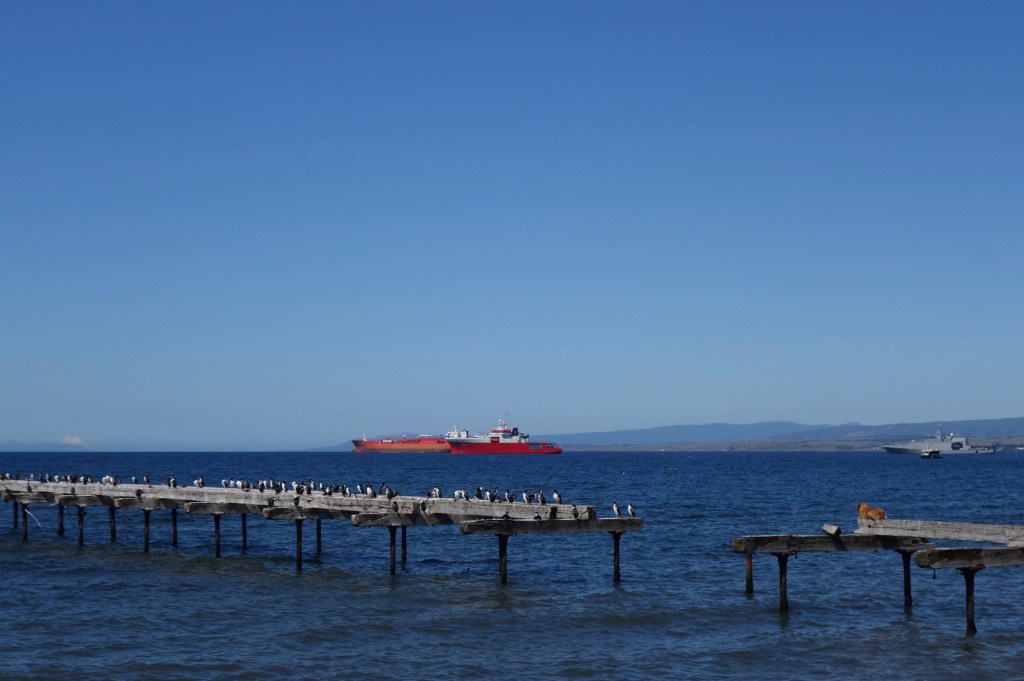
We left the guesthouse late in the morning and let our legs carry us downhill, through the center of town to the waterfront. Between two newer concrete piers, the skeletal remains of an old timber jetty still stretched out towards the harbour. The middle section of the jetty had collapsed, rendering the end unreachable from the shore. This section was inhabited by hundreds of cormorants, drying their wings in the stiffening breeze following a morning of fishing. On the end of the section still attached to land lay a lone dog. We sat and watched this scene for half an hour. The dog, its paws hanging over the end of the jetty and its attention firmly fixed on the birds, did not move the entire time we were there. It was a picture of optimism. I regularly consider this image as I reflect on what I gained from my time in South America. Overwhelmingly, there were more questions raised from my time on the road than there were answers received. I’ve long come to accept my enduring search for what are perhaps unattainable feelings of satisfaction and achievement. I see myself in that dog; focused on the unreachable, finding difficulty in appreciating the present. Much like for that dog on the pier, sometimes you can only look and never touch.

The remainder of the morning involved coffee shops, galleries and local artisan stalls. We conveniently found ourselves at the fish market around lunchtime. As we walked past a row of vendors selling fresh ceviche, one man stepped towards us, put on a plastic gold crown and proclaimed to be the ‘King of Ceviche’. How could we let this opportunity pass us by? We purchased a bowl and sat on some steps overlooking the water.
I’ve watched my fair share of cooking shows, with theatrical scenes of people tasting freshly prepared food. However, I don’t think I’ve ever witnessed someone’s entire being soften in ecstasy when tasting something for the first time as I did that day when Dad tried the ceviche. I’m sure it had something to do with the contrast to our diet over recent weeks; pasta, packet meals cooked in salt water, and stale biscuits, versus freshly caught salmon cured in a citrus, coriander and garlic marinade. Regardless, this is a man who has often stated that he struggles to see why people get so excited about food. It’s just fuel for your body, right? It was so nice to witness his enjoyment.
In a ceviche coma, we wandered back towards the center of town. Occupying a bench in a shady park, we watched people posing with a large statue of Ferdinand Magellan. A Portuguese explorer who took part in the first successful circumnavigation of the globe, Magellan died en route, leaving Juan Sebastian del Cano to complete the voyage. However, it is Magellan who was credited with the discovery of what would come to be known as the Strait of Magellan. Arguably the most important natural passage between the Atlantic and Pacific oceans, the 570 kilometer long passage separates the South American mainland and Tierra del Fuego to the south.
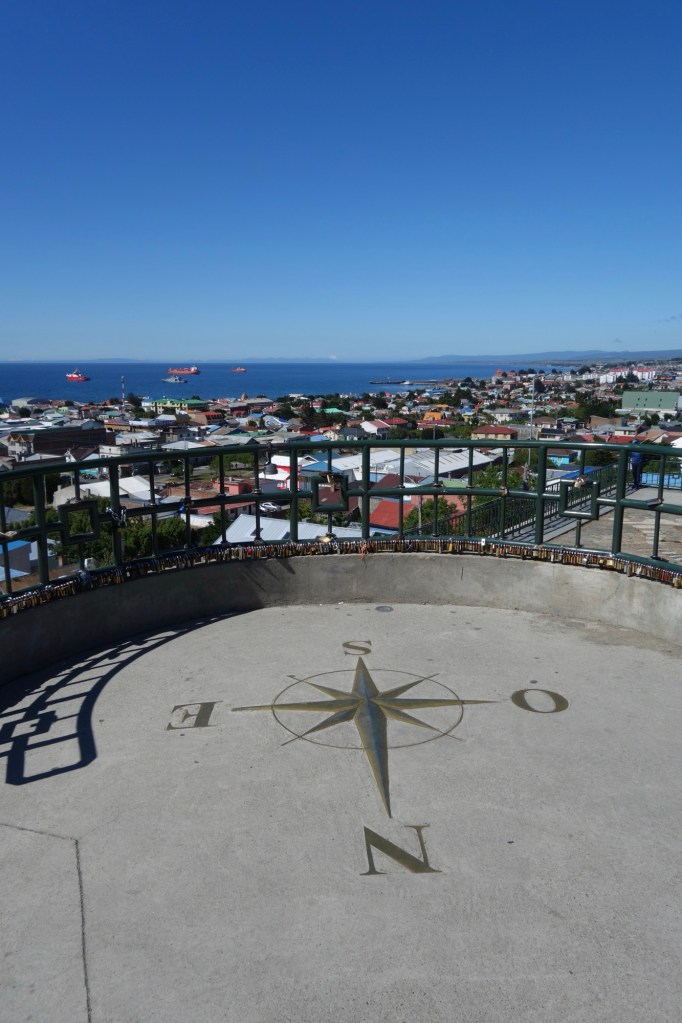
As we watched on, we were approached by a man who took a seat next to me before asking if it had been us riding our bikes into town yesterday. As soon as he asked this question, I recognised him as the man who had held out chocolate bars for us as we’d ridden past.
He introduced himself as Mark from Canada. On learning his name, we realized that this was the Mark who had been central to several stories we’d heard from other cyclists along the road. The Canadian boys had told us of their meeting with Mark back near Yungay, where he had been desperate to show them his van which contained nothing but a futon.
Over the next half an hour, Mark detailed his current situation. He had spent the last three winters driving his $600 van south from Canada, finding somewhere to park it before flying home for the North American summers. His plan had been to drive the van into the water upon reaching Ushuaia, hopeful of creating an artificial reef. However, with his trip now close to the end he was having second thoughts and was considering turning back north and heading for Brazil. Mark spoke vaguely about ‘some shit’ that had happened to him a few years ago. Whatever it was, it had been the catalyst for his new mindset.
‘Every morning when I wake up’, he said staring out into space, ‘I think to myself, ‘life is good. What adventure will I have today?’.
Despite our objective of having no plans for the day, there was one job that was hanging over our heads. With a flight home to Australia in a few days, we needed to find appropriate boxes for our bikes. This had been a common topic of discussion with other cyclists who were also riding south. Some had planned to just wrap their bikes in bubble wrap, while others were considering taping smaller bits of cardboard together to construct boxes that would fit their bikes. We had remained hopeful of finding a bike shop in Punta Arenas that might have old boxes, however, the very few bike shops we’d located all failed to produce the goods.
It was, therefore, serendipitous when I received a message that afternoon from Nick. I’d reached out earlier in the day to see if he’d made it home to Canada safely. His response outlined the feelings that one expects to experience on returning to ‘normal’ life after such a journey. However, what I didn’t expect was detailed instructions on how to acquire a bike box in Punta Arenas. The message, which had been passed down to Nick from another cyclist, read as follows:
‘Take a taxi to a place called Sanchez and Sanchez Hypermarket. It’s in the Zona Franca area of the city. Tell them that you need a bike box. Someone will then take you to their bike building warehouse which is two blocks away. They have tons of free boxes.’
The instructions were clear. We found a taxi and showed the driver the name of the place we needed to go.
The ‘Hypermart’ was a large ‘sells everything’ style department store. We found the sporting equipment section and tried to explain that we needed two bike boxes. The attendant excitedly beckoned for us to follow, leading us to their mountain bike section. We quickly realized that my request for bike boxes had translated to us wanting two new bikes. He was less excited when he understood that we weren’t there to spend money. However, as per Nick’s instructions, the man gave us directions to their warehouse, telling us that there would be someone there who would be expecting us.
Sure enough, after walking the two blocks to the nondescript warehouse in the center of an industrial area, we saw two cardboard bike boxes leaning against a wall. We found someone inside to thank before picking up the boxes and carrying them to a main road in search of taxi big enough to fit us and our new luggage.
Acquiring the boxes felt like the final piece in the puzzle. We stacked them in the shed beside our bikes, ready to begin the packing process in the coming days, before heading into town for dinner.
‘What should we do today?’ Dad questioned upon waking up on the second morning in Punta Areans. ‘Go for a ride?’
Following another interesting conversation around the kitchen table with Walter and Anna-Marie, we changed into our cycling clothes and got back on the bikes. Having come from the north, the logical plan was to keep riding south.
The road was sensational; smooth asphalt that hugged the coastline for 30 kilometers. We stopped at a monument beside the road that marked the geographical center of Chile; the point between the Peruvian border to the north, and the southernmost point of Chilean territory at the South Pole. There was also a conveniently located cafe in a geodesic dome that provided the perfect spot for a coffee.
As we sat in silence looking out over the ocean, we watched as the flags in front of the cafe began to come alive, dancing in the breeze. By the time we’d finished out coffees, the flags had stiffened and spray was now blowing in from the water. Fortunately, the wild weather was heading in the same direction as us as we turned for home.
We raced back along the coastline, past verdant patches of beech forest and new modernist developments juxtaposed against the rusted steel hulls of fishing boats lying on the rocky shore on the opposite side of the road. We arrived at the fish market just as my odometer ticked over to 7000km. A visit to the King of Ceviche seemed like a fitting way to celebrate this milestone.
Heading back to the guesthouse after another dose of ceviche, we stopped at a convenience store to buy some packing tape. Just as we walked out of the shop, we heard a very familiar sound. It was Sophie, riding towards us tooting the big horn attached to her handlebars; a sound we’d come to know so well back on the Carretera Austral.
Sophie told us of the wild winds that she’d encountered in Torres Del Paine National Park. At one point, she’d taken a break from riding and left her bike by the side of the road propped up on its kick stand. Not only had a gust of wind blown her fully loaded bike over, but it had also lifted it up and flipped it over again. Since this experience, she had caught a bus from Puerto Natales, only just arriving in Punta Arenas that morning. We chatted for a while, sharing stories of encounters we’d had with some of the same characters along the road. It soured our moment with Mark the day before, when Sophie told us that she’d been hassled by him several times, resorting once to moving campsites to get away from him. Otherwise, conversation was refreshing. With a ferry booked for that afternoon to carry her south to Ushuaia, we said our goodbyes, again, not entirely sure that we wouldn’t bump into her again somewhere before we left!
The afternoon was spent dismantling our bikes and packing them into boxes. Using scraps of cardboard that we found in the shed and an extortionate amount of packing tape, we protected the vital organs of the bikes (derailleurs, shifters, etc,) as best as possible and sealed the boxes. It was bittersweet knowing that we wouldn’t be riding our bikes on this continent again, at least for this trip. However, with Christmas soon approaching and a Tasmanian summer with friends and family on the horizon, an excitement about returning home was beginning to simmer.
We celebrated this milestone with a pizza and pint at the Magellan Craft Brewery in the center of town. The final hour of daylight was spent strolling along the waterfront, past an outdoor basketball court and a skatepark where a DJ was spinning records to inspire those shooting baskets and kickflipping as the sun set over the strait.
Our final morning in South America included yet another interesting morning around the kitchen table. Walter and Anna-Marie had left the day before, making way for three Swiss girls traveling together for a few weeks, a Chinese girl who was on holiday from her job as an energy trader in Beijing, and a Korean girl who had just quit her job with Hyatt Hotels to travel for as long as her money lasts. Several cups of coffee later, we returned to our room to pack our bags. Luanna kindly let us store our belongings in the shed for the day after checking out.
The final day of any trip is often a strange affair. However, the self-imposed obligation to partake in some gift shopping was a sure way of bringing down the mood. We spent an hour or so walking through a few galleries and design spaces, searching for some small tokens to take home to loved ones. This proved fruitless, resulting only in some tense words being exchanged before coming to the mutual agreement that present shopping is a great way to ruin our final day. Retrospectively, I think we were just riddled by the tokenism of this endeavor. There had been several items I’d toyed with buying over the last few months, trinkets from locations that had impacted me profoundly. However, a lack of real estate in my panniers had forced me to focus on collecting only memories and photos. We were retuning home rich with stories and new perspectives. Random gifts and more ‘stuff’, seemed pointless additions to our luggage. Despite these feelings, we collected a few presents over the course of the morning hoping (and knowing) that our return home would be enough for those who cared.

Stopping at a small grocer, we bought some bread, cheese, and fresh cherries for lunch. It was exciting to think that the cherries at home would also be beginning to ripen; a favourite summer delicacy and yet another commonality between the southern climes of this continent and our own island home. Constantly comparing and searching for familiarity between where you are and what you know is how the mind tries to makes sense of new experiences and surroundings. The further south we’d plunged, the greater the physical similarities to home had become. Evidence for the Gondwana supercontinent was strong; an objective link between where we were and the place we know so well. However, I was not only seeing these shared traits. I was feeling them with all my senses. The skin-tightening southerlies from Antarctica, the musty aromas of decaying plant matter on the floor of dark beech forests, and the sweetness of fresh cherries. It was the familiar experiences that I’d begin to crave more than the new ones. I was ready to go home.
We ate lunch in front of a newly constructed sign by the waterfront, marking 500 years since the European discovery of the Magellan Strait. Over the course of lunch, I may have given some stray dogs a little too much love. Wandering back into town, we were followed by a pack of eight new canine friends. It became a game of trying to lose them. If we noticed them get distracted by a new scent or a pole on which to take turns marking their territory, we’d quickly change direction. Within seconds, at least one dog would find us, scamper back to the pack to alert them of our whereabouts, before they all returned to our heels. This challenge occupied the next hour until the dogs eventually realised they weren’t going to receive any more of the pats and ear scratches they’d enjoyed over lunch.
After collecting some laundry we’d dropped off that morning, I indulged in an overdue haircut. With fresh clothes and a fresh cut I felt adequately prepared to return home, aware that I probably wouldn’t be feeling that fresh after 24 hours of travel.
Following a pizza for dinner and one last beer, we made our way back to Luanna’s guesthouse to collect our luggage. Luanna kindly offered to transport myself and the bikes in her personal car and ordered a taxi for Dad and some other guest needing a lift to the airport.
Arriving at the airport at around 9pm, we loaded our luggage onto a trolley and went in search of somewhere to try and get some rest for a few hours before we were able to check in for our flight to Santiago. Using our bags as a barrier, we found a quiet corner of the airport and lay down on the floor.
Thankfully, Dad shook me awake at 2.30am once check-in had opened. I was surprised when my luggage weighed in several kilograms lighter than it had been on arriving in South America. Upon reflection, there had been a handful of items that I’d relinquished along the journey; things that I’d discovered to be unnecessary as I became confident on the road.
It wasn’t just the contents of my panniers that had been stripped down over the last five months. Traveling by bike, and mostly alone, erased many of the needs and wants that I have had in the past. I wouldn’t say life became simpler. Whilst the complexities of life were reduced, I felt things with a greater intensity than ever before. Loneliness was visceral, painful even. Finding resilience in times of illness or fatigue was harder than peddling over any mountain pass. But like any sort of training, the more you do it the stronger you become. Spending extended periods of time at the edge of your comfort zone only increases the difficulties that you can comfortably tolerate.
I’m have no doubt that cycling through Patagonia alone would have provided an unforgettable conclusion to my journey. However, I will be forever grateful for the opportunity of spending those final weeks with Dad. His presence dissolved the loneliness that had begun eroding away the vigor with which I was approaching each new day. Being together reignited my desire for adventure and allowed me to see colours again in all of their vibrancy. Our shared experience in South America will remain one of the most impactful and significant of my life. The privilege of being an adult son traveling for several weeks in a foreign country with his father is not, and will never be, lost on me. The trust he put in me is meaningful beyond words. His willingness to travel to the opposite side of the world to have an adventure together is a trait that I hope I still possess in thirty years from now. I felt an overwhelming sense of pride each time we met someone new on the road and I was able to say ‘this is my Dad’. I have so much love for him as a man, a father, and a friend.
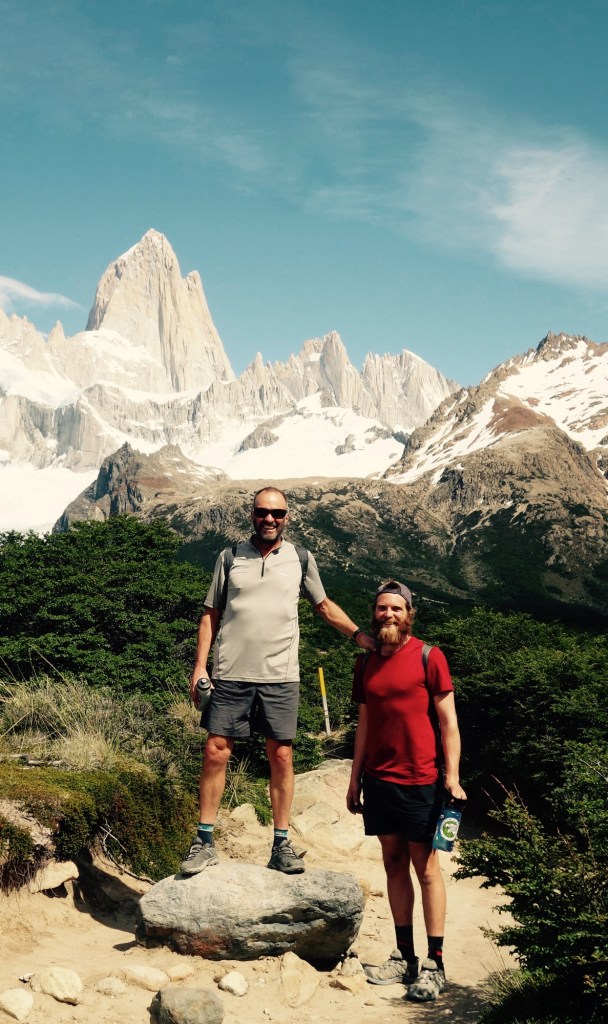
We arrived home on Christmas Eve, greeted by family and the long twilight hours of a typical summer’s night in Tasmania. We exchanged anecdotes with loved ones, becoming increasingly aware over the following days, that there is simply no way of truly describing what we shared together. You just had to be there.
The End
For those still reading, five years on, thank you. Whilst I have my journals, I wanted this blog to be a project that I saw through until completion. Thank you for for supporting my perseverance.
The next ‘project’ is just around the corner.
 Faults and Folds