I was emotionally bolstered from the rest and reflection in La Paz. Excited about the next leg of the journey, I purchased a ticket from the capital to the town of Oruro; a relatively short bus ride by South American standards, but far enough away from the capital to provide some necessary breathing space. Oruro was the obvious port to stock up on food before immersing myself in the blankness of the famous, well-photographed, Salar de Uyuni.
Predictably, the transcendent experience of cycling alone, across the world’s largest salar (Spanish for ‘salt flat’), exceeded every preconceived hope I had brewed up over the previous days, weeks and months. Nervous conversation around the table at the Casa de Ciclitis had left me questioning the conditions of the salar, as well as the ability of both myself and my bike for this leg of the ride. Was the salar going to be too wet? Were my tyres wide enough to cope with the unique and potentially soft terrain? The ethereal, reflective images that are commonly seen of this landscape are taken when a shallow layer of water covers the salar; the result of seasonal rainfall. Admittedly, I had been envisioning my own version of spatially distorted images, using the featureless white horizon to manipulate scale. However, explanations from other cyclists were now beginning to highlight that wet, reflective surfaces were the last thing I wanted. My focus shifted from photographic opportunities to salt conditions and weather reports.
Fortunately, after a few hundred kilometres, I arrived at the edge of the dry salar. The two days that followed, provided cycling that was truly beyond anything my imagination could have conjured. However, most unexpectedly, the arterial roads that lead me to Bolivia’s great, salty heart, dealt some of the most memorable interactions with locals that I have experienced on this ride so far. Arriving in the oasis town of Uyuni on the edge of the salar, with a bike and body buried beneath a salty crust, I was awash with a sense of satisfaction and contentment; sensations which had been absent during the previous few weeks.
Riding from the Rain

Limited late night options and unfamiliar Spanish words resulted in a regrettable dinner in Oruro. The bus had arrived mid-afternoon, following a meditative trajectory across the undulations of the barren antiplano. The road had been dry yet sheets of rain hung like matte grey curtains over the distant hills. After finding somewhere to sleep for the night, I spent the remaining sunlit hours dissecting the chaotic market square, accumulating provisions for the following days. Time was absorbed by overwhelming aromas and organised pandemonium. The end of the school day was evident when the population on the streets suddenly doubled. Swept up in the festival-like atmosphere of what was just a normal evening in Oruro, I walked in circles for the next few hours. Eventually, my stomach began talking louder than the surrounding vendors and school children.
Every restaurant that was still open seemed to be advertising the same dish; charque. I hadn’t seen this anywhere before and, unfortunately, there didn’t seem to be anyone around still eating for me to catch a glimpse of the mystery dish. I wandered into the most illuminated restaurant I had seen and took a gamble, ordering a serve of the only available dish. I was promptly dealt my dinner.
A bowl of white beans, salty queso fresco (fresh cheese), and a boiled egg formed the base for what was clearly the centrepiece of the dish; the charque. The dry, shredded meat sat atop the other components of the meal like a bird nest. As much as I tried to separate it with utensils, I kept ending up with a mouthful of the stringy, salty meat. Perhaps my observation skills had been marred by my appetite, but it wasn’t until I’d eaten the meal that I looked around the restaurant. From the various posters and framed images around the room, it quickly became clear that I had just consumed a bowl of sun dried llama meat. The entire experience left me with a strange taste in my mouth. Several litres of water later, I fell into a deep slumber built on anticipation of the coming days and the fatigue of trying to forget my last meal.
The following morning involved some bike maintenance in my hostel room followed by an egg sandwich and strong instant coffee from the local market. I left Oruro around 11, riding out of town past the bus depot where I had arrived the previous evening, before taking a sharp turn for the south. The first hour of riding was fast. The pocket of air in front of the rapidly encroaching rain storm rocketed me along the road. Eventually, the the dark sky caught up, engulfing me in steady rain. A perfectly placed roadside building with accentuated eaves provided enough shelter for me and my bike. I sat against the wall with my knees pulled up to my chest to keep my toes out of the rain, taking the opportunity to add extra layers of clothing and hoe into some bread and jam.
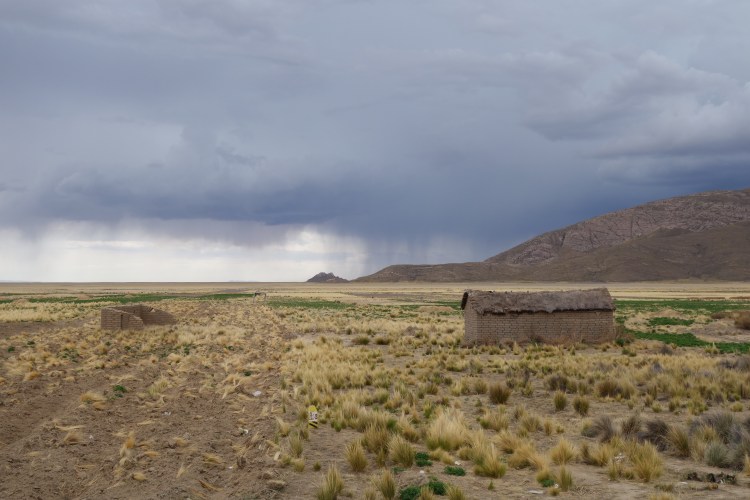
The immediate rain front passed, revealing a flat, shimmering landscape. Isolated showers were scattered across the horizon; the sheets of rain appearing like grey columns holding up the sky. Gentle roadside hills provided protection from a stiff easterly crosswind, which billowed through whenever it was given a chance. Between rain showers, crosswinds and sporadic lightning strikes, I struggled to relax. Despite the seemingly horizonless antiplano, I was on edge for the entire day.
As the afternoon rolled on, I set my sights on a small town called Pazna; a mere speck of civilisation on the map. Rounding a corner on the outskirts of the town, I was struck by a familiar sight. The large, beige vehicle I had seen outside Copacabana was parked beside the road, recognisable by the Cochlear implant logos. A lone man stood on the opposite side of the road, camera in hand, looking out over the mountains to the east. He saw me approaching and turned to greet me as I slowed. He introduced himself as Joe; the proud owner of the converted, ex-military MAN truck which we had both turned to admire. Joe was from Germany, where he still returns each European summer. He shipped the vehicle from Britain to the East Coast of Canada, over two and half years ago. Since then, he has travelled extensively through Canada, Alaska, the lower 48 states, Mexico, and Central America. Like me, he is feeling the pressure of the approaching wet season and wants to make it south in time for the Patagonian summer. Whilst I listened to this logic, I couldn’t help by compare the size of our wheels and question the relatively of our concerns.
Whilst it had become obvious during our brief conversation, Joe went on to explain that he is also the owner of a life-changing cochlear implant, hence the insignia on the vehicle. Cochlear, a Sydney-based company, sponsor Joe’s travel in the way of paying for fuel. In response to the organisation’s generosity, Joe is simply required to raise awareness of the empowering device, which in many ways is enabling his current lifestyle. When I asked him what he plans to do when he reaches the end of the continent, he told me he’ll drive up to Buenos Aires; the cheapest location from where to ship a vehicle. Once back on the soils of his home continent, he plans to immediately commence a trip along the Silk Road. I considered camping beside Joe’s big rig, but the proximity to the road was a little unnerving; an issue that Joe and his military-grade vehicle would rarely have to consider.
We wrapped up our conversation, in the same way so many interactions on the road seem to end; ‘goodbye for now, I’m sure I’ll see you again somewhere along the road’. A few kilometres later, I rolled in to Pazna. Passing a local school brimming with the sound of children, and a church with an adjoining cemetery, my entry into the town was watched closely by a number of elderly locals sitting outside their homes.
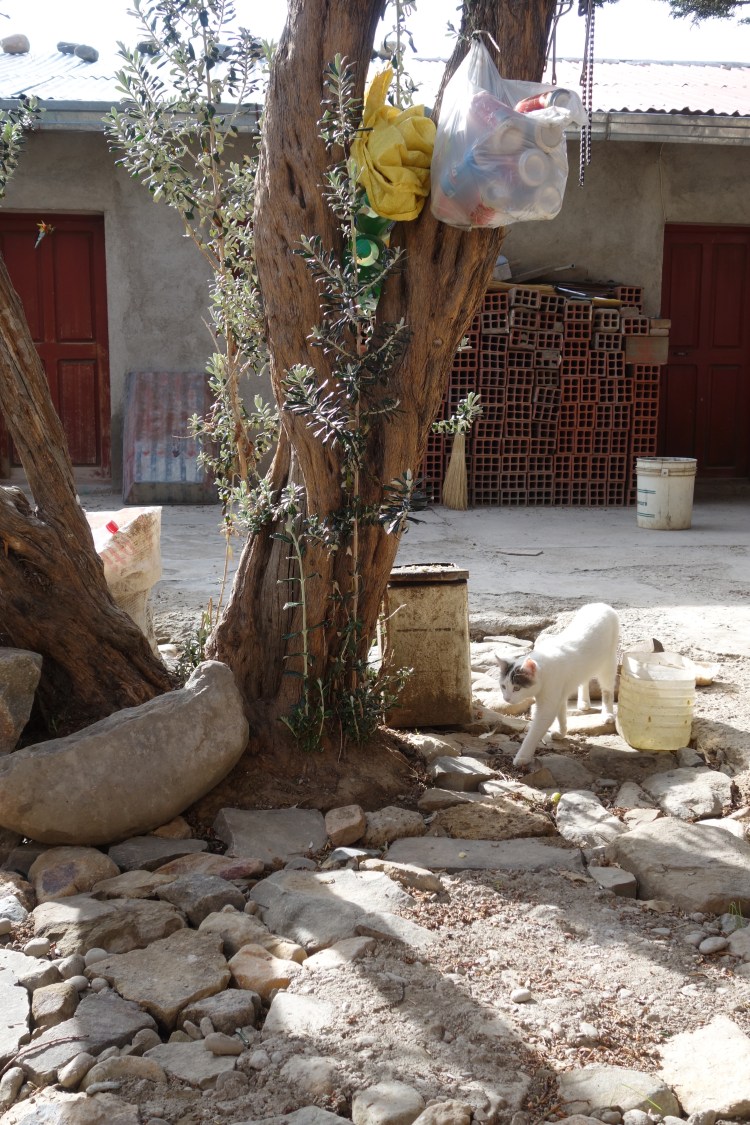
I had read of a small homestay within the town which was becoming increasingly attractive given the approaching rain. However, when I arrived at the described location, I found a brick wall with a padlocked wooden door. I sat on the ground for a while, back against the door, reassessing my options for the night. Just as I was about to pedal back to the cemetery in search of somewhere to pitch my tent, two young boys in school uniform stopped and leant over me to unlock the door of the building. I asked the eldest looking of the two whether I could stay for the night. Without breaking stride, he gestured for me to follow him, leading me out into a small courtyard. He opened the door of a small, free standing building to reveal a concrete floor with a single bed and a desk. Following minimal dialogue, the boys returned to the main building and left me alone for the afternoon. I spent the following hours in the company of the house cat, alternating between writing and eating. The rain eventually eased, revealing a subdued twilight sky and a few lingering clouds which turned from ash to amethyst as the light faded. My final waking hour was spent indulging in a downloaded episode of ‘Chef’s Table’. Regardless of your interest in the culinary world, I highly recommend investigating the altitudinal adventures of Peruvian chef, Virgilio Martinez.
After hitting snooze for the third time, I moved a few metres from my bed to the courtyard. Following a bowl of extra sugary porridge, I drank several coffees while chatting to the matriarch of the household as she washed clothes. I ran out of fuel for my stove which forced me to start packing up and getting on with the day. Fittingly, I left the property at the same time as her sons who were on their way to school. The eldest of the boys pulled the wooden doors together, and snapped the padlock back into the position it had been in when we’d met the previous afternoon.
Checkmate
Scattered cloud and only the slightest breath of wind were a welcome change from the constant threat of rain the day before. I rode with purpose for the first hour before arriving in the town of Challapata, where I picked up some gasoline for my stove as well as some bread rolls for the coming days. The open road and expansive vistas brought out my inner vagabond. I tore the sleeves off the old t-shirt I’d be wearing for too long and continued south, energised by the sun and wind on my bare shoulders.
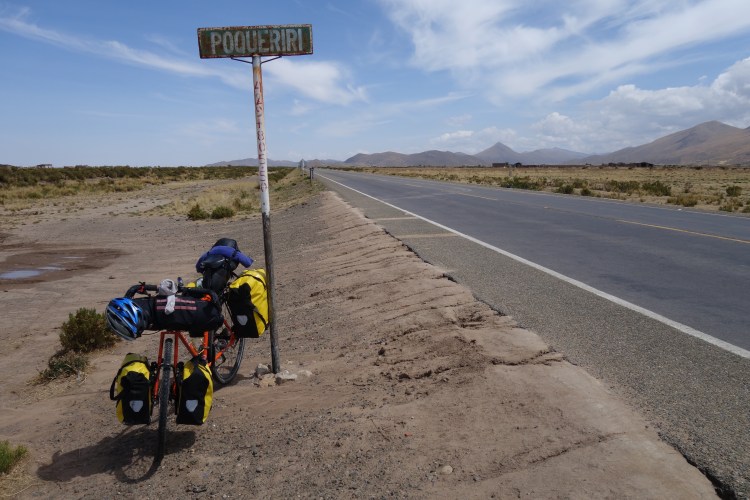
A few kilometres down the road, still attempting to channel Che Guevara despite lacking a motor and revolutionary beliefs, my bladder forced me to pull over and dump my bike on the side of the road. Just as I had finished alleviating the internal pressure, a group of actual motorcyclists appeared over a small rise in the road. Their bikes were loaded up with heavy duty panniers, covered in stickers to highlight their previous geographical conquests. Three of them passed by, each raising an obligatory index finger from their handlebars in acknowledgement of our shared concept of ‘adventure’. The fourth rider, a little further back from the other, pulled on the brake levers and swung into the gravel beside my bike. Wearing thick yellow wet weather gear, he looked more like a commercial fisherman than any bikie I’d ever come across. Having seen my bike lying on the ground, he had stopped to see if everything was alright; a somewhat rare display of genuine solidarity between pedal-powered and motorcycle tourists out here. The man, who appeared to be in his sixties, spoke with a strong West Country accent, recognisable over the sound of his idling engine. He introduced himself as ‘Phil from Devon’. I asked him about his friends further up the road but he told me he’d just met them earlier in the day and wasn’t too fussed whether he made it to the same location as them that evening. Phil had also started his South American adventure in Colombia, only a few weeks before I set off. Considering his meandering route and loose plans, we acknowledged the likelihood of running into each other again at some point. We shook hands before he twisted the throttle and shot off into the distance.
Having been on the main highway south since Oruro, I was eagerly awaiting the road junction which would send me down a quieter road towards the northern edge of Salar de Uyuni. Just as it was becoming difficult to ignore my stomach, the turn-off came into view. A well positioned mud brick wall provided the perfect windbreak to sit behind and devour some bread and jam, while attempting to conjure the energy to push on for the afternoon.

The strengthening breeze and barren landscape meant I’d need to find some form of shelter if I was to have a peaceful night in the tent. Tracing my finger across the map, I located a small scattering of buildings another 60 kilometres or so down the road. Hopeful that there would at least be a wall that I could camp behind, I set myself the goal or reaching this mystery town. Over the course of the afternoon the sky remained clear and the indecisive breeze swing back and forwards in a 180° arc. Fortunately, it never quite became a headwind.
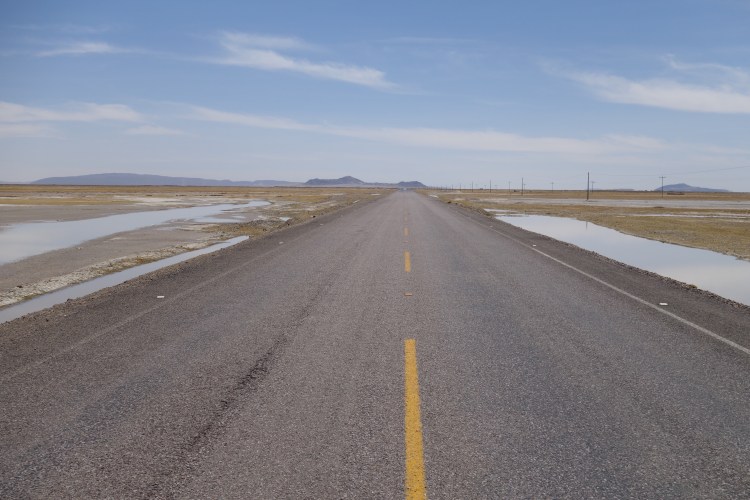
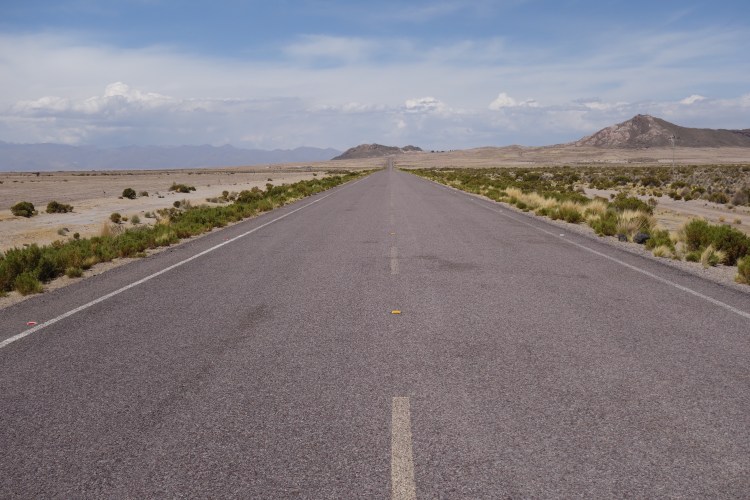
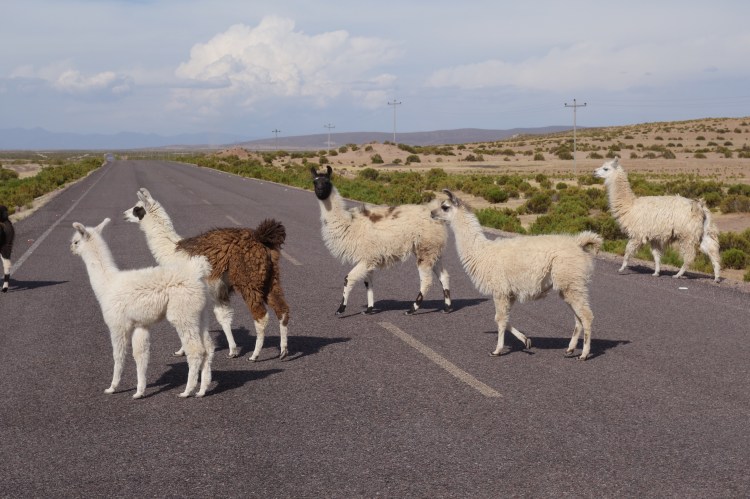
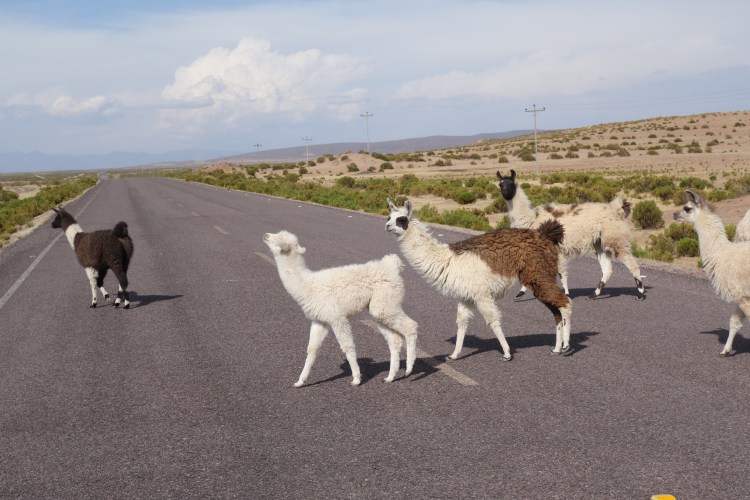
The knowledge that the world’s largest salt flat was only a day away explained the increasingly dehydrated landscape. The rocky soil was punctuated by the occasional green tussock. Any depressions, such as old creek beds, revealed a salty crust on the stones and pebbles, appearing like a heavy frost. Llamas were prolific, both as distant herds on the horizon and inquisitive collectives on the side of the road. At times they blocked the road, forcing me to come to a complete stop while they decided whether they would let me continue.


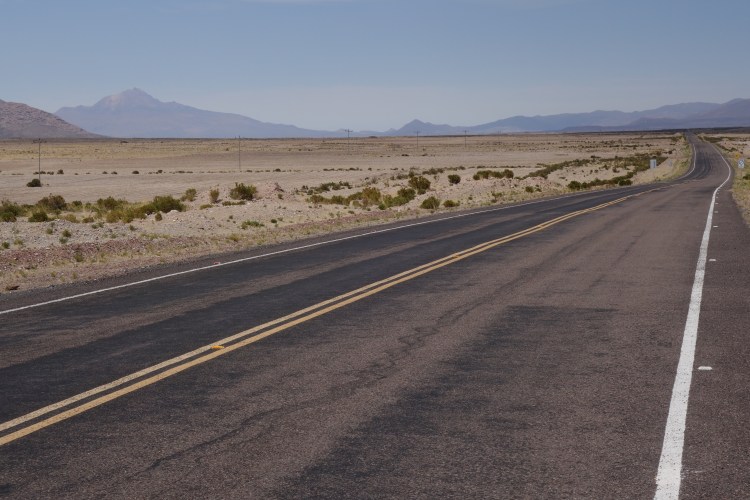
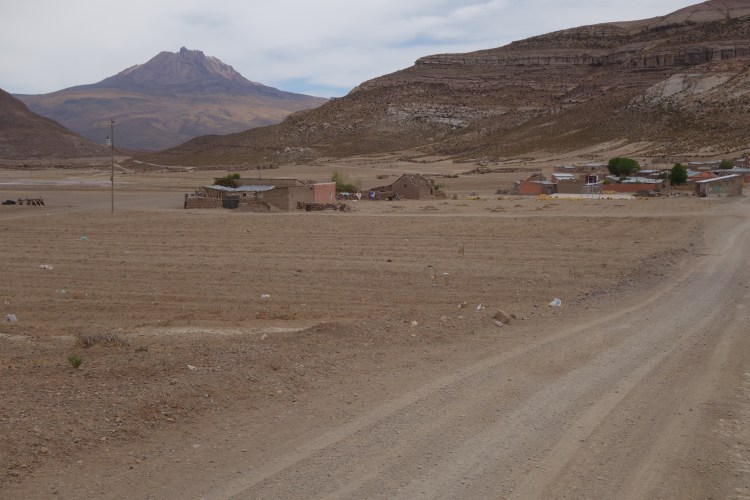
As the afternoon progressed, I was faced with what felt like never ending rolling hills. Having been on a relatively flat road all day, it appeared as though I was riding into the Earth’s crumple zone; gentle folds in the landscape caused by a collision with another landmass somewhere down the road. The undulations sapped my legs of all remaining energy, as my eyes and mind hoped that the crest of every hill would reveal the perfect campsite. After 130 kilometres, a modicum of mud brick buildings finally came into view. Another few minutes of inspired pedalling carried me to a narrow slip lane which acted as an entrance to the town. Snaking slowly through the dusty streets, it was hard to tell whether anyone actually lived there. There was an eerie silence; the absence of human sounds in a built environment. Regardless, the buildings would provide the perfect shelter from the wind for the night and considering my fatigue levels, I felt as though I would have slept thorough a gale.

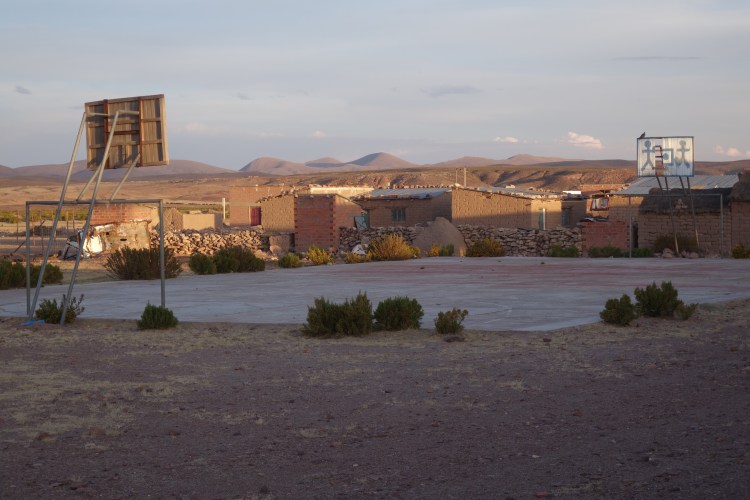
On the edge of town I could see a large open-walled shed. As I got closer, I realised that it was an undercover basketball court. Scanning the area for somewhere to pitch my tent, I was startled when a man and woman appeared from behind a nearby building. I dropped my bike and walked over, encouraged by their beaming smiles and vigorous waving. Following a brief introduction, they proceeded to tell me that they were the two teachers of the local school. Within seconds of sharing this detail, the doors of the building we were standing beside swung open, and several energetic children cascaded out towards us. I think we were all equally shocked by each others’ presence; I got the feeling that the town doesn’t get many visitors. To add to my confusion, a minivan arrived a few minutes later. The two teachers informed me that this was the school bus and that only a few of the students actually lived in that particular town. Having cycled over 100 kilometres since the last sizeable town, I was baffled as to where these children had come from. The bus driver worked like a sheep dog, chasing the children towards the doors of the bus. I stood still, aware that my presence was a novelty and may be causing an unusual amount of hyperactivity amongst the class. Eventually, the overweight and now sweaty driver managed to herd his flock into their seats and shut the door. Kicking up a cloud of dust, the bus rolled out of town and back down the road from where I had travelled.
As the dust settled, literally and metaphorically (I could completely empathise with the teachers at the end of a school day), I asked if there was anywhere I could pitch my tent. Without discussion or debate, they simply told me that it would be far too cold to camp. The male teacher insisted that I followed him, leading me to another building on the other side of the basketball court. He swung open the doors, revealing what appeared to be the school’s assembly hall. A concrete floor lay before an elevated wooden stage. Visibly dusty curtains were pulled to either side of the stage and some wooden chairs were positioned randomly around the room. The teacher told me I could sleep anywhere in the building before pointing out of the window to show me the town’s water tank. I was humbled by his generosity, thanking him profusely. My face must have also been showing signs of fatigue as he was quick to cut off our conversation and wish me a good night, squeezing my shoulder before walking out the door. By the time I had rolled out my sleeping gear and stepped back outside to collect some water, there wasn’t anyone in sight.


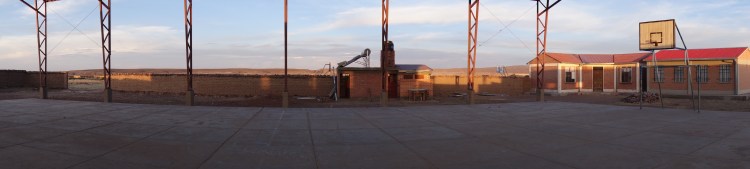
I set up my stove on a concrete step beside the basketball court and cooked a lentil stew. Still a little perplexed by why this town exists, I revelled in the sights and sounds of rural Bolivia at night. A full moon cast a silver glow over the tussocks on the plain, while flashes of lightening illuminated the faults and folds of the distant mountains. Barking dogs injected chaos into the flocks of swallows nesting in the beams above the basketball court. Red tail lights marked the location of far away roads, while the occasional motorcycle cut through the natural soundscape with ease. Entertained by the simple scratching of my beard on the nylon shell of my down jacket, I sat still in my own thoughts. Shadows were sprawled across the court, growing in size and crispness as the moon rose higher into the sky. Full of gratitude and lentils, and with an increasingly cold nose, I closed the assembly hall doors behind me and settled in for the night.

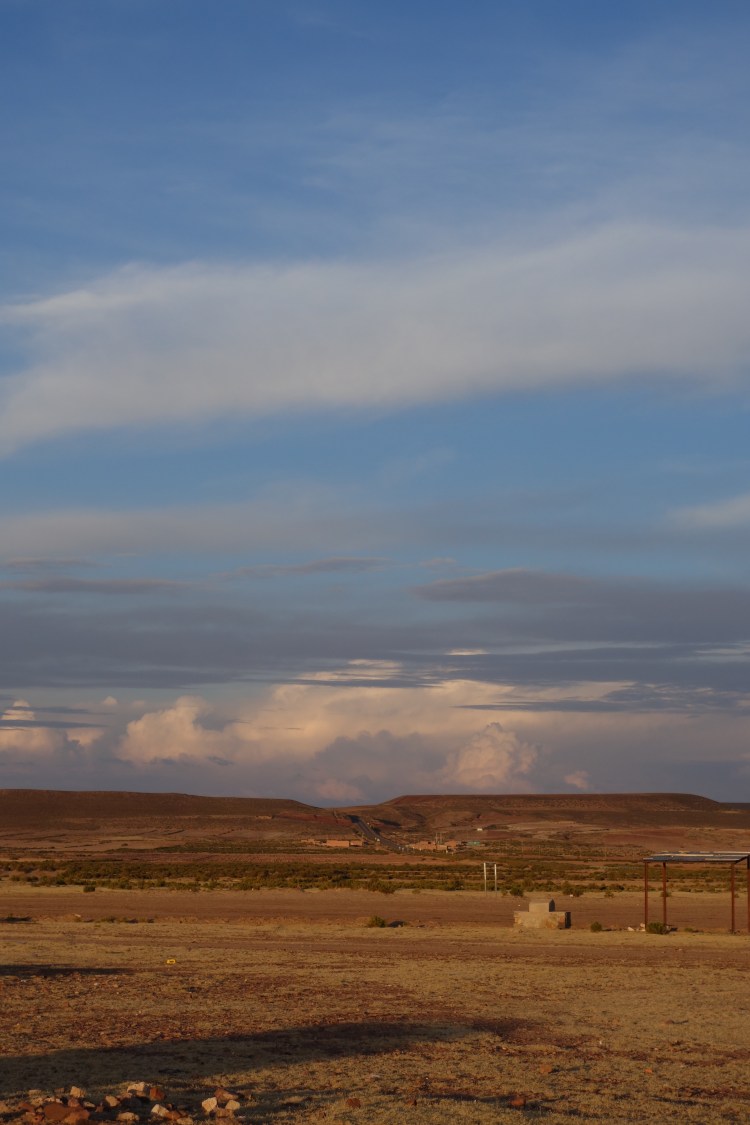
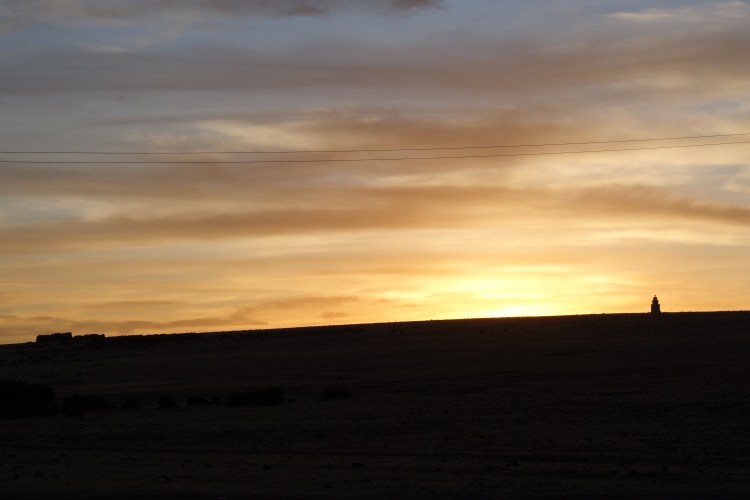
I woke to an equally cold morning, following a magnificent sleep. I returned to where my stove was still set up from the night before and made a supersized porridge and enough hot water for too many coffees. As the sun rose higher the town began to come to life, one small child at a time. I had noticed one young boy slowly pacing the perimeter of the basketball court as he assessed my every move. Like a moth to a flame, literally, he eventually walked towards me, clearly intrigued by the blue heat emanating from my stove. Wearing a hand knitted crimson vest over his school uniform, he sat on the other side of my breakfast and watched me sip coffee, using his sleeve to repeatedly wipe his runny nose. After giving him ample time to suss me out, I introduced myself and told him where I was from. In response, he told me his name was José and pointed towards one of the houses on the edge of town to show me where he lived.
It didn’t take long before some other local children followed José’s lead and gathered around me. After a lot of staring, feet shuffling and broken conversations one of the older girls ran to the classroom and returned with a basketball – the perfect cross cultural icebreaker. I was anticipating some casual shots and banter, but the kids had other ideas; Australia versus Bolivia. Despite their ten player advantage, they quickly realised my height proved to be an insurmountable challenge and subsequently lost interest in the game. Before I could even return to my tepid cup of coffee, the next challenge had been established. Lead by José, a few of the boys returned the basketball to the classroom and reappeared with two chess sets; a game where height unfortunately has no advantage. Pushed forward by his comrades, José challenged me to a game. I checked the time as I knew there was a lot of riding ahead of me that day. Retrospectively, this was a move of utter arrogance. Who was I to think this game might actually last more than a few minutes? I wish I could draw out the details of the game, but the truth is that I got trounced. I was quick to accept a match with another opponent to redeem myself. With a yellow hoodie pulled over his head, my new challenger was equally as fast at annihilating me as José had been. Just as the children had done with the basketball only minutes earlier, I walked away from the impossible challenge, and began to pack my panniers.
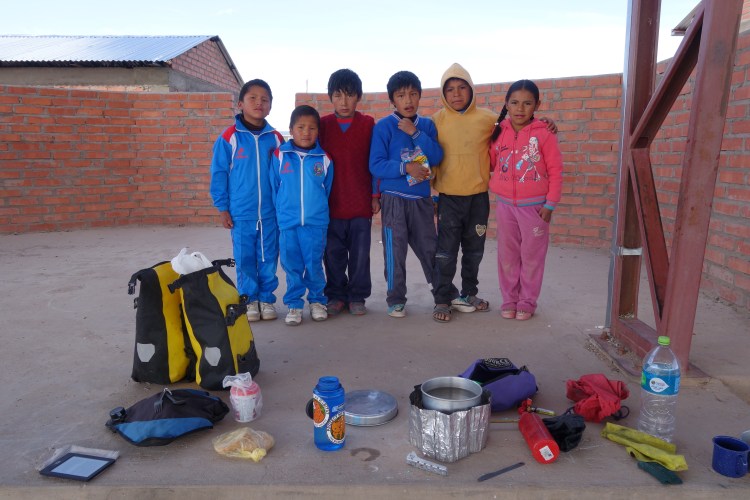


Right on 9am, a young girl ran a lap of the basketball court vigorously shaking the school bell. The sharp tones reverberated through the steel beams and corrugated iron roofing. It seemed unnecessary, considering the other students were within whispering distance. However, as the students began to line up on the edge of the court in height order, a few late risers emerged from the surrounding houses and filled the gaps in the attendance line. While loading my panniers on to the bike, I listened as the two teachers that I had met the night before paced in front of the line of students asking for various morning greetings in both Spanish and English. Whenever it came to the English translations, José and a few others would look over their shoulders towards me and shout their ‘hello’, ‘good morning’, ‘how are you?’, with gusto and a smile. I finished packing as the students filed into the school house. After thanking the two teachers for their generosity, I left and rode out of town past the windows of the school which were filled with waving students.
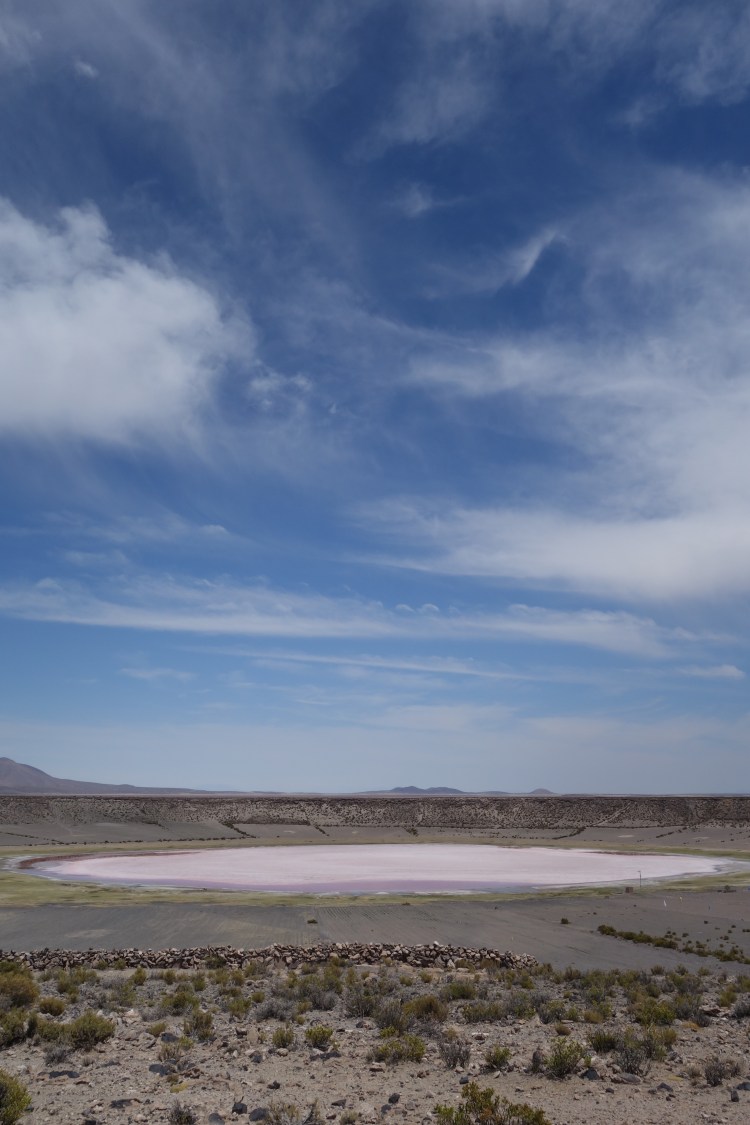
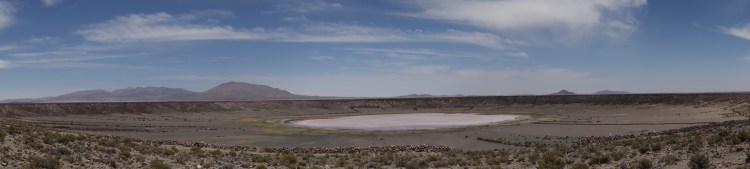
Buoyed by the energy of the children and the hospitality of the townsfolk, I enjoyed an exquisite morning of riding. The desiccated landscape created meditative vistas where llamas outnumbered people and vehicles; a heart warming ratio. After an hour or so of motivated pedalling, I came across a small wooden sign staked into the hardened earth beside the road. A hand drawn depiction of an antique camera (circa. 1800s) suggested a possible point of interest which caused me to scan the relatively featureless horizon. It was only when I wandered a few metres from the road that the large depression in the landscape came into view. A shallow briny lake lay at the base of the perfectly round crater. I later learned that this is thought to be the site of a major meteor collision. The flawless dent certainly appeared to be otherworldly; an anomalous feature in the otherwise stark landscape.
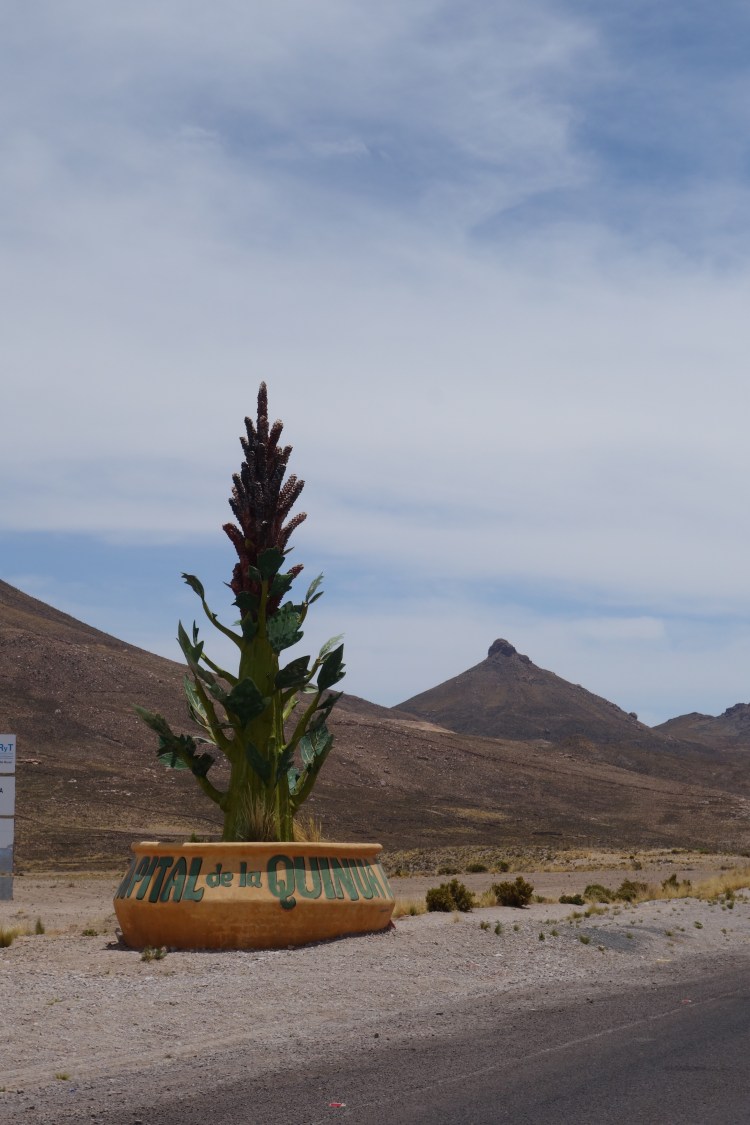
Hoping to make it to the edge of the Salar de Uyuni by end of play, the first significant waypoint for the day was the town of Salinas De Garcia Mendez (abbreviated to Salinas de G.M. on every map, sign and even building within the town itself). Appearing to be the last port of call for provisions before Uyuni on the other side of the salar, I pulled in to the town square. Propping my bike against what I assume was one of the only palm trees in hundreds of kilometres, I ventured into a nearby convenience store. Brimming with unpacked boxes and slabs of bottled water, I shuffled throughout the store looking for food that would be nutritious yet lightweight. I emerged with a jar of jam, a packet of crackers, a few tins of sardines and a handful of chocolate bars; the diet of desert champions. Enjoying the shade of the lone tree and the sweetness of the preservative rich jam, I sipped at my replenished water bottle and prepared for the next 30 kilometres of riding which would deliver me to the town of Tahua on the shore of the great salt flat.
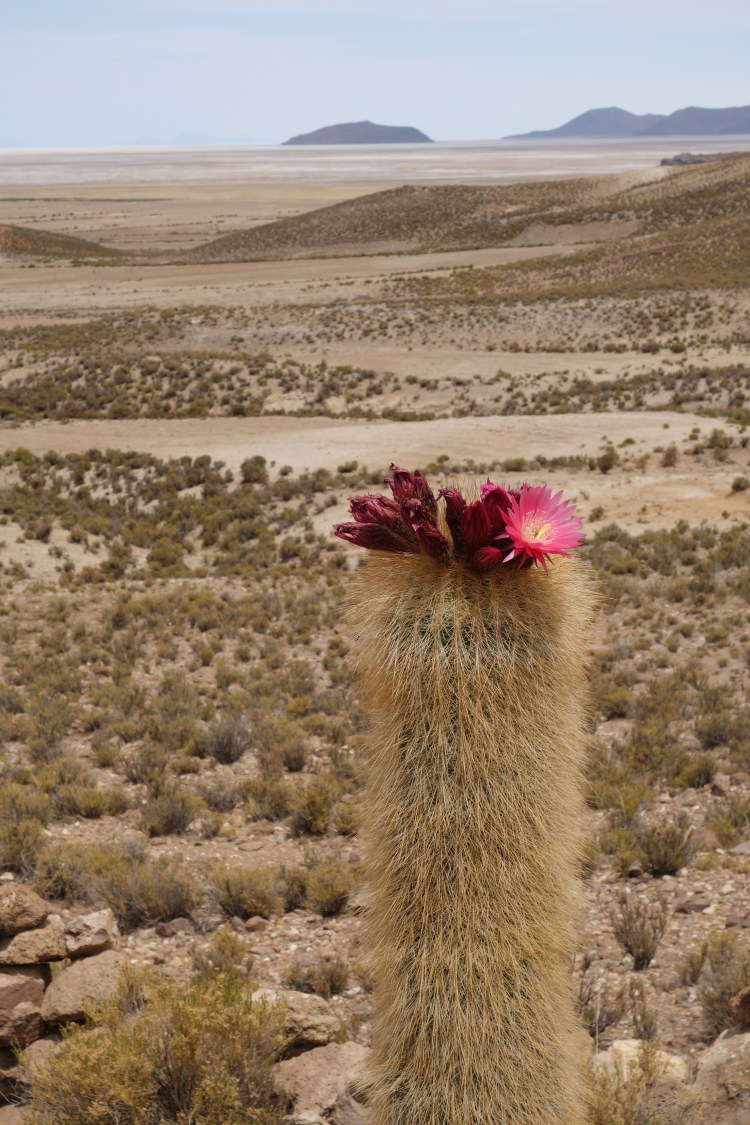
The first hour of afternoon riding was corrugated, yet relatively swift. Salinas de G.M. had also marked the end of sealed surfaces for the foreseeable future. The road meandered between small hills, passing a smattering of mud-brick hamlets seemingly void of people. The earthy hues I had become so familiar with were punctuated with colourful explosions of flouring cacti. These floral delights beckoned for my attention, welcoming further exploration on a macro level. Insects crawled amongst the stamens of the plants, eager to indulge in the nutritional delights before the flowers closed again on dusk.

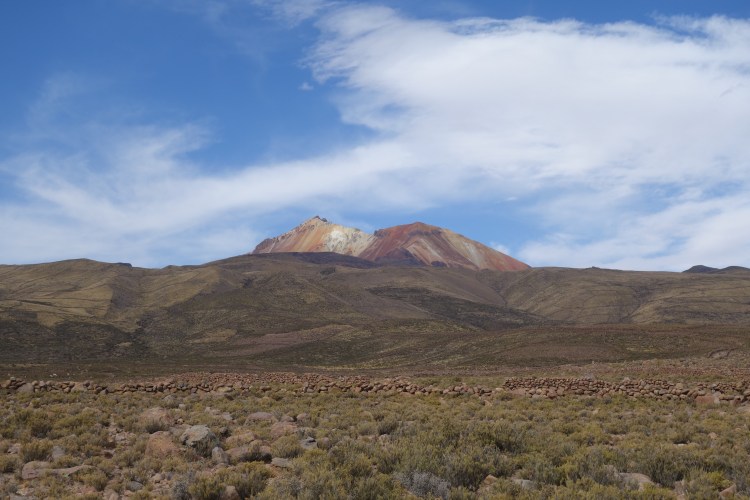
As the afternoon wore on, the horizon became increasingly dominated by the impressive Volcan Tunupa. Standing at 5321 metres (roughly two kilometres higher than the surrounding terrain), Tunupa is of great geological and mythological significance. The astounding landform is identifiable by its striking pigmentation. It’s flanks are embellished by gold, saffron and rust coloured bands of soil, indicative of previous periods of glaciation. Whilst the vistas became increasingly otherworldly, the quality of the roads deteriorated. During the final 15 kilometres, I was reduced to pushing on a number of occasions, as the compressed earth gave way to deep, soft sand.
The testing conditions came and went, just like the clouds. In the sporadic sunlight, the volcano modelled its entire wardrobe of colours. Llamas dotted the pastures beside the track, occasionally extending their necks above the hardened shrubs long enough for a quintessential Bolivian photo shoot. The only human contact I had during the afternoon came in the form of a weathered llama farmer, leading his herd of colourful, wooly beasts. We exchanged a few words which I feel would be a typical conversation in his day. He gestured towards the volcano with an air of intrigue and wonderment. I love meeting people who are mesmerised by their own backyards.
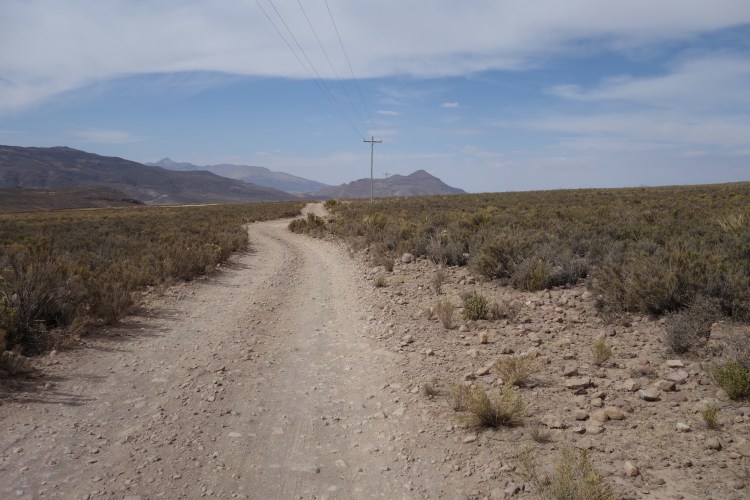


It was around 5pm when I crested a rocky rise and caught my first glimpse of the salar. With the sun having fallen behind Tunupa, the salar had been draped in a silver cloak. If it weren’t for a few distant jeeps hurtling across the salt, the landscape would have definitely been mistaken for an ocean. Awash with a sense of achievement having finally made it to Salar de Uyuni, I released my grip on the brakes and bounced my way down the hill into Tahua. Slowly rolling around the dusty streets of the town, I came across a public tap where I was able to fill all of my water carrying vessels; a total capacity of 8 litres (or, as I have come to see it, 8 kilograms). The water which spilled to the ground around me was quickly slurped up by a tame, forthcoming pig.

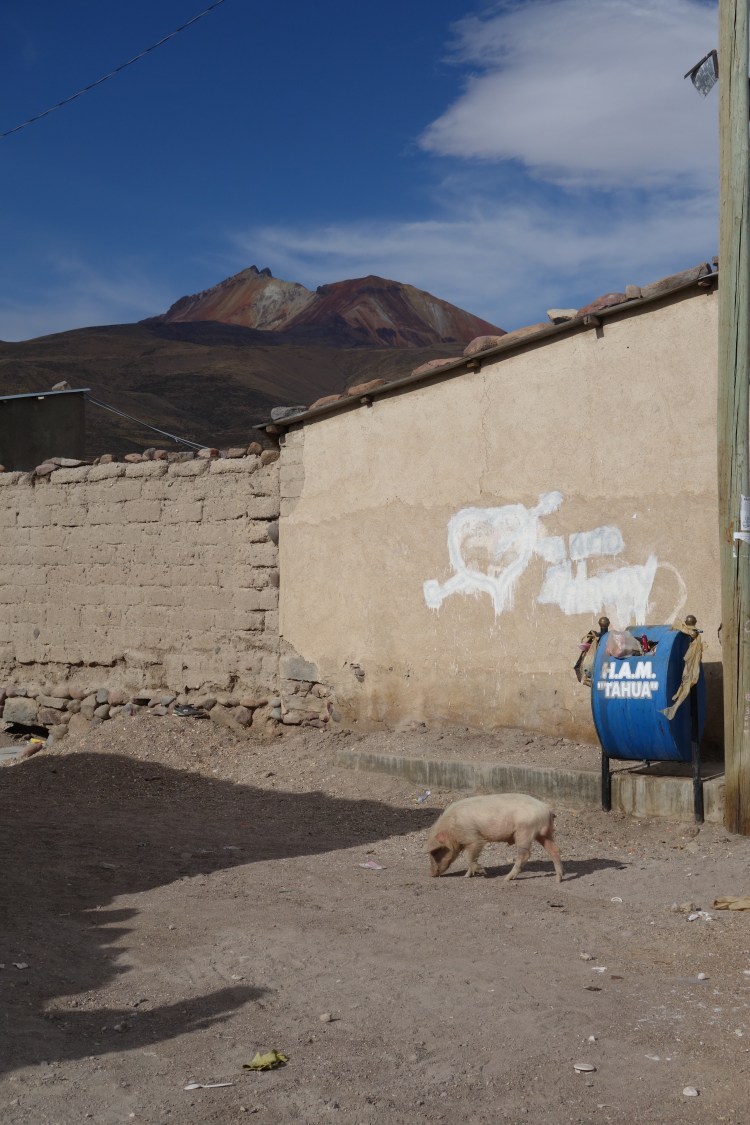
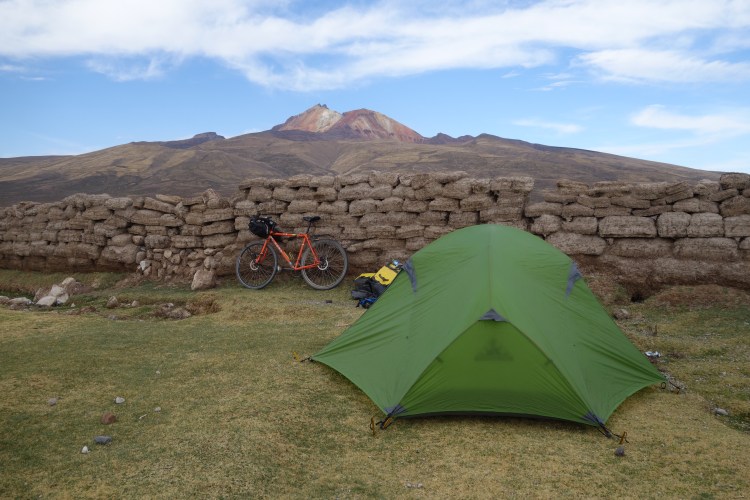
With my bike wobbling under the additional weight which sloshed from side to side with each pedal stroke, I made my way back through the centre of town. Despite a few local men hosing the salt off their vehicles, it appeared as though most people had battened downed their hatches for the evening. The sun had now fully disappeared and the cold wind had strengthened. I rolled down towards the edge of the salar in search of some form of windbreak where I could set up camp. After a few optimistic, yet fruitless, endeavours into patches of dense scrub I eventually discovered an open farm gate and a perfectly positioned stone wall. From the angle of the wall and the presence of sheltering llamas, I got the feeling that an evening gale from the north was commonplace in this part of the world. I quickly got to pitching my tent as close to the wall as possible, thanking the llamas for the manicured lawns as the tent pegs slid into the soil with ease. After indulging in a quick sponge bath, I let the frigid breeze dry my skin in seconds, before diving into my tent in search of brief reprieve from the wind. The next few hours were spent with my sleeping bag pulled up to my chin, watching the film ‘Mountain’, which I had downloaded for a moment just like that one. With the wind whipping over the wall behind my tent, I immersed myself in the astute cinematography of Renan Ozturk, the smoky voice of Willem Defoe, and the efficacious words of one of my favourite writers, Robert Macfarlane. By the time the credits began to roll I was feeling warm and grounded. I emerged from the tent to cook some pasta with sardines, which I ate crouched behind the wall, marvelling at the stars suspended above the salar.
A mother’s tears
Having fallen asleep to the unnerving tattoo of a tent fly in the wind, I awoke to a serene stillness. As I crawled from my sleeping bag, I was greeted by a rich indigo sky hanging above the green field where I was camped. The beige, brown and white bodies of the llamas were scattered evenly across the grass, occasionally taking a break from grazing to stretch their necks and also take in the view. I made some porridge and a few coffees whilst slowly breaking camp and tending to my dust encrusted chain. Caught between the urge to begin the unique journey across the salt, and the desire to spend the reminder of the day lying in the grass beneath the warm Bolivian sun, my departure was a little delayed. It was around 9.30am when I eventually pushed my bike back towards the entrance to the field, startling a young, dozing llama who had also recognised the perfection of the morning sun.

My plan for this leg of the ride had been built on a combination of advice from other cyclists and what I could dig up on various blogs. I set off from the field in Tahua with the intention of spending two days on the salar, overnighting on one of the many cactus covered islands dotting the white horizon, Isla Incahausi. A gravel tongue, much like a boat ramp, extended out onto the salt for a hundred metres or so. I can only assume this was to carry vehicles and cyclists over the wet, spongy edge of the salt flat where pools of briny water glistened in the morning sunshine.
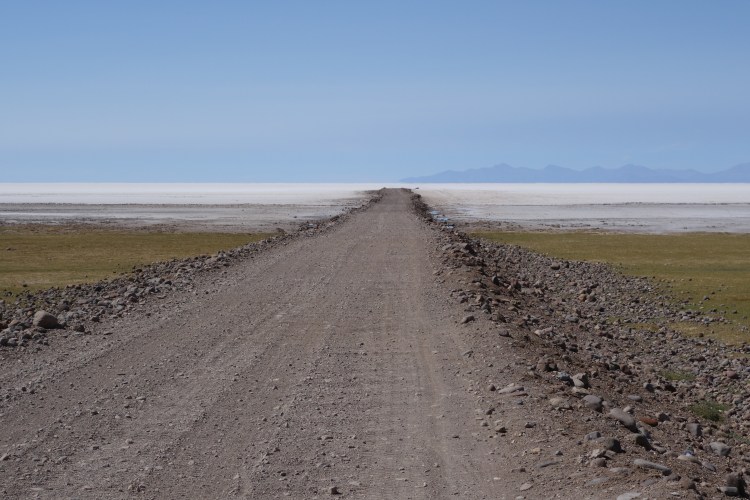
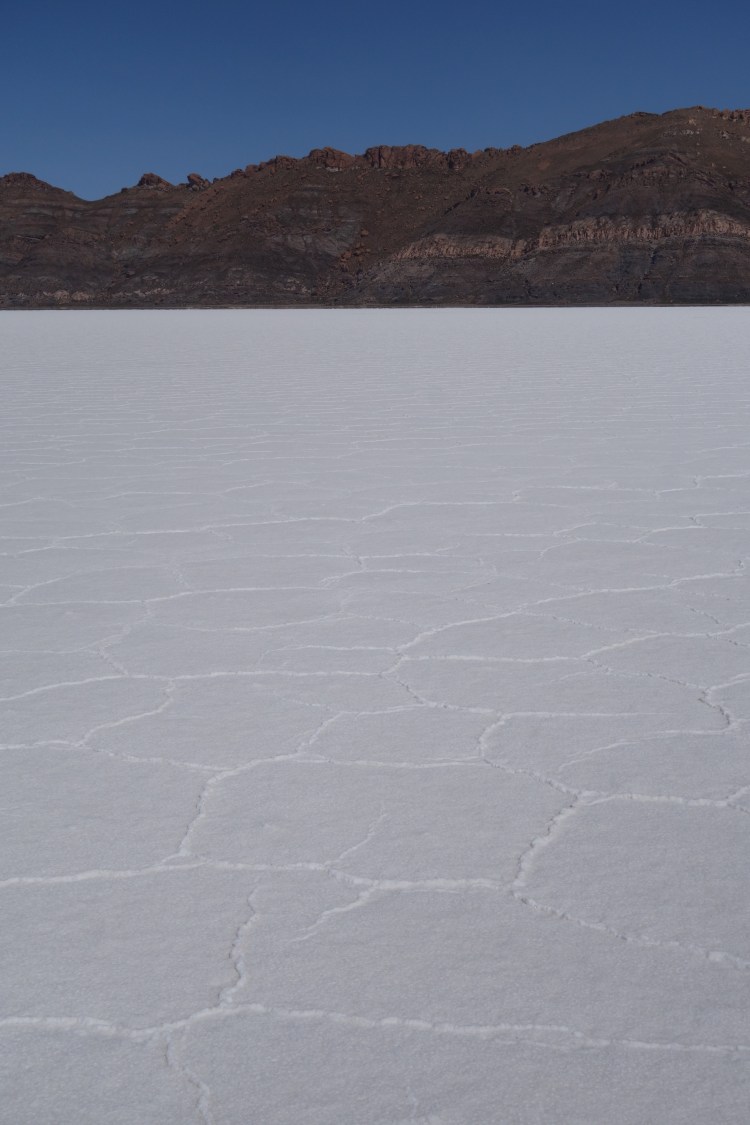
As my tyres left the concrete and crunched onto the salt, I was instantly engaged. The entirety of the 10,582 spare kilometre salar was rolled out before me, as if I was its only audience. Each of my senses was exposed and stimulated. In the distinct absence of any aromas, my nose began picking up on the miasmic notes emanating from my clothing. The soundscape was dominated by my heavy breathing and the cracking of rubber on salt. As water that falls during the rainy season evaporates, the surface of the salar develops a regular pattern of hexagonal convection cells; meditative to stare at yet bone crunching to ride across. As my tyres bounced across the unworldly corrugations, the edges of these cells would shatter beneath my weight. The jarring rhythm forced me to loosen my grip on the handlebars while the blinding glare somehow bent its way around my sunglasses causing me to scrunch my face and squint my eyes. I was drawn to an identifiable path across the salt, ironed out by heavy vehicles. This created a much smoother ride, however, it would only take minutes before my trajectory veered back on to virgin salt, distracted by the siren song of the dreamy surrounds.
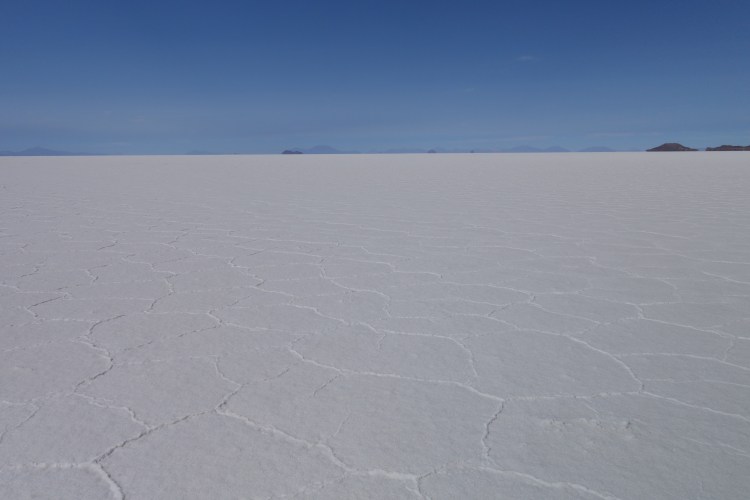
After an hour on the bike, the computer indicated that I had travelled 22 kilometres. Isla Incahausi didn’t appear to be getting any bigger, while behind me, Tunupa certainly hadn’t lost any of its grandeur. I had been told that Millenia ago, the volcanoes of the antiplano would roam the land, often meeting up for conversations in the area now covered in salt. Amongst the common collective of volcanoes, there was only one woman, known as Tunupa. When Tunupa fell pregnant to an unknown father and bore a small child, all of the male volcanoes whom she had courted tried to claim the fatherhood of the infant volcano. Out of anger and frustration, the men kidnapped the child from Tunupa and hid him in the nearby area now known as Colchani. This selfish, immature behaviour infuriated the gods, who punished all of the volcanoes by fixing them to the ground where they stood. The sad consequence of this action was that Tunupa was unable to rescue her newborn child as she was also frozen in place. The salt that I found self riding across is thought to be the tears and breastmilk of Tunupa. I can certainly attest for the maternal nature of Tunupa’s watchful eye.
For lunch, I stopped and indulged in the most tranquil jam and crackers I think I’ll ever have in my life. I sat in the stillness for over an hour. I took some photos and removed my clothes. The urge to be as naked as the landscape was too strong to deny. It was so quiet, so peaceful, and so magically memorable.

The next few hours were spent zigzagging towards Isla Incahausi. Relishing the wide open space, I felt liberated in being alone while concurrently experiencing the desire to be sharing the day with someone. Swapping my helmet for a director’s hat, I attempted to document my ride in film (see the Oscar worthy production below).
It was early afternoon when I wheeled my bike off the salt and onto the rocky outcrop. During the final few kilometres of my approach, the outline of the mirage-like island had begun to sharpen at the edges, as though coming into focus through a camera lense. Arriving at the island was my first experience with the swelling tourism industry in South West Bolivia. Since arriving in Tahua the night before, I had observed vehicles hurtling across the salt. However, beginning my crossing in the less frequented northern region of the salar, I was yet to come into close contact with these vehicles, which were primarily carting tourists around the salar. Most tours begin in the town of Uyuni on the southern shore of the salar, before making a beeline for Isla Incahausi for lunch. By the time I had found somewhere to rest my bike, the number of Landcruisers and Jeeps seemed to have quadrupled. Local tour operators jumped to the task of setting up umbrellas and picnic tables on the salt, and producing cold beverages and fruit platters from Eskies in the back of their vehicles. In the meantime, some of the passengers trekked to the summit of the island, while others attempted to create their own versions of the scale-distorted images which seem to be (judging my the internet) Bolivia’s biggest export. The sudden exposure to crowds was disconcerting and I could only watch so many people pretending to be eaten by plastic dinosaurs which sat a hundred metres away from them on the salt. I donned a jacket and went for a stroll.
Poking my head in and out of various buildings, I discovered a small man with a lazy eye sitting behind a counter. Only the top of his head was visible from the doorway, but he stood up when he heard the shuffling of my feet and beckoned me in with his smile. Following a few pleasantries, he informed me that entry to the island cost 15bob (AU$ 3). I had read that this was the case for all visitors to the island. I had also read that the island was closed at night time. So, when I optimistically asked if there was somewhere I could camp, I wasn’t expecting such an accommodating response. He told me to come and find him when the last Jeep leaves in the evening, and he will find me somewhere to sleep. I had been told by one of the boys in the Casa de Ciclitis in La Paz that there was a cave on the eastern side of the island which makes for a pretty special hidden bivouac. I still expected that this is where I would end up sleeping when I asked the man how much extra it would be to sleep on the island. However, when he shook his head and said that the ticket I had just purchased would be plenty, it was evident that he was bending the rules to accommodate me. I thanked him and assured him that I’d be back later in the afternoon.
When I emerged from the ticket office, I noticed four fully loaded touring bikes parked outside the island’s small restaurant. Upon entering, I found the owners of the bikes tucking into heaving plates of bistek, boiled potatoes and rice, each washing their meals down with a bottle of Coke; a cyclist’s best friend. I quickly recognised two of the riders from the border crossing into Bolivia a few weeks prior. A brief conversation revealed that our itineraries had only put us a few days apart during our journeys through the country. They had even been sleeping at the Casa de Ciclitis the day before I arrived. The other two riders, Liza and Marc, were from Luxembourg. Both primary school teachers, they had managed to accrue enough leave to cycle the world for two years. They had already ridden through North America and were on a trajectory for Patagonia. Following this, they plan to fly to New Zealand then Australia, before continuing through Indonesia and South East Asia for the remainder of their journey. Chatting to other riders is always uplifting. However, sitting with these two couples in the middle of the most surreal environment, only made me wish that I too was also experiencing this with someone close. I was somewhat relieved when both parties revealed that they intended to continue riding that afternoon. I didn’t eat at the restaurant, but as the others paid for their meals, the chef emerged from the kitchen and handed me a bottle of Coke and slapped my shoulder with his other hand. There was an awkward moment of silence as the others looked at him, then at me, questioning the special treatment that had just unfolded. Perhaps I reeked of loneliness or he had simply mistaken me for someone else. Regardless, I said goodbye to the other riders and gleefully returned to my bike where I sat in the shade and wallowed in the cool sweetness of the chef’s gesture.
With a few hours to spare before the crowds were due to dissipate, I decided to make the most of a restful afternoon. Settling in beneath a small stone-walled pergola to avoid the heat of the mid-afternoon sun, I set up my stove and pulled out my book. However, my quiet spot in the shade was quickly filled up by other people trying to avoid the heat while they waited for their lunches to be made. My bike created a great talking point. Some people asked to take photos of me. Some took photos without asking, as though I was a permanent feature of the island. Fortunately, some people just wanted to chat which lead to some rich conversations over the course of the afternoon.
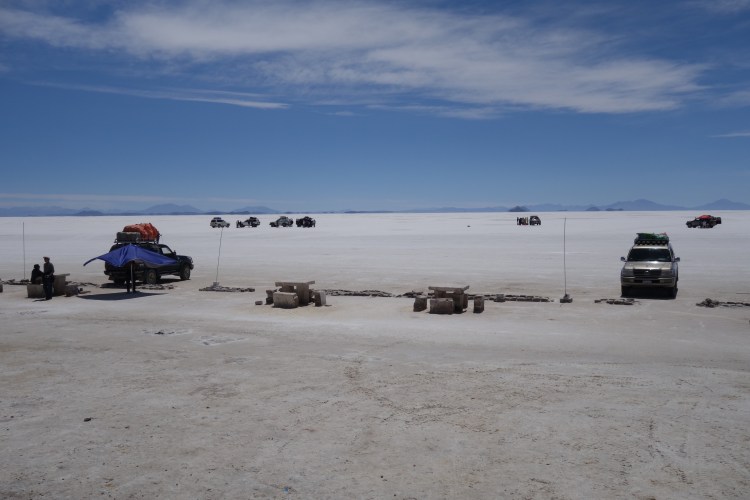
One couple, Julia and Christian, sat beside me making up for the cigarettes that they hadn’t be allowed to smoke in the tour vehicle over the previous few hours. They were from Austria and had three weeks leave from their jobs in hospitality. It quickly became obvious that their whirlwind itinerary around Bolivia, Ecuador and Peru was just an excuse to spend time together as far away from their real lives as possible. Christian told me that while he loves to experience wild places such as the salar, he really only travels for the hotels. His eyes rolled back into his head as he fantasised about pressed sheets and rolled white towels. Out of courtesy, Julia asked me if I liked travelling by myself, as if she expected a pre-meditated, enlightened response. When I told her I was actually feeling really lonely, she exhaled a lung full of smoke and turned to face me.
“Thank you for your honesty”, she said.
She then processed to reel of the various times in her life when she has experienced loneliness, vulnerability or fear. It was as if an honest response from a stranger had unlocked a vault of trust, reminding me of the importance of open communication. Soon thereafter, their guide waved them back to the vehicle for lunch. I said goodbye and returned to my book. Minutes later, a hand appeared over my shoulder. I turned to see Christian holding a plate of fresh fruit.
“You’ll enjoy it more than us’, he said with a smirk. ‘Anyway, I’m sure there’ll be plenty of good food for us at the hotel tonight”.
Later in the afternoon I was joined by a sandy-haired Frenchman called Tomas. Pensive in nature, he was visibly weary of the other young backpackers on his tour. A few years ago he had moved to Norway to study Geography and Geology before completing a Masters Degree in Glaciology. As part of this course, he had spent time in Chile undertaking research in the Southern Patagonian Ice Field. This current trip was just a holiday, visiting friends he had made during his last visit, and seeing a few things that he had missed previously, such as Salar de Uyuni. Tomas still resides in Norway, where he works in GIS for the local council. His face lit up when taking about Norway. When I asked about his tolerance towards the darkness during the Northern winter, the response he gave was unexpected.
“The winter is fantastic! Summer is boring, everyone is out doing their own thing. But, during the winter, the only thing people can do is go out to bars. It’s so social, I love it”.
When Tomas’ driver came and told him it was time to leave, he offered me some chocolate and the promise that I’ll fall in love with Patagonia when I get there. I have no doubt. Tomas’ empty seat was soon filled by a Swiss girl named Barbara, and her Australian boyfriend, Dan. They had met in Switzerland a bit over a year ago, before deciding to test their newly kindled romance by hitting the road. The last year had seen them living and working throughout Central and South America. Following their tour across the salar, they were planning to head south towards Torres Del Paine to spend a few weeks hiking. It was apparent that they were still ironing out their plans and intentions, however, it sounded as though they were going to being moving back to Australia together at the end of their trip. We chatted about our respective journeys for an hour or so, occasionally pausing the conversation to stare out across the gleaming white vista. Dan shared tales of getting robbed on busses in Mexico and Ecuador, before Barbara interjected to dwell on the positives of their travels. Their highlight so far had been the hostel they had worked at in Guatemala; a country which I’ve only heard people talk positively about so far. They looked at each other as they reminisced about sunsets on the veranda, with a joint and a beer, while watching volcanoes erupting on the horizon.

As the sun fell further to the west, my conversation with Dan and Barbara turned towards our lives back home. Namely, how easy we have it. I told them of the insatiable cravings I had had that morning for a fridge. The image of a bowl of muesli and cold soy milk, topped with fresh fruit, seems to crop up in the forefront of my mind every time I’m slurping down stodgy, lukewarm porridge. We agreed that when we begin to fantasise about our lives back home, it is evidence of how fortunate we are in life.
Eventually, the tourists began piling into the few remaining vehicles parked on the salar and heading off towards the shimmering horizon. Soon I was the last remaining visitor on the island, awash with gratitude. Watching people come and go from this unworldly location all day, all at the mercy of an itinerary and tight schedule, I looked at my bike with a new sense of appreciation. It was one of the first times on the ride so far where I had felt a genuine sense of achievement. I had arrived in this location under my own power, fuelled by inquisition and and the need for adventure. Not that I needed convincing, but in that moment there was no denying that bikes equal freedom.
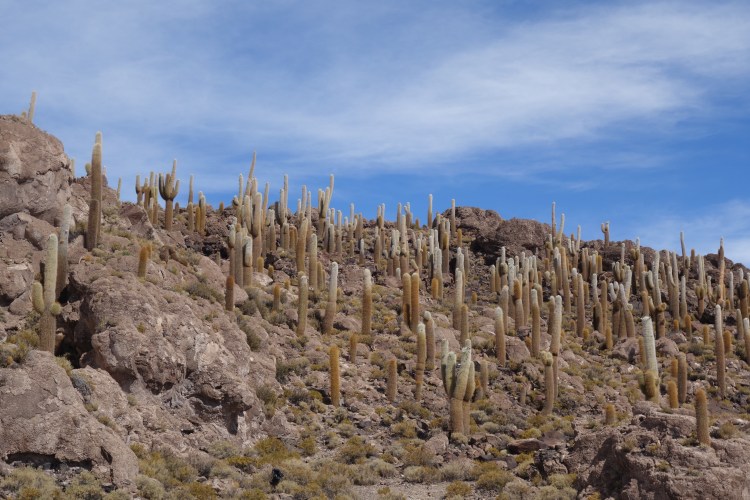
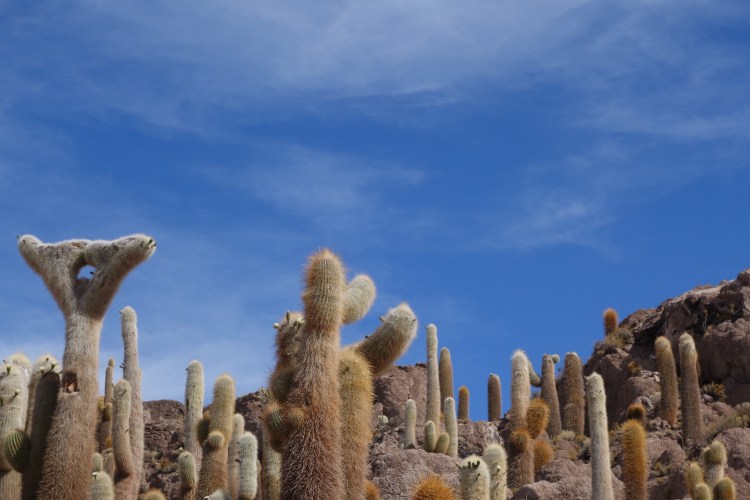
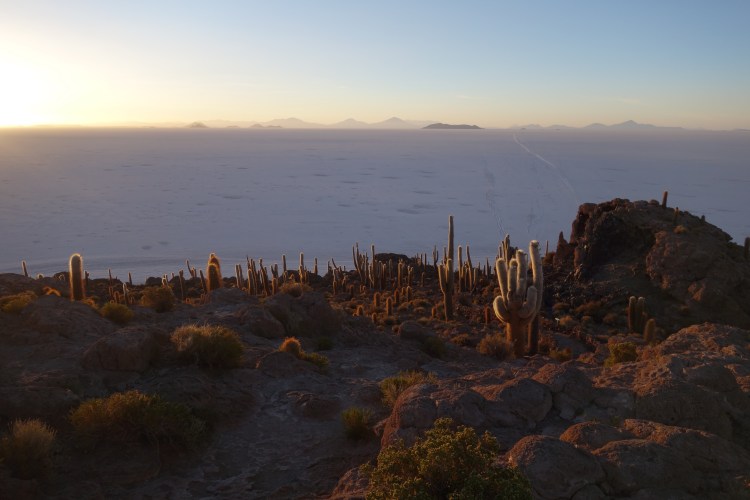
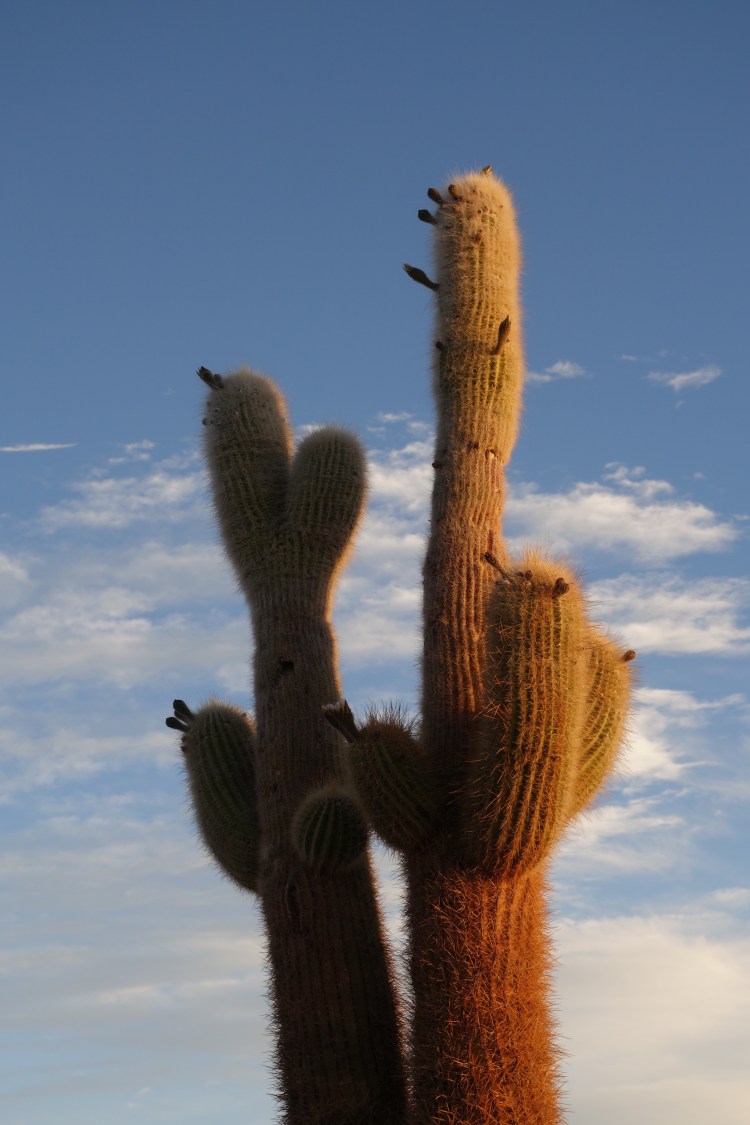
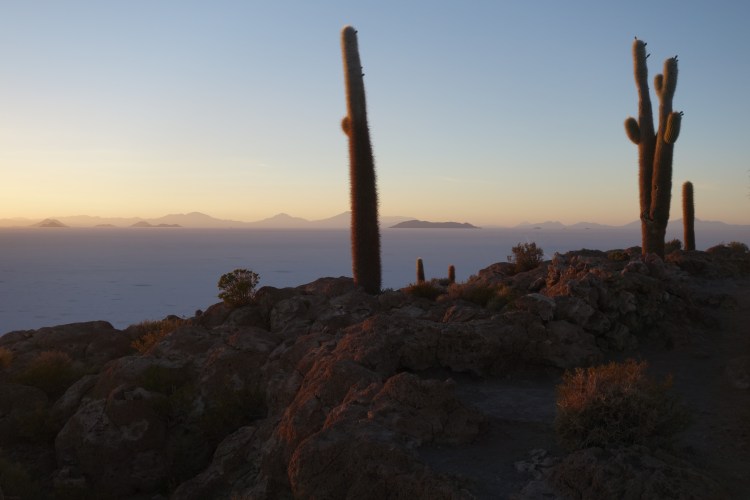
When the air began to cool, I pulled on a jacket and reached into my pannier to find the can of warm beer I had been saving for a moment like this. I had been waiting all day for the crowds to dissipate before making my way towards the summit of the island. The rocky trail snaked its way between the gigantic cacti (Trichocereus pasacana), many of which stand at well over two metres. Considering this species only grows around one centimetre per year, the size of some of the plants contributed to the ancient feeling of the island. Incahausi (hausi deireved from the Quechua word, wasi, meaning house) translates to ‘house of the Incas’. The island is thought to be to the top of an ancient volcano which was submerged by a prehistoric lake which covered the area around 40,000 years ago. Strange coral-like structure and fossils are evidence of this watery past.
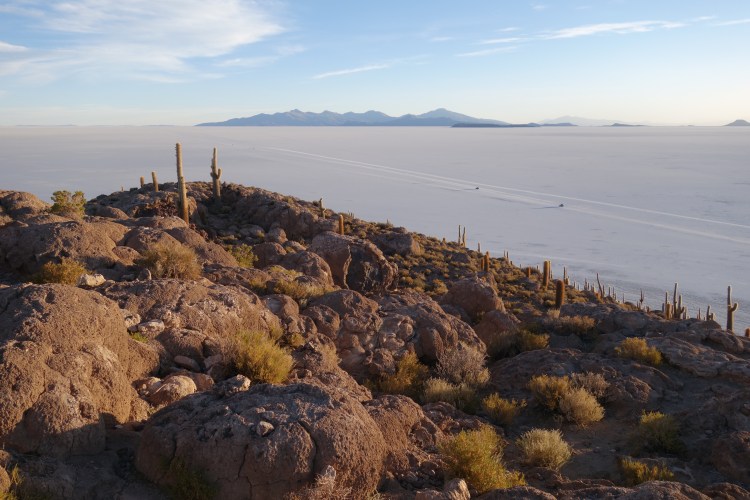
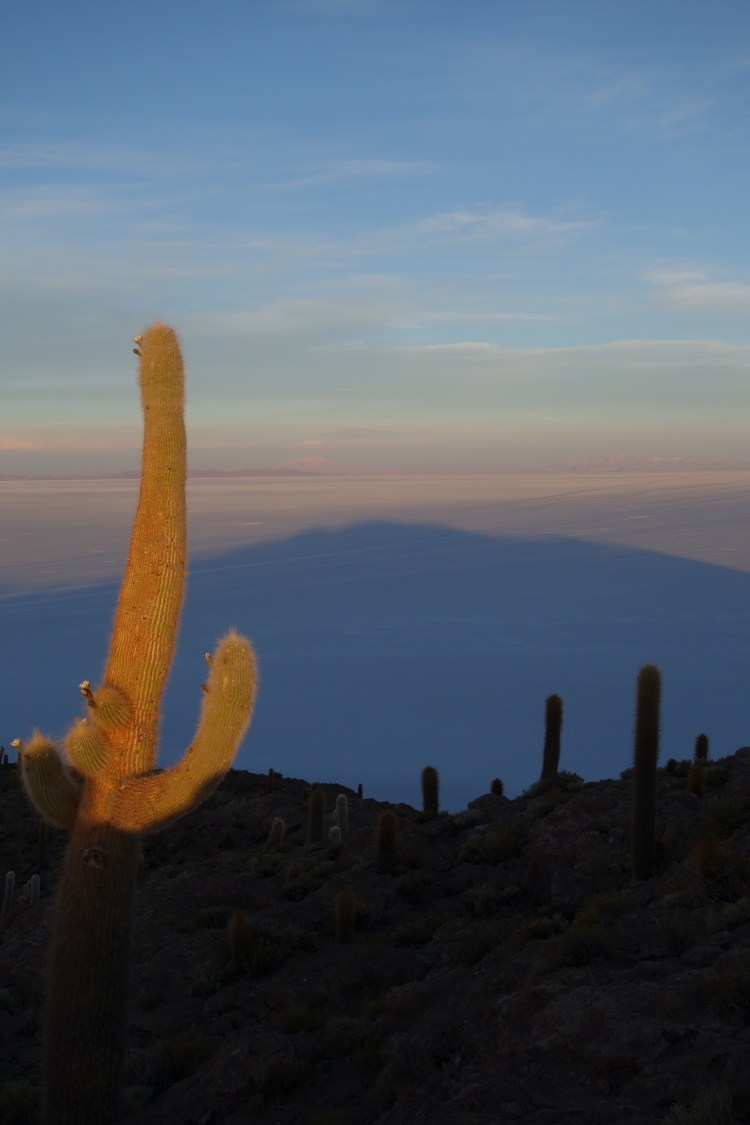
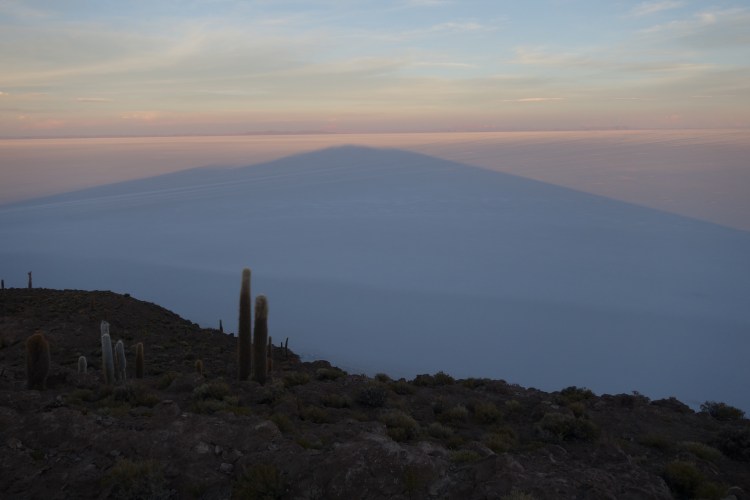
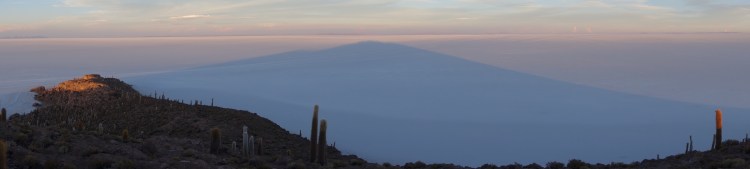
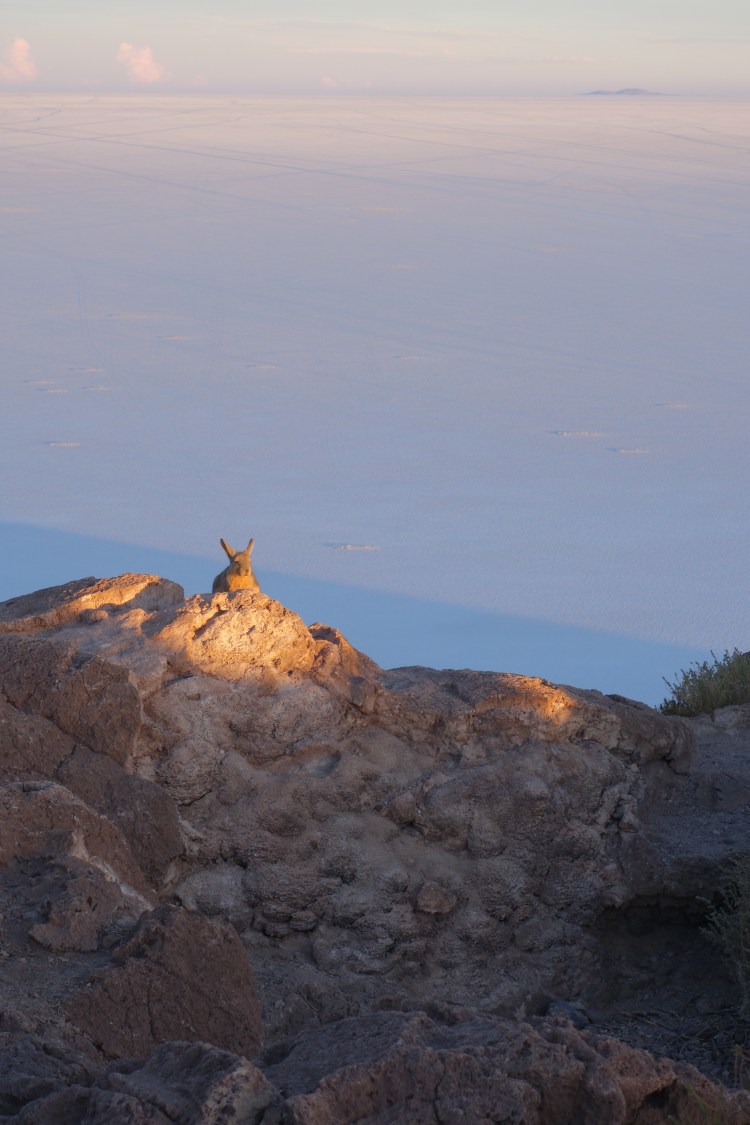
After climbing the 120 metres from where my bike was parked on the edge of the salt, I reached the summit of the island, which itself is 3,656 metres above sea level. I cracked the can of beer and sat cross legged on a rock, completely engrossed in the scene. Looking eastward, the shadow of the island stretched out across the salar as the sun dropped further towards its resting place behind me. In a near meditative state, I watched as the pointed crown of the triangular shadow moved towards the distant mountains. Aware of the immense physical scale of the moment, it still felt as though I should be able to see my own shadow atop that of the island. I held my breath as the island’s shadow finally made contact with the land on the edge of the salar, before turning to watch the ensuing light show to the west. I was joined by one of the island’s rabbit-like viscachas, who seemed equally as stunned by the Elysian vision before us. The sun’s final effort for the day brushed the sky with apricot, before a fatigued shade of heather fell over the landscape. Having been touched by something bordering on spiritual, I finally managed to pull myself away from the summit to avoid having to find my way down in the dark.
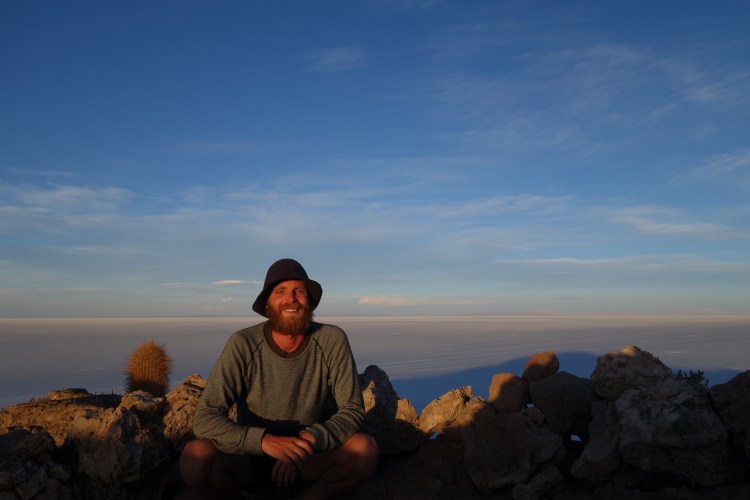
I arrived back at my bike, just as the man with the lazy eye was locking up at the ticket office. He lead me to a building which housed an offbeat, dusty museum containing randomly placed papier-mâché replicas of Incan artefacts. The man pushed open an adjoining room and swept his arm out in front of him, revealing a concrete floor and a lone, double mattress in the corner; absolute perfection! He told me I could bring my bike through into the room, before giving me a pat on the back as he left. I rolled out my sleeping bag before heading back outside to cook a quick dinner of pasta with sardines and tomato. Having been incredibly still all day, a strong wind now engulfed the salar. I crouched in the lee of the building, with my head torch the only visible light on the island. My hands froze as I washed up before bed. Overawed by the scenery, hospitality and introspection experienced throughout the day, I sunk into the mattress.
A plunge pool and a monument
I was woken around 5.30am by idling engines and heightened conversation. The first wave of tourists had arrived for sunrise on the summit. As more people began milling about outside, a few poked their head into my room. To avoid being mistaken for an interactive museum exhibit, I did a rushed pack-up, and wheeled my bike back outside and got to making some coffee in the sun.
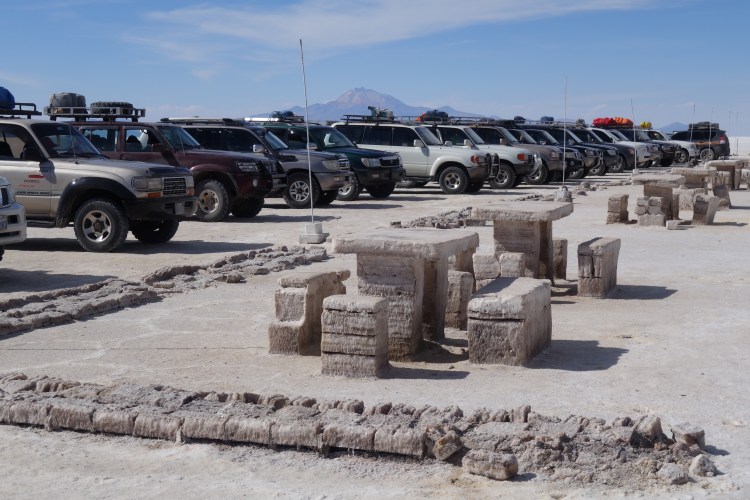
Over the course of the morning, the line of vehicles grew across the salt in front of the island. People came, took photographs, and left again. During the hour it too me to eat breakfast and watch the sun come up, the wind swung a full 180 degrees. Having woken to a substantial breeze from the east, all that remained was a gentle westerly puff; AKA a tail wind! Inspired by the conditions and depleted by the crowds, I filled my water bottles and hit the salt.

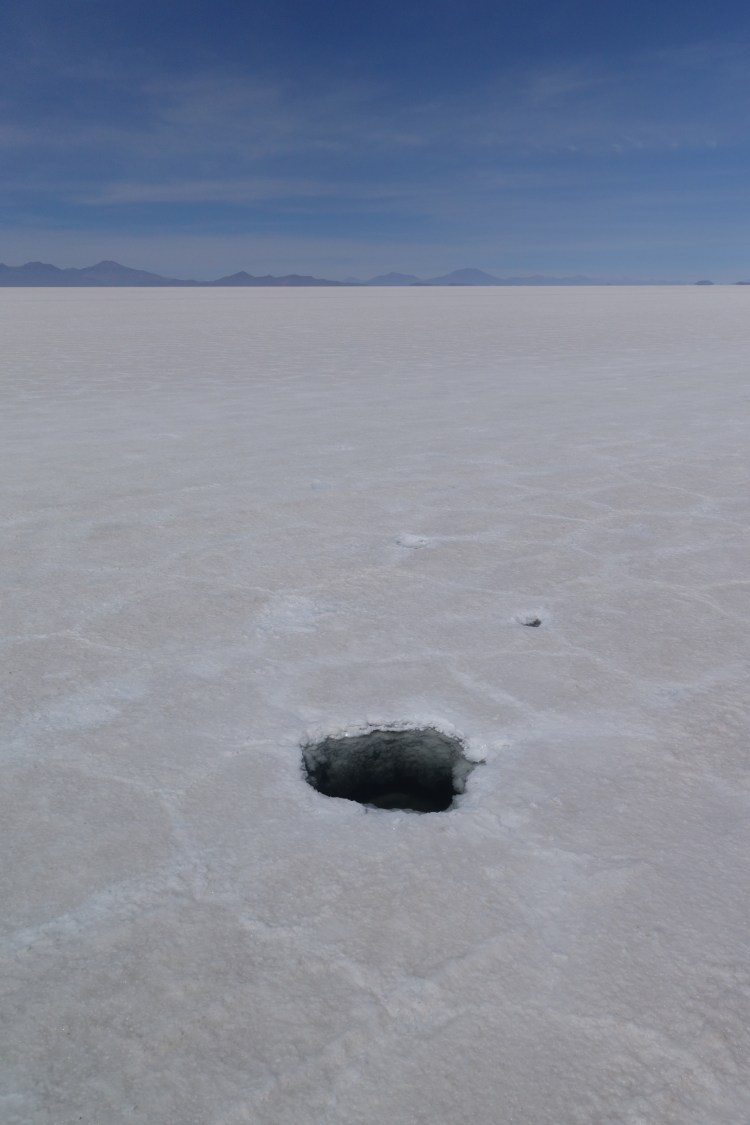
The first hour of riding was utter magic. The surface of the salar was hard and smooth, the only vehicles I saw were specks in the distance, while the morning sun bathed the snow capped peaks on the horizon. The cyclists I had met the day before had warned me of some deep potholes which they had seen on this stretch of the ride. When I first sighted one, I instantly understood their fear of these features. Often up to a metre in diameter, these seemingly bottomless holes in the salt would eat the front wheel of a bicycle for breakfast. Fortunately, they were filled to the brim with shimmering azure water, which contrasted against the white of the salt making it easy to avoid the potential disaster. After riding past several of these strange anomalies, my curiosity got the best of me. I stopped, stripped and lowered myself into one of the holes. With only my head above the water, my body was both relieved and shocked by the sensation of the water. The frigid temperature felt fantastic as it sent deep chills into my muscles. However, the intense salinity revealed a thousands cuts which I didn’t know I had.
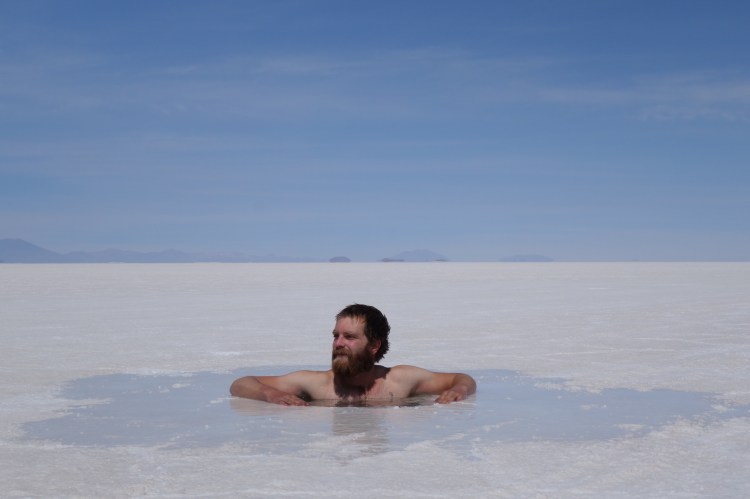
Within seconds of climbing out of the water, my body had dried in the breeze and formed a thin crust of salt. I began to crave a shower, empathising with my bike. Once back in the saddle, the riding conditions began to deteriorate. The smooth surface gave way to sharp corrugations, making for slow, jarring progress. The salt appeared dirtier in colour, looking like yellow snow in some places. The wind had swung again and was now on the nose, whilst the midday sun bore down on me with a vengeance. What had been a whimsical morning of riding had suddenly turned into a mental war. After a hard 50km push, I arrived completely exhausted at one of the more bewildering features of Salar de Uyuni; the ‘Dakar Monument’. Due to safety concerns in Africa, the Dakar Rally has taken place in South America since 2009. One of the most testing stages for the racers, due to the altitude, is the one across the salt flats. The monument was constructed in 2014 in honour of those who travel the world to take part in the race each year. The imposing block of carved salt stands several metres high and is regularly surrounded by tourists chasing photo opportunities. Next to the monument, vibrantly coloured flags from various countries appeared starched stiff in the wind. Contrasting against the monotonous tones of the salar, these flags indicate the nationalities of the competitors over the years, commanding the attention of people passing by in vehicles or on bikes.


Adjacent to the monument and flags sat a large public shelter, unique in its salt walls and internal support pillars which together hold up a thatched roof. Quietly observing the proceedings taking place around me, it became obvious that this was a popular lunch stop for the tourist vehicles. Inside the building, the long salt benches were lined with people and a host of languages and accents danced around the room. I opted to find a quiet space outside, using the building for shade and as a windbreak whilst I cooked up everything I had left in my panniers. This resulted in a steaming hot bowl of stodge; instant mashed potato, flavoured with miso and bulked up with Bolvia’s answer to 2-minute noodles. What it lacked in flavour, it certainly made up for with carbs. If only I’d brought some salt for seasoning…
Before commencing my final push to the edge of the salar, I felt the need to get my own photo beside the Dakar Monument. I rolled my bike towards a crowd that all had the same idea. Again, my bike became the catalyst for conversation. An American lady with an enviable head of curly hair, told me that her husband had cycled across the salar a few days ago. As she was with a tour group, I asked whether he had hired a bike in Uyuni, or was with an organised group. After expressing her dislike of being on two-wheels, she went on to explain that her husband was actually riding his bike for a year. In fact, they were both travelling independently for a year, meeting up in various locations around the world. Following this most recent rendezvous in Bolivia, they are planning to see each other again in December in the Argentinian wine region of Mendoza, where their children are also going to be joining them for a family Christmas. I was inspired by their level of compromise and understanding.

As I watched couples and groups of friends pose for photos beside the monument, I was approached by a Bolivian man in board shorts, with a ponytail and a snapback hat. He spun the peak of his hat towards the back and leant in towards me initiating a dap (dignity and pride) handshake; a greeting developed amongst black soldiers in the Vietnam War with strong ties to the Black Power movement of the late 60s. Being ‘smooth’ has never come easy for me. After grabbing my hand and pulling me into his chest, he attempted to sign off with the quintessential ‘popping’ of fingers. However, I let my index finger go limp and as he pulled away he almost ripped it from the joint. The sudden and unexpected look of pain in my eyes caused him to jump backwards in shock. As I stood there shaking out my hand, he told me that he had actually been born in a nearby town but had moved to California in his late teens. He was currently back visiting family and a few famous Bolivian sites such as Salar de Uyuni. He explained that Bolivia will always have an important place in his heart. However, he reassured me (several times) that California was his home now. He offered to take a photo for me and as we parted ways, he initiated a much simpler fist bump, of which I nailed. I rode away to shouts of ‘hang loose, brother’ and a Shaka being waved in my direction. It felt like I had found an extra salty version of Venice Beach.
A few kilometres on from the Dakar Monument, the salt turned to dust as I reached the edge of the salar. I stopped in the town of Colchani for some chocolate and a coke, alternating bites and sips of the two energy rich delicacies while I sat on a curb in the shade. From Colchani, there was another 23 kilometres of riding remaining if I wanted to reach Uyuni; my planned destination for a much needed wash and rest day. The instant sugar hit came on strong and I conjured the enthusiasm and legs to continue. It was a bittersweet feeling being back on the road. With the wind on my back, I managed to hold between 35-45km/h for the entire ride to Uyuni. However, it quickly became evident that I will probably never feel the same sense of freedom on a bike as I did during my two days pedalling across the world’s largest salt flat.

Thanks for reading.
Additional Reading
Since arriving home in Australia, my attention is piqued by anything to do with the countries I visited in South America. I recently read a National Geographic article titled ‘This metal is powering todays technology – at what price?’. The story outlines the potential riches for the Bolivian people which lie under Salar de Uyuni. As the world’s demand for powerful batteries only increases, the large lithium deposits beneath the salt have caught the interest of many around the world. This article is a pivotal read for anyone wanting to better understand the costs associated with the development of battery power for the likes of energy storage and transport. There’s always two sides to the story. Bolivia is home to the most genuine and generous people I met during my travels. Being one of the poorest countries on the continent, I desperately hope that the imminent extraction of lithium is done in a way that benefits the lives of all Bolivians.
 Faults and Folds